Bloom Energy: Undaunted by Fears of Delays, Can It Fully Capitalize on the Dividends from AI-Driven Power Shortages?
After market close on July 28, 2026, Bloom Energy released its 2026 Q2 financial results. Against the backdrop of market concerns that delays in large customer projects would slow down the delivery pace and affect recent revenue recognition, Bloom Energy still delivered a financial report far exceeding expectations, and continued to raise its full-year 2026 guidance, dispelling market doubts.
Specific details:
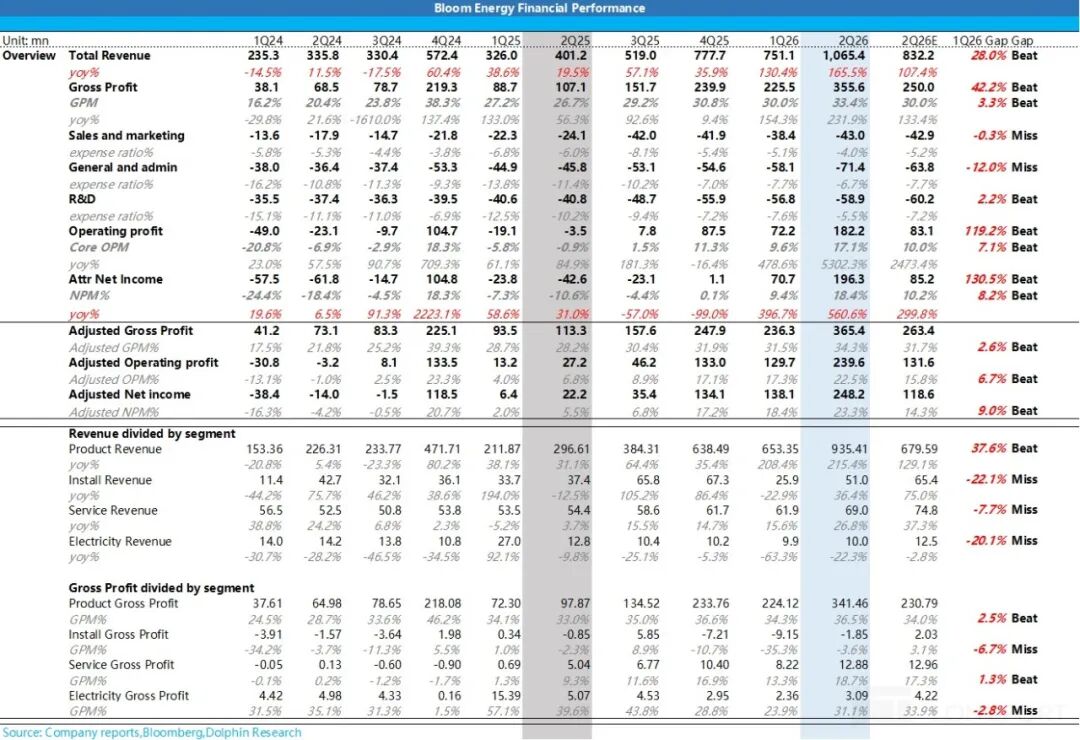
① Revenue far exceeded expectations, SOFC delivery remained strong: Total revenue in this quarter reached 1.07 billion US dollars, far exceeding the market expectation of 830 million US dollars. The core driver of the outperformance was still the substantial growth of product revenue (direct sales of SOFC fuel cells), which reached 940 million US dollars, a year-on-year increase of 215%, significantly higher than the expected 680 million US dollars.
Under the assumption that the average product price (ASP) fell moderately by about 5% year-on-year, our calculation shows that the corresponding shipment volume is about 308MW, a year-on-year increase of about 232%. The strong delivery volume in this quarter directly dispelled the market's concerns about the company's capacity ramp-up capability (execution) and the delay risk of signed large orders.
② Scale effects continued to release, gross margin increased steadily: The gross profit in this quarter was about 360 million US dollars, and the gross margin continued to rise by 3.4 percentage points quarter-on-quarter to about 33.4%, mainly due to the dual improvement of gross margins of products and services.
a. Cost reduction drove the gross margin of product business to continue to exceed expectations: The product gross margin rose by about 2.2 percentage points quarter-on-quarter to about 36.5%, which is the core reason for the overall gross margin exceeding expectations, mainly benefiting from the release of scale effect brought by the rapid increase in output — the cost side continued to decline in three aspects: materials, labor and manufacturing expenses.
On the product pricing side, since the company delivers comprehensive value rather than bulk commodities, the pricing fully reflects the "time to power" that customers value most and the technical capability of the system, and the continuous cost reduction capability is expected to support the further increase of the gross margin of product business.
b. The gross margin of service business also improved significantly: The service gross margin soared from the historical low (-21%) at the time of listing to 19% in this quarter, and continued to rise by 5.4 percentage points quarter-on-quarter. This is already the fifth consecutive quarter that the company has achieved double-digit service gross margin.
The improvement of profit margin is mainly driven by the improvement of operation stability of operating units, the extension of stack life and the scale effect, and the management believes that the profit margin level above 20% can be maintained for a long time.
The extension of the service life of the stack is a key factor for the improvement of the gross margin of the service business — the stack replacement cycle has been improved from 9 months in 2018 to about 5 years, and related durability problems are expected to appear as early as 2028-2029.
Service revenue will grow synchronously with the installed capacity deployed in recent years, and the built-in annual price adjustment mechanism of contracts will support short-term profit margin expansion.
③ Operating leverage was released, operating profit margin rose sharply: Driven by the substantial increase in the delivery volume of products (especially SOFC for data centers), both revenue and gross profit grew strongly. At the same time, the structural release of the company's operating leverage directly promoted the sharp surge of operating profit. The operating profit in this quarter reached 180 million US dollars, and the operating profit margin rose by 7.5 percentage points quarter-on-quarter to 18.4%.
While revenue increased by 166% year-on-year, operating expenses only increased by 48% year-on-year, mainly benefiting from the structural release of operating leverage — the R&D base and infrastructure are basically fixed, and each incremental gigawatt of delivery hardly brings incremental management expenses; SG&A, service operations and supply chain are all driven by automation and data analysis, expanding with technology rather than personnel. The management said that although R&D and management investment will continue in the future, the growth rate of operating expenses will be significantly lower than the growth rate of revenue, and operating leverage will continue to be released.
④ Full-year 2026 guidance is raised again:
After the strong delivery in the second quarter, the company continued to raise its full-year 2026 expectation:
The total revenue guidance is raised to 3.9-4.2 billion US dollars (year-on-year +93%-108%), corresponding to SOFC product shipment of about 1.14-1.25GW (calculated by us based on revenue guidance and ASP assumption). It is expected that the shipment in the second half of the year will be about 606-716MW, a quarter-on-quarter increase of 14%-34%, which is further raised compared with the full-year guidance given in the previous quarter (corresponding to about 0.9-1GW), directly dispelling the market's concern that the delay of large order projects will affect the 2026 revenue recognition.
The full-year Non-GAAP gross margin remains at a relatively high level of 34%, implying that the Non-GAAP gross margin in the second half of the year is around 34.8% (calculated by us), which continues to rise compared with 34.3% in this quarter, still driven by the rising product gross margin brought by scale effect release, technology and material cost reduction, and the service business gross margin remaining at a relatively high level.
Non-GAAP operating profit is raised to 800-900 million US dollars, corresponding to Non-GAAP operating profit of 430-530 million US dollars in the second half of the year, and the operating profit margin is 20.7%-22.3% (22.5% in this quarter). Under the background that the shipment volume will still increase quarter-on-quarter in the second half of the year, the operating profit margin remains at a high level, which further verifies the continuous improvement of the company's profitability.
Dolphin's View:
Overall, against the backdrop of market concerns that delays in large customer projects will slow down the delivery pace and affect recent revenue recognition, Bloom Energy delivered a strong financial report this quarter and continued to raise its full-year 2026 expectation, giving the market a "shot in the arm".
As we have repeatedly emphasized before, the core of BE's investment logic has undergone a fundamental shift — from the "technology verification" stage to the "capacity ramp-up verification" stage.
In the technology verification stage, the core proposition is: "Is the SOFC technology reliable? Will customers use it?", and BE has obtained large-scale endorsement from CSP and has a sufficient backlog of orders.
The core advantages of Bloom Energy compared with other solutions can be summarized as:
① "Time to Power" advantage and absolute "time arbitrage":
According to Bloom Energy's actual deployment records, its delivery speed far exceeds traditional expectations. For example, in its first head cloud computing customer Oracle project, it only took 55 days to successfully power on the data center. This extremely fast delivery at the "monthly" unit perfectly solves the fatal pain point that AI data centers are built quickly, but the grid connection of traditional power grids often takes several years.
Although the levelized cost of electricity (LCOE) of large North American gas turbines or power grids may have a slight advantage at present, Bloom does not compete with traditional solutions on pure LCOE.
Take a 1GW full-stack AI data center as an example: even if adopting the BE solution requires paying hundreds of millions of dollars in electricity bills and equipment premiums, if the data center can be put into operation one year in advance, the additional computing power (Token) revenue brought by the head start is as high as 12-24 billion US dollars. Using a premium of less than 500 million US dollars to leverage the high-gross-margin first-mover revenue of tens of billions of dollars is a pure "time arbitrage" that guarantees profit without loss.
② Avoid "NIMBY effect" and greatly reduce the difficulty of approval:
With the improvement of the community's environmental requirements, the approval resistance of data center projects in terms of noise, air and water consumption continues to rise. Bloom Energy's fuel cells adopt non-combustion technology, which have far lower air pollution than traditional turbines and engines, almost negligible water consumption, and the operating noise is even lower than ordinary air conditioning equipment. This environmental protection feature makes it easier to obtain air permits and community support.
Based on this, some customers who originally ordered combustion turbines and reciprocating engines directly canceled their original orders and turned to Bloom this quarter (Nebius also signed the agreement with a similar cooperation model).
③ Natively adapted to 800V DC architecture, conforming to AI trend:
Bloom Energy's fuel cells are naturally capable of directly providing 800V direct current (DC). In the future trend of on-site power generation and data centers accelerating the transition to DC architecture, BE has a significant first-mover advantage, which can effectively reduce the demand for additional power conversion equipment such as solid-state transformers and energy loss.
At the same time, Bloom Energy has introduced financial investors such as Brookfield to solve the capital pain points for the owners, who only need to pay electricity bills monthly. In June this year, Brookfield expanded its cooperative credit line to 25 billion US dollars. Customers can rely on power purchase agreements to introduce financiers and only need to pay electricity bills monthly to solve capital pain points, so that customers do not need large-scale capital investment in the early stage.
This is also directly reflected in Bloom Energy's order volume and order structure:
① The current order volume is still relatively sufficient:
By the end of 2025, BE's total backlog of orders hit a new historical high of about 20 billion US dollars, providing extremely high visibility for performance release in the next two years. Among them, product-side orders are about 6 billion US dollars, a year-on-year increase of 150%, corresponding to about 2GW of SOFC system deployment capacity, which has basically covered the company's 2026 performance target (corresponding to 900MW-1GW), and has begun to lock in the capacity release in 2027 and beyond in advance.
Service-side orders are about 14 billion US dollars, a significant increase over the same period of the previous year, most of which come from long-term operation and maintenance service contracts. Service contracts usually have the same term as PPA contracts (10-15 years), which means that once the project is implemented, BE can obtain stable service revenue for 10-15 years.
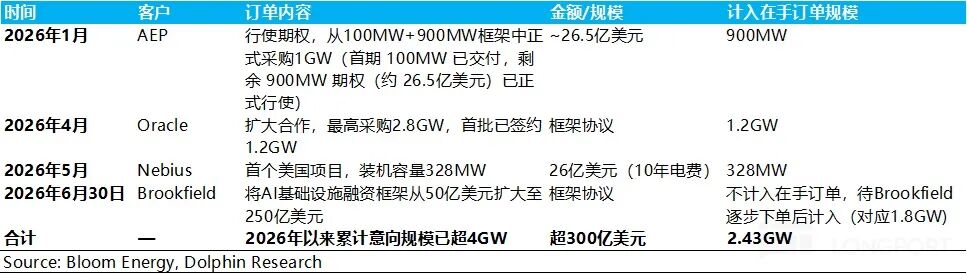
Entering 2026, the order acceleration trend has been further strengthened. In the first half of 2026 alone, BE signed a number of large new orders (including AEP 900MW option, Oracle's first phase 1.2GW, Nebius 328MW, etc.), with a total product order value of over 8 billion US dollars, corresponding to an installed capacity of about 2.4GW on the product side (if the upper limit of the framework agreement is included, the total intended scale is about 4GW), which has exceeded the product backlog capacity (2GW) at the end of 2025. The current order volume is sufficient to support the capacity release up to 2028.
② The order structure is also continuously optimized:
a. Oracle from "pilot" to "standard configuration": In July 2025, the first small-scale pilot order was signed (100MW delivered in 55 days), and in April 2026, it was expanded to a 2.8GW plan, in which projects originally planned to use gas turbine + diesel backup scheme finally adopted 100% of BE's SOFC. This marks that BE's SOFC can be fully used as the base load power source for large data centers.
b. Old customers continue to repurchase: AEP exercised rights all the way from the 100MW framework agreement to 900MW (the scale increased by 9 times), and Brookfield's cooperation expanded from 5 billion to 25 billion US dollars (about 8GW). The continuous repurchase of old customers further confirms the technical feasibility.
Therefore, under the assumption that the power demand of AI data centers remains strong and CSP does not significantly cut capital expenditure, after the certainty on the demand side (continuous high growth of backlog + continuous repurchase of CSP) is digested by the market — the focus of market attention is shifting from "whether the demand is real" to "whether the supply can keep up".
① The market is worried about the delay risk of large customer orders:
a. Project Jupiter (Oracle New Mexico Project)
Oracle's planned 2.45 GW super-large AI data center, in order to meet environmental protection and water resource protection requirements, completely replaced the previously planned gas turbines and diesel generators, and decided to adopt Bloom Energy (BE) fuel cells to build a pure microgrid.
Market concern: The supporting natural gas pipeline needs to go through the Section 7 review of FERC (Federal Energy Regulatory Commission), which may drag down the gas supply progress and the data center construction period.
However, we believe that the default risk of this project is extremely low, for the following reasons:
Alternative in the early stage: The gas consumption for initial commissioning is small, which can be solved by tanker transportation without waiting for the pipeline to be fully connected. The FERC review is a procedural requirement for pipeline construction, the project itself is not delayed, and the construction is still in progress.
Sufficient delivery buffer: The short-term delivery exposure in 2026 is extremely small, and the large-scale delivery is concentrated in 2027-2028, with sufficient time.
Deployment flexibility: BE's supply contract is based on the Master Service Agreement (MSA) framework and is not bound to a single site. If the pipeline is delayed, Oracle can completely transfer the equipment to other data centers under its name, and the financier in the contract chain still has the obligation to receive the equipment from BE. Therefore, the actual probability of order cancellation is minimal.
b. Project Jade
BE signed a contract directly with American Electric Power (AEP) to provide it with a 1 GW fuel cell system (the upper limit of the framework agreement, the first phase of 100MW has been delivered).
The market is worried that the previous infrastructure partner Crusoe announced its withdrawal, triggering market panic over the project stranding and the abortion of BE's huge order.
In fact, the project is advancing at full speed:
The project has not been suspended: Black Hills, an energy supplier, has publicly clarified that the project is still in progress, and relevant parties are currently working directly with end customers, bypassing the withdrawn intermediary.
The contract structure is stable: BE's direct contracting party is AEP, not the withdrawn Crusoe. As long as the end computing power demand remains unchanged and AEP's cooperation continues, BE's order execution will not be substantially affected. In addition, BE's contract protection clauses (MSA framework + financier's purchase obligation) provide additional protection.
② The market is worried about supply chain risks:
Previously, short-selling agency Hunterbrook questioned that the global supply of Bloom Energy's raw material scandium oxide (a type of rare earth) cannot meet BE's capacity expansion plan.
But Bloom Energy responded that only through recycling from existing industrial tailings (by-products of titanium, nickel, cobalt and uranium processing), hundreds of tons of scandium oxide can be produced every year. The existing supply chain is sufficient to support a maximum annual capacity of 25GW, and raw materials do not rely on a single source in China.
③ Capacity expansion risk:
The market is still worried that BE's capacity