Bond financing of real estate enterprises in the first half of the year: the scale has increased significantly, and the multi-level REITs market is accelerating its formation.
In the first half of 2026, the total bond financing volume increased year on year and stabilized against the low base. However, the root cause of the continuous decline in the financing scale of real estate enterprises in the past was the continuous balance sheet shrinkage driven by the market downturn, so the current stabilization momentum is not solid. Credit bonds remain the absolute main force for issuance and financing, central and local state-owned enterprises are the absolute main issuers, and the issuance scale of local state-owned enterprises in particular has increased significantly. Overseas debt grew on the basis of a low level, with only a small amount of issuance. The first batch of commercial real estate REITs were successfully listed, the proportion of ABS financing scale rose, and CMBS/CMBN and quasi-REITs supported by underlying assets accounted for nearly 80%.
Bond Financing Scale: Up more than 20% Year on Year in the First Half, Stabilizing Against Low Base
In the first half of the year, the total bond financing volume increased year on year, showing a momentum of stabilization. Affected by the low base effect, the year-on-year growth rate of financing scale is positive. Although there are fluctuations in the month-on-month data, the cumulative scale still maintains positive growth. However, this stabilization momentum is not solid. First, most of the funds raised are used to repay existing debts, so the scale of bond issuance is affected by the scale of debt repayment. Second, bond issuance requires under-construction projects or underlying assets, and the issuance scale is constrained by high-quality assets. The root cause of the continuous decline in the financing scale of real estate enterprises in the past was the continuous balance sheet shrinkage driven by the market downturn. At present, the real estate market is still in the bottoming period, and the scale of bond financing is still constrained.
Figure: Financing Volume and Year-on-Year Change from January to June 2026
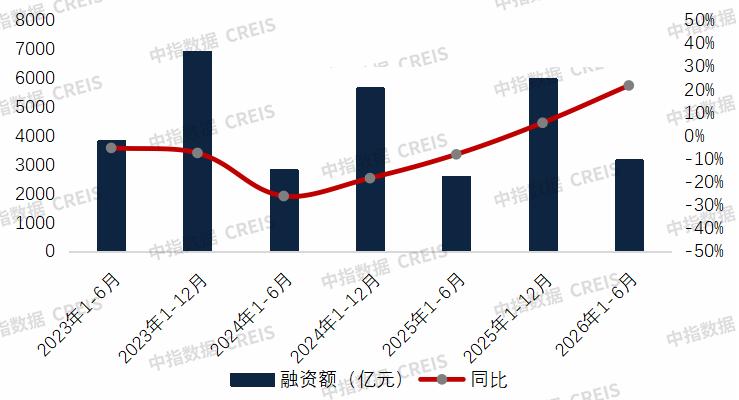
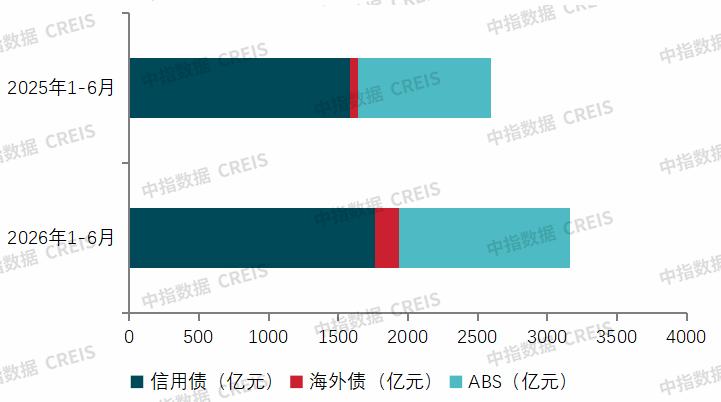
Credit bonds remain the absolute main force for financing, overseas debt has recovered at a low level, and ABS financing accounts for nearly 40%. From January to June 2026, the total bond financing of the real estate industry was 3,158.8 billion yuan, up 21.7% year on year, and the growth rate reached a new high in recent years. From the perspective of financing structure, credit bond financing reached 1,766.1 billion yuan, up 11.8% year on year, accounting for 55.9%; overseas debt financing reached 171.7 billion yuan, up 199.4% year on year, accounting for 5.4%; ABS financing reached 1,221.0 billion yuan, up 27.5% year on year, accounting for 38.7%.
Figure: Financing Structure from January to June 2025 and January to June 2026
From the perspective of funds in place for real estate development enterprises, the scale continued the downward trend since 2022, and the actual financing environment has not yet recovered significantly. From January to June 2026, the funds in place for real estate development enterprises reached 40,233 billion yuan, down 20.2% year on year. Among them, domestic loans reached 5,716 billion yuan, down 31.7%; self-raised funds reached 14,740 billion yuan, down 16.4%; deposits and pre-sales receipts reached 12,442 billion yuan, down 15.8%; individual mortgage loans reached 5,137 billion yuan, down 24.9%.
Financing Structure: Credit Bonds Remain the Absolute Main Force for Issuance and Financing, Central and Local State-Owned Enterprises Are the Absolute Main Issuers
■ Credit Bonds: Central and Local State-Owned Enterprises Are the Absolute Main Issuers, Local State-Owned Enterprises Drive the Growth of Industry Issuance Scale
In 2026, the issuance scale of credit bonds in the real estate industry reached 1,776.1 billion yuan, up 11.8% year on year, accounting for 55.9% of the total bond financing scale, down 5.0 percentage points from the same period of the previous year. The average issuance term is 3.44 years, and the term has been shortened. From a monthly perspective, the issuance scale of credit bonds continued to fluctuate in the first half of the year.
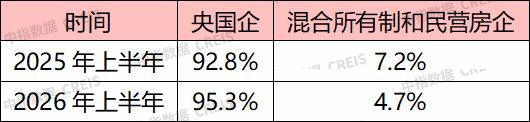
From the perspective of issuance structure, the issuers of credit bonds are mainly central state-owned enterprises and local state-owned enterprises. In the first half of the year, the issuance proportion of central and local state-owned enterprises reached 95.3%, up from the same period of the previous year; the issuance proportion of private enterprises and mixed-ownership enterprises declined. In the first half of 2026, the credit bond issuance scale of local state-owned enterprises increased significantly. Enterprises such as Capital Land and Beijing Capital Group issued bonds with a scale of over 10 billion yuan, and enterprises such as Suzhou New Hi-Tech Group, Lujiazui, and China Enterprise Holdings issued bonds with a scale of over 4 billion yuan. The growth of the issuance scale of local state-owned enterprises also drove the increase of the credit bond issuance scale of real estate enterprises. In the first half of 2026, the bond issuance of private enterprises remained at a low level. The number of private enterprises and mixed-ownership enterprises issuing bonds was 6, which were mostly large-scale enterprises that had not encountered operational risks, and it was difficult to benefit most private enterprises with tight capital chains.
Figure: Financing Structure from January to June 2025 and January to June 2026
Poly Developments and Holdings Group Co., Ltd. plans to issue convertible corporate bonds to specific targets, with a total raised capital of no more than 50 billion yuan, which will be used for 9 real estate development projects in core cities such as Shanghai, Hangzhou, Guangzhou and Foshan, and has obtained the registration approval from the China Securities Regulatory Commission. Long-term funds with the characteristics of equity instruments will help enterprises improve their balance sheets.
■ Overseas Debt: Growing on the Basis of Low Level, Still with Small Issuance Volume
In 2026, the issuance scale of overseas debt is only 171.7 billion yuan, a sharp increase year on year, accounting for 5.4% of the total financing scale, up 3.2 percentage points from the same period of the previous year; the average issuance term is 3 years, with a relatively long term. From the perspective of issuing enterprises, they are mainly central and local state-owned enterprises, high-quality private enterprises and mixed-ownership enterprises such as Yuexiu Property, China Overseas Grand Oceans, Greentown China and Seazen Holdings, and the growth of their issuance scale drives the growth of the industry scale.
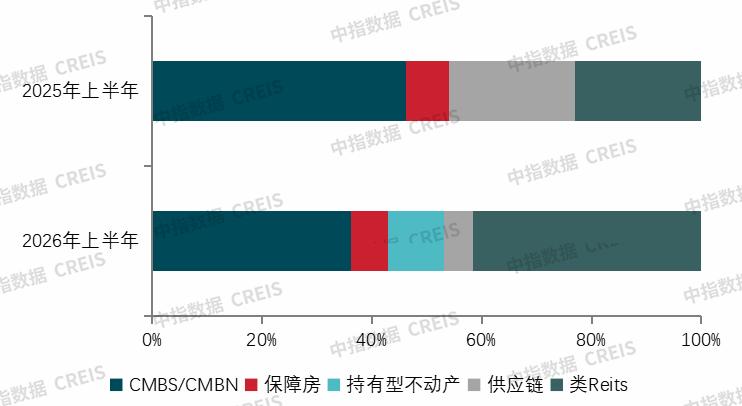
■ ABS: The Proportion of Financing Scale Rises, CMBS/CMBN and Quasi-REITs Supported by Underlying Assets Account for Nearly 80%
In 2026, ABS financing accounts for 27.5% of the total financing scale, up 1.7 percentage points from the same period of the previous year, and plays an increasingly important role in bond financing. The average issuance term is 17 years, and the term is significantly extended. From a monthly perspective, in the first half of the year, the issuance scale of ABS fluctuated greatly, and the issuance scale was constrained by policy guidance and high-quality assets. From the perspective of issuance structure, quasi-REITs, CMBS/CMBN have become the main issuance types, accounting for 41.6% and 36.3% respectively.
Figure: ABS Issuance Structure in the First Half of 2026
The pilot of commercial real estate REITs was launched, the first batch of commercial real estate REITs were successfully listed, and the paths for revitalizing commercial stock assets increased. On December 31, 2025, the China Securities Regulatory Commission issued a policy, clearly stating that it would "promote the stable and healthy development of commercial real estate REITs", pointing out that "promoting the development of the commercial real estate REITs market is an important measure for the capital market to implement the decision-making arrangements of the CPC Central Committee and the State Council on 'revitalizing stock assets and optimizing incremental assets' and 'increasing the proportion of direct financing', and is an effective means to support the construction of a new real estate development model through market-oriented mechanisms". At the same time, it proposed to "focus on supporting assets that meet the policy orientation and have commercial attributes to issue commercial real estate REITs, and improve the efficiency of issuance and listing. Encourage REITs to hold asset portfolios with similar formats, complementary functions or operational synergy, promote cross-field asset integration, and improve scale effect and risk diversification capabilities". In June, the first batch of commercial real estate REITs were successfully listed. The underlying assets of the 4 commercial real estate REITs are distributed in core cities such as Beijing, Shanghai and Xi'an, covering formats of outlet malls, office buildings and commercial complexes. The original equity holders are Beijing Capital Group, Shanshan Group, Sandhill Group and Shanghai Real Estate Group, covering local state-owned enterprises and private enterprises. Up to now, a total of 22 commercial real estate REITs have been declared, and the industry expects the total raised capital scale to exceed 70 billion yuan, which will further revitalize the stock commercial assets.
The implementation of holding-type real estate ABS products has accelerated. The "CITIC Securities - China Resources Commercial Assets Holding-type Real Estate Asset-backed Special Plan" was established, and the "Guojin Asset Management - Wuyue Plaza Holding-type Real Estate Asset-backed Special Plan" completed the expansion of shares. In general, the types of ABS products during the year are still dominated by types supported by high-quality underlying assets, and the ABS channel is always open to enterprises with high-quality holding-type assets.
Conclusion: The Multi-level REITs Market Is Accelerating to Take Shape, and Fine Operation Is the Core Competitiveness
When the financing cash inflow of the industry shifts from relying mainly on entity financing to relying mainly on project financing, tying the source of debt repayment to specific projects, repairing the maturity mismatch problem of "short-term debt for long-term investment" in the past market boom period, policies such as the "white list" mechanism and public offering REITs are still being implemented at an accelerated pace. Specifically, on January 9, the regulatory authorities issued the latest policy guidance on the real estate financing coordination mechanism, the core of which is that the loans for real estate "white list" projects can be extended for 5 years if they meet the conditions. It is expected that under the "white list" system, domestic loans will still form an important support for the funds in place of real estate enterprises. In the first half of the year, the implementation of commercial real estate REITs promoted the public offering REITs market to form a two-wheel drive development pattern of "traditional infrastructure + commercial real estate", and together with the holding-type real estate ABS, formed a multi-level REITs market. The launch of commercial real estate REITs has further improved the closed loop of the whole chain of "investment, financing, construction, operation and exit" in the real estate industry, truly opened up the development space for enterprises in the professional operation field, and laid an important foundation for building a new real estate development model.
Leading central state-owned enterprises, local state-owned enterprises and private enterprises are all exploring innovative financing channels such as public offering REITs and holding-type real estate ABS, which can not only revitalize stock assets, but also enrich the inflow of financing funds. Up to now, real estate enterprises such as China Resources, China Merchants, Jinmao and China Overseas have all realized the issuance of public offering REITs in China. At the same time, real estate enterprises such as Poly Development, Seazen Holdings, China Merchants Shekou, China Resources Land and Xinghe Group are actively applying for commercial real estate REITs. REITs form a positive cycle of high-quality credit, sound operation and fine operation, continuously strengthening the credit moat of enterprises.
This article is from the WeChat public account "China Index Academy", author: China Index Research, published by 36Kr with authorization.