How was Shanghai's "Land King" forged?
The sixth batch of land auctions in Shanghai contains a huge amount of information.
Leaving aside keywords such as the 10-billion-yuan land king and hundreds of rounds of bidding, returning to the three plots themselves, they all share one common feature:
All of them have undergone planned usage adjustments before being publicly transferred for sale.
Specifically, the Yangpu Badaitou Plot is adjusted from the original commercial and office-dominant function to a mixed land type that prioritizes residential use and is supplemented by supporting commercial facilities; the Xuhui Guilin Park Plot is adjusted from the former industrial land of Guanshengyuan Food Factory to a comprehensive commercial and residential land; the Fengxian New City Plot is adjusted from commercial and office land to pure residential land.
This is not the first occurrence. In the fourth batch of Shanghai land auctions in May this year, all 5 plots also completed a round of planning adjustments before being transferred for sale.
There is one key phrase behind all these high-quality residential plots: functional transformation of stock land.
01
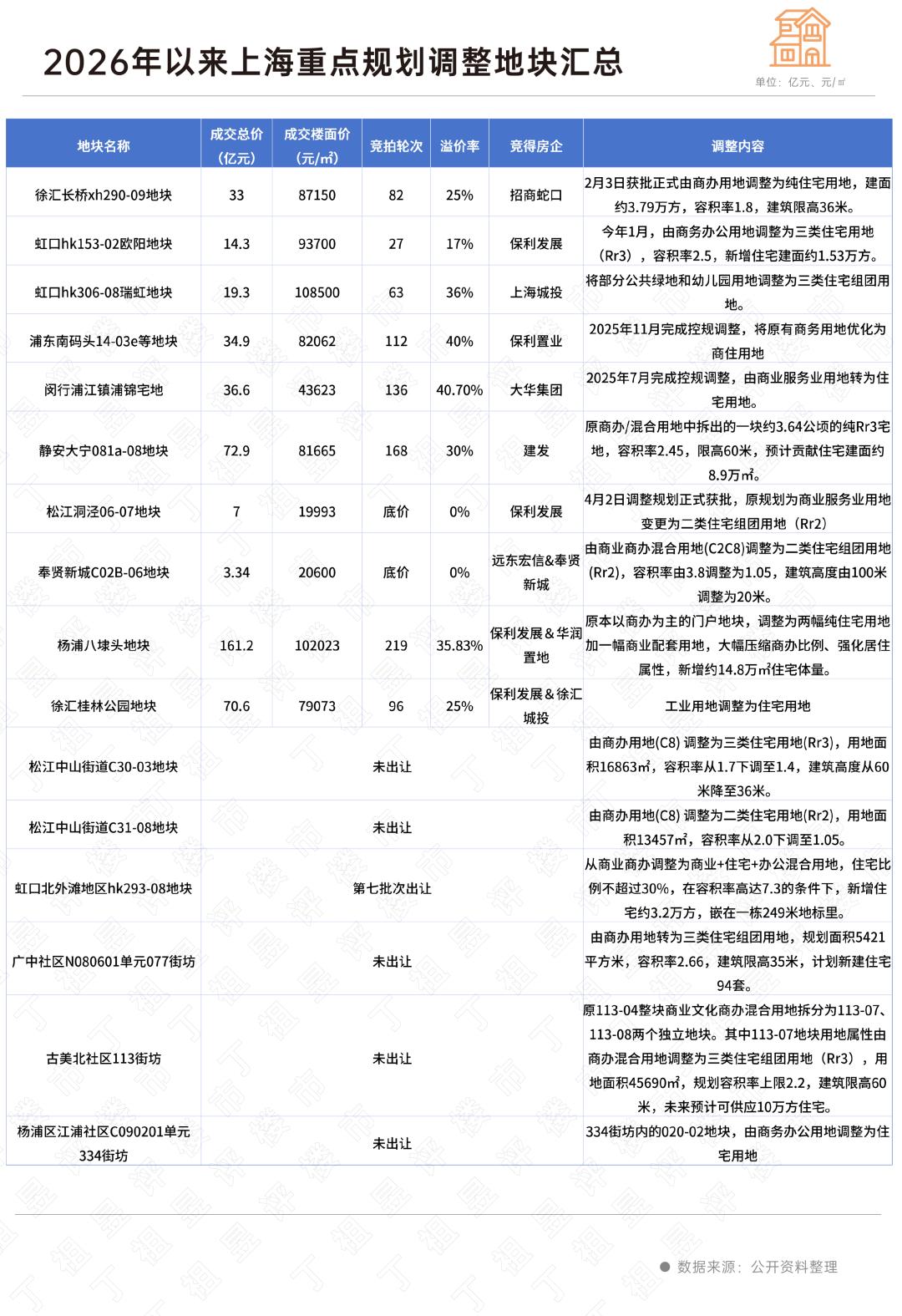
According to incomplete statistics, since 2026, 15 plots in Shanghai have undergone planning adjustments, converting commercial and office plots into residential plots.
Among them, 9 plots have been successfully transacted in each batch, which means half of the 20 residential-related plots transacted in the first six batches of 2026 are converted from commercial and office land or commercial service land.
The most representative one is the Badaitou combined plot. It is the fastest-to-market plot after the planning adjustment of stock land in Shanghai's core area.
The adjustment plan for the Yangpu Riverside Badaitou Plot was publicized on May 14, officially approved on June 18, it only took about 36 days from the draft publicity to approval, and was included in the sixth batch of transfer lists at the end of June.
The original gateway plot dominated by commercial and office use is adjusted into two pure residential plots plus one supporting commercial plot, greatly reducing the proportion of commercial and office space. After the adjustment, the total floor area of pure residential buildings on the plot is about 148,000 square meters, and the commercial volume is retained at about 10,000 square meters, making it the largest new residential land supply along the Shanghai riverside belt in 2026.
In March this year, the Xuhui Changqiao xh290-09 Plot won by China Merchants Shekou in the third batch of land auctions is also a plot transferred after planning adjustment, and it is also the plot with the highest premium rate in the first three batches of Shanghai land auctions in 2026.
In fact, the prelude to the planning adjustment of Shanghai's land market was opened as early as 2024. At that time, the former Xiaomi commercial and office plot on Xuhui Riverside was converted to residential use for market entry, and later won by Greentown for 4.8 billion yuan, with a floor price of 131,000 yuan per square meter, making it the national unit price land king at that time. The project was sold out as soon as it opened for sale after entering the market.
In July 2025, the Block 051 of Xuhui Hengfu Historical Area, which was converted from mixed commercial and office land to low-density historical-style residential land, went through 28 rounds of bidding and was finally won by Qixiang Wangyu for 1.225 billion yuan, with a floor price of 200,300 yuan per square meter, refreshing the national record for unit price of residential-related land.
Entering 2026, Shanghai's land planning adjustment has been fully rolled out, becoming a key measure to supplement the scarce residential supply in the inner ring and the inner-middle ring, and balance the city's work-residence structure.
In addition, the predecessor of the Guilin Park Plot is the former site of Guanshengyuan Food Factory, which is adjusted from industrial land to comprehensive commercial and residential land, including two major functions of ordinary commercial housing and catering and hotel industry. It is also a typical case of revitalizing inefficient industrial land in Shanghai's central urban area and supplementing residential supply.
02
Shanghai is not an isolated case.
Core cities across the country are also accelerating the optimization and adjustment of stock land, and a new logic has emerged in land supply.
Since 2026, Guangzhou, Shenzhen, Hangzhou, Wuhan, Qingdao, Jinan, Changsha and other first- and second-tier cities have successively transformed inefficient and idle commercial and office stock land into residential land to supplement the improved housing supply in the city's core areas.
First look at Guangzhou. Recently, Guangzhou has successively publicized the regulatory plan adjustments for two core areas: Pazhou South Area and Liwan Dongsha (Baietan Tan Area) have both optimized land attributes, and two rounds of adjustments have released 7 new residential plots. Among them, 3 residential plots are located in Pazhou South, and 4 residential plots are located in Dongsha, Baie Tan. These residential plots converted from commercial and office use precisely make up for the long-term shortage of residential land supply in the main urban area, and the subsequent bidding heat is predictable.
The representative plot in Shenzhen is the super plot of Universiade New Town, whose fate has changed several times. It was originally planned to build China's tallest building of about 700 meters, but later stopped construction due to the enterprise's liquidity crisis, and failed in two judicial auctions. Finally, it was acquired by the Shenzhen Municipal Government for 6.8 billion yuan in 2025, and China Resources was introduced to restart the development.
The biggest change in this restart is that the land is adjusted from pure commercial landmark land to comprehensive commercial and residential land, with the residential proportion directly reaching 64%, and the commercial part only retaining about 30%. Transforming from an ultra-high idle commercial and office landmark to a core residential plot in the main urban area, this plot has also become a benchmark sample of Shenzhen's urban renewal and stock land transformation.
Almost all popular residential plots in Hangzhou come from stock transformation. The Chengdong New Town Plot in Shangcheng District, the Changmou Unit Plot, and the Future Science and Technology City combined plot all entered the market after completing the planning adjustment in 2025.
Also due to their scarcity, after these plots entered the market after planning adjustment, the overall premium rates all stood above 30%, and real estate enterprises generally have strong willingness to acquire land.
The pace of planning adjustment in Hangzhou is still accelerating. The latest adjusted plot is the Liuxia Unit Plot next to Xixi Wetland, which is directly changed from commercial + commercial financial attributes to pure second-class urban residential land, and the planning indicators are greatly optimized at the same time.
A large number of second-tier cities have also kept up with the pace, fully launching the wave of revitalizing inefficient commercial and office stock land.
Jinan officially issued a special new policy in April 2026, clearly encouraging the transformation of inefficient commercial and office land to residential use to revitalize stock resources. The policy was quickly implemented. In June, two plots with planning adjustments in Jinan were all transacted at high premiums: the Tangye TY12-1 Plot was successfully won by Dahua Group after 48 rounds of fierce bidding; the East Plot of the CBD Political and Legal College was won by Greentown for 386 million yuan.
The C5 South Plot of Yuelu Riverside New City in Changsha also aroused the bidding enthusiasm of leading real estate enterprises. At the beginning of 2026, the plot was adjusted from the original pure commercial land to pure residential land. The auction in June attracted 8 leading real estate enterprises including China Resources, Poly, and C&D. After 40 rounds of bidding, it was won by local Jiaxin Real Estate for 1.212 billion yuan, with a premium rate of 38.98%, and the floor price refreshed the land price record of the Riverside Plate.
Stock revitalization has become a brand new path for land supply in the property market.
On the whole, the nationwide promotion of functional transformation of stock land across the country brings two-way benefits to urban development and property market trends.
On the one hand, it effectively solves the common urban pain points of excess commercial and office inventory and inefficient vacant buildings in major cities, and the functional transformation of stock land can revitalize long-term idle stock assets; on the other hand, most of these plots are located in the core of the main urban area and plates with mature supporting facilities, making up for the shortage of residential supply in core areas, and strengthening the investment confidence of real estate enterprises in high-quality plots in core cities.
The more important meaning behind it is that the land supply in core cities has long bid farewell to the large-scale new land supply model, and stock revitalization and urban renewal have officially become the main force of land supply. In the future, expanding residential supply through land planning adjustment, optimizing residential layout, and improving the work-residence balance in urban areas will become the long-term direction of property market development and urban renewal in major cities.
This article is from the WeChat Official Account "Ding Zuyu Reviews the Property Market", author: Editorial Department, released by 36Kr with authorization.