Meituan is falling behind AI.
Is Meituan trying to evolve from an APP to an API?
In the near future, users only need to say to Tencent Yuanbao: "Help me order a beef rice meal nearby with a high rating that can be delivered in half an hour". The AI will complete the search, coupon claiming and order placement, and half an hour later, the rider will deliver the takeout to the door as usual.
Throughout the whole process, the yellow takeout box shows up, but the yellow Meituan APP never appears.
This is not a sci-fi fantasy. On June 1, at the 2026 Q1 earnings call, Wang Xing announced that Meituan's AI agent "Xiaomei" will launch cooperation with Tencent Yuanbao. After the cooperation goes live, users can submit demands in Yuanbao, and "Xiaomei" will call Meituan's takeout and local life services. Wang Xing also put forward a new direction: in the future, Meituan will not only serve consumers and merchants, but also serve AI Agents.
This sounds like Meituan has added a new channel for itself, which is a good thing, but it also exposes its biggest contradiction in the AI era: if users first turn to other people's AI, and then that AI calls Meituan, is Meituan still an entry, or has it already become an API interface?
Billions of investment poured in but at risk of being reduced to a mere delivery service provider
In recent years, with AI booming, Meituan has not held back on its investment in AI.
In 2025, Meituan's R&D expenditure reached 25.998 billion yuan, a year-on-year increase of 23.5%; its R&D investment in the first quarter of 2026 hit 7 billion yuan, up 22% year on year. Although the large-scale R&D investment is not all allocated to the AI field, and also covers directions such as drones, autonomous vehicles, and instant logistics scheduling technology, AI has been placed at the core of Meituan's technology strategy.
Relying on the self-developed large model LongCat base, Meituan has successively launched consumer-facing AI assistants "Xiaomei" and "Xiaotuan", as well as merchant-oriented intelligent shopkeepers and AI digital employees. According to the open source information released by Meituan on July 6, the latest LongCat-2.0 has a total parameter scale of 1.6 trillion, with an average of about 480 billion parameters activated per Token, and the whole process of model training and inference is built on a domestic computing power cluster.
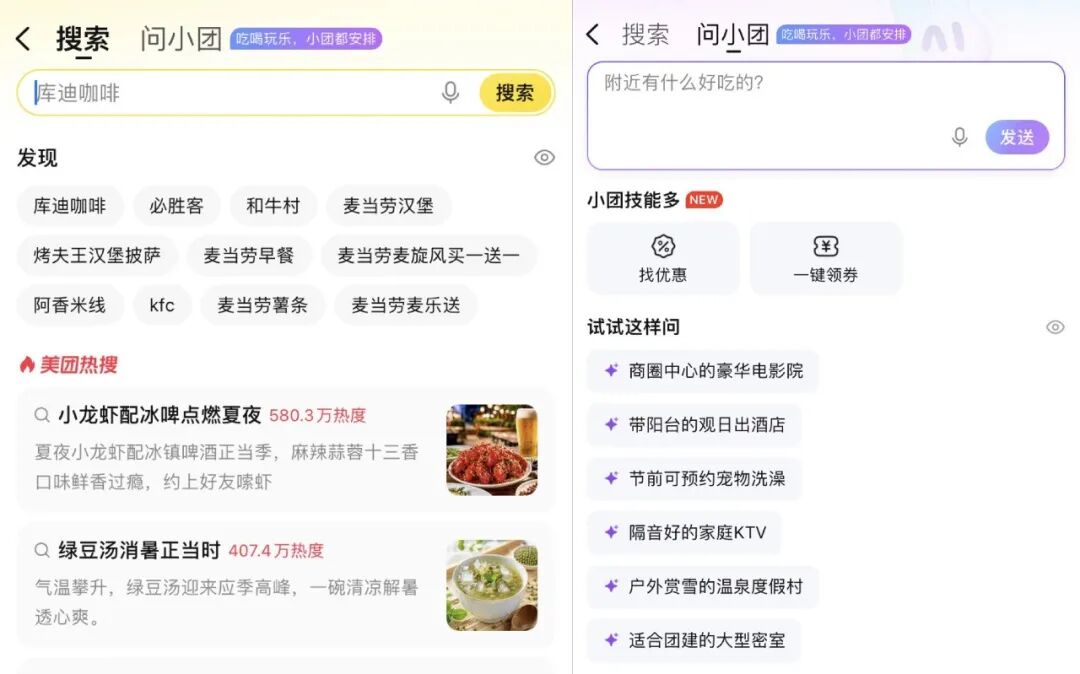
Judging from its full-stack layout, Meituan is not here to just take a quick glance at the AI industry and leave. It has almost equipped itself with models, applications, merchant tools and logistics hardware.
However, Meituan's heavy investment in AI does not stem from shrinking demand in its original business. As of the third quarter of 2025, the number of transacting users on the platform in the past 12 months exceeded 800 million, and the core local commerce still maintains a huge scale. The real demand for takeout still exists, and what Meituan is really worried about is that the path users take to order takeout is changing.
In the mobile internet era, when consumers think about eating, their first reaction is to open Meituan. As a result, the platform grasps user demands, search behaviors, comparison processes and final transactions.
In the AI era, consumers may no longer actively look for a specific App, but submit their demands to a general assistant: "Help me book a restaurant suitable for a date", "Find a nearby pet-friendly hotel", "Order a dinner within 40 yuan without coriander".
The AI is responsible for understanding the demands, and Meituan is responsible for execution. Meituan's business still exists, but its position has moved one step back, which is very dangerous.
In the past, when using Meituan, users had to first enter the homepage, then search for categories, browse merchants, check reviews, compare prices, claim discounts, and finally complete the order. Although the process is cumbersome, every step is crucial to the platform, because every click, stay and comparison of users strengthens the relationship between Meituan and consumers, and accumulates user data for Meituan.
What AI Agents pursue is exactly to compress all these steps.
Users do not need to look at twenty stores, nor do they need to study the full-reduction rules. As long as they put forward their demands, the AI can directly give the answer, and even complete the transaction. The process that used to take users five minutes to operate may now only require one sentence.
Of course, AI will not take over all local life entrances at once. Demands with clear goals and clear constraints, such as repurchasing a fixed lunch and looking for a dinner within 40 yuan, are the easiest to be taken over by Agents.
From this perspective, the orders that will be first diverted from the Meituan APP are standardized and directly executable orders. It just so happens that these orders have high frequency, short paths, and are the most suitable for upstream AI to cultivate user habits.
Being reduced to an "API" refers not only to the technical interface, but also to the business position. Users no longer directly access Meituan, and only regard Meituan as a service capability called by other AIs.
This is also rather awkward. Accessing AI can bring new traffic, but full opening will also develop users' habit of bypassing the Meituan APP.
In the past, users chose between different platforms and used the one with lower price. In the future, AI may choose the platform for users. This also means that Meituan not only has to compete with peers for orders, but also strive to be called preferentially by upstream AIs.
However, since behaviors such as wandering around casually on weekends, looking for new stores, checking group buys and reviews still require visual shelves and content browsing, the Meituan APP will not suddenly lose its value.
What is more fatal than the reduction of orders?
When discussing Meituan, we cannot only focus on takeout, riders and delivery fees. One of Meituan's more critical capabilities is deciding what users see first.
Open Meituan and search for "hot pot", and the page will show natural ranking, sales ranking, discount packages, brand promotions and recommended merchants. The platform not only facilitates transactions, but also controls the traffic allocation method.
This "shelf economy" supports a huge business. According to Meituan's 2025 annual report, its online marketing service revenue increased from about 49.2 billion yuan in 2024 to about 51.9 billion yuan (online marketing includes performance marketing, display marketing, etc., which cannot be simply equated with "paying for ranking"). Merchants are willing to pay this sum of money because a higher ranking in Meituan means more opportunities to be seen by more consumers.
However, AI is not a smaller shelf. It is more like a shopping guide who is only willing to give answers. When a user asks "Which barbecue restaurant nearby is suitable for a four-person dinner", a qualified AI cannot throw out all fifty store options, at most two or three options, or even directly recommend one.
This leads to a key question: Should this unique answer belong to the merchant most suitable for the user, or the merchant most willing to pay for promotion?
Of course, AI can also sell advertisements. Recommendation cards can be marked as "sponsored", and the platform can continue to charge by clicks or transactions, but what is actually shrinking is the ad inventory. An APP screen can fit more than a dozen stores and multiple promotion slots, while a conversation usually only leaves two or three candidates, which means that for the same transaction, the number of sellable exposures is greatly reduced.
In addition, if recommendations are interfered by paid content for a long time, it will also consume users' trust in AI. Therefore, Meituan's marketing revenue will not disappear quickly, but its price, form and ceiling all need to be recalculated.
This is exactly the commercial paradox Meituan's AI is facing. The more useful the AI is, the less users need to browse Meituan; the less users browse, the fewer traffic slots Meituan can display and sell. What's more troublesome is that if the final answer is generated by external AI, Meituan will also lose its final right of recommendation.
However, the real pressure will not be released until general Agents acquire the capability of multi-platform calling. At that time, Meituan holds the menus, prices and riders, but the mouth that decides which restaurant to eat at belongs to other AIs. The vote closest to users may be transferred from Meituan's hands.
In this case, although the orders are still fulfilled and commissioned by Meituan, "why this specific order" is no longer explained by Meituan.
The forward shift of entry brought by AI will also take away something more valuable, that is, the intent data before order placement. Users state their requirements such as budget, taste, number of diners and time in Yuanbao, and Meituan only receives an order in the end. What users have searched for, what they have compared, why they gave up a certain store, why they chose this current store... All these process data remain in the upstream AI. In the long run, although Meituan is still earning commissions, it will be more difficult to understand users, promote cross-category consumption, and prove to merchants how much an exposure is worth.
Which platform the order falls on is only the surface. Who hears the demand first determines the next round of recommendation right. When Meituan loses user intent, can it still be the platform that knows users' tastes best?
Playing a supporting role for AI?
Of course, with years of accumulation, Meituan is not so easily sidelined by AI.
AI can understand users' demand of "wanting to eat something light", but it may not know which store is open today, which dish has been sold out, which coupon can be used, and how long the delivery will take on a rainy day. These seemingly trivial information are the most difficult parts to handle in local life services.
According to Meituan's disclosure, "Xiaotuan" has cumulatively verified 700 million pieces of merchant information across the country, and calibrated them with 1.3 billion real user reviews; the intelligent shopkeepers have served more than 700,000 merchants in total, and the digital employees cover more than 300,000 merchants. Coupled with the distribution network, payment, after-sales service and real-time updated inventory, Meituan's real moat is fulfillment, that is, turning a demand into a reliable transaction.
Many tech giants can build an AI that recommends restaurants, but not all AIs can deliver a bowl of noodles to users within half an hour.
Conversely, if all general AIs need to call Meituan, Meituan can even get more orders at a lower customer acquisition cost. In the past, Meituan had to find ways to make consumers use its APP, but in the future, it needs to make various AIs inseparable from itself.
When upstream AIs grasp the traffic, they can also charge diversion fees, require revenue sharing, and use multi-platform price comparison to lower commissions. The customer acquisition costs saved by Meituan may be converted into "toll fees" paid to the new entry.
Therefore, the final result depends on three things: who holds the user intent, who decides the final recommendation, and who formulates the transaction sharing rules. In a word, who sets the rules behind the interface determines which layer of the value chain Meituan stands on.
If Meituan still controls merchant relationships, transaction closed loops, user data and fulfillment standards, it is the operating system of local life; if Meituan can only accept the price comparison, order splitting and negotiation from upstream AIs, and is only responsible for delivering the goods, Meituan is more like a busy backstage with little initiative. The former is infrastructure, while the latter is just a supplier. Although both seem to be receiving orders, their business statuses are completely different.
Therefore, Meituan needs to complete two mutually restrictive tasks at the same time: on the one hand, make "Xiaotuan" and "Xiaomei" its own AI entry, so that users can form the habit of "asking Meituan first for local life services"; on the other hand, open up its capabilities and become an indispensable service layer for external AIs such as Yuanbao.
This battle is more difficult than training large models. Because models can be measured by parameters and rankings, but who users will turn to first cannot be easily solved by computing power.
Conclusion
In the final analysis, Meituan's AI dilemma lies in its business position. The business it is most familiar with will be redistributed by new entries.
The worst result is that other AIs are responsible for greeting customers, ordering dishes and making recommendations, while Meituan can only be busy working in the back kitchen. There may be more orders, but user relationships, advertising space and the final decision-making power remain in the front end.
However, this kind of "invisible victory" is a more terrifying narrative for the capital market than losses. After all, when a company no longer decides "what users see" and is only responsible for "where to deliver the goods", according to this logic, its price-earnings ratio should be aligned with logistics companies, not internet platforms.
If one day Meituan only has riders and algorithms left, can it still be an internet giant? (Image source: Meituan APP)
Disclaimer: The content of this article is compiled based on public information and does not constitute any investment advice.
This article is from the WeChat Official Account "Business Style Pro", Author: Pink Demon, published with authorization from 36Kr.