Entrusted with heavy responsibilities, the provincial capital that is on the verge of hitting the trillion-yuan GDP mark can no longer afford to slow down its development pace.
Local economic data for the first half of the year have been released one after another.
Liaoning's GDP reached 1.62272 trillion yuan, up 2.5% year on year, lower than that of the same period last year (4.7%) and also lower than the national average (4.7%).
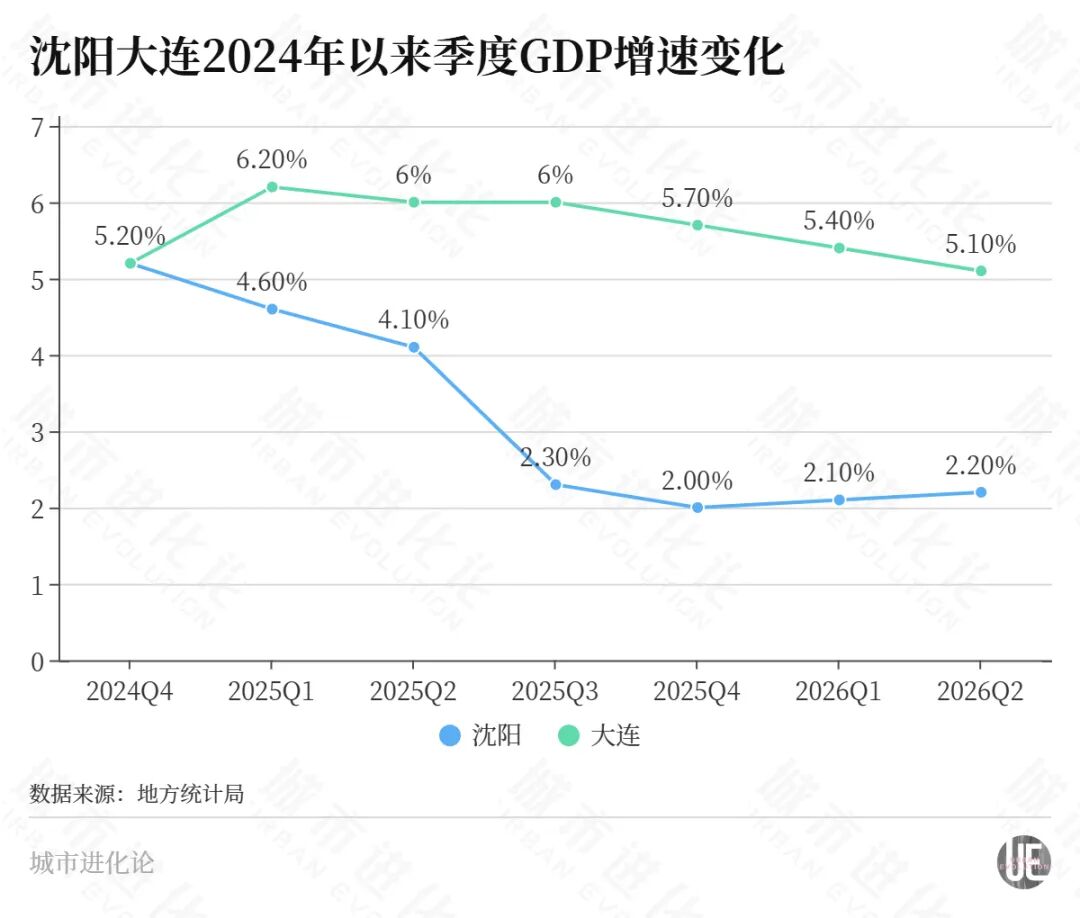
The two core cities in the province show a clear polarization trend. Dalian recorded an upward curve with a 5.1% growth rate, while Shenyang posted a 2.2% growth rate, with a gap of 2.9 percentage points between the two. This marks the sixth consecutive quarter that Shenyang's economic growth rate lags behind that of Dalian.
Shouldering the responsibility as the provincial capital, Liaoning has once again named Shenyang in its work deployment. Recently, Xu Kunlin, Secretary of the Liaoning Provincial Party Committee, presided over a symposium for principal leading Party and government officials of all counties (cities, districts) in Shenyang. Xu Kunlin emphasized that it is necessary to promote high-quality development with a strong sense of responsibility and urgency, and make greater efforts to enhance the core competitiveness of the city.
The provincial Party secretary's dialogue with principal leading Party and government officials of all counties (cities, districts) in Shenyang sends a very clear signal — Shenyang must play the role of the "high-jump team" in the all-round revitalization of Liaoning.
Looking back at 2025, Shenyang's GDP reached 910.03 billion yuan, making it expected to become the second "trillion-yuan city" in Liaoning and even Northeast China after Dalian. However, the current low growth rate has obviously restricted its breakthrough pace.
Judging from the economic data of the first half of the year, why is Shenyang "slowing down"? Can the provincial-level deployment open up a new situation for Shenyang to reshape its competitiveness? For the revitalization of Liaoning, what other cooperation space is there between the two "twin star" cities in the province?
Shenyang Is "Slowing Down"
Shenyang's economic growth rate is slower than expected.
According to the work report of the Shenyang municipal government, the expected economic growth target for Shenyang in 2026 is around 4.5%, with an average annual growth of around 5% during the 15th Five-Year Plan period. Calculated at this growth rate, Shenyang is expected to break through the "trillion-yuan" threshold in the middle of the 15th Five-Year Plan period.
With the release of the economic "half-year report" at present, Shenyang's GDP reached 443.01 billion yuan, up 2.2% year on year. The growth rate is lower than expected, 0.3 and 2.5 percentage points lower than the provincial and national average respectively. Compared with other cities that are also sprinting towards the "trillion-yuan" level such as Xuzhou, Shaoxing and Weifang, Shenyang's growth is also significantly slower.
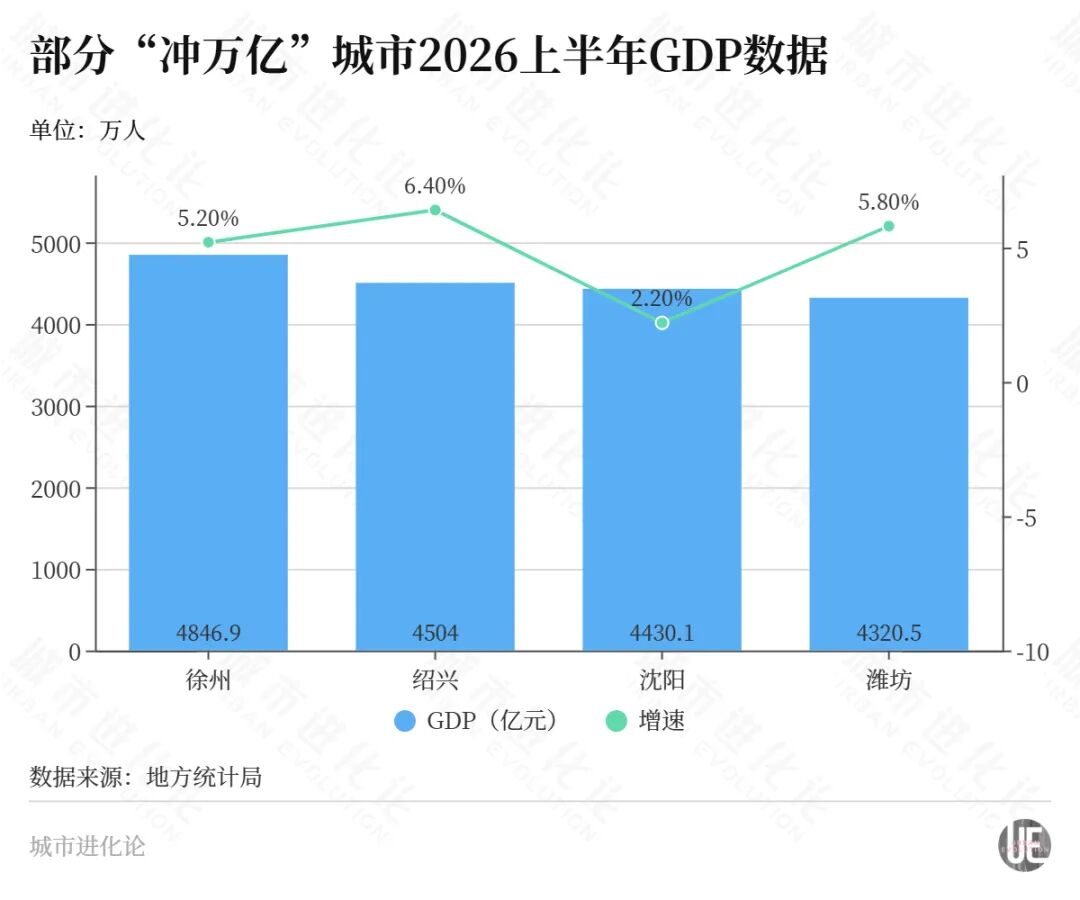
The in-depth adjustment of the industry is the core reason for the slowdown of Shenyang's economic growth.
In the first half of the year, the added value of Shenyang's secondary industry reached 136.62 billion yuan, down 2.1% year on year. Specifically, the growth rate of the added value of industries above designated size in Shenyang dropped by 3.1%, lower than the annual target of "4% growth in the added value of industries above designated size"; the equipment manufacturing industry, which accounts for about 70% of the added value of industries above designated size in the city, decreased by 3.6%; industrial investment dropped by 29.5%.
The automobile industry is the largest industrial cluster that Shenyang is making every effort to build. In previous years, the revenue of Shenyang's automobile manufacturing industry once accounted for nearly half of the total operating revenue of the city's manufacturing industry, among which the OEM manufacturing of foreign automobile brands such as BMW and GM was the top priority.
However, the production and sales data of BMW in the first half of this year shows that total deliveries in the Chinese market reached 261,800 units, down 20.4%. More urgent than the decline in sales volume is the challenge of electrification transformation. It is reported that BMW China will fully stop production of all domestically-produced pure electric models including i3, i5 and iX1 starting from July, and the new-generation electric vehicles after the transformation are expected to be launched in the fourth quarter of this year.
To a certain extent, Shenyang's automobile industry is going through a special transitional phase of "the old is out, the new is not yet mature". Zhang Xiang, an auto industry analyst and researcher at the Automotive Industry Innovation Research Center of North China University of Technology, told City Evolution that BMW's overall sales have dropped sharply, and it has adjusted the production of pure electric vehicles, leading to low capacity utilization of its current factories. As one of BMW's largest production bases around the world, Shenyang will inevitably be affected.
Previously, Shenyang's 15th Five-Year Plan has listed the transformation of the automobile industry as its top priority, clearly proposing to "lay out the whole industrial chain of intelligent connected new energy vehicles". Earlier this month, Huo Bugang, Secretary of the Shenyang Municipal Party Committee, and Lyu Zhicheng, Deputy Secretary of the Municipal Party Committee and Mayor, held talks with visiting Mr. Franz Decker, President and CEO of BMW Brilliance Automotive Ltd.
During the meeting, Huo Bugang said that the automobile industry is an important pillar industry in Shenyang, which has formed a relatively complete industrial system with solid foundation and huge space for transformation and upgrading. He expressed the hope that BMW Brilliance will grasp the general trend of the development of the automobile industry, actively adapt to market demand, speed up product iteration and upgrading, realize the early production of new-generation models, optimize its business layout in Shenyang, expand diversified markets, accelerate the localization of the supply chain, and drive more supporting enterprises to settle in Shenyang.
Momentum Transformation
The upgrading of traditional industries is to "stabilize the basic market", while emerging industries and future industries are the key to "breaking the deadlock".
Zeng Gang, Dean of the Institute of Urban Development of East China Normal University, told City Evolution that old industrial bases are prone to "path dependence" in industrial development, and he suggested that Shenyang "appropriately phase out backward production capacity to make room for emerging industries".
At this symposium, Xu Kunlin emphasized that it is necessary to promote high-quality development with a strong sense of responsibility and urgency, accelerate the cultivation and expansion of new driving forces, focus on transformation and upgrading based on industrial foundation and resource endowment, and focus on key fields such as aerospace, integrated circuits, industrial software, artificial intelligence and new energy, to cultivate and introduce ecosystem-leading enterprises and "specialized, refined, differential and innovative" enterprises.
As the first key field to be "named", Shenyang's aerospace industry has a solid foundation. Known as the cradle of China's aviation industry, Shenyang has not only produced the first domestically-made jet fighter and the first aero-engine, but also built a whole industrial chain system covering military aircraft, civil aircraft, aero-engines, general aviation and UAVs.
Statistics show that Shenyang's aerospace cluster has been listed as a national advanced manufacturing cluster, with more than 500 entities in the aerospace sector, including 149 enterprises above designated size. The industrial scale exceeded 120 billion yuan in 2025, up 10.1% year on year. This year, it strives to exceed 130 billion yuan and maintain double-digit growth.
This also provides a starting point for the linkage between Shenyang and other cities in the province. The previously released 15th Five-Year Plan for Marine Economic Development of Liaoning Province clearly proposes to plan and build a commercial offshore rocket launch base, and build an integrated "Marine + Aerospace" whole industrial chain cluster covering rocket final assembly, offshore launch, satellite application, measurement, control and communication.
Dandong in Liaoning is one of the alternative sites for the above offshore rocket launch base. Relying on its aviation industry foundation and university scientific research resources, Shenyang can form a collaborative model of "R&D in Shenyang + Launch in Dandong". Last December, the Shenyang-Dandong industrial enterprise production-demand docking event was held in Shenyang. Taking this as a starting point, the two cities have established a regular industrial collaboration mechanism.
As Chen Yao, Vice President and Secretary-General of the Chinese Regional Economic Association, said, Shenyang's industrial upgrading should follow the path of "technology leadership". Relying on its own scientific research resources, it should focus on the core links of advanced manufacturing, and strengthen high value-added tracks such as artificial intelligence, industrial software, integrated circuits and aerospace. General manufacturing links should be transferred to surrounding cities in the Shenyang metropolitan area in an orderly manner, forming a gradient division of labor of "R&D in Shenyang, manufacturing in surrounding areas".
Strong Alliance
As the "twin stars" in the province, Shenyang and Dalian account for half of Liaoning's total GDP. In other words, if Shenyang and Dalian are strong, Liaoning will thrive.
However, in recent years, the two core cities of Shenyang and Dalian have shown completely different economic development trends. In 2024, the GDP growth rate of both cities was 5.2%, moving forward side by side. In the same year, Liaoning's GDP reached 3.26127 trillion yuan, up 5.1% year on year, making it the only province among the three northeastern provinces whose growth rate exceeded the national average.
However, since the first quarter of 2025, the economic trend of the two core cities has continued to diverge. Up to now, Shenyang's economic growth rate has been lower than that of Dalian for six consecutive quarters — in the first half of this year, Dalian's economic growth rate was 5.1%, while Shenyang's was 2.2%. From the perspective of the whole province, Liaoning is developing under pressure with an economic growth rate of 2.5%, 2.2 percentage points lower than the national average.
Previously, in the 15th Five-Year Plan of Liaoning, strengthening the dual-core leadership of Shenyang and Dalian and building the Shenyang-Dalian Economic Corridor were listed as the top priorities. It is clearly required that Shenyang and Dalian should play the leading role, and collaborate with cities such as Anshan, Yingkou, Liaoyang and Panjin to build a cross-regional innovation cooperation and industrial collaboration system.
"As the two core cities, Shenyang and Dalian have similar total economic volume, but their economic structures are completely different. They should focus on their respective industrial endowments and comparative advantages to make efforts." Chen Yao pointed out that Liaoning should base on the differences in industrial structure between Shenyang and Dalian, define the differentiated functional positioning of the two cores, avoid homogeneous competition, and form a joint force for the development of the whole province.
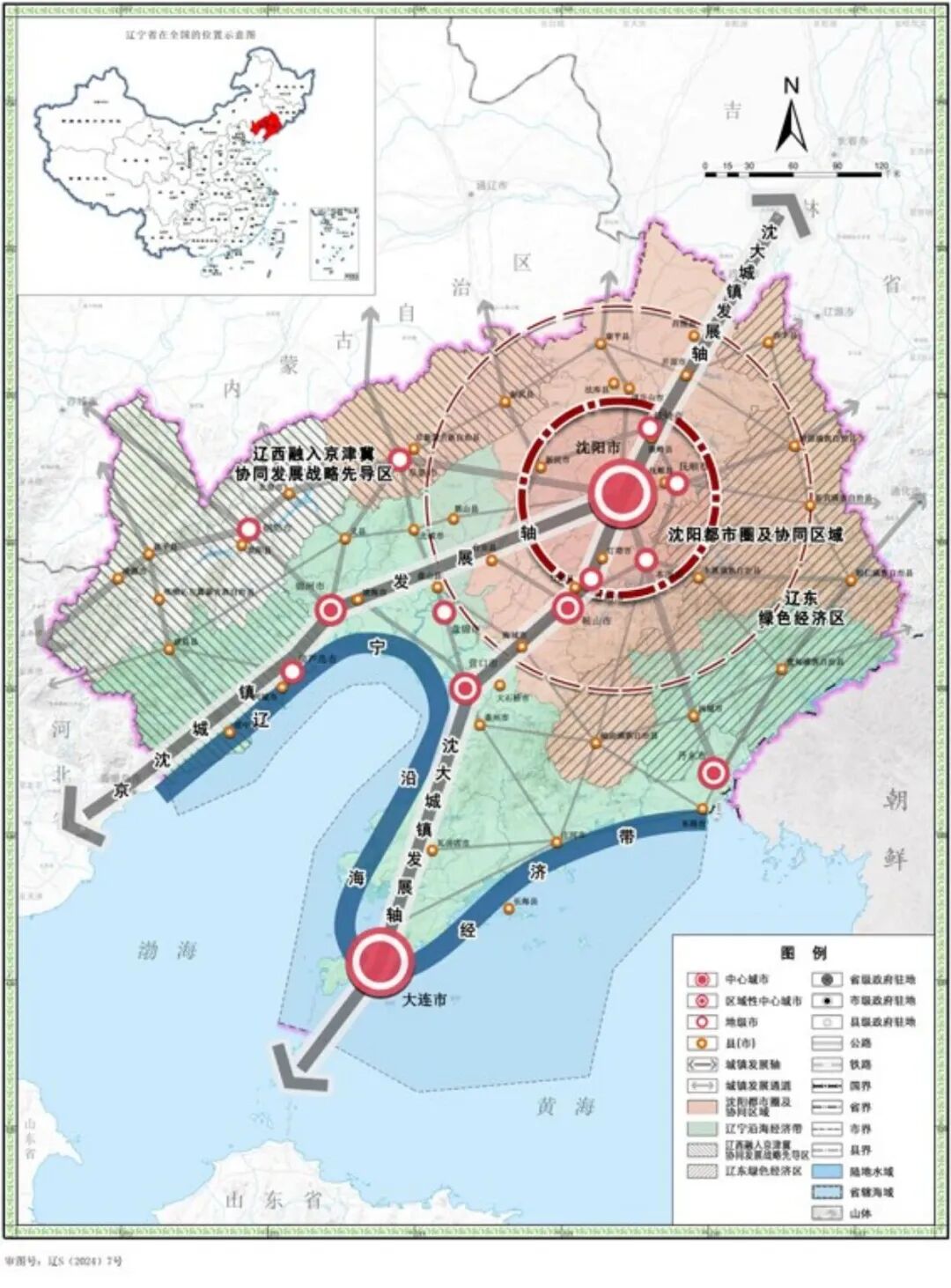
Image source: Liaoning Provincial Territorial Spatial Plan (2021-2035)
Liaoning has proposed to "build the Shenyang-Dalian Industrial Science and Innovation Corridor". It will strengthen the R&D and application collaboration between Shenyang and Dalian in key fields such as industrial mother machines, support nodes along the Shenyang-Dalian line to jointly build new energy industrial clusters, promote Shenyang Hunnan Science and Technology City and Dalian Yinggeshi Science City to gather innovation factors and strengthen the function of innovation source.
From the current situation of industrial development, Chen Yao said that Dalian's industrial structure is more in line with the current market demand, and its industries such as petrochemical, shipbuilding and offshore engineering are developing with stronger momentum. Shenyang's industrial development is impacted by the transformation of the automobile industry, and the emerging sectors of equipment manufacturing are difficult to achieve rapid growth in the short term.
In this context, Dalian should focus on giving full play to the role of a port-side industry base and opening-up gateway, and act as the "leader" of Liaoning's economic development. Shenyang, based on its function as the provincial capital, should transform to a service-led economy, vigorously develop modern service industries, and focus on producer services such as finance, modern logistics and scientific and technological services. Only in this way can the provincial-level support be transformed into a key support for the economic development of the two core cities of Shenyang and Dalian.
This article is from the WeChat official account "City Evolution", written by Liu Xuqiang, and authorized for release by 36Kr.