The food delivery war has ushered in a "ceasefire", and there will be no explosive order surge this summer.
A crowdsourcing rider, Wang Ping (pseudonym), has a scrape on his left leg, which was left when he collided with a tricycle selling lotus seeds while hurrying to deliver food during the noon peak hours. "I couldn't brake in time and crashed into it," he said, lifting his leg to show the wound to the reporter from National Business Daily (hereinafter referred to as NBD reporter). While talking, he glanced at his mobile phone from time to time, refreshing the order dispatching page of a certain crowdsourcing App (application).
The so-called crowdsourcing riders refer to personnel who register independently on platforms (the main crowdsourcing platforms include Meituan Crowdsourcing, Hummingbird Crowdsourcing, JD Instant Delivery Riders, UU Run, etc.) to engage in food delivery. Different from dedicated riders who are uniformly recruited and managed by third-party service providers of food delivery platforms, crowdsourcing riders can log in and out freely and accept orders flexibly. According to Meituan Rider Annual Occupational Report (2024~2025), from 2022 to 2024, the proportion of dedicated riders and crowdsourcing riders among the platform's monthly active riders has remained basically stable at 3:7, and the proportion of crowdsourcing riders has continued to rise, increasing from 64.15% to 71.52%, making them the main force of the platform's food delivery.
In the summer of 2025, the food delivery war broke out everywhere, and it was this group of crowdsourcing riders that supported the blowout demand for delivery capacity. However, in July 2026, NBD reporters interviewed more than a dozen riders in Beijing - the vast majority of whom were crowdsourcing riders like Wang Ping - and their feedback was highly consistent: the number of delivery orders, unit price and income were almost "cut in half" compared with the same period last year.
"Now there are more people delivering food than people ordering food, and the unit price is far worse than before," Wang Ping sighed. The order receiving background displayed by a rider to the NBD reporter shows that there are more than a dozen orders nearby and 75 online riders, "on average, 7 to 7.5 people share one order". This situation was also confirmed by many riders in the reporter's interview as not uncommon.
When the smoke of the food delivery war cleared, what was left to the riders was a summer without explosive orders.
"Too many orders to deliver" turns into "unable to get orders"
In July in Beijing, the heat wave surges on the road. Under the bright sun, the shade of trees has become the most sought-after thing in the area around the China World Trade Center CBD (Central Business District). On a street hundreds of meters long, electric bikes are neatly parked along the curb. Some riders lean back on their bikes, some squat on the side of the road, some take off their helmets to fan themselves, and some lower their heads to refresh the order receiving interface over and over again.
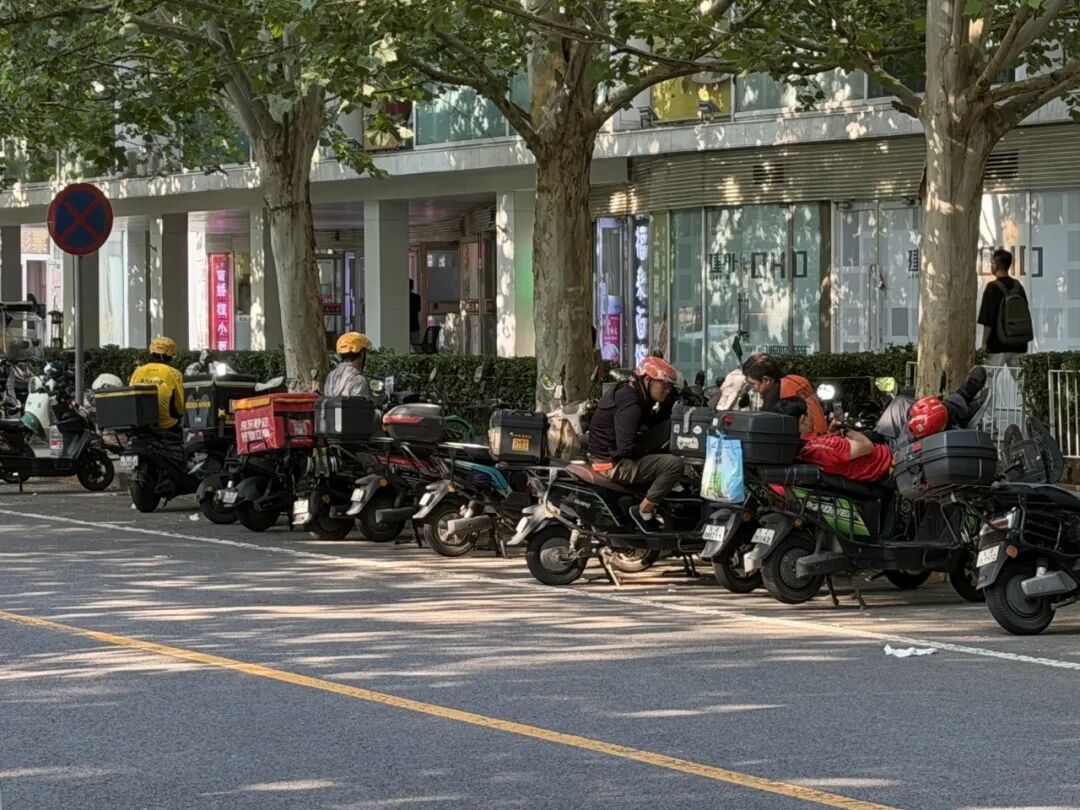
Riders rest by the roadside. Photo by Zheng Xinwei, NBD reporter
At a little after 3 p.m., rider Xiao Lin (pseudonym) is also among them. Xiao Lin, who is resting under the shade of a sycamore tree, told the NBD reporter, "I don't want to rest either", but as soon as the peak hours passed, he fell into a situation where there were no orders to take. The same period last year was a different scene: "Orders kept coming in, you couldn't deliver them all, and as soon as you logged in, orders were dispatched to you. Sometimes you had to log out voluntarily for fear that you couldn't finish the delivery."
"They (the food delivery platforms) stopped fighting, now there are fewer orders and more riders, and several people are scrambling for one order," said the rider who has been delivering food for 5 years. Last summer, when the food delivery war was in full swing, the number of tea and coffee orders was so huge that he could pick up 11 orders at a single drink shop. Wang Ping also witnessed the "grand scene" of a chain hand-made lemon tea brand receiving thousands of orders in one day, "the clerk's arm was almost dislocated from stirring". At that time, Wang Ping was even unwilling to take tea and drink orders - the merchants couldn't prepare the food in time, and the riders were anxious to deliver, "it was very easy for everyone to fight".
However, this summer, the difficulty in getting orders or even having no orders to take has become a common dilemma for crowdsourcing riders. Xiao Lin, who completed 13 delivery orders during the noon peak hours on the interview day, could run about 28 orders in the same period last year, and 70 to 80 orders all day, but now he can only run about 40 orders a day. Many interviewed crowdsourcing riders also gave similar data that was almost "cut in half".
"This year, the number of orders has dropped significantly, and the unit price is also dropping," said a crowdsourcing rider who was resting and chatting with Xiao Lin. Last year, with the support of platform subsidies, the average unit price per order could reach 8-9 yuan, but now it has dropped to 3-4 yuan per order. Xiao Lin confirmed, "Now there are a lot of orders with 3 or 4 yuan, and sometimes you can't earn more than ten yuan in an hour."
Yang Tao (pseudonym), who joined Meituan's "Le Pao Yuan" plan (an advanced order-taking mode of Meituan Crowdsourcing that mainly takes long-distance orders), could get 10 yuan for a 5-kilometer order last year, but now he can only get 7 or 8 yuan. In the half hour of talking with the NBD reporter, he only grabbed one order, "7.6 yuan, 4.7 kilometers. In the past, this kind of order was 9 yuan or 10 yuan."
This "post-2005s" rider joined the rider army last summer, just catching up with the hottest period of the food delivery war. At that time, he and 6 other roommates who were also riders could earn more than 20,000 yuan a month, but now "it's no longer possible". "My income has been falling this year, and now it's difficult to earn 10,000 yuan a month," Yang Tao said.
The decline in income is almost the common situation of all interviewed crowdsourcing riders, with the decline generally reaching one-third or even half. Xiao Lin said that when he did well last year, he could earn "17,000 to 18,000 yuan" a month, but now he can only get two or three hundred yuan a day. He opened the background interface, and the number on it showed that the rider who went out at 8 a.m. and worked for 7 hours had an income of 124 yuan.
High subsidies once raised short-term income expectations
"The high subsidies of the previous food delivery war raised short-term income expectations. After the subsidies withdrew, the industry returned to the market-based basic unit price, leading to a decline in income. The deeper problem is the excess of delivery capacity. During the subsidy expansion period in 2025, a large number of new riders poured in, exceeding the actual rigid demand of the industry, and the redundant delivery capacity diluted the number of orders and unit price," Chen Liteng, an analyst of life service e-commerce at the E-Commerce Research Center of 100EC, interpreted the current dilemma of riders in an interview with NBD reporter.
A rider put it more plainly: "Why is the delivery price so cheap now? It's because there are too many people. If you don't take the order, someone else will always take it."
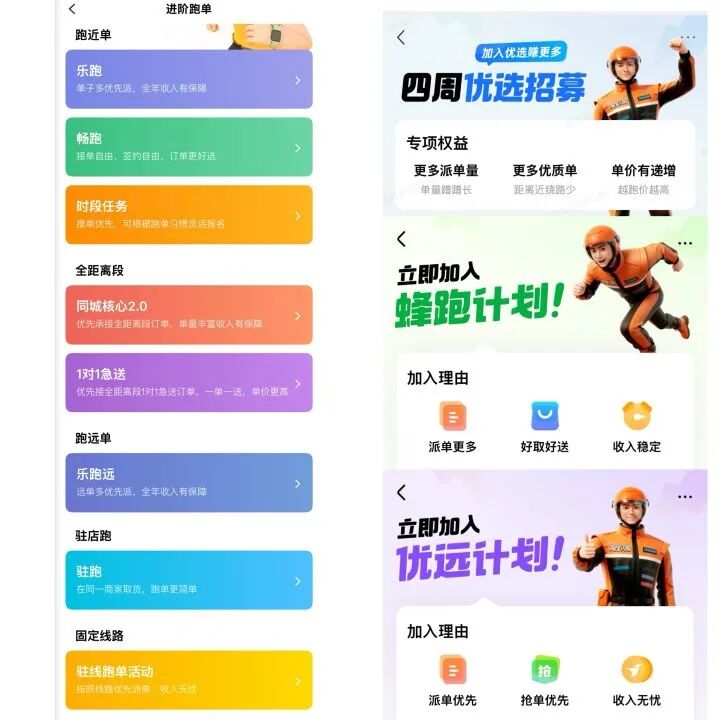
Different advanced order-taking modes of Meituan Crowdsourcing (left) and Hummingbird Crowdsourcing (right). Image source: App screenshot
The large number of riders is only one aspect. The complex delivery capacity line settings of the platforms also make some crowdsourcing riders not adapt well.
As the food delivery industry moves towards refined operation, order types are also constantly differentiated. According to the length of distance, whether it is goods or meals, and the size of weight, different orders have different requirements for the labor and time of riders. In order to adapt to different scenarios, major platforms have differentiated a variety of advanced crowdsourcing order-taking modes (i.e. different delivery capacity lines): the "Meituan Crowdsourcing" platform has Le Pao, Chang Pao, etc., and the "Hummingbird Crowdsourcing" platform has You Xuan, Feng Pao, etc. Each mode corresponds to different unit prices for different distances, order dispatching priorities and working hour requirements. The system will filter orders in layers.
NBD reporter saw in the "Meituan Crowdsourcing" App that both Le Pao and Chang Pao focus on "taking short-distance orders". The introduction of Le Pao prompts "more orders will be dispatched to you first", while Chang Pao emphasizes "easier orders to deliver" and "more efficient and short-distance orders". In the eyes of the interviewed riders, the easier-to-deliver orders refer to orders with smooth pickup and delivery (easy to find buildings, no need to climb stairs) and combined orders along the way (multiple orders are picked up and delivered at the same time with close routes), and these "good orders" often have lower unit prices.
However, some riders also admitted that if the unit prices are the same, there will be a situation where no one is willing to take orders with long distances and heavy weights, and these orders may eventually be snatched by new riders who do not know the situation. For those new riders who have just joined the food delivery rider team, this is also unfair.
When Xiao Lin, who is dissatisfied with the few good orders of "Le Pao", was asked why he didn't join the Chang Pao plan with "easier orders to deliver", he laughed and said that it was for people who love to "involution". Xiao Lin explained that the unit price of "Le Pao" is relatively higher, reaching 5-6 yuan per order, while for Chang Pao orders with lower unit prices, riders need to rely on "volume" to earn the same income. "They can run more than 100 orders a day, that's how they involute."
According to this standard, Wang Ping is the rider in Xiao Lin's eyes who loves to "involution". A person in charge of a Taobao Flash Purchase Rider Station revealed to NBD reporter that You Xuan and Feng Pao are currently the main food delivery capacity lines of Taobao Flash Purchase. "You Xuan is responsible for orders of 3 kilometers for meal pickup, and Feng Pao's orders are even closer." Wang Ping worked in "You Xuan" for several years, but finally chose to leave: "There are few orders in You Xuan, and once you rest, you will rest for an hour or two." Although the unit price of Feng Pao is lower, at least "the number of orders is guaranteed, and you can make small profits but quick turnover".
Many riders will also mention "chaotic order dispatching" - for example, the platform will push orders that require picking up meals to the north and delivering meals to the south, or several orders in completely different directions are crowded together, resulting in the rider's delivery being overtime. A rider pointed to an order pushed by the background and explained to the reporter: this order is 1.8 kilometers away, needs to be delivered within 25 minutes, and with subsidies, it is only 4.3 yuan. The platform did not push any other orders along the way. If you take this order, it is one-to-one dedicated delivery. "The price is so cheap, it doesn't make sense to take this kind of order. Now there are no good orders to deliver, and orders scattered in different directions are very easy to be delivered overtime."
Regarding the problem of delivery capacity line differences complained by riders, Chen Liteng believes that this is a dual strategy of the platform's refined delivery capacity control and reducing labor costs. Through the layered mode, the platform locks stable delivery capacity and fills the delivery capacity gap, while using layered competition to lower the overall delivery unit price.
NBD reporter also sent an interview outline to relevant platforms on the issues of platform delivery capacity line settings and order dispatching logic. Industry analysts said that the adjustment of delivery capacity line settings "cannot only look at the unit price", but should look at the actual income level of riders in the same period of time. "The income will not fall; on the contrary, the better riders will have higher income", and the overall direction is tilted to riders who run orders stably for a long time. As of press time, Meituan and Taobao Flash Purchase have not responded to relevant issues.
The reporter noticed that Meituan emphasized in its publicly released algorithm description in May this year that it adheres to fair, reasonable and non-discriminatory order dispatching, stating that "when dispatching orders, it will refer to the rider's degree of following the route and the probability of overtime, and will not differentiate order dispatching based on factors such as the rider's gender, age, and delivery unit price".
The 2025 "Ele.me" Platform Online Delivery Algorithm and Labor Rules Agreement signed in September last year clearly states that for crowdsourcing online delivery personnel, the pricing algorithm model will combine local CPI (Consumer Price Index) levels, local average hourly wages of blue-collar industries and other factors to ensure that the hourly labor remuneration (including subsidies, activities, etc.) under normal labor conditions is not lower than the local minimum hourly wage standard.
Under the governance of "anti-involution", front-line changes still take time
No matter how the algorithm is designed, the feelings of crowdsourcing riders this summer are almost the same: the number of orders is less, the unit price has fallen, and in order to fill the income gap, they can only work harder with longer working hours and more order volume like Wang Ping.
Nowadays, Wang Ping goes out at 6 a.m. every day, and has to deliver more than 100 orders to earn 400 to 500 yuan, and finishes work after 10 p.m. Even though he is already "involuted enough" in the eyes of his peers, he can't help but sigh: "Brothers are all scrambling for orders, and take any order as soon as it comes out."
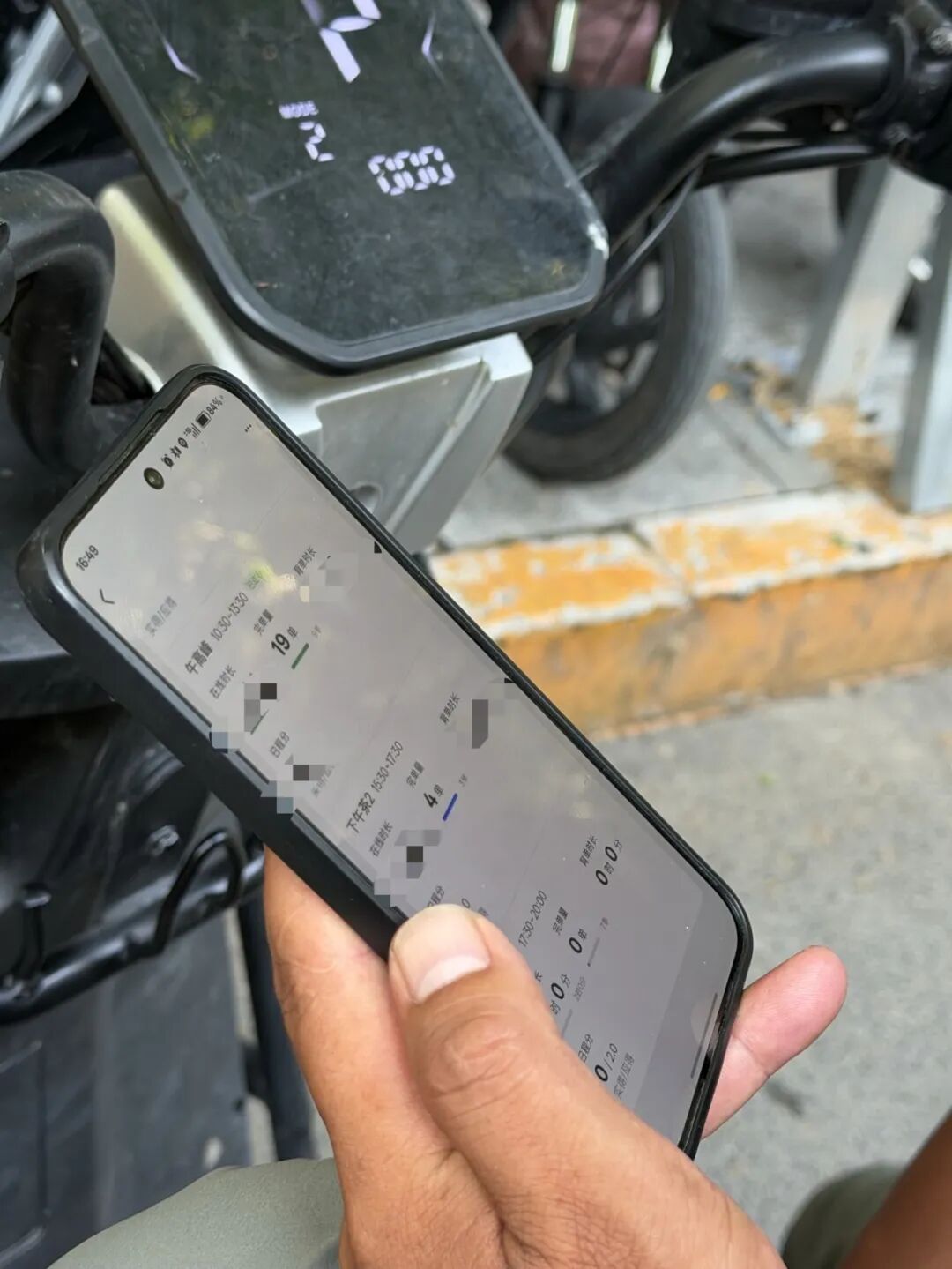
A rider shows the order receiving background to NBD reporter. Photo by Zheng Xinwei, NBD reporter
"Involution" is the deepest feeling of many interviewed riders. Rider Li Xi (pseudonym) is also running "Feng Pao". "Last summer, running from 8 a.m. to 10 p.m., I could earn 400 to 500 yuan at least, and 600 to 700 yuan at most. Now it's hard to earn 300 yuan."
"Some people run 17 or 18 hours a day. Several people I know don't even rent a house, and just find a random place to sleep." Li Xi pointed to a nearby office building and told NBD reporter that two or three riders would sleep in that building at night.
While riders are sighing about "involution", the "anti-involution" actions at the regulatory level have actually been promoted. The supervision of the "involution-style" platform competition behind the food delivery war has long moved from "calling out" to "setting rules": from the release and implementation of the recommended national standard Basic Requirements for Food Delivery Platform Service Management at the end of 2025, to the release of the Ten Rules for Food Delivery Platform Subsidy Behavior (Public Draft for Comments) in July 2026, the protection of riders' rights and interests is an important part. Meituan, JD Food Delivery, and Taobao Flash Purchase have also issued statements many times to support policy supervision and protect the rights and interests of delivery personnel, consumers and merchants.
Chen Liteng believes that the crux of riders' feeling of "involution" is: riders belong to flexible employment, there is no standardized salary and rights protection system, the core driving force of industry involution - the price suppression caused by excess delivery capacity competition - has not been effectively constrained;