Automakers are no match for battery manufacturers.
On July 28, the 2026 Fortune Global 500 list was officially unveiled. In this year's list, a total of 35 vehicles and parts companies worldwide have been successfully shortlisted, covering the entire industrial chain fields such as complete vehicle manufacturing and core components.
Meanwhile, China's automotive industry has delivered an impressive performance on this globally authoritative list. A total of 10 Chinese automakers and parts enterprises have made it to the Fortune Global 500, ranking firmly among the top globally, demonstrating the solid strength of the large-scale rise of China's automotive industry.
Among them, BYD ranks the highest among Chinese automakers, at 91st, keeping the same position as last year, firmly taking the first place among Chinese automakers and being the only Chinese carmaker that breaks into the top 100; CATL has maintained a strong momentum of growth, jumping 43 places year-on-year to rank 260th, achieving a leapfrog rise that demonstrates the absolute advantage of Chinese enterprises in the power battery track.
Overall, the 10 shortlisted Chinese automakers and parts enterprises cover all aspects of the automotive industrial chain, ranging from traditional complete vehicle manufacturers, new energy vehicle enterprises to core component suppliers, forming a preliminary complete industrial matrix.
This also proves that the Chinese automotive industry has achieved a substantial leap in industry competitiveness, industrial discourse power and brand influence in the global market.
10 China-related Automotive Enterprises Shortlisted
As is known to all, the ranking of the Fortune Global 500 is based on the total revenue of enterprises in the previous fiscal year, which corresponds to the market scale and industry volume of the enterprises. The 10 shortlisted China-related automotive enterprises show obvious hierarchical revenue performance, with leading new energy enterprises and traditional leading automakers each having their own highlights, while the competition situation and transformation rhythm differences between Chinese and foreign automakers are clearly highlighted.
Among them, BYD still remains the highest-ranked Chinese automaker.
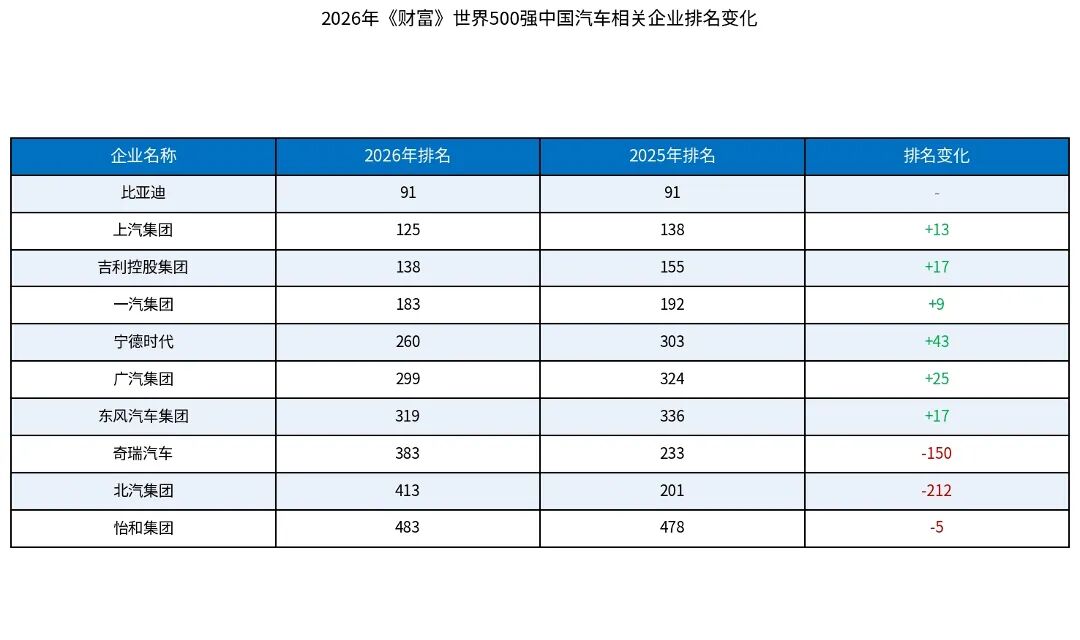
In 2025, its operating revenue reached 111.853 billion US dollars, taking a leading position in revenue scale among all shortlisted global vehicles and parts enterprises. In 2025, BYD sold 4.602 million new energy vehicles throughout the year, with huge growth in overseas markets: its annual export volume hit 1.05 million units, a year-on-year increase of 145%, and the proportion of overseas revenue rose to 38.6%.
At the same time, traditional leading automakers have maintained steady operation.
SAIC Motor ranks 125th. As a time-honored domestic complete vehicle giant, it maintains a stable revenue scale relying on its sound production and sales system as well as dual layout of joint ventures and self-owned brands; Geely Holding Group ranks 138th, steadily promoting the transformation from traditional fuel vehicles to new energy vehicles with its global M&A layout and diversified product matrix, and its market-oriented risk resistance capability continues to improve.
Newly shortlisted Chery Automobile has achieved a breakthrough. In 2025, Chery Automobile participated in the ranking for the first time as a listed entity, ranking 383rd and becoming the only newly shortlisted enterprise in China's mainland automotive sector this year. In the same year, Chery Automobile's revenue reached 41.778 billion US dollars.
Different from complete vehicle enterprises, CATL has taken a unique growth path. Although its total revenue scale is lower than that of leading complete vehicle automakers, its profitability is far ahead. As the global leading power battery enterprise that is deeply embedded in the supply chain of global new energy automakers, its sharp rise in ranking is backed by the continuous improvement of global market share and the continuous consolidation of technical barriers.
It is worth mentioning that Tesla, which used to be the global new energy leader, suffered its first annual revenue decline in history in 2025, with its annual vehicle delivery volume dropping year-on-year for two consecutive years, and finally failed to enter the top 100 of this year's list.
Currently, under the pressure of underperforming results, Tesla is accelerating its strategic transformation: it has stopped production of Model S and Model X, shifted its production capacity to the Optimus robot project, and plans to launch the Cybercab self-driving taxi, making all-out efforts to sprint into the new AI intelligent mobility track.
In addition, traditional global giants still occupy high positions on the list.
Volkswagen of Germany ranks 13th, retaining the title of the world's largest automaker for four consecutive years, and Toyota ranks 14th. European, American, Japanese and South Korean automakers including Ford, General Motors, Stellantis, BMW, Mercedes-Benz, Honda and Hyundai all rank in the top 100 of the list. The pattern of the global leading automotive camp is stable, but most of these giants have shown signs of sluggish growth, and the pressure of industrial iteration has become prominent.
Automakers Are Less Profitable Than Battery Manufacturers
For a long time, the market generally believes that the domestic automotive industry has thin profits and automakers face great difficulties in making profits.
However, according to the full data of the 2026 Fortune Global 500, low profitability is a common problem for the global automotive industry, not unique to Chinese automakers. Meanwhile, the profitability of the automotive industry also shows characteristics of differentiation across the industrial chain.
Specifically, the 35 shortlisted global vehicles and parts enterprises belong to one of the five core pillar industries on the list, which together with finance, energy, technology and medical industries support the core volume of the list, accounting for 61% of the total number of shortlisted enterprises and 66% of the total revenue, with extremely high industrial weight.
However, the overall profitability of this industry is relatively low, with a global average return on sales of only 1.7%, which is a typical industry with large revenue but low profit.
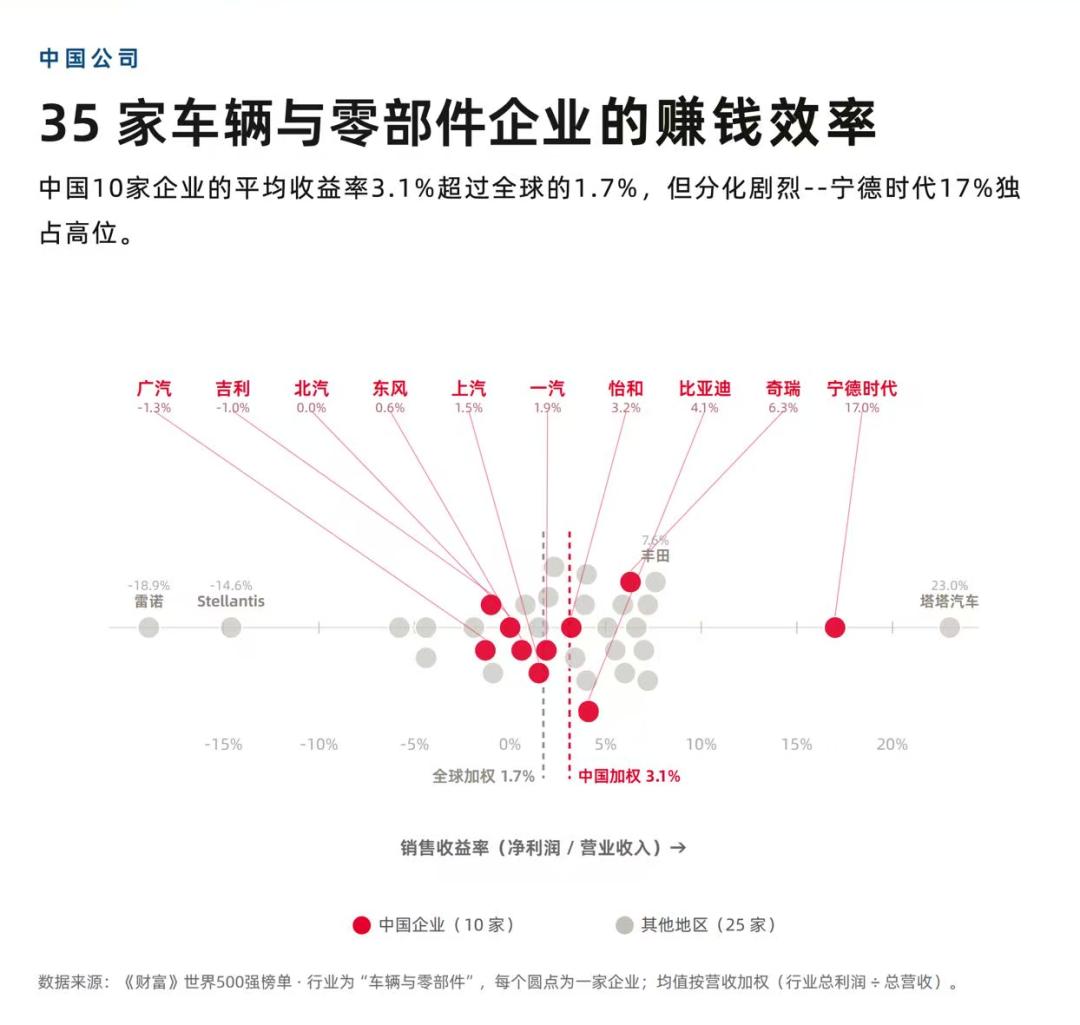
Looking at the overall profitability of the 10 shortlisted Chinese automakers, it is better than the global average, with an average return rate of 3.1%, leading the global industry average. However, the internal differentiation is extremely drastic, and the profit dividend is highly concentrated in the upstream core component enterprises.
Among them, CATL leads the list with an ultra-high return rate of 17.0%, which is more than 11 times the profitability of Chinese shortlisted complete vehicle enterprises, and it is also among the top 50 companies with the highest return on equity worldwide.
After excluding the return rates of CATL and Jardine Matheson, the average return rate of the remaining 8 Chinese complete vehicle manufacturing enterprises is only 1.5%, slightly lower than the global industry average of 1.7%.
Specifically, there is a huge gap in the profitability tiers of complete vehicle enterprises: the return rates of Chery and BYD reach 6.3% and 4.1% respectively; the return rates of SAIC, FAW and Dongfeng are all lower than 2%; BAIC's return rate drops to zero, while GAC and Geely are even in loss. This clearly reflects the industry status that the profitability of the upstream new energy component track is far better than that of the downstream complete vehicle manufacturing track.
Meanwhile, from a global perspective, the profitability dilemma of leading automakers is also very obvious.
Among the world's top 10 automakers, only BMW and Hyundai have achieved profit growth, while the rest have all seen profit decline. For example, Volkswagen's revenue rose slightly by 3.4%, but its profit plummeted by 32.7%; Toyota's revenue increased by 6.7%, but its profit dropped by 18.3%. General Motors and Mercedes-Benz saw both revenue and profit decline: General Motors' profit plummeted by 55.1%, and Mercedes-Benz's profit dropped by 47.5%.
In addition, the loss-making situation of the industry is further expanding.
This year, more than 30 shortlisted enterprises worldwide are loss-making, and the automotive industry is the hardest-hit area. Europe's Stellantis Group ranks first on the loss list with a loss of more than 25.2 billion US dollars; Ford suffered a loss of 8.182 billion US dollars, with a year-on-year profit decline of 239.2%; Honda's loss reached 2.813 billion US dollars, down 151.3% year-on-year; Tesla saw both revenue and profit decline, with the decline rate reaching 2.9% and 46.5% respectively.
Therefore, on the whole, although the average return rate of 1.5% for Chinese complete vehicle enterprises is very low, it is basically in line with the global industry average of 1.7%, with no obvious disadvantage gap. This means that the current global automotive industry is in a painful period of electrification and intelligent transformation, and all automakers are bearing the profitability pressure brought by technological iteration and intensifying market competition.
This article is from the WeChat Official Account "Auto Community" (ID: iAUTO2010), written by Li Sijia, and published with authorization from 36Kr.