The 9.9-yuan body fat scale hides the way forward for internet healthcare.
China's weight loss market is ushering in an unprecedented critical inflection point.
Previously, relying on the online prescription drug sales of GLP-1 class drugs, internet medical platforms achieved rapid growth. Alibaba, JD, and Meituan competed to launch weight-loss injections first, and the complete closed loop of prescription + cold chain + electronic prescription allowed the platforms to reap substantial profits.
However, on May 15, 2026, the revised *Regulations for the Implementation of the Drug Administration Law of the People's Republic of China* (State Council Decree No. 828) was officially implemented. Except for injectable hypoglycemic drugs, the path of directly selling GLP-1 injections online on e-commerce platforms as "weight-loss drugs" has been completely blocked.
Alibaba and JD have abandoned the pure drug-selling logic and turned to the traffic operation mode of hardware subsidies + weight management check-ins; digital weight management has become the new main line of the weight loss track for internet medical platforms. However, the two core problems of prescription compliance and long-term drug safety still restrict the long-term commercialization of the industry.
01 GLP-1 Online Channels Once Saw Explosive Growth
According to the data from *World Obesity Atlas 2025*, the overweight/obesity rate of Chinese adults has exceeded 50%, and it is estimated that the number of related people will reach 515 million by 2030. When a drug that requires only one injection per week and has clear weight loss effects appears, the demand is rapidly ignited.
Novo Nordisk's 2025 financial report shows that the global sales of all semaglutide products are about 228.288 billion Danish kroner, and the sales in China are about 6.815 billion Danish kroner; among them, the sales brought by the weight loss indication in China reached 796 million Danish kroner, a year-on-year increase of more than three times.
According to the calculation of CITIC Securities, the market size of China's GLP-1 weight loss drugs reached 14.3-15.5 billion yuan in 2025, and will exceed 38 billion yuan by 2030, of which obese people contribute more than 60% of the share.
Both the hit GLP-1 weight loss drugs and various online channels have experienced explosive growth.
In November 2024, the weight-loss version of semaglutide (Novo Ying) of Novo Nordisk was officially launched in China, and the Ali Health Medical Service flagship store immediately launched a reservation service with prices ranging from 1,680 yuan to 2,706 yuan;
On the evening of December 23, 2024, Eli Lilly's tirzepatide was launched for a limited time on Meituan, selling out in 3 seconds on the first night, and the number of reservations increased by more than three times day-on-day;
In February 2025, Yinno Pharmaceutical's exupatide α (Yinuoqing) was simultaneously launched on all online and offline channels of Ali Health Pharmacy and JD Health.
In July 2025, Innovent Biologics's margetitide (Xinerme) was first launched on Ali Health, becoming one of the fastest-growing GLP-1 products.
In April 2026, Senxu Biotech's ecnoglutide (Xianweiying) opened reservations on Ali Health.
In May 2026, Ark Healthcare reached a strategic cooperation with Teru Pharmaceutical, and the innovative GLP-1 drug Paidakang (Vapeptide Injection) will be launched for the first time across the whole network on the Ark Internet Hospital platform.
After several years, GLP-1 drugs have brought substantial profit growth to internet medical platforms.
During the 618 shopping festival in 2025, the sales volume of GLP-1 drugs on JD Health increased by more than 3% year-on-year; during the Double 11 shopping festival, GLP-1 "weight loss injection" became a phenomenal hit product after beauty and home appliances. JD Health's total revenue in 2025 reached 73.4 billion yuan, a year-on-year increase of 26.3%, and the net profit margin rose to 8.9%, setting a new all-time high for the company.
Ali Health's revenue in fiscal year 2025 was 30.6 billion yuan, and its revenue in the first half of fiscal year 2026 was 16.697 billion yuan, a year-on-year increase of 17%, and the net profit was 1.266 billion yuan, a year-on-year increase of 64.7%.
The order volume of GLP-1 drugs on Meituan Medicine platform has reached 2 million since 2023, of which the order volume of Eli Lilly's tirzepatide has exceeded 500,000 since its launch at the end of 2024; in August 2025, the monthly sales of GLP-1 exceeded 200,000 orders, with the order volume increasing by 25% month-on-month.
The interaction between platforms and pharmaceutical companies is also deepening continuously.
JD Health has reached strategic cooperation with GLP-1 pharmaceutical companies such as Novo Nordisk and Eli Lilly. Relying on 20 national pharmaceutical cold chain warehouses and a drug transportation network covering more than 400 cities, it realizes the fastest 2-hour direct cold chain delivery of drugs in first-tier cities, integrates B2C e-commerce, O2O instant retail and offline self-operated pharmacy resources, and builds a full-link closed-loop service of "medical treatment + testing + diagnosis + drug".
Ali Health has reached first-launch cooperation with Huadong Medicine, Yinno Pharmaceutical, Innovent Biologics, etc., and the Tmall Health platform serves more than 56,000 merchants.
Meituan Medicine launched the "full refund if no weight loss" service, promising to give refund compensation if users do not lose weight after using semaglutide or tirzepatide, and the maximum compensation is increased to 1000 yuan.
Behind these figures is a fully operational closed loop: online consultation → electronic prescription → platform cold chain drug delivery.
However, as an injectable prescription drug, supervision has always been the Sword of Damocles hanging over the online sale of GLP-1 drugs. Internet medical platforms have long wandered on the edge of compliance, relying on the convenience of electronic prescriptions to turn weight loss drugs into hit consumer products.
This also laid the groundwork for the subsequent tightening of supervision.
02 New Regulatory Policies Implemented, Online Drug Selling Business Came to an Abrupt Halt
On May 15, 2026, the newly revised *Regulations for the Implementation of the Drug Administration Law of the People's Republic of China* (State Council Decree No. 828) was officially implemented. This is the first comprehensive revision of the regulation in 23 years, which has drawn a clearer boundary for online drug sales.
The core clause is Article 46: drugs under special control such as vaccines, blood products, narcotic drugs, and psychotropic drugs shall not be sold online; other drugs with high medication risks shall not be retailed online. According to the implementation rules subsequently issued by the National Medical Products Administration, injectable drugs (except hypoglycemic drugs) are clearly included in the list of prohibited online retail.
In other words, GLP-1 weight loss injections such as semaglutide, tirzepatide, and margetitide can no longer be directly sold on e-commerce platforms as "weight loss drugs" in the legal sense.
When consumers buy drugs in offline pharmacies, they must hold a valid paper prescription issued by a physical hospital, and a licensed pharmacist needs to conduct a second review. The authority of internet hospitals to issue electronic prescriptions is also cut off synchronously.
This means that the channel for users to complete the whole process of "online consultation → instant prescription issuance → drug purchase on the platform" on their mobile phones has been blocked.
The purpose of this supervision is clear: weight loss drugs are not consumer goods, they are prescription drugs.
The right to prescribe should remain in physical hospitals, and online channels cannot become a convenient way to bypass clinical evaluation.
The consumerization of weight loss prescription drugs and the drug safety risks brought by the lack of clinical evaluation in the whole process are the core background of the tightening of supervision.
When a hypoglycemic drug is widely used for weight loss in healthy people, and when an online consultation can issue a prescription in a few minutes, the potential risks are systematically underestimated — this is exactly what "Decree No. 828" aims to correct.
The most popular drug selling business of internet medical platforms came to an abrupt halt.
The original monetization path of "consultation — prescription — drug purchase" has been standardized for compliance, and the growth engine brought by pure drug sales can no longer operate normally. But the real demand of the weight loss market has not disappeared.
03 National Weight Loss Campaign, Seize User Entry
Internet giants did not quit. Less than two months after the new policy, two weight loss campaigns quickly became popular, and pushed body fat scales to the hot search list.
The "Scientific Weight Loss for 50 Million Kilograms" action launched by Ant Group's A Fu on June 22: users can get a smart body fat scale worth nearly 100 yuan by paying 9.9 yuan for express delivery; after connecting the hardware, the AI personal trainer generates a personalized weight loss plan based on the diet and exercise data input by users, with 7 top three hospital weight loss doctors' AI avatars as professional endorsement; users can get honor incentives by participating in check-ins. As of July 12, more than 808,000 people across the country have used the scale, with a total weight loss of 590,000 kilograms.
The third phase of "Weight Loss Is Easy" launched by JD Health on July 13: there is no restriction on the brand and model of body fat scale, which can be connected via Bluetooth, users without a scale can get a scale for 0.01 yuan by inviting new users, and the photo weight recognition function will be launched on July 16; new users are provided with free dynamic blood glucose monitors; step-by-step cash rewards are set, 200 yuan for losing 2.5kg in 21 days, 500 yuan for losing 4kg in 35 days, 1000 yuan for losing 5kg in 56 days, and a "redeemable bonus pool" is set, where the bonus of team members who fail to check in will be transferred to the pool. It only took 3 days for the number of applicants to exceed 3 million, driving the JD Health App to top the free overall list of Apple App Store, refreshing the platform's highest ranking record ever.
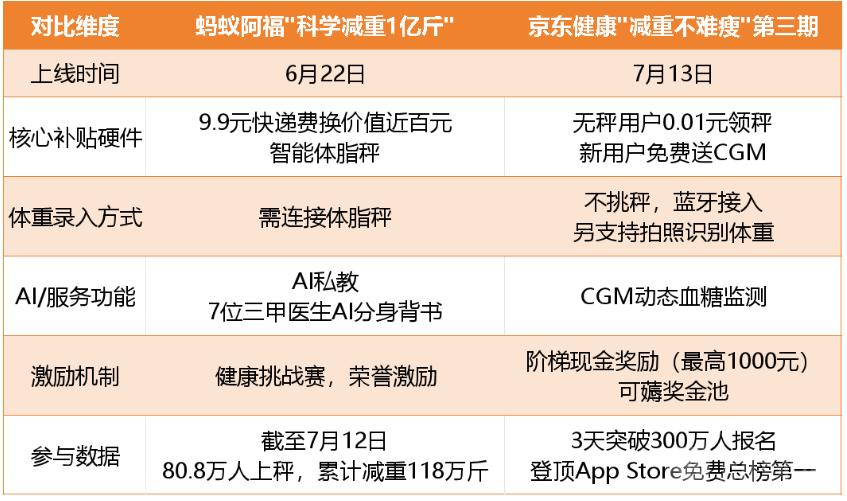
Ant A Fu and JD Health launched weight loss marketing activities respectively, data source: organized by vcbeat based on public information
The production lines of body fat scale factories began to operate 24 hours a day, and workers packed six to seven thousand packages every day but still could not keep up with the order speed, and the delivery cycle was repeatedly extended.
The topic of users taking body fat scales on business trips became a hot search, and weighing and checking in became an obsession that many weight loss people could not interrupt, so body fat scales were promoted to a status equivalent to that of computers.
Driven by the call of the huge bonus pool, nearly 5 million people gathered instantly and stood on the body fat scale.
This scene is very similar to Alipay during the Spring Festival Five-Fortune Collection period, and WeChat Pay when grabbing red envelopes in group chats.
Although the two platforms have different strategies, their underlying logic is basically the same, that is, abandoning the previous idea of simply selling drugs and adopting the classic internet traffic thinking: hardware (body fat scale / CGM) seizes the entry of physiological data and precipitates long-term user assets; AI weight loss services undertake users' daily weight management needs; abandon short-term drug transactions and extend the user life cycle.
This is in the same line as the customer acquisition logic of Pinduoduo's billions of subsidies, Didi Chuxing's subsidies, and Meituan Waimai's red envelopes, which is to gather people first, then retain them, and finally realize monetization.
04 New Opportunities and Internal Shortcomings
When users and data are in the hands of the platform, the commercial closed loop of the weight loss market has more possibilities.
In terms of hardware, body fat scales and CGM are not one-time consumer goods. Users' continuous weighing and continuous blood glucose monitoring mean that the hardware can be purchased, upgraded, and bound repeatedly, which essentially locks users in the hardware ecosystem.
In terms of health service monetization, AI personal trainers, diet plans, exercise suggestions and other services can be charged for themselves, and more importantly, they can turn users from "passive weight loss" to "active management", extending the user's life cycle on the platform.
Offline hospital prescription diversion is the most critical link — the prescriptions for weight loss drugs will eventually flow out of hospitals. What the platform needs to do is to circle users in advance before the prescriptions flow out, build stickiness, and undertake conversion when the prescriptions flow back.
Under the internet ecosystem, pharmaceutical companies, internet medical platforms, and hospitals are beginning to form closer cooperation.
Pharmaceutical companies cooperate with internet platforms to do brand exposure and patient education, helping users establish accurate awareness of weight loss needs and GLP-1 drugs; internet platforms cooperate with hospitals to open up the full path from weighing to prescriptions, and then to GLP-1 drugs.
The goals of the three parties began to align: the platform wants to keep users in the APP, pharmaceutical companies want to guide users to prescriptions, and hospitals want to receive the returned prescriptions.
For a long time, the connection between the three in the weight loss market has been loose, leading to a lot of repeated construction — market education is scattered between internet platforms and hospitals, with low efficiency; patient compliance management is maintained by both pharmaceutical companies and hospitals with great efforts, but the effect is not good.
The intervention of the internet model is changing this situation.
However, the lively national weight loss marketing has not resolved the two core bottlenecks of the weight loss market.
After the online consultation and prescription issuance is restricted, the issuance of GLP-1 drug prescriptions has become a high-decision process: from appointment registration to outpatient queuing, and then to the dual process of paper prescription and pharmacist review, the convenience is greatly reduced. The significantly increased friction cost will eliminate a considerable proportion of purchase conversions. For the platform, this is an unavoidable structural threshold.
The medication problems of GLP-1 drugs themselves also need to be solved urgently.
Weight rebound after drug withdrawal is an unavoidable problem for weight loss drugs. The 4-year follow-up data of Novo Nordisk's STEP series studies show that one year after drug withdrawal, the subjects regained an average of about two-thirds of the lost weight, and the data of Eli Lilly's tirzepatide SURMOUNT series are similar.
This means that GLP-1 is not a drug that "cures" obesity, but a chronic disease management tool that requires long-term maintenance — it requires users to be psychologically and financially prepared for long-term medication.
However, the long-term safety data is still insufficient at present. GLP-1 class drugs have been widely used for weight loss indications for not a long time. Although their potential risks to pancreatitis, medullary thyroid cancer, and gallbladder disease are marked as warnings in the instructions, the large-scale long-term follow-up data in the real world are still being accumulated.
For healthy people taking a hypoglycemic drug for weight loss for a long time, the final answer to safety still needs time to be given.
In addition, check-in incentives have significant effects on short-term user growth, but once users lose their incentive motivation, whether they are willing to continue paying for hardware, AI services, and long-term health management is still an unproven commercial proposition.
05 Where the Road Leads
From the drug selling business to the traffic logic, the acceleration of the weight loss market is sudden and steep. This carnival is only a transition after all, and the final outline of the industry is gradually becoming clear.
The weight loss market is shifting from "drug retail" to full-cycle digital obesity chronic disease management, and drug sales are only one part of it, not the whole.
Future competition will expand around three dimensions:
First, physiological data assets — whoever grasps the users' continuous data of weight, blood glucose and diet will have the foundation for continuous service;
Second, AI personalized intervention system — the algorithm capability based on data determines the effectiveness of intervention