Emotional companion robots cannot stop UBTECH's share price from coming under pressure
Diversification is not a mistake, but when the core humanoid robot track is redefined by latecomers with lower costs and higher efficiency, UBTECH's "full-stack full-scenario" strategy has instead become a burden.
On July 2, 2026, an official approval from the China Securities Regulatory Commission granted Unitree Technology the official admission ticket for its STAR Market IPO. The company, founded only ten years ago, is set to become the "first humanoid robot stock" on China's A-share market with an issuance valuation of 42 billion yuan, an annual non-recurring net profit of 600 million yuan, and a gross profit margin of 60%.
In the Hong Kong stock market, UBTECH, the real "first humanoid robot stock", still sees its share price fluctuating around HK$78, lower than its issuance price of HK$90. Its market value is about HK$56 billion, equivalent to about 50 billion yuan — which seems comparable to Unitree, but its financial statements tell a different story: in 2025, it recorded revenue of 2.001 billion yuan, a net loss of 790 million yuan, and a cumulative loss of over 4.2 billion yuan in four years.
The moment Wang Xingxing, founder of Unitree Technology, strikes the gong on the STAR Market, UBTECH's investors have to face a harsh question: if Unitree is worth 42 billion yuan, how much should UBTECH be worth?
From "First Stock" to "Being Priced": UBTECH's Valuation Dilemma
In December 2023, Zhou Jian stood in front of the Hong Kong Stock Exchange with the Walker S, saying that it was "using robots to strike a new chapter in the future of humanity". At that time, UBTECH was the world's first humanoid robot enterprise to land on the capital market, and the capital market was willing to pay a premium for a story about the future.
But the story has been told year after year, and the figures are getting worse and worse.
In 2025, UBTECH delivered 1,079 full-size humanoid robots for the whole year, generating revenue of 821 million yuan, a year-on-year increase of 2203.7% — this figure looks very impressive, but on closer inspection, the base in 2024 was only 3 units. That is to say, a company founded 14 years ago with financing of over 5.7 billion yuan only sold 3 full-size humanoid robots in 2024.
The more striking comparison comes from Unitree. In 2025, Unitree Technology achieved revenue of 1.708 billion yuan, non-recurring net profit of 600 million yuan, shipments of 5,500 humanoid robots, an average unit price of about 170,000 yuan, and a gross profit margin of nearly 60%.
Put the figures of the two companies side by side:
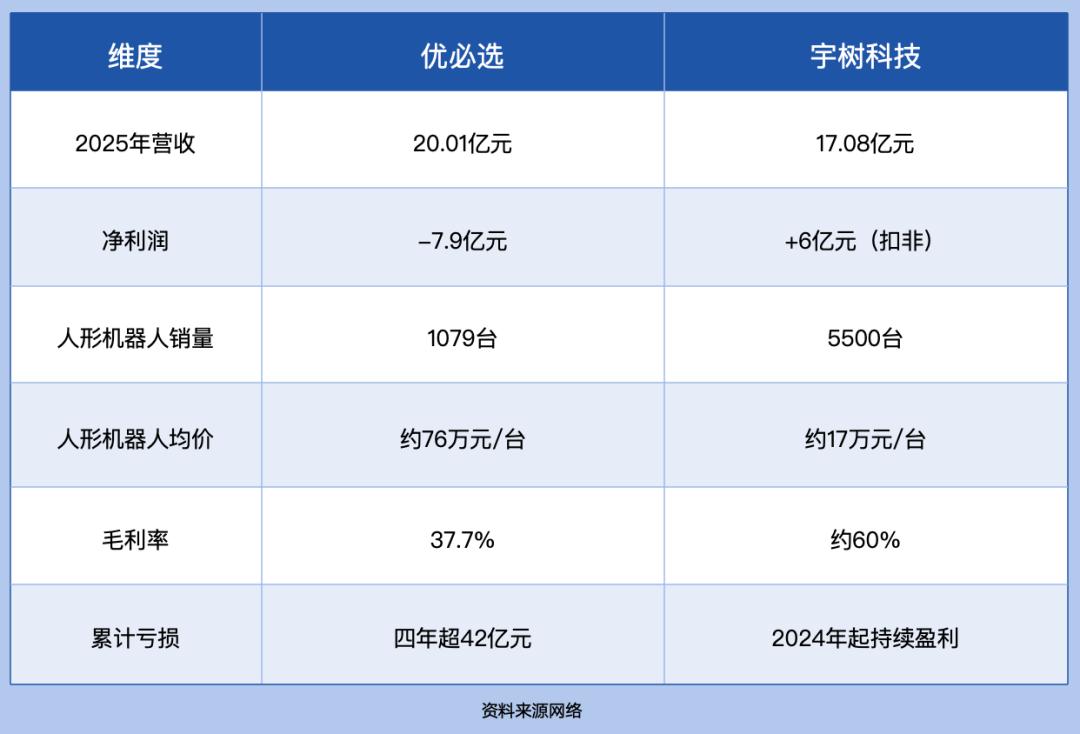
One sells at 760,000 yuan and still loses money, while the other sells at 170,000 yuan and can still make 600 million yuan. This is not a simple price war, but a fundamental divergence between two business logics.
Unitree follows the path of "extreme hardware cost reduction + open source ecosystem + large-scale volume growth". It self-develops motors, reducers and controllers, with the localization rate of core components exceeding 90%, driving the price of bipedal humanoid robots from hundreds of thousands of yuan to below 100,000 yuan. Its cost structure is extremely lean — in the first three quarters of 2025, the R&D expense ratio was only 7.7%, and the sales expense ratio was 6.5%. It hardly does any marketing promotion and operates relying on natural brand traffic and word of mouth.
UBTECH, on the other hand, is like a "do-everything" robot group. It covers educational robots, logistics robots, consumer smart hardware (litter boxes, lawn mowers, sweeping robots, pool robots), plus the Walker series of humanoid robots. In 2025, the revenue from "other smart hardware devices" was 499 million yuan, the revenue from logistics robots dropped by 16.9%, and the growth rate of educational robots was only 13.7%.
Diversification is not a mistake, but when the core humanoid robot track is redefined by latecomers with lower costs and higher efficiency, UBTECH's "full-stack full-scenario" strategy has instead become a burden.
The Paradox of Emotional Companionship: "High Praise but Low Market Adoption" Behind 13,000 Pre-orders
On June 30, 2026, UBTECH held a grand launch event in Shenzhen. Under the spotlight, a row of bionic humanoid robots with delicate skin and empty eyes walked slowly onto the stage. This is UWORLD, a brand new consumer-facing brand launched by UBTECH, and its first product, the U1 series, focuses on emotional companionship, with prices ranging from 119,800 yuan to 990,000 yuan.
After the launch event, UBTECH announced that the total pre-order volume of the U1 series across all channels exceeded 13,361 units. Estimated based on the lowest-end configuration, the theoretical revenue exceeds 1.5 billion yuan. Founder Zhou Jian devotes 50% of his energy to the home scenario, claiming that "the human-robot companionship economy is the first rigid-demand scenario in human history with unlimited emotional value and no boundaries for companionship".
But the real market reaction is far more complex than the applause at the launch event.
First, there is a serious mismatch between product functions and price. Both the U1 Lite (119,800 yuan) and the U1 Pro (169,800 yuan) are semi-fixed or fully fixed versions, which cannot walk autonomously or do housework — they cannot sweep the floor, cook, or help you pick up parcels, and their core function is just "chatting with you". Some netizens accurately summed it up as "silicone doll plus AI chatbot".
Second, the channel side is lukewarm. Reporters checked e-commerce platforms and found that only 1 unit of the related product was shown as sold in the Tmall flagship store, and there were no user reviews of the products on the official flagship store pages of both JD and Tmall. This forms a strange contrast with the grand narrative of "13,000 pre-orders".
Third, the deposit threshold is low, but the balance payment poses a huge test. The pre-order deposit for the U1 series is only 3,000 yuan, and customers can cancel their orders for a full refund at any time before July 15. Although UBTECH's management responded in a closed-door meeting that the overall order cancellation rate was less than 8%, the first batch of products will not be delivered until September 16 — during the three-month gap between pre-order and delivery, the public's disenchantment effect is gradually emerging.
The deeper contradiction lies in the question of whether the demand is real or not. China indeed has 127 million people living alone, and emotional companionship is a real pain point. But when a robot priced at 120,000 yuan can only sit by your bed and chat with you, with a battery life of only 2 to 4 hours and requiring regular maintenance, is the cost-performance ratio of this "emotional value" sufficient to support large-scale repeat purchases?
An industry analyst's comment is quite sharp: "The U1 series at the current stage is more like an early attempt to find PMF (Product-Market Fit). The high price and 10,000-unit orders indicate a certain demand base, but the annual production capacity of 6,000 units and the adjusted net loss of 690 million yuan reflect the challenges of scaling up. At this stage, it is more likely that technical feasibility testing and market education are carried out in parallel."
The reaction of the capital market is equally subtle. On the day of the launch event, UBTECH's share price once rose by more than 17%, but with the disclosure of product details, the share price quickly corrected, and fell by 9.92% the next day. Investors voted with real money: for this story, they dare not fully believe it for the time being.
Three-Way Showdown: The Route Dispute Between Unitree, UBTECH and Agibot
In 2026, China's humanoid robot track has formed a tripartite pattern. But the three companies are taking three completely different paths.
Unitree Technology: Hardware Fundamentalism
Wang Xingxing's philosophy is very simple — cut the cost down and scale up the business. Unitree's core competitiveness lies in its extreme supply chain control: it self-develops motors, reducers, and force control sensors, with the self-development rate of core components exceeding 90%, getting rid of overseas dependence. In the 2025 CCTV Spring Festival Gala, 16 H1 robots performed Yangge dance, and it won four speed championships at the World Humanoid Robot Games, with its brand influence reaching its peak.
Unitree's product matrix is clear: B series (industrial grade) and Go series (consumer grade) of quadruped robots; H1/H2 (full-size) and G1/R1 (small and medium-size) of humanoid robots. The price range covers from several thousand yuan to more than 100,000 yuan, covering multiple scenarios of scientific research, industry and consumption. Its open source ecosystem has more than 40 projects on GitHub, and the developer community is active.
But Unitree's shortcomings are also obvious: it has little accumulation in embodied intelligence large models and in-depth implementation in industrial scenarios. It is more like an "extreme hardware company" rather than a "AI + robot" platform enterprise.
UBTECH: Idealism of Full-Stack Full-Scenario
Zhou Jian's ambition is to build a "human-robot symbiosis" platform. From servo steering gears to emotional large models, from automobile factories to home living rooms, UBTECH tries to cover all scenarios. In 2025, the Walker S series has been deployed for practical training in automobile factories such as BYD, Geely, and Dongfeng Liuzhou Motor, with industrial scenario revenue accounting for more than 80%.
UBTECH's technical strength is real: it has 2,985 globally authorized patents, including 508 overseas patents; the 52-degree-of-freedom Walker S2 has a load capacity of 15kg and an autonomous battery swapping system; it has accumulated over 100 million pieces of industrial data in the automobile manufacturing scenario.
But the cost of "wanting everything" is scattered resources. In 2025, UBTECH's R&D expenses reached 507 million yuan, with an R&D expense ratio of 25.36%, far higher than Unitree's 7.73%. The high investment has not been transformed into an obvious technical generation gap, but has continuously eroded profits. What's more troublesome is accounts receivable — the balance at the end of 2025 was 1.302 billion yuan, of which the payment from government-related customers was delayed, resulting in a credit impairment loss of 151 million yuan.
Agibot: A Radical Experiment on the Data Flywheel
As one of the companies with the largest valuation in the track (about 18 billion yuan), Agibot has chosen a more "AI-native" path. It does not focus on a single hit product, but builds a complete infrastructure of "multi-robot family + data platform + simulation training + overseas channels". Its shipment volume reached 5,168 units in 2025, ranking first in the world according to Omdia data.
Agibot's strategy is "mass production first, data closed loop". It entered the A-share market indirectly by acquiring Shangwei New Materials, and in July 2026, it officially announced the launch of the Hong Kong IPO process, with strong capital operation capabilities. Its advantages lie in the integration of large models and embodied intelligence, as well as the exploration of the RaaS (Robot as a Service) business model.
But Agibot was founded only three years ago, and it still needs time to verify whether its technical accumulation and supply chain control capabilities can support its grand platform narrative.
Revaluation: Where is UBTECH's Value Anchor?
After Unitree goes public, the entire embodied intelligence track will usher in a drastic value revaluation. If UBTECH cannot give clear answers in the following dimensions, the valuation pressure will only increase.
First, the large-scale delivery capability in industrial scenarios.
This is UBTECH's most certain moat at present. In 2025, the Walker series had pending orders of nearly 1.4 billion yuan. In 2026, the S3 model will be mass-produced with a unit price starting from 180,000 yuan, and the annual shipment target is 5,000 units. If industrial humanoid robots can achieve the leap from "practical training" to "stably creating benefits" in automobile factories, UBTECH will prove that it is not just "capable of making robots", but that "robots can make profits".
But the challenge is that Unitree is also accelerating its penetration into industrial scenarios. Once Unitree sends 100,000-yuan-level humanoid robots into factories, how many customers can UBTECH's 760,000-yuan Walker retain?
Second, verification of the profit model for consumer-grade business.
The U1 series is a key leap for UBTECH to move from To B to To C. But the "emotional companionship" track is essentially selling "non-rigid luxury goods". The entry price of 119,800 yuan is already close to the price of a family car. With limited functions and unproven reputation, the real feedback, return rate and repeat purchase rate of the first batch of users will determine whether this story can continue.
A more realistic possibility is that the U1 series will become "high-end toys" and "commercial display products" in the short term, rather than a real rigid demand for families. UBTECH needs to answer — when the novelty fades, are users still willing to pay high maintenance costs for this "chatting machine that cannot do chores"?
Third, the balance between cost reduction and gross profit margin.
UBTECH's gross profit margin in 2025 was 37.7%, an increase from 28.7% in 2024, but there is still a huge gap compared with Unitree's 60%. The goal of the Walker S3 is to reduce the unit price from 760,000 yuan to 180,000 yuan, which means that the gross profit margin must be increased simultaneously to maintain profitability. This requires UBTECH to make greater breakthroughs in supply chain integration — its acquisition of 29.99% equity in Zhejiang Fenglong Electric is precisely to strengthen the independent control of core components such as servo motors.
Fourth, the narrative transformation from "story-driven" to "profit-driven".
The tolerance of the Hong Kong stock market for loss-making technology companies is declining. UBTECH's cumulative loss in four years exceeds 4.2 billion yuan. Although its adjusted EBITDA loss narrowed to 438 million yuan in 2025, it is still far from breaking even. The listing of Unitree Technology will provide a clear valuation anchor: how much PE is a profitable humanoid robot company worth? What about the unprofitable ones?
An investor's words are thought-provoking: "When there is no obvious gap in embodied intelligence technology among all players, capital capability is more important for enterprises. Even if robot companies keep making losses after listing and their product technology is not the leading in the industry, they can still maintain a market value of tens of billions of yuan with sufficient funds."
Original Title: Emotional Companion Robots Cannot Stop UBTECH's Share Price from Hitting the Bottom