The anxiety of CATL is exactly the same as that of NVIDIA.
On July 25, CATL released its interim report, kicking off the A-share interim reporting season and delivering a solid performance. In the first half of the year, it achieved total operating revenue of 2769.17 billion yuan, a year-on-year increase of 54.80%, and net profit attributable to shareholders of 432.84 billion yuan, up 41.98% year-on-year. However, it is worth noting that its gross margin has declined significantly.
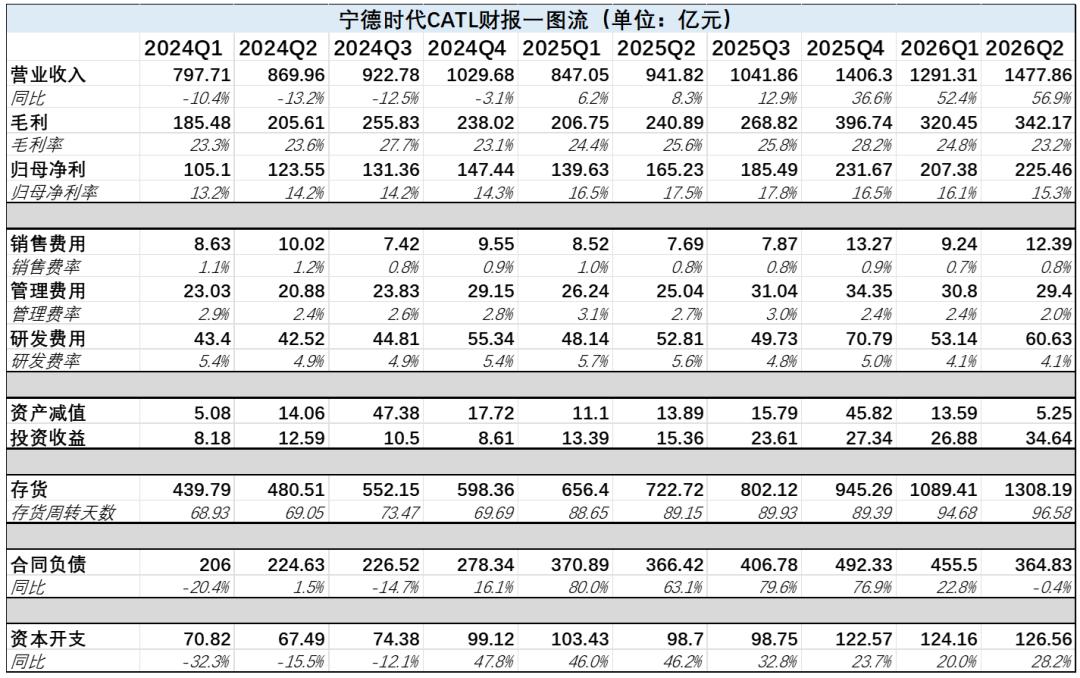
(The one-page infographic of CATL's financial report is shown in the figure, unit: 100 million yuan, source: WIND, collated by Financial Report Chronicle)
Therefore, the question we need to explore through the financial report is: under the circumstance that CATL holds a dominant position in the revenue side, why does it still choose to take the initiative to sacrifice profits rather than maximize financial returns?
On the very day when CATL released its financial report, Jensen Huang posted his first tweet on X, reposting an open letter co-signed by 25 technology companies with only one core proposition: fully support open-source AI models. Jensen Huang's logic is clear: the prosperity of open-source models can underpin the demand for computing power.
Back to CATL's interim report, we will find that the narrative logic and even investment logic of CATL and NVIDIA are exactly the same: the more prosperous the downstream ecosystem is, the better the upstream business will perform. Therefore, this symbiotic relationship forces the seemingly invincible giant to transfer part of its benefits. At the same time, in order to mitigate potential market risks brought by product generation iteration, these giants have to become "investor-friendly" companies.
Our core views are as follows:
· The revenue side performs excellently, the capacity utilization rate is nearly saturated, and both energy storage and power battery businesses deliver strong results.
· The gross margin has declined relatively obviously. Against the general background of slowing growth, CATL chooses to cut prices actively to seize market share.
· Contract liabilities have declined significantly, and the inventory of finished products shows an upward trend. In the medium term, there is certain pressure on CATL's performance expectation.
· The symbiotic relationship between CATL and the new energy industry is very prominent at this stage, so fluctuations in industry trends will be directly reflected in its financial statements. Similar to NVIDIA's logic, CATL also needs strong prosperity and fierce competition in the downstream to maintain its current position, which is the core reason why CATL chooses to transfer benefits at this moment.
Booming production and sales, CATL's position is unshakable at this stage
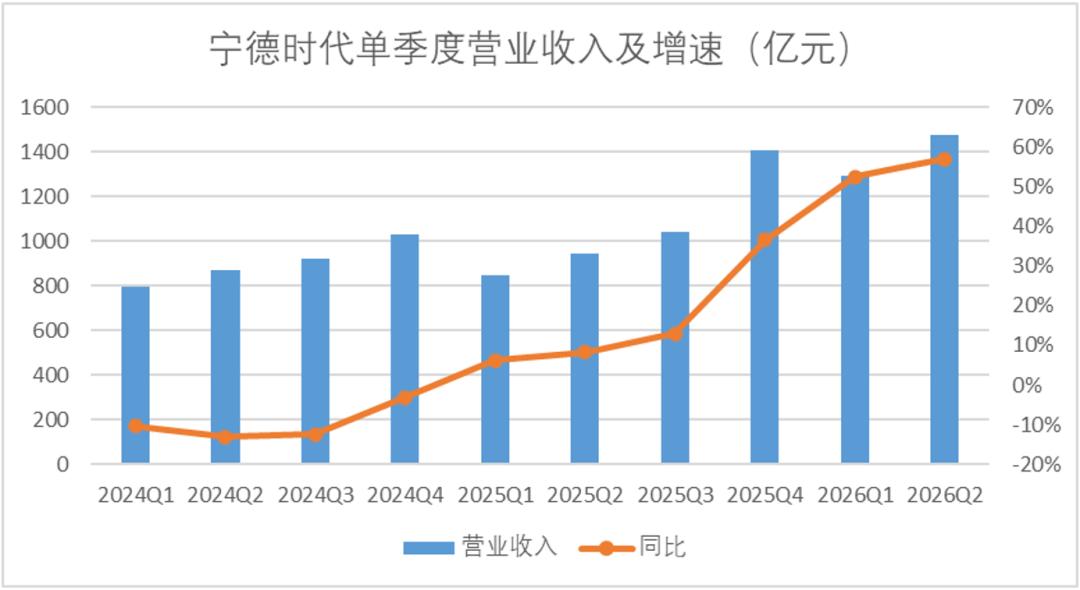
In the second quarter, CATL recorded revenue of 147.79 billion yuan, a year-on-year increase of 56.9%, which was basically in line with market expectations and hit a new single-quarter high. Both the growth rate and absolute revenue are impeccable, and the performance can be described as perfect.
In terms of production and sales, the battery output reached 498GWh and sales volume reached 434GWh in the first half of the year, both up 61% year-on-year, among which the sales of energy storage batteries surged 102% year-on-year. This is also the core change point of CATL's revenue structure this year: in the first half of this year, CATL's energy storage business reached 53.26 billion yuan, accounting for 19.2% of the total revenue, up 340 basis points year-on-year.
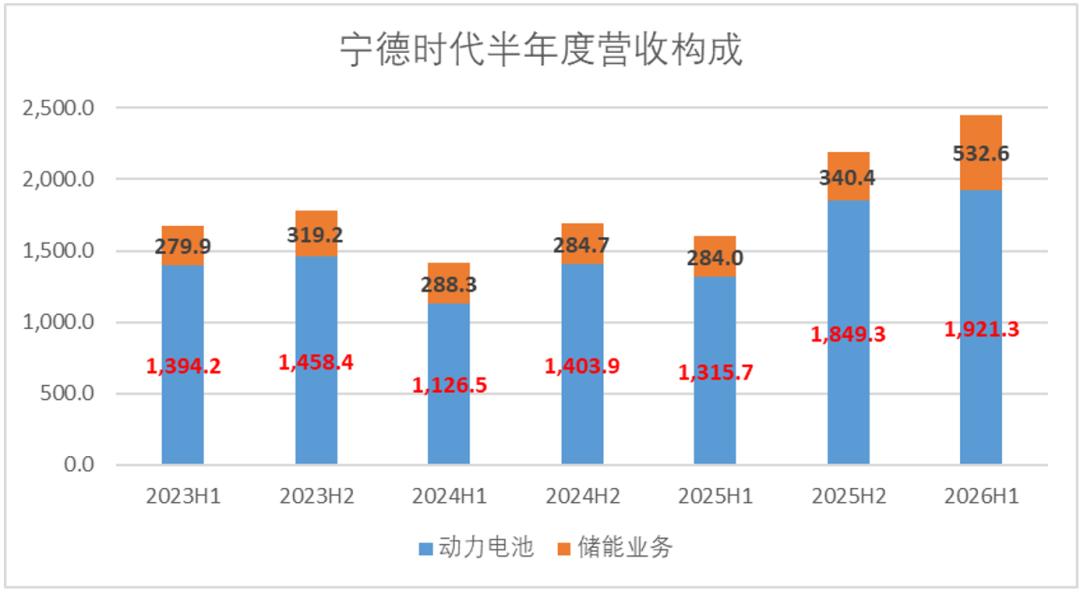
In terms of power batteries, although the new energy market has been under relatively high pressure since the beginning of this year, it has not affected CATL's performance at all. The revenue of the power battery business reached 192.1 billion yuan, a year-on-year increase of 46%. It is worth noting that the output growth rate of new energy vehicles in the first half of this year was only 6.7%.
The reason is similar to what we analyzed in the first quarter:
First, the competition pressure in the new energy vehicle market is extremely high at this stage, and automakers cannot afford abnormal fluctuations in costs, so there are a large number of contracted orders, and the temperature changes of the terminal market do not have a strong impact on CATL.
Second, since the second half of last year, newly launched models have experienced a "large battery revolution". Not only pure electric vehicles are competing for longer range, but extended-range/ plug-in hybrid vehicles are also iterating with larger batteries, which naturally leads to a significant increase in demand for power battery installation capacity.
Although automakers are also trying to reduce their dependence on CATL, from the perspective of market share, CATL's share in the domestic passenger vehicle market has risen to 47% in the first half of the year. Indeed, new energy brands cannot withstand any public opinion fluctuations at this stage, and CATL's battery products can build a firewall between product quality and brand reputation.
Active price cuts, seizing market share is CATL's top priority
Different from the booming revenue side, in the first half of this year, especially in the second quarter, CATL's profit side did not perform well. Looking at the gross margin first, CATL's overall gross profit in the second quarter was only 34.22 billion yuan, with a gross margin of only 23.2%, close to the lowest point since 2024.
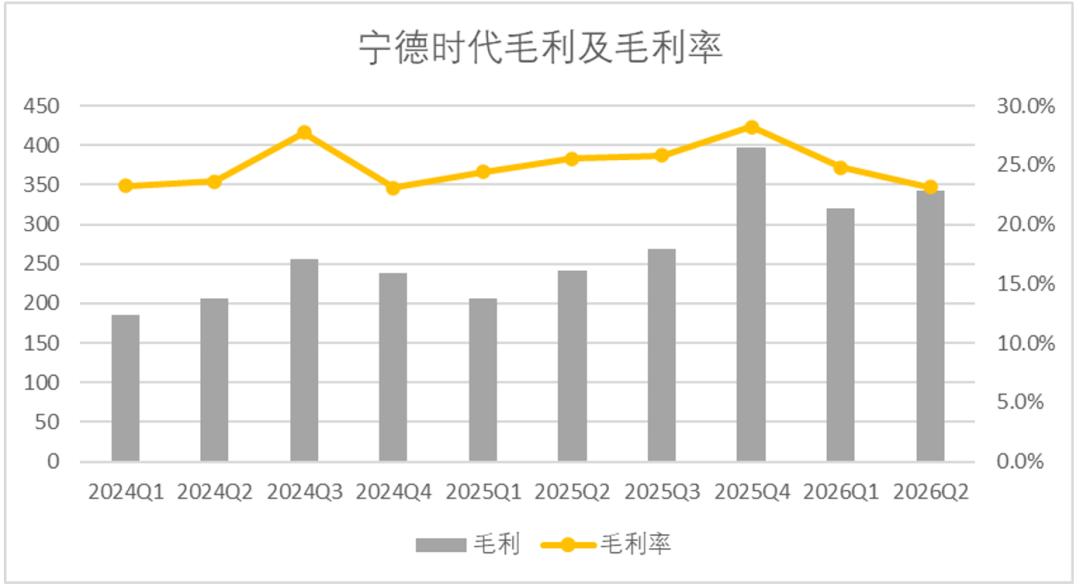
The reason for the decline in gross margin needs to be analyzed from both supply and demand sides. On the supply side, the price of lithium carbonate in the first half of 2026 soared from the low of 58,000 yuan/ton in 2025 to nearly 190,000 yuan/ton. CATL's long-term agreement price is relatively stable, but it is certainly under the pressure of price increases.
On the demand side, CATL did not pass the cost pressure on to automakers. Calculated according to the financial report disclosure, the unit price of CATL's batteries is about 0.56 yuan/Wh, which is basically the same as last year, indicating that CATL's main strategy at this stage is to maintain sales volume and cut prices, and bear part of the raw material fluctuation costs by itself to stabilize market share.
CATL is actively "blocking bullets" for downstream players.
In terms of expense control, benefiting from the rapid expansion of revenue scale, CATL's expense ratio performance has been very stable since the beginning of this year, and the total of the three expense ratios in the second quarter did not exceed 7%.
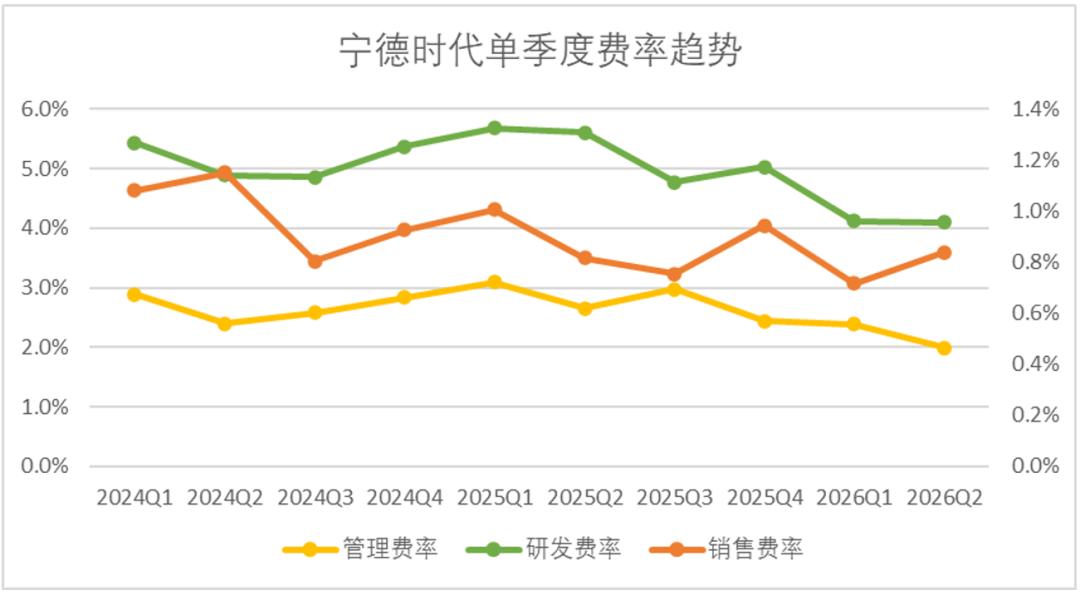
It is precisely thanks to the stability of the expense ratio that the decline of CATL's attributable profit is not large, remaining at the 15% profit line.
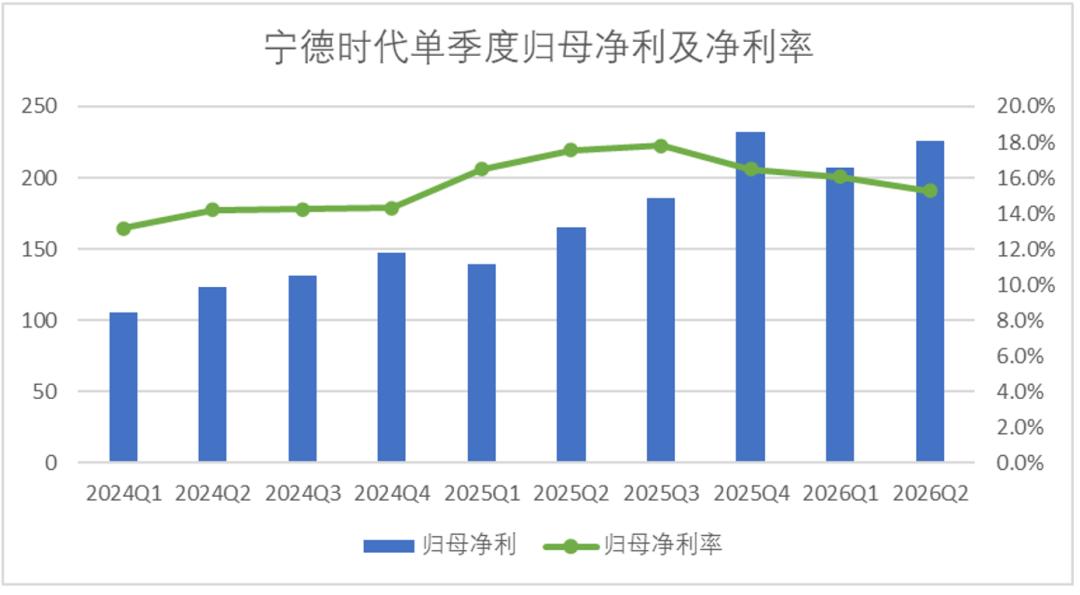
On the whole, CATL has taken a clear path in the first half of the year — exchanging gross margin for market share. The unit price of batteries barely rose in the second quarter, and the price of energy storage products even declined. CATL took part of the pressure of lithium carbonate price increases on its own and did not pass all the cost to downstream players.
The consideration behind this is not complicated. One possibility is that CATL feels the pressure from external competitors: second-tier battery manufacturers are catching up rapidly in terms of prices, and the trend of automakers developing self-owned batteries is also accelerating. CATL does not want to leave room for competitors to penetrate the market. Another possibility is that CATL wants to use this short cycle to accelerate industry clearance and squeeze weak competitors out of the market with its stronger fundamental strength.
No matter which possibility it is, maintaining market share is CATL's top priority at this stage.
Growth rate of contract liabilities declines, inventory of finished products rises significantly
If CATL's current performance seems to be flawless, we can still see the pressure it is bearing from more subtle perspectives, such as contract liabilities.
At the end of 2025, CATL's contract liability balance reached a peak of 49.2 billion yuan. At the end of the first quarter of 2026, it still remained at a high level of 45.6 billion yuan. However, by the end of June 2026, the balance of contract liabilities dropped to 36.5 billion yuan. For two consecutive quarters, the downward trend of contract liabilities is quite clear.
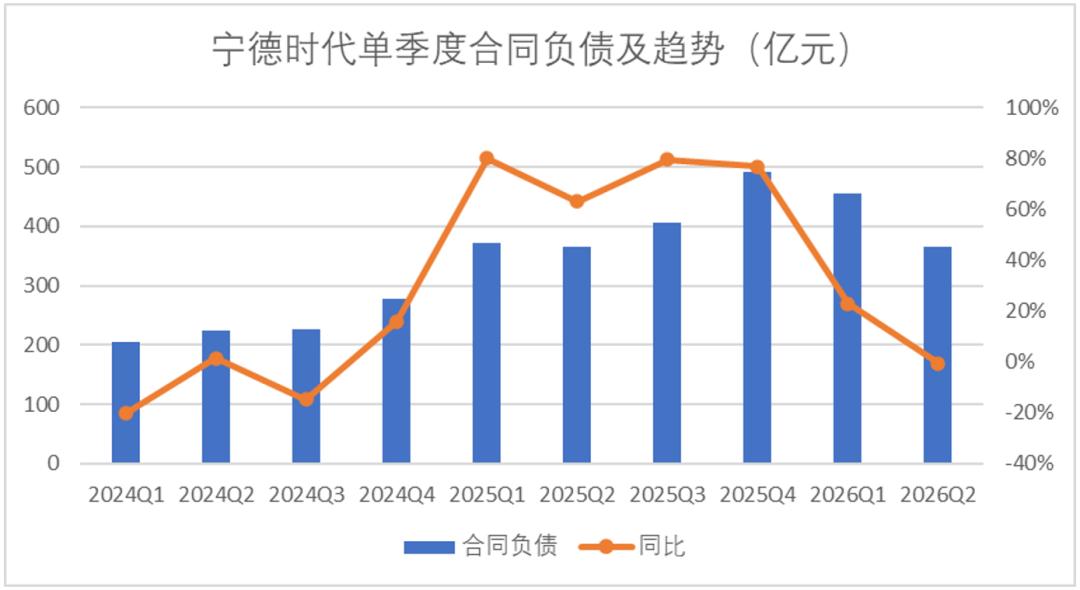
The consecutive month-on-month decline in contract liabilities mainly reflects changes in two aspects:
First, CATL's capacity utilization rate has increased significantly. According to the financial report, the capacity utilization rate at this stage can reach 95%, and the pace of capacity expansion is obvious. Since the fourth quarter of last year, CATL's capital expenditure has been at a high level, digesting part of the existing orders.
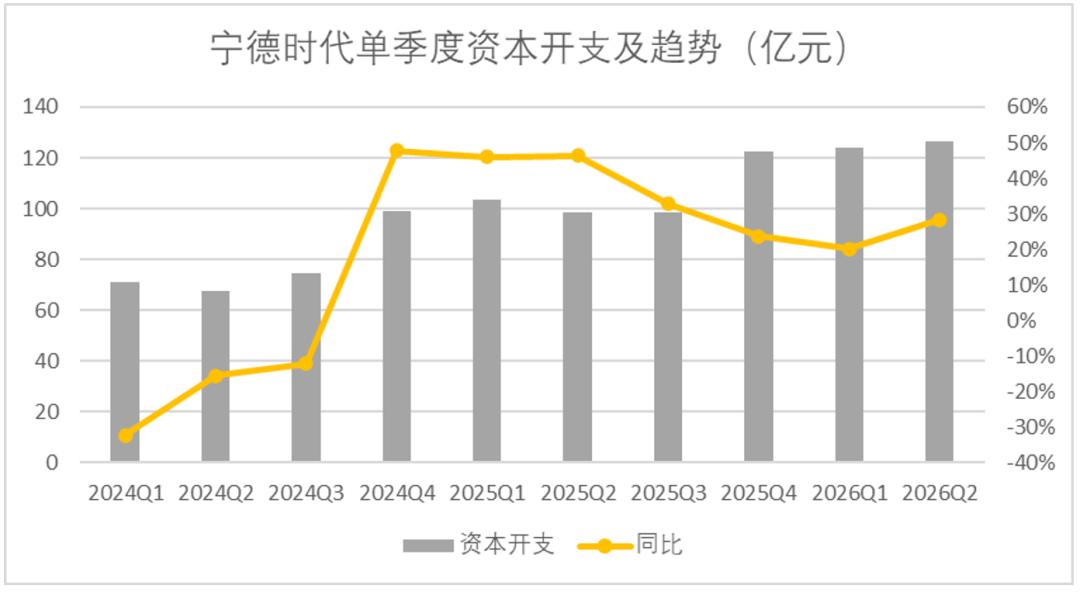
Second, the reserve of long-term orders from automakers is in a downward range. We have analyzed for many times the general background of slowing growth after the new energy market has cooled down since the beginning of this year. Coupled with the previous expectation of lithium battery price increases, automakers have maintained a high level of stockpiling, so the slowdown in the growth rate of new orders is reasonable.
For automakers, as the most important energy source and the largest cost item of vehicles, batteries, they certainly do not want to put all their eggs in one basket. For example, this year, the XPeng GX uses batteries from CALB, which has opened a gap in the market for models priced above 250,000 yuan.
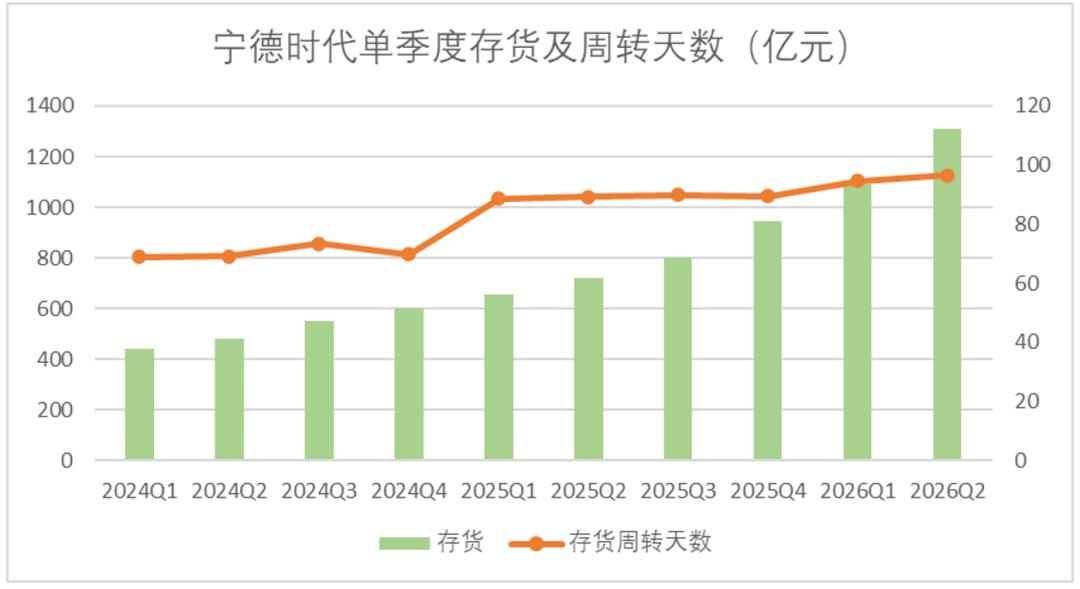
In fact, CATL's current capacity planning is at a relatively high level. The book value of construction in progress at the end of the period is 33.1 billion yuan, corresponding to a capacity that may double its current capacity. The inventory balance in the latest second quarter exceeded 130 billion yuan, with the inventory turnover days increased by 7.4 days.
Moreover, not all of the inventory is raw materials hoarded for the expectation of lithium battery price increases. The proportion of finished products in the inventory during the interim report period has increased from 26% at the beginning of the year to 37%. If the growth rate of the new energy vehicle market slows down significantly in the second half of the year, CATL will still face certain inventory pressure.
The elephant in the room: all disputes in the new energy industry will be reflected in CATL's financial statements
If the changes in the structure of contract liabilities and inventory are financial signals of the loosening relationship between CATL and downstream players, then more hidden and far-reaching changes are taking place in the underlying logic of industrial policies: for CATL, it is no longer a close cooperative relationship with a single automaker, but a symbiotic relationship with the entire industry.
Therefore, all disputes in the new energy industry will eventually be reflected in CATL's financial statements.
For example, the most hotly debated issue of road maintenance fees this year: after the 2009 refined oil tax reform, road maintenance fees were abolished, and road maintenance costs were borne by fuel vehicles through refined oil consumption tax. However, in 2026, the penetration rate of new energy vehicles has exceeded 60% for several consecutive months, and the average curb weight of new energy passenger vehicles has reached 1939.3 kg, an increase of 27.5% compared with 2020.
The fact that there are more and heavier electric vehicles on the road not only leads to unfair road usage fees, but also reflects the current market's aversion to blindly pursuing longer range and excessively increasing vehicle weight. For CATL at this stage, once the public opinion trend shifts to a more comprehensive energy replenishment system, the installed battery capacity per vehicle will decline.
For another example, although the curb weight of vehicles has been continuously increasing under the pressure of range anxiety, the marginal space for improvement has been very limited. At present, the average battery capacity of new energy vehicles is stuck below 65kWh. If the overall sales volume cannot rise, the increment driven only by the expansion of battery capacity will be very small.
Even some product structure changes, such as some automakers going global and generally choosing to launch extended-range vehicles considering the differences of energy replenishment systems in different regions (for example, Xiaomi has also launched extended-range vehicles), will affect CATL's future order expectations, which is a problem that cannot be underestimated.
Under the price war, automakers are still looking for cheaper battery suppliers. Every dispute, every policy adjustment, and every change in model decision-making will eventually be transmitted to CATL's orders, inventory and capacity planning in some way.
CATL's anxiety is exactly the same as NVIDIA's
Both CATL and NVIDIA are irreplaceable at the moment.
The new energy vehicle market is in an extremely fragile competitive state. A single spontaneous combustion accident of a