Microsoft CEO Satya Nadella's latest warning: Staking everything on a single large model is handing over the company's vital lifeline.
If a company pins all its hopes on a single AI, it could end up losing the entire business!
This statement may sound somewhat alarmist, but the person who said it is none other than Satya Nadella, CEO of Microsoft, a company that is going all out to sell AI products.
On CNN's "Fareed Zakaria GPS" program, Nadella issued a stark warning to all enterprises that believe "one large model can handle everything":
Any enterprise that loses control over its data, memory and AI usage records may cease to exist, because it has outsourced its own thinking!
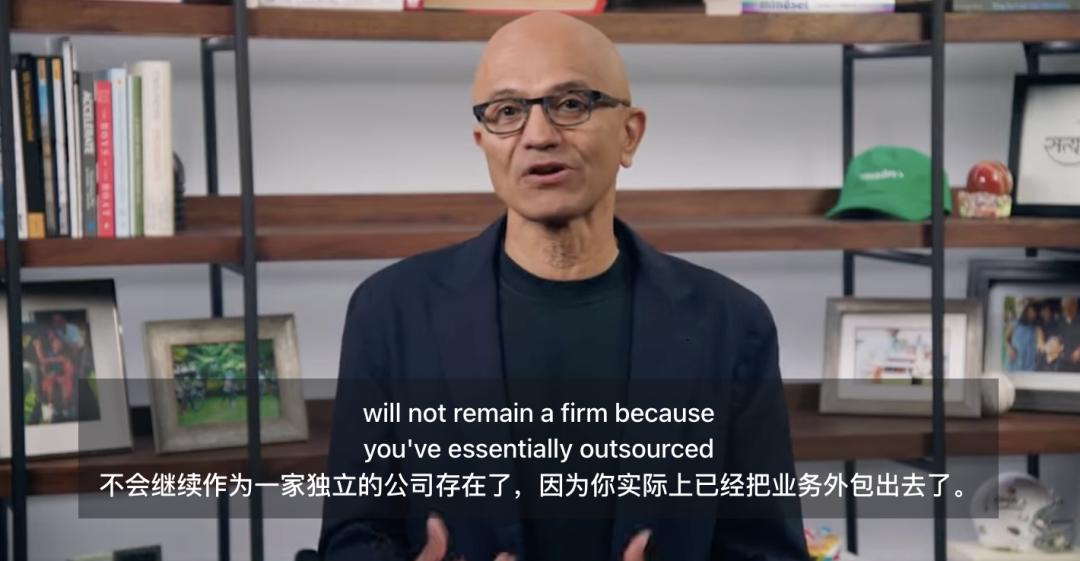
He also added that the deeper an enterprise integrates AI into its daily operations, the more opportunities the AI vendor behind it will have to figure out exactly how the enterprise functions.
Eventually —
What enterprises pay out may not just be token fees, but also a set of business experience that no competitor can buy at any cost.
So what exactly is Nadella worried about?
Pinning All Hopes on One Single AI, Enterprises Will End Up Outsourcing Their Own Core Capabilities As Well
Then why would a company that only uses a fixed AI face such a severe situation that it might even struggle to survive?
The core of Nadella's concern can be summed up in two words: "lock-in".
It is worth noting that when enterprises access AI today, what employees see in front of them may only be a chat window, but far more things are connected behind it —
Prompts, internal data, context, long-term memory, and the Harness that directs AI to call tools and execute tasks will all be gradually integrated into the system.
Moreover, employees will keep supplementing company materials into the AI to make it better understand the business!
As a result, tens of thousands of prompts, calls and error corrections are stacked together, leaving a true record of the company's working methods:
How to serve customers, how to assess risks, how to iterate products, and who to follow when encountering special situations. (The real secret manual for business success)
Although this set of logic is not fully written into any employee handbook, it may determine why the company is more capable of doing business than its competitors...

Leaking business experience is only one layer of risk.
If the model, Harness, enterprise context and long-term memory are all locked into the product of a single AI vendor, there will be another problem, that is —
When the company wants to switch to another model, it will find that what it needs to migrate is far more than just a chat window!
All the context, memory, tool calling methods and workflows accumulated in the past may need to be rebuilt from scratch, and that will be a huge trouble...
In addition, once the original model suddenly raises prices, stops services, lags behind in capabilities, or makes major adjustments to certain functions, it will be very difficult for enterprises to quickly migrate to other AI solutions.
Enterprises either have to bear high migration costs and retrain the system from scratch; or stay on the original platform and accept the vendor's prices, rules and product changes.
The model raises prices, you have to follow. (Helpless smile)
The model falls behind in capabilities, you still have to follow. (Helpless smile)
The model vendor changes the product direction, the enterprise's own core workflow has to change accordingly. (Helpless smile)
This is the full logic behind Nadella's statement that using only one AI "may not survive" —
If an enterprise attaches all its data, memory and working methods to a single AI system, it has actually outsourced part of its thinking capabilities.
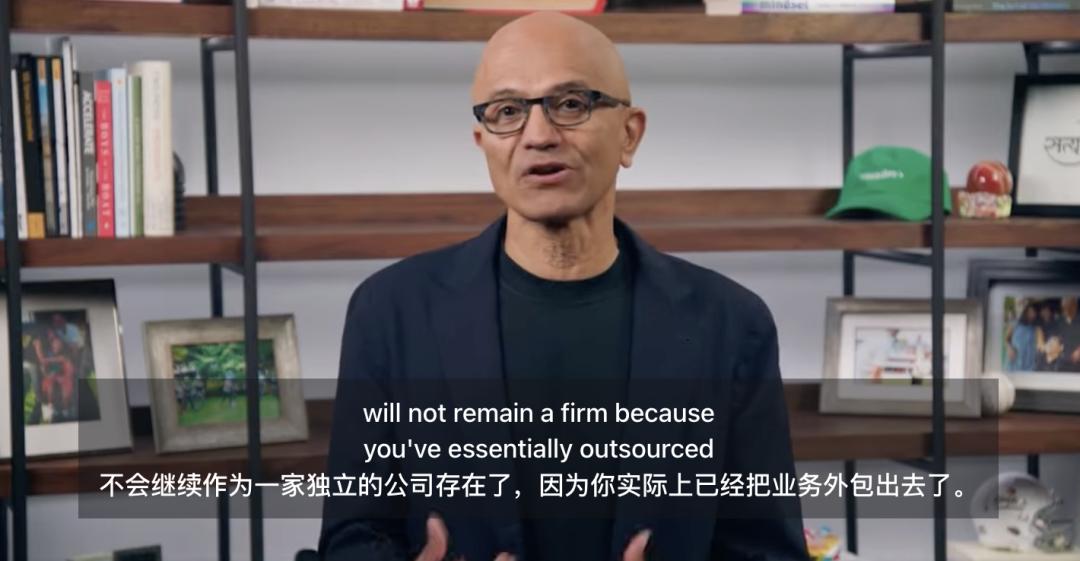
Without that specific AI, the company may not even know why it made past decisions, nor how to continue its work afterwards.
It seems that the AI is working for the company.
But in the end, the company may end up being unable to survive without relying on the AI vendor. (That hits the nail on the head)
The Most Advanced Models Can Be Leased, But The Company's Unique "Way of Thinking" Must Be Retained By Itself
Okay, then here comes the question: can enterprises just avoid lock-in by training their own foundational large models from scratch?
It should be noted that training cutting-edge models requires huge computing power, massive data and professional talents, which the vast majority of enterprises neither need nor can afford...
The solution Nadella puts forward is actually one word — decomposition!!!
Separate the model from the Harness, and separate the context and memory from the model as well.
The underlying models can come from OpenAI, Anthropic, Microsoft or other vendors, while the enterprise's own data, usage records, context and long-term memory must always remain in its own system.
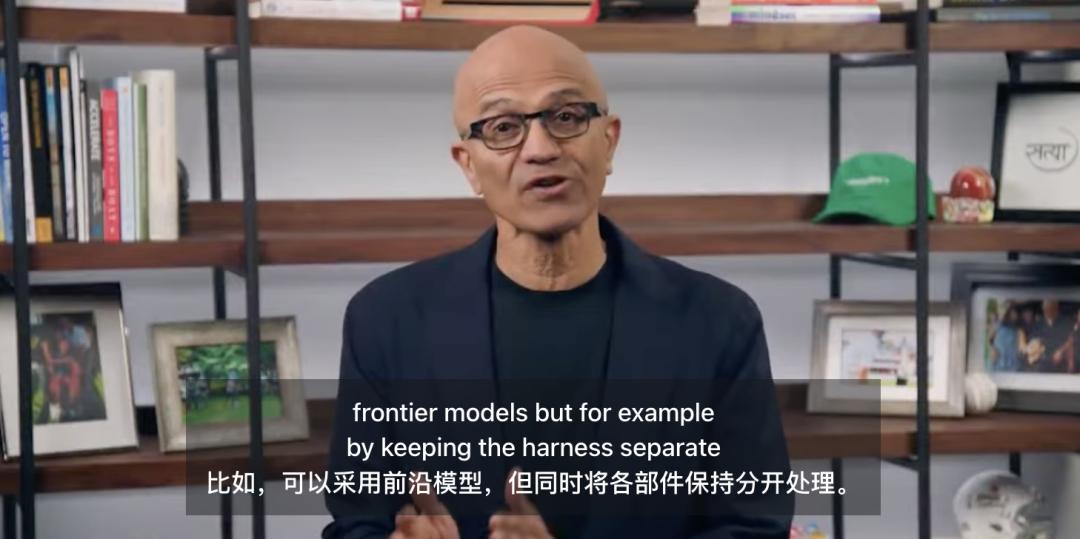
According to Nadella's vision, every time an enterprise uses a model, the metadata generated around this call should be retained by the enterprise itself.
The metadata here can include what questions the enterprise raised, what content the model called, what results it output, and what modifications the employees made afterwards.
After these records are accumulated, enterprises can also use them to train their own weights or models, so as to continuously precipitate the process of using AI into their own capabilities.
In addition, it is best not to permanently bind the Harness to a single model.
The benefit of this approach is that the model can be changed from the all-in-one brain, body and memory of the entire system to a replaceable inference engine.
When writing code, you can call a model that is better at programming.
When analyzing long documents, you can switch to a model with stronger long-context capabilities.
When processing sensitive materials, you can also use an open-source weight model deployed within the enterprise.
Whichever model has better capabilities and lower costs can be put into use~
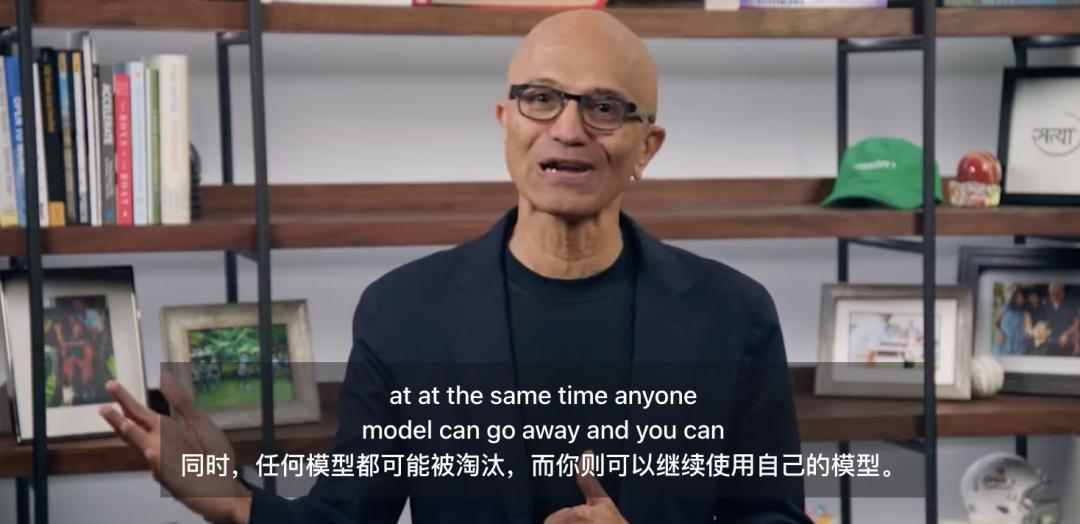
In Nadella's words, even if "any one model disappears", the enterprise can still remain in full control of its own destiny.
In fact, Nadella's concern has already emerged in the startup ecosystem before.
Previously, OpenAI once proposed a special investment scheme to startups in Y Combinator's spring and summer batches.
Each company can obtain up to $2 million worth of OpenAI tokens, and in exchange, OpenAI will get corresponding equity through a SAFE agreement.
Investor Jason Calacanis then publicly reminded entrepreneurs that accepting these tokens means OpenAI may see exactly what the startup is doing, then replicate its idea, and integrate similar capabilities into its own free products.
Now, Nadella has extended this same warning from startups to all enterprises —
In the past, one of the most important assets of a company was the experience accumulated by its employees and the organization over a long period of time.
In the AI era, these experiences will further evolve into prompts, context, evaluation data, agent memory, as well as records of tool calls and manual modifications.
Together, they form the new "neural pathways" of a company.
This set of neural pathways can call different models to operate, and can also become smarter as the models upgrade.
But no matter how many generations of external models are replaced, the enterprise itself must always be in control of this set of neural pathways.
After all, the most advanced models can be leased.
The company's own "brain" must always be firmly in its own hands~
References:
[1]https://www.facebook.com/fareedzakaria/videos/1344036211210716/
[2]https://techcrunch.com/2026/07/27/satya-nadella-says-companies-that-trust-one-ai-for-everything-may-not-survive/
This article is from the WeChat official account QbitAI, written by Meng Yao, and published with authorization by 36Kr.