DingTalk, Feishu and WeCom quietly complete their low-profile "eastward voyage" to the Japanese market.
"Starting from July 28, 2026, the free personal version of Teams will no longer be accessible for login in Chinese Mainland."
An increasing number of Chinese users are seeing such a pop-up prompt when opening the Microsoft Teams desktop client. Behind this pop-up lies the nine-year tortuous journey of Microsoft Teams in the Chinese market.
In March 2017, Microsoft Teams officially entered the enterprise collaborative communication market as a challenger to Slack. When the global COVID-19 outbreak hit in 2020, the demand for remote work skyrocketed, and the number of global Teams users surged from 20 million to 145 million, making it the fastest-growing enterprise-level application in Microsoft's history.
In the Chinese market, Teams Free entered the vision of a group of individual users and freelancers along with this wave of remote work, and was especially favored by cross-border workers who need to maintain high-frequency collaboration with overseas clients and foreign enterprise teams. On April 1, 2023, Microsoft announced that the domestic version of Microsoft Teams operated by 21Vianet was officially launched, trying to build Teams into the "digital hub" for Chinese enterprises.
However, after nine years of entering the Chinese market, Microsoft Teams has never really opened up the market situation.
According to QuestMobile data, in China's collaborative office market in 2026, the combined market coverage of the three leading products DingTalk, Feishu and WeCom has reached 92%, leaving Teams' market space squeezed to a narrow 8% gap by local rivals.
When the global giant of enterprise office software takes the initiative to shrink in the Chinese market, a question worthy of consideration emerges: where will the local players go in this competition?
The Failure of Old Rules
DingTalk, Feishu and WeCom seem to "divide the world into three parts", but there is a considerable gap in user scale between them.
QuestMobile data shows that DingTalk has accumulated over 800 million users, with about 200 million monthly active users, ranking first in China's collaborative office market with a 32.7% market share; WeCom has about 100 million monthly active users, accounting for 23.4% of the market; Feishu has about 30 million monthly active users, with a 18.9% market share. Judging from monthly active users alone, DingTalk is almost seven times that of Feishu.
"Whoever has more users is the winner" — according to this "truth" that was once widely accepted in the office software industry, DingTalk should be the undisputed winner.
However, if you only focus on the user scale, you may miss the more essential changes that are happening.
In terms of revenue data, although Feishu's user scale is only about 15% of DingTalk's, its revenue in 2025 has exceeded 3 billion yuan, while DingTalk's revenue in 2025 exceeded 4 billion yuan; DingTalk's subscription revenue exceeded 3 billion yuan, and Feishu's annualized subscription revenue has exceeded 2.1 billion yuan. The gap between the two sides is actually not large. To a certain extent, this also proves from the side that user scale does not necessarily equal commercial value, which is the first old rule that is failing.
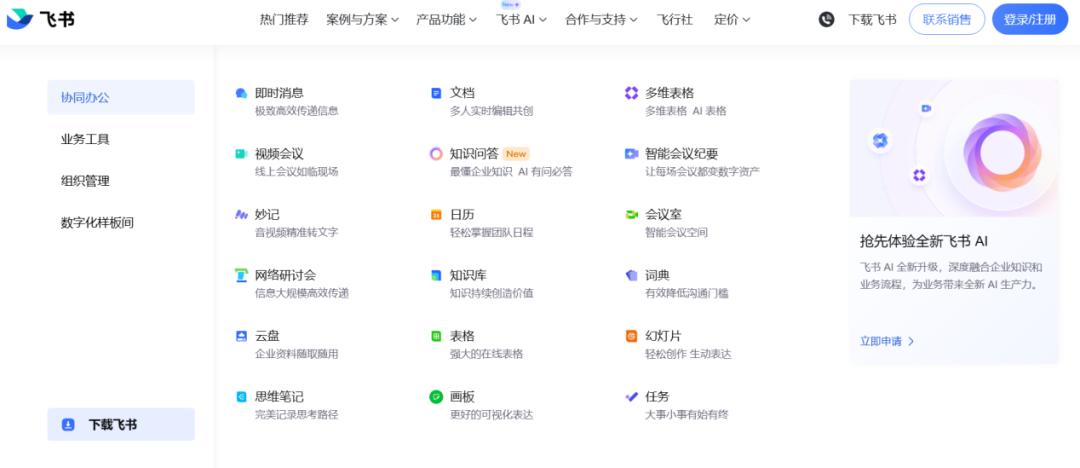
Source: Feishu official website
The second failing rule is the growth logic of "expanding user scale for free and realizing monetization in the later stage".
Enterprise service is never a business of traffic, but a business of trust. The value of an enterprise customer who is willing to pay continuously, use the product deeply and make additional purchases constantly is far higher than that of 100 active free users.
If an office software chooses the on-demand subscription and on-demand payment model from the very beginning, instead of the path of expanding user scale for free and then converting them to paying users slowly, this will determine that its customers have stronger willingness to pay and higher use depth from the very start.
As the incremental market dries up and stock game becomes the norm, only those who can squeeze higher value density from fewer users can better grasp the pricing power and the initiative of growth.
The third failing rule is more hidden. The competitive barrier of office software is shifting from "quantity of functions" to "depth of ecosystem".
The withdrawal of Teams Free from the Chinese market is ostensibly a commercial decision that Microsoft shifts its strategic focus to AI and Copilot, but at a deep level, the competitive barrier of "tool + ecosystem" makes it difficult for foreign players to cross.
DingTalk is backed by the Alibaba Economy. The ToB business capabilities of Taobao, Tmall, 1688, Alipay, Alibaba Cloud and other platforms are gradually embedded into the platform in the form of skills, which will become the unified export of Alibaba's AI capabilities in enterprise work scenarios; WeCom has the unique advantage of the WeChat ecosystem, supporting message interconnection with more than 1 billion WeChat users, connecting mini-programs and WeChat Pay, helping enterprises efficiently connect external customers, and realizing a full-link closed loop from internal collaboration to external services.
Behind Feishu are ByteDance's content capabilities and globalization layout. As of August 2025, the global monthly active users of ByteDance's applications have exceeded 4 billion, which is equivalent to nearly one third of global Internet users using ByteDance's products. This may enable Feishu to deeply embed the organizational experience and technical capabilities accumulated by ByteDance in content distribution and global operation into its products. All of these cannot be replicated by simply piling up functions.
Old rules are failing, and new rules are emerging. This is not a competition about who has more users, but a contest about who can squeeze higher value from fewer users, take the lead in crossing the boundary of digital-native enterprises, enter the broader industrial hinterland, and build an ecological barrier that cannot be replicated by rivals.
AI Enters the Game, Each Shows Its Unique Skills
On March 17, 2023, Microsoft took the lead in fully embedding GPT-4 capabilities into Office and released Microsoft 365 Copilot. In November of the following year, the commercial version of Microsoft 365 Copilot was released, kicking off the AI era of Windows. Traditional office software is about to face the dimensionality reduction challenge brought by GPT.
However, the response of the Chinese market was faster than expected. Feishu followed up and released a series of AI products such as "Feishu Smart Partner" in November of the same year; in January 2025, DingTalk officially released its AI assistant product co-created based on the needs of 700,000 enterprises; in April, Tencent announced that its collaborative SaaS products, including WeCom, would fully access Tencent Hunyuan large model. The leading players almost pushed AI from concept to product at the same time.
Nowadays, the final outcome of rule iteration has not yet been determined, but the entry of AI has pushed the intensity of this competition to a new level. Based on their respective genes and accumulations, DingTalk, Feishu and WeCom have chosen different paths.
The path DingTalk chose is the hardest and most difficult one — reconstructing the underlying architecture.
In March 2026, Alibaba released Wukong, the world's first enterprise-level AI-native work platform, which is directly built into DingTalk. In the same month, DingTalk completed a comprehensive CLI transformation, enabling Wukong Agent to natively operate thousands of capabilities of DingTalk instead of simulating humans clicking the graphical interface, realizing "communication means execution".
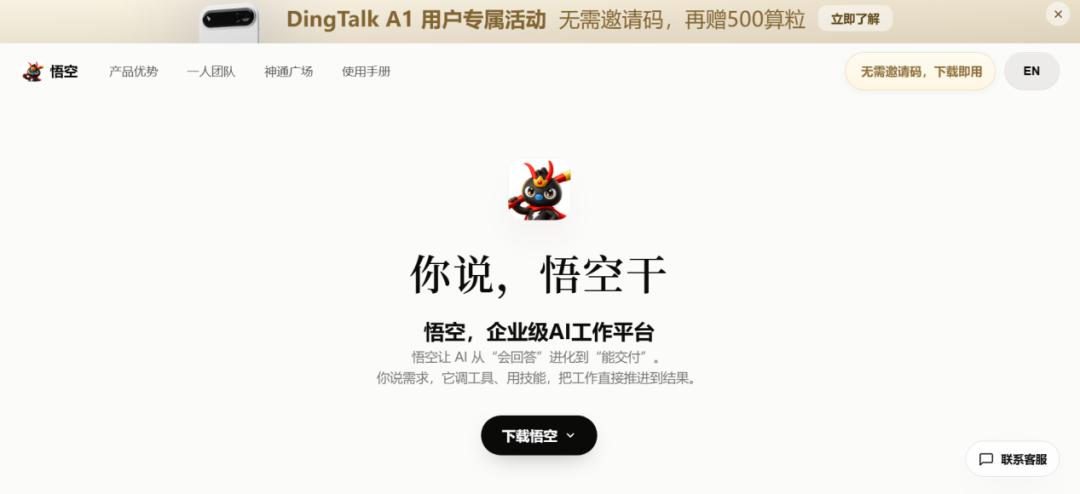
Source: Wukong official website
While Wukong was released, there were two other Agent products running independently within Alibaba. Launched in September 2025, MuleRun is positioned as a cross-platform Agent execution engine, which has served enterprise users in 43 countries and regions so far, and 34% of its users pay more than 200 US dollars per month; QoderWork, launched in January 2026, is positioned as a desktop-level AI agent tool, whose daily active users, weekly active users and Token consumption all rank first among all AI tools of the group.
In July, Alibaba made another strategic choice. According to the report of *Caijing*, Alibaba will launch "Qianwen Office", integrating the three Agent products QoderWork, Wukong and MuleRun into one, which will be managed by Chen Yusen, the new CEO of DingTalk.

Chen Yusen, CEO of DingTalk, Source: MuleRun official WeChat public account
From "multi-line exploration" to "resource convergence", DingTalk is twisting the scattered AI capabilities into a single force. It is destined not to be accomplished overnight for a platform carrying 800 million users to complete underlying reconstruction in the AI era, but this project of "rewriting for AI" at the architecture level is essentially laying the foundation for the next decade.
In contrast, Feishu was designed from the very beginning as a complete set of data system that allows AI to "settle in".
It did not build an independent Agent product from scratch, but disassemble the AI capabilities little by little and embed them into the existing product matrix.
The reason why it can do this is that Feishu's documents, spreadsheets, knowledge base, calendar, approval, project management, multidimensional spreadsheet and automated processes are all in the same system, and almost all the data is structured, which is exactly what AI needs most. This design that was regarded as "heavy" in the era of collaborative office provides the first-mover advantage of "stock compound interest" in the AI era.
Therefore, along the original product line, Feishu's AI capabilities are specifically extended to Feishu aily Smart Partner, smart meeting minutes, AI functions for documents and multidimensional spreadsheets, Feishu CLI agent operation tools, and CodeM agent for R&D scenarios.
Since 2026, more than 90% of Feishu's new customers have purchased Feishu AI products at the same time. The significance of this data shows that enterprises are no longer willing to pay for "products that seem to have AI", but start to pay for a set of infrastructure that allows AI to enter the operation of the organization.
It is worth mentioning that the direction of deep integration between Doubao and Feishu has been clarified. The collaboration between an AI assistant with over 150 million daily active users and a collaborative platform carrying core enterprise data is opening up greater imagination space.

Source: Feishu official website
The unique feature of WeCom is that it puts AI into connections.
In June, WeCom launched an AI Agent named "Dayuan", which has entered the internal beta stage. Different from the common independent AI chatbots on the market, "Dayuan" is more like an AI assistant that "grows inside WeCom". Users can call it out by swiping left lightly anywhere on the WeCom interface, it can intelligently identify the current interface, and automatically understand demands based on existing work data such as group chats, documents, meetings, emails and schedules.

Source: WeCom official WeChat public account
At the same time, relying on the natural advantage of 1.432 billion monthly active accounts of WeChat, "Dayuan" may not only serve internal enterprise collaboration in the future, but also further cut into customer operation scenarios. If implemented smoothly, WeCom may become one of the few AI Agent entrances that have both "work data + customer connection" dual scenarios.
The three strategies have different focuses, and no one can give an answer in advance about which path is more correct. But what they have in common is: whoever takes the lead in making AI truly "enter" the texture of the organization will get the first move in the next round.
Bet on AI Office, Piling Up Parameters Is Far From Enough
In this competition of AI office, the capability of large models used to be the core concern. But with the iteration of technology, the gap between models is narrowing rapidly. According to the Stanford AI Index Report, as of the beginning of 2026, the score gap of mainstream large models in multiple evaluations has been reduced to less than 25 points, which is almost at the same horizontal line.
When the gap between large models gradually disappears, the competition between office software has also begun to shift from "function superposition" to "agent implementation". The most intuitive change occurs at the junction of the physical world and the digital world. Software functions are becoming increasingly homogeneous, and the growth curve is gradually slowing down. Launching hardware is no longer a icing on the cake choice, but a key strategy to break the deadlock and seek differentiation.
At DingTalk's 10th anniversary celebration in August 2025, it launched its first AI hardware, DingTalk A1. This AI recording card with a thickness of only 3.8mm is equipped with a 6nm low-power AI audio chip and a 6-microphone array, supporting clear sound collection within 8 meters, with a transcription accuracy of 97%.
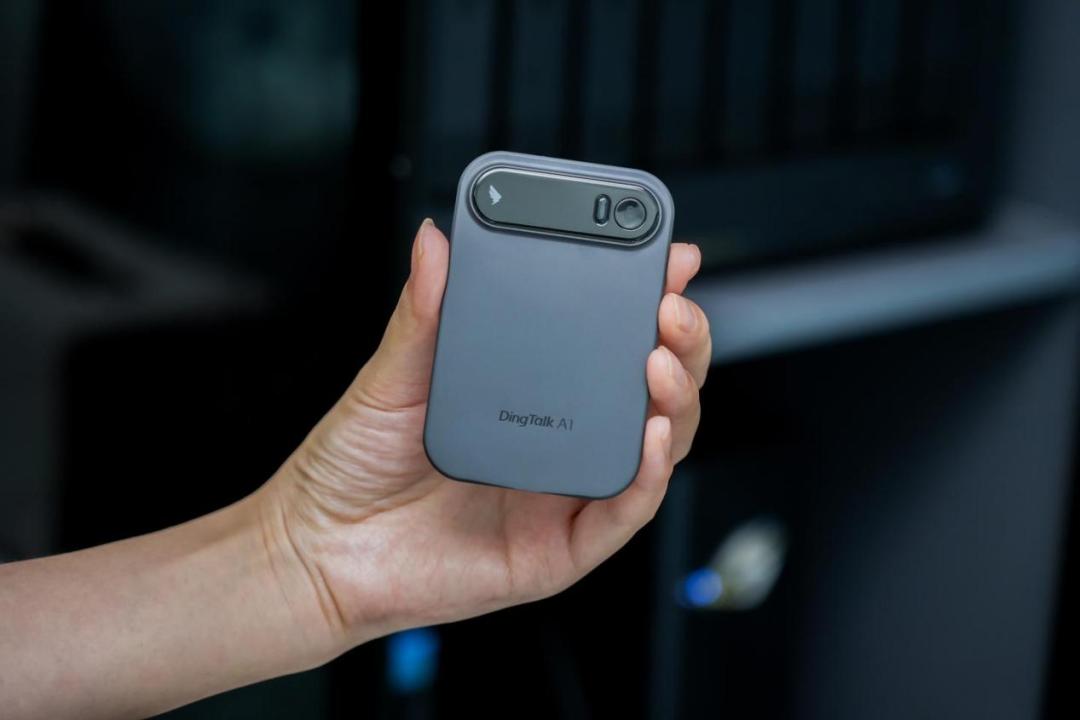
Source: Baidu Baike
Only half a year after its launch, DingTalk A1 became a hit domestic AI hardware product, and its sales volume has long ranked first on channels such as Tmall and Douyin. During the 2026 618 shopping festival, DingTalk A1 even won the sales champion of AI recording equipment on the three major platforms Tmall, Douyin and JD.
When the voice of every face-to-face discussion, every offline meeting and every customer communication scenario is automatically collected, transcribed, precipitated into structured data, and seamlessly connected to their respective AI workflows, it may blur the boundary of office software, extending office software from a single screen to the entire real world.
If hardware is the outpost battle to seize the entrance, industrial penetration is the positional battle that determines who can survive longer.
As of the end of the second quarter of 2026, Feishu's ARR increased by more than 100% year-on-year, and it is accelerating its "out of the circle" development.
What is