The People Who "Dress Up" Prospectuses: How Hong Kong Stock IPOs Are Artificially Inflated
Since January this year, Wang Sheng, an industry consultant for Hong Kong stock IPOs, has suddenly become extremely busy.
The industry chapter of the prospectus he is responsible for drafting originally spans around 30 pages, but he now needs to cut it down to only a dozen pages.
Most of the deleted contents are the expressions he and his colleagues polished repeatedly in the past — some enterprises like to package themselves with terms such as "solution provider", "one-stop" and "end-to-end"; some enterprises limit their own tracks to a narrow field to become a leading player in the specific segment; some enterprises want to associate themselves with AI and embodied intelligence...
The feedback from Hong Kong Exchanges and Clearing Limited (HKEX) is straightforward: "Please delete all marketing-related rhetoric."
The trigger for this "slimming" campaign was a circular issued by the Securities and Futures Commission of Hong Kong (SFC) on January 30, 2026. The circular pointed out that the number of Hong Kong stock listing applications surged in 2025, while the quality of draft documents (including prospectuses) declined. The circular requires that the number of pages of a prospectus shall not exceed 300, and all relevant personnel must complete the review and correction within a three-month time limit.
Over the past two years, the problem of "watering down" prospectuses of enterprises has spread rapidly.
According to HKEX data, in the whole year of 2025, HKEX received and confirmed 516 new listing applications. Wind data shows that from 2022 to 2024, the number of new listing applicants on HKEX did not exceed 100 per year.
Among the surging number of enterprises, there are A-share listed companies planning A+H dual listings and arranging international capital operations, enterprises that came to Hong Kong after being blocked from A-share listings, and another category — they carry valuation adjustment agreements and need to complete the listing before the agreed time, taking the Hong Kong stock market as the most feasible exit channel. Many interviewed practitioners said that for these enterprises, submitting the application before the agreed time is more important than the stock price and market value after listing.
In Wang Sheng's view, prospectuses are increasingly similar to "compliant advertisements" — enterprises want to use them to attract investors, while intermediaries charge fees to complete these documents. Some companies clearly know that they may not be able to go all the way to the end, but they are still willing to spend tens of millions of RMB in intermediary fees to go through the whole process.
"Some intermediaries accompany the companies to put on a show," he said. Before the end of the listing boom cycle, Hong Kong stock IPOs are still a "stage". After the implementation of the new regulations, where will this "show" go next?
Rushing to the Hong Kong Stock Market
After the circular issued in January, the team of lawyer Tang Hailong is also revising prospectuses. Tang Hailong is a senior partner at Beijing Deheng (Shenzhen) Law Firm, and has taken charge of Hong Kong stock IPO projects of many enterprises over the past ten years. After the circular was issued, the projects undertaken by his team also received revision and deletion requirements.
According to Tang Hailong and Wang Sheng, a prospectus is jointly drafted by multiple intermediaries, and the core roles include sponsors, domestic and overseas lawyers of the issuers, auditors and industry analysts.
As the domestic lawyer of the issuer, the team of lawyer Tang Hailong is mainly responsible for drafting the regulatory overview chapter of the prospectus. This chapter has a fixed format with little room for content expansion. The industry chapter that Wang Sheng, as an industry consultant, is responsible for, and the main part of the prospectus that overseas lawyers are responsible for, usually have more flexible space for information interpretation, and are often the hardest-hit areas of "watering down".
Why has the problem of "watering down" prospectuses become so serious that a circular is needed to rectify it? The answer lies in the drastic changes in the Hong Kong stock IPO market over the past two years.
According to Wind data, in 2021, 2022, 2023 and 2024, the number of companies that newly submitted prospectuses to HKEX was 130, 75, 68 and 83 respectively. But by 2025, according to HKEX disclosures, HKEX received and confirmed 516 new listing applications, exceeding the total number of the previous four years. In the first half of 2026, the number of IPO listing applications accepted by the HKEX Main Board has reached 373.
Wang Sheng entered the industry in 2023, when the period for enterprises to submit listing applications to Hong Kong was at a low ebb. By 2024 and 2025, enterprises including Mixue Ice City, Guming and Laopu Gold went public on the Hong Kong stock market in succession. "Everyone found that the valuation and liquidity of the Hong Kong stock market are pretty good." Coupled with the tightening of A-share review and the relaxation of listing application conditions in Hong Kong, more and more small and medium-sized companies are flocking to Hong Kong. "Even the intermediaries in the Hong Kong market did not expect such a boom."
The number of projects has skyrocketed, but the manpower of intermediaries cannot keep up. Many law firm teams and consultant teams cut staff during the previous low ebb, and at that time, a large number of financial practitioners in Hong Kong turned to selling insurance and real estate, which even became a hot topic. When the market exploded, institutions began to poach people at several times the original price and "expand recruitment crazily".

● Source: The Wolf of Wall Street
In addition to the shortage of manpower, professionalism is also declining. "Teams that have never done Hong Kong stock IPOs before are starting to do it now, and they have no idea about the review intensity of the exchange at all," Wang Sheng said.
Time is also compressed. Tang Hailong explained that with the surge in the number of applications, all enterprises are afraid of being queued up later and leading to a longer review cycle. "All parties of intermediaries will unconsciously set a shorter listing schedule. After the time is compressed, the quality of prospectus documents may decline."
The most rushed project Wang Sheng has experienced took only 87 days from launch to application submission — nearly half shorter than the normal cycle of three to four months. He recalled that the project could be completed in such a hurry because the enterprise had done solid compliance work in the early stage. But not all enterprises have such a foundation.
An overseas lawyer also observed that in 2025, the normal state of Hong Kong stock IPO projects was that from enterprises to all parties of intermediaries, everyone was in a state of "urging each other".
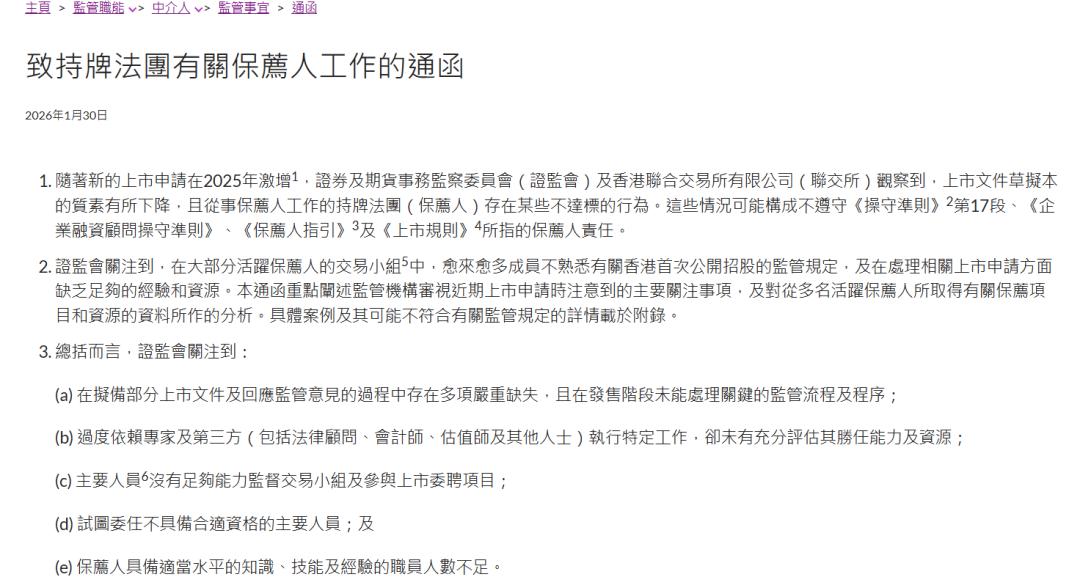
● On January 30, 2026, the SFC of Hong Kong issued a circular, pointing out that most of the active sponsor transaction teams are not familiar with the Hong Kong IPO regulatory provisions, and lack experience and resources. Source: SFC of Hong Kong
Insufficient manpower of intermediaries, lack of experience and tight time are the superficial reasons for the decline in prospectus quality. But the deeper problem lies with the enterprises themselves.
Wang Sheng observed that in the past, most of the enterprises going to Hong Kong for listing were large technology companies and high-quality consumer companies, but now more and more small and medium-sized companies are coming, with "uneven quality". These enterprises have limited business highlights themselves, but have strong listing demands. They often sign valuation adjustment agreements with investors, and must complete the listing within the specified time.
Qi Jingjing, a partner at Beijing Dacheng (Shanghai) Law Firm, has long focused on the capital market. She attributes the driving force of this round of listing boom to several layers:
In previous years, the primary market was booming, and a large number of enterprises signed valuation adjustment agreements with investors, agreeing to complete the listing within a certain period, otherwise they would have to bear the repurchase or compensation liability. As the A-share listing channel narrows, the Hong Kong stock IPO threshold is lowered and the cycle is shorter, the number of enterprises going to Hong Kong for listing has exploded.
The influx of these enterprises faces a set of norms different from those of the A-share market.
"The Hong Kong stock market is like an argumentative essay." This is a description Tang Hailong has heard repeatedly over more than ten years of his career. He said that A-share prospectuses are like "eight-part essays", with fixed formats, detailed regulatory requirements and relatively limited freedom in writing; the Hong Kong stock market is different, which follows principle-oriented disclosure requirements, giving enterprises more space to explain their business logic, and with more flexible expression forms.
The rules leave room for narrative. When the quality of enterprises is uneven and they have to complete the listing before the agreed time, this space is pushed to the extreme.
Wang Sheng can clearly feel the operation of this rule in his work. A key step in the Hong Kong stock IPO application is to prepare Form A1 (the official listing application form), which includes the draft prospectus. After submission, the draft prospectus will generally be posted on the official website for more than six months.
In the past, many enterprises he contacted wanted to add more promotional words to the draft version. In his understanding, the Hong Kong stock market is a buyer's market, so issuers naturally need to find ways to attract investors, which is understandable.
Before the new regulations, although HKEX would reject the draft and require the deletion of highly promotional language, the version was still available on the official website during the revision period. When enterprises hold non-transaction roadshows and make business plans, the contents can also correspond to the promotional contents of the draft prospectus one by one.
"Strictly speaking, it is just an advertisement," Wang Sheng said. Most of the enterprises he has come into contact with prefer expressions such as "solution provider", "end-to-end" and "full-stack". Before the new regulations, "the whole industry acquiesced in this practice."
Tang Hailong also found that by 2025, many practitioners joked privately that the prospectuses of Hong Kong stock IPOs had become "brochures".
Yang Yu has worked at a leading law firm in Hong Kong for more than 10 years, responsible for drafting the main part of prospectuses. She observed that over the past decade, the number of pages of prospectuses has gradually increased from 300-400 pages to 600-700 pages. After 2025, with the increase in the number of enterprises and inexperienced intermediaries, the scope and means of "watering down" have also escalated.
When there are no new stories to tell for listing, the language for telling stories begins to expand. Wang Sheng often thinks that the AI stories that enterprises applying for listing are still chasing in their prospectuses have already been told by many enterprises. "The stories have been told by the first wave of people, and the second wave of people have no new stories to tell, so they will naturally water down the contents."
By June 2026, Liu Ying, co-head of HKEX IPO Review, once again put the prospectus issue on the table. She said frankly that the prospectuses submitted after the circular can meet the requirements in terms of length, but there are still problems in the draft prospectuses of some enterprises, such as exaggerated wording, unclear introduction of business models, beautified industry rankings, and vague revenue recognition methods.
She emphasized that the IPO review progress has been slowed down by "watered-down" contents. The SFC of Hong Kong disclosed that by the end of 2025, 16 IPO projects had been suspended due to the poor quality of their prospectuses.
How Do "Watered-Down" Prospectuses Approach the Red Line?
How is a "watered-down" Hong Kong stock IPO prospectus produced?
The use of advertising-style promotional words mentioned earlier by Wang Sheng is the most common way of "watering down". Before the new regulations, HKEX would list some promotional words as examples, such as the aforementioned expressions like "solution provider", "end-to-end" and "full-stack", and give feedback to relevant intermediaries, requiring them to delete similar marketing-related rhetoric.
Going a step further than language packaging is redefining one's own track. Tang Hailong noticed that some enterprises, in order to increase their attractiveness to investors, will add a large number of qualifiers to their prospectuses to narrow the industry scope and highlight their leading position in the specific segment.
He has seen the operation method of a catering brand A. In the industry where A is located, there is already a leading listed company. So A positions itself as the number one brand with a per capita consumption of "more than 120 yuan". This statement may be true in itself, but it selectively avoids the real position of the enterprise in the whole industry. Tang Hailong believes that such expressions cannot provide comprehensive market information and are easy to mislead investors' decisions.
Going one step further, some enterprises even forcefully associate themselves with popular concepts. Wang Sheng once came into contact with a traditional manufacturing company that produces electric drives and bearings. The company insisted on packaging itself as an embodied intelligence company in the industry chapter. After Form A1 was released, HKEX questioned the company and the industry consultant, requiring the deletion of contents irrelevant to the company's business. "HKEX thought those contents were incomprehensible," Wang Sheng said.
In the past two years, with large model companies going public in Hong Kong, words such as "AI", "embodied intelligence" and "low-altitude economy" have appeared more and more frequently in prospectuses. Some companies with very traditional businesses tend to get close to emerging industries, "wanting to express themselves in a more fancy way."
But this does not mean that all mentions of AI are "watering down". Some of Wang Sheng's clients were originally labor-intensive enterprises, which have achieved cost reduction and efficiency improvement with the help of AI. "It is totally reasonable for them to talk about AI, the key is whether the story conforms to the reality." The boundary lies in: those supported by real business are transformation; those that fabricate a business purely to catch up with the trend are packaging.
Take Momenta as an example. This L4-level autonomous driving company was called "the first physical AI stock" by the media in its recent listing promotion. But Wang Sheng noticed that such expressions do not appear in its prospectus. "From the perspective of prospectus, it is not allowed to say that during the disclosure process."
"Watering down" intensifies step by step, and may finally come to the red line.
Guo Meng, a partner at Shanghai Juerui Law Firm, has rich experience in civil and commercial litigation. Among the IPO litigation cases her team has come into contact with, some of the listed enterprises being sued have fraudulent financial data — inflated revenue, related company fund transfer, and fictional transactions through yin-yang contracts, etc., which mislead investors and cause them major economic losses, so they are sued by investors.
In such cases, "watering down" and fraud often coexist. When disputes arise, enterprises can justify the watered-down parts in the prospectus, and it is objectively difficult for investors to produce evidence. "For ambiguous contents, the court is not easy to make a judgment." The fraudulent parts are more likely to be identified as fraud, and more likely to be identified as associated with the losses of investors.
Guo Meng summed up a clear identification sequence: the easiest to identify is often the situation where the enterprise has been punished by the regulatory authority for fraud, and the court can take the punishment decision as preliminary evidence. The second is the situation where the enterprise has obvious financial fraud that reaches the level of fraud. The hardest to identify is the situation of exaggerated propaganda in the prospectus.
Sometimes, the boundary between false facts and language packaging often becomes blurred in the game between intermediaries and companies.
Long before the circular was issued, Wang Sheng had doubts about the wording of some enterprises. "I will ask the enterprise, do you have actual business? Have you achieved a certain scale? Do you have revenue? If you have nothing but a vision, there is no need to put it in the prospectus."
But for enterprises that cannot be persuaded, he can only write according to their requirements first. "After all, we are the service provider." After such documents are submitted, HKEX will often give feedback and require intermediaries to make revisions. "The language is divorced from the actual business