The neglected old-timers in the insurance industry are quietly raking in huge profits.
When the market's attention is focused on companies in the AI, storage, and "Yizhongtian" tracks, insurance companies, as representatives of the "old guard", are quietly reaping huge profits.
On July 27, Changxin Storage was listed on the stock exchange, becoming the largest IPO on the A-share market so far this year.
On the same day, China Life stated that its subsidiary China Life Investment has deployed capital through insurance asset management products. The listing of Changxin Technology marks another landmark achievement of the company in the hard technology track.
Earlier, at the economic management work conference for the first half of 2026, China Life openly stated that "its key operating indicators have reached the best level in the same period in history".
At the meeting, China Life released a set of staggering data: operating revenue reached 520 billion yuan, a year-on-year increase of 60%. Net profit hit 1.3 trillion yuan, a sharp year-on-year rise. Total assets exceeded 9 trillion yuan, and the scale of assets under management stood at 18.5 trillion yuan.
It is not only China Life, but also another insurance capital giant New China Life Insurance that has seen explosive performance growth.
Amid the collective rush into the electronics, semiconductor and AI waves, 6 "old guard" insurance players including China Life, PICC and SinoLife are also making substantial gains quietly by investing in hard technology sectors.
01. Explosive growth of the "old guard" insurance companies
Around the same time, public funds released their 2026 Q2 reports. The total number of market funds reached 14,513, with total net assets of 39.9 trillion yuan, an increase of over 2 trillion yuan compared with the first quarter.
In the past, public funds preferred core assets, white horse and blue-chip stocks, but now they are flocking collectively to the tech sector led by AI.
Wind data shows that in the second quarter, 17 of the top 20 companies by total market value of fund heavy holdings are in the communications and electronics industries.
The "Yizhongtian" concept stocks have become the favorite of public funds. Among them, Innolight and Source Photonics took the top two spots with total market value of holdings at 260.5 billion yuan and 205.5 billion yuan respectively.
On the contrary, what public funds are massively reducing their positions in are generally leading companies in the "old guard" industries. The top 20 companies with position reductions are mainly stocks from the building materials, banking, insurance and energy sectors, many of which are representatives of "high dividend" companies.
In the past three years, the average dividend yield of Industrial Bank was 5.7%, that of CNOOC was 7.2%, the average dividend yield of PetroChina, ICBC, Ping An Insurance and China Merchants Bank exceeded 4%, and that of Zijin Mining, China Yangtze Power and Baoshan Iron & Steel exceeded 3%.
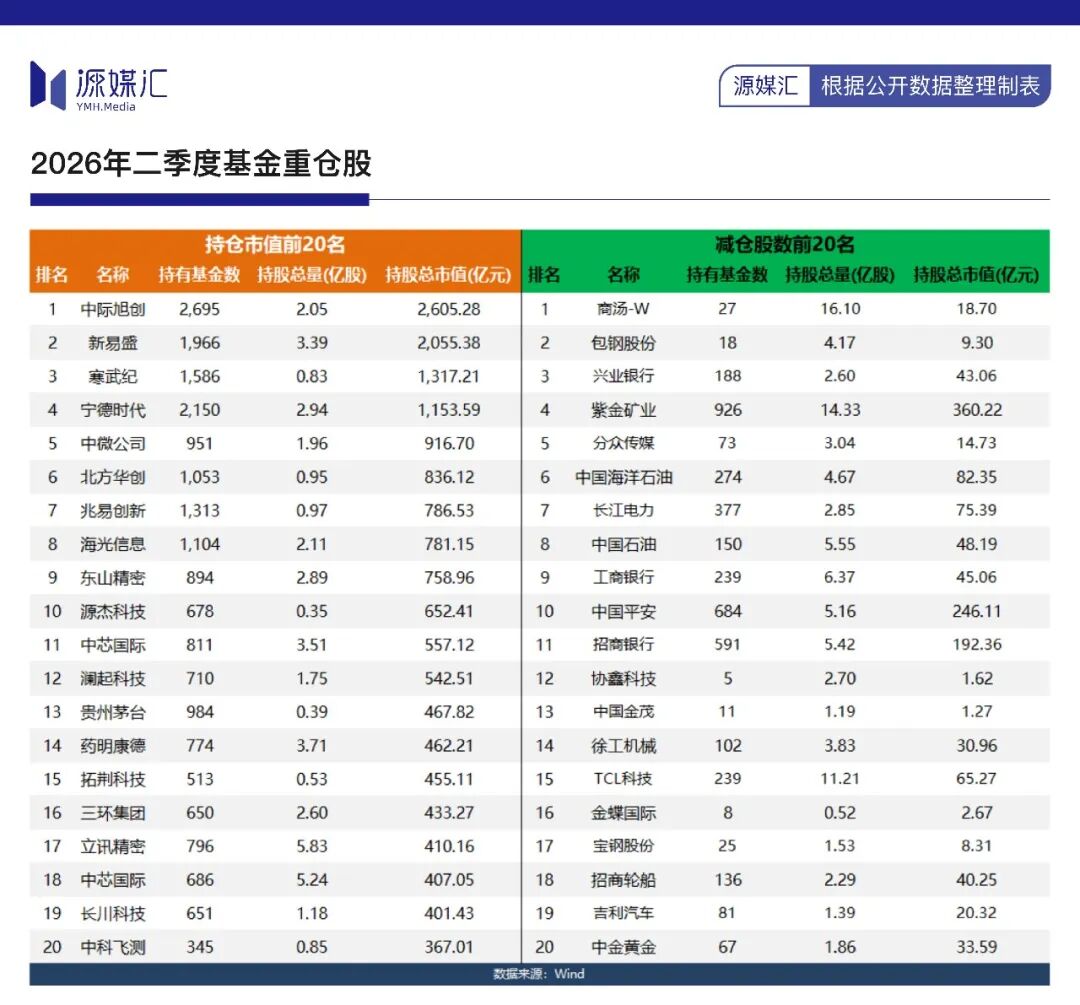
In the second quarter, China Life and New China Life Insurance had their positions reduced by funds by 90.6062 million shares and 21.798 million shares respectively in the A-share market.
In this massive bull market of tech stocks, smart money is all pouring into the technology sector, even including "old guard" insurance players such as China Life.
Earlier, China Life released its 2026 H1 performance forecast, predicting that the attributable net profit to shareholders will be between 128.933 billion yuan and 137.1 billion yuan, and the non-recurring profit and loss adjusted attributable net profit will be between 129.175 billion yuan and 137.377 billion yuan, representing a year-on-year increase of about 215% to 235%.
China Life attributed the performance growth to two points: first, the linkage of assets and liabilities, diversified products and businesses, and the improvement of production and operation efficiency; second, the returns from long-term investment layout and the investment portfolio gains.
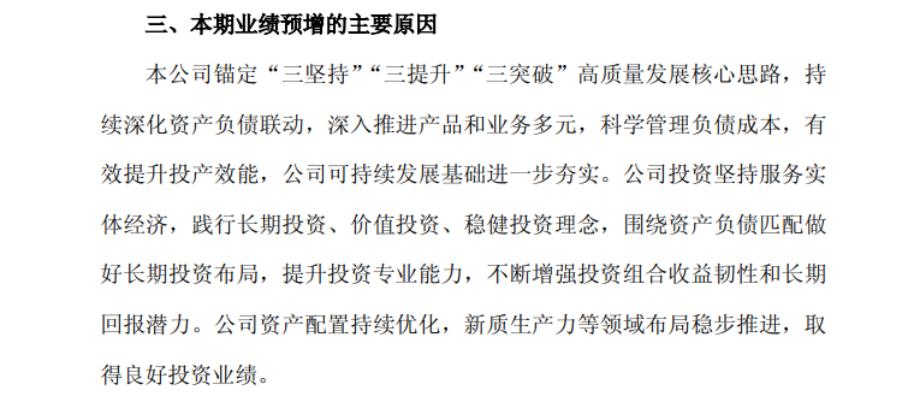
Screenshot from the corporate announcement
Several days after the release of the performance forecast, it released 8 more connected transaction disclosure announcements, stating that its investment products sold 1.11 million shares of GigaDevice at a price of 615.9 yuan per share, cashing out 682 million yuan to exit the position.
China Life's investment and cash-out capability is quite impressive.
On June 29, GigaDevice's share price hit an all-time high of 846.66 yuan, then began to fall, and now it is around 434 yuan, with a retracement of 48.74%, almost halved. When China Life exited the position, the share price had only dropped by about 27% from its peak.
The reason why China Life could accurately invest in GigaDevice and exit at the top of the market is that its independent director Chen Jie also serves as an independent director of GigaDevice.
GigaDevice is only one of the targets in China Life's investment portfolio.
Wind data shows that as of July 27, the scale of funds held by China Life reached 366.3 billion yuan, of which the total of equity funds and hybrid funds was 22.5 billion yuan, accounting for about 6.16%.
The explosive performance of New China Life Insurance is also inseparable from its investment business.
In the first half of 2026, New China Life Insurance is expected to realize an attributable net profit to shareholders of 20.72 billion yuan to 23.68 billion yuan, representing a year-on-year increase of 40% to 60%.
In the performance forecast, it classified the pre-increase in performance as the result of the development of life insurance main business, the three-end collaborative linkage of "insurance + service + investment", the construction of investment research capability and the optimization of asset allocation structure.
Interestingly, the "old guard" makes money by relying on the "new guard".
02. Addicted to stock investment
After making this round of profits, China Life and New China Life Insurance have become very keen on such investments, and both immediately stated that they will continue to increase their equity investment.
Among them, China Life stated that it is optimistic about the allocation value of the equity market, will continuously promote equity market investment and increase the layout of high-quality core assets. New China Life Insurance said it will increase the intensity of equity asset investment and enhance support for scientific and technological innovation and new quality productive forces.
China Pacific Insurance also announced that it will increase the proportion of equity allocation and continue to invest in stocks and ETFs in sectors such as technology growth, consumption and new energy.
Although the insurance giants have not yet disclosed in detail the returns generated by their investments, we can see from the first-quarter financial reports that the substantial performance growth mainly came from the second quarter.
In the first quarter of this year, China Life achieved operating revenue of 93.29 billion yuan, down 15.3% year on year, and net profit of 20.07 billion yuan, down 31.4% year on year. New China Life Insurance's operating revenue fell 33.7% to 22.13 billion yuan, and its net profit reached 6.5 billion yuan, up 10.5% year on year.
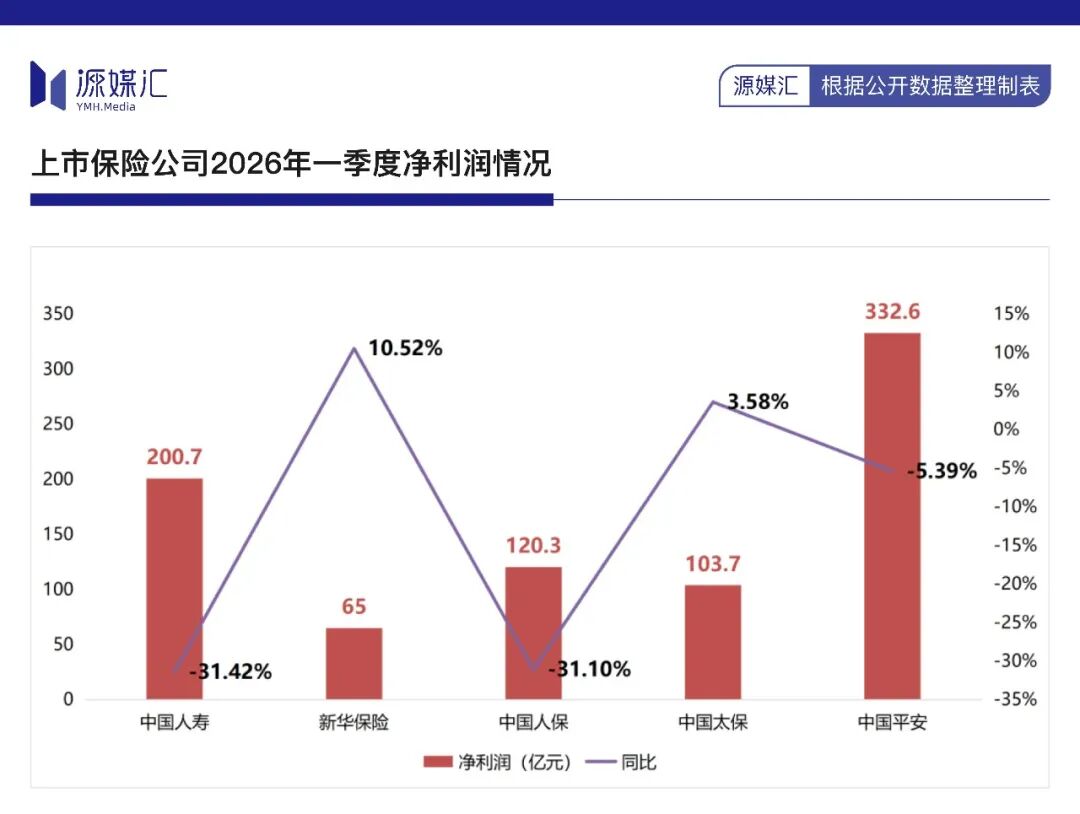
In the second quarter alone, China Life's net profit reached 1088.6 billion yuan to 1170.3 billion yuan, with a staggering year-on-year growth of 758.5% to 823%. Although New China Life Insurance's performance is relatively lower, it also saw a sharp increase, with net profit of 142.2 billion yuan to 172 billion yuan, up 59.4% to 92.6% year on year.
It is very difficult to achieve explosive performance growth in a short period of time only by selling a few more insurance policies, because the improvement of insurance product profits, premium growth and rate settlement all take a period of time to show effects.
The State Administration of Financial Regulation released the operating data of the insurance industry on July 24. In the first half of this year, the insurance industry achieved original insurance premium income of 3.86 trillion yuan, a year-on-year increase of 3.25%, with total assets of 43.86 trillion yuan, up 6.15% from the beginning of the year.
Funds invested in stocks and funds can create huge floating profit for insurance companies as the value of equity fluctuates.
However, in the first quarter of this year, these "old guard" insurance companies suffered painful floating losses. Among them, China Life recorded a fair value loss of 42.86 billion yuan, Ping An Insurance lost nearly 50 billion yuan, New China Life Insurance and PICC lost more than 20 billion yuan respectively, and China Pacific Insurance lost 5.59 billion yuan.
After holding on to the second quarter, the market trend reversed, and companies including China Life and New China Life Insurance may have covered their losses one after another and generated explosive floating profits.
Why are insurance capital rushing into equity investment and achieving explosive profit growth? This is related to the previous industry reform: the transition to the new accounting standards.
There is a key indicator in the new standards: FVTPL. In simple terms, the equity of held financial assets and interest rate fluctuations are directly included in the profit and loss, that is, both floating profits and floating losses must be recorded in the income statement.
But all these profits are just "paper wealth".
Take China Life's investment in GigaDevice as an example. Although it exited the position with profit, the amount recorded in the income statement is far different. The selling price on July 8 was 615.9 yuan per share, but the amount recorded in the income statement was calculated based on the price of 815 yuan per share at the end of June, with a bubble value of as high as 24.4%.
Therefore, the fluctuation of investment profit and loss can easily obscure the actual operating status of an insurance capital company, including its real business quality, profit, assets and liabilities, and solvency.
More importantly, insurance capital companies are easily constrained by short-term profits, making it a difficult problem to figure out how to pursue long-term value in operation.