The return of nearly 100,000 tons of lithium: Has CATL gotten through this tough hurdle?
Has the Jianxiawo lithium mine resumed production or not? For quite some time, this question has sparked prolonged debates between the bulls and bears in the lithium carbonate market.
Those claiming it has resumed production cited permits, equipment mobilization and accounts from insiders; the skeptics, however, pointed to the missing public environmental assessment information. During an on-site investigation by a reporter from Shanghai Securities News, no vehicles were seen entering or leaving the ore dressing plant. The environmental assessment process was suspended for half a year after its first public notification in December 2025, and it was not until July 27 that the draft for comments was posted, bringing the project back to the statutory public participation stage, with the official environmental assessment approval yet to be obtained.
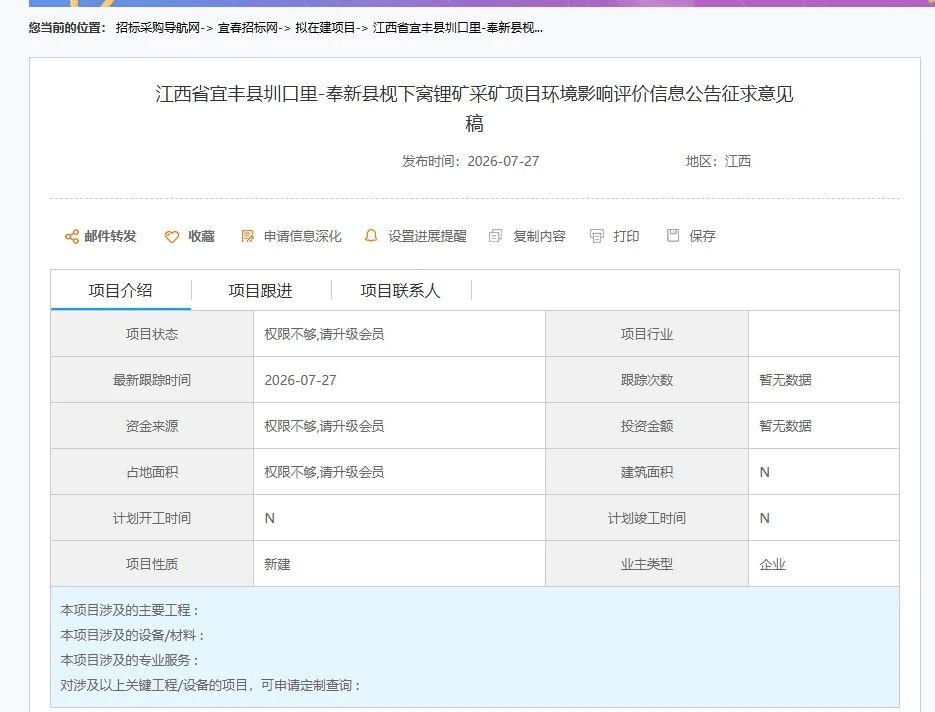
Jianxiawo has passed the key permit node for resumption of production, but its "full resumption" has not yet been officially confirmed. However, as the approval process restarts, the market has already priced in the expected output in advance.
The market moves faster than the approval process. On May 12, the main lithium carbonate contract of the Guangzhou Futures Exchange hit an intraday high of 208,800 yuan per ton for the year; on June 18, as the news that the new land use permit for Jianxiawo was approved spread, the main contract fell by 6.58% in a single day. Few mines can trigger such a drastic reaction in the futures market just by releasing a single procedural document.
Perhaps because the owner of this mine is CATL. It is not only the controller of the potential supply resumption, but also one of the biggest bearers of lithium raw material price fluctuations. A month later, the company released its half-year report, recording a net profit attributable to shareholders of 43.284 billion yuan, up 42% year on year.
The Shutdown of a Mine
Jianxiawo is one of the largest single lithium mica mines in the world. The inferred resource volume of porcelain stone ore in the mining area is about 960 million tons. Roughly converted based on the raw rock density of 2.7 tons per cubic meter, its volume is equivalent to the water storage capacity of 25 West Lakes in Hangzhou.
The mining area is associated with 2.6568 million tons of lithium oxide, which is theoretically equivalent to about 6.57 million tons of lithium carbonate equivalent. Calculated based on the recoverable reserves and the annual mining scale of 30 million tons of raw ore, the mine has a service life of about 26 years. Before the shutdown, its mining, beneficiation and smelting system produced about 7,000 to 8,000 tons of lithium carbonate per month, accounting for 8% to 10% of the country's monthly output and more than 20% of the monthly output of lithium mica in Jiangxi Province; the industry estimates that its full-capacity annual output can reach 100,000 to 120,000 tons.
The shutdown was caused by the expiration of the mining license. The mine obtained the mining license in 2022, and the key links of mining, beneficiation and smelting were put into operation successively in October 2023 and entered the capacity ramp-up phase. The license expired on August 9, 2025, the mining operation was suspended, and CATL confirmed the shutdown on August 11.
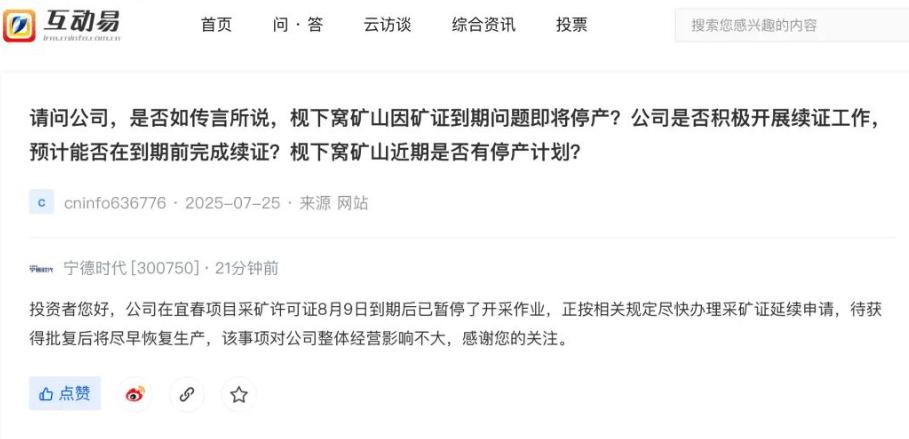
On August 11, a reporter from Securities Daily ran into several investors during an on-site investigation. "We might be the only outside witnesses to the shutdown of the Jianxiawo mining area," the investors said, "Yesterday, we climbed to the top of the mountain via a path at around 9 p.m., arrived at the top at 11 p.m., and by 12 midnight, all the operating excavators and bulldozers stopped production on time."
The real reason why Jianxiawo was shut down for more than ten months is that the license renewal process coincided with the tightening of lithium resource management rules — after the new version of the *Mineral Resources Law* came into effect in July 2025, the registration, transfer and mining permits for strategic minerals were further standardized.
Jianxiawo was originally registered as "ceramic soil (lithium-containing)", but later its main economic value turned to lithium extraction. The average lithium oxide grade in the mining area is only about 0.27%. The local rectification requirements mandate re-verification of reserves, change of main mineral type, re-calculation of the proceeds from the transfer of mining rights, and re-alignment of procedures related to land use, environmental assessment, and work safety. Eight lithium mines in Yichun are undergoing centralized license renewal and rectification, and Jianxiawo is the largest and fastest-progressing one — every step of its progress has therefore become a sample for the whole industry to observe the overall rectification progress.
Subsequently, this mine became one of the most sensitive buttons for lithium price fluctuations. The first time the button was pressed hard was on the day of the shutdown. On August 8, the last trading day before the license expired, the main lithium carbonate contract had soared 7.73%, approaching the daily limit; on August 11, when CATL confirmed the shutdown, the main futures contract hit the 8% daily limit at the opening, closing at 81,000 yuan per ton, hitting the 2025 high for the year — the bulls had rushed to take positions before the official news landed.
In the following trading days, the contract fluctuated sharply, and hit the down limit again on August 20. After the news of the resumption of production work conference in September 2025 and the first public notification of environmental assessment information on December 19, the market expected the resumption to happen around the 2026 Spring Festival, which ultimately failed to materialize.
In May 2026, the price hit a new high for the year; in June, the old land use procedures were cancelled, and the price continued to rise; on June 18, the new land use permit was approved, and the market plummeted sharply in a single day; on June 29, the updated work safety permit was approved — the main mineral type was changed from "ceramic soil (lithium-containing)" to "lithium ore, ceramic, rubidium, cesium", with a permitted production scale of 30 million tons of raw ore per year. From the perspective of permits, this mine has transformed from a ceramic soil mine to a lithium mine.
On July 27, the draft for comments of the environmental assessment that had been suspended for half a year was released, entering the public participation stage — the process restarted, but according to the workflow, there are at least two more rounds of public notifications after acceptance and before the approval decision before the final approval is issued. What the market has been trading back and forth is essentially one thing: when will the potential annual output of nearly 100,000 tons be restored.
Calculations by Citic Futures show that in the neutral scenario, the global lithium resource supply and demand in 2026 will only have an oversupply of about 7,000 tons of LCE; Citi previously also judged that the resumption of production at Jianxiawo will not reverse the industry's destocking trend. Even if the approval process continues, the actual output increment within the year still depends on the environmental assessment approval, resumption of production and the capacity ramp-up rhythm. The previous sharp fluctuations in the market triggered by a single procedural document were more driven by trading sentiment rather than actual output volume.
The mine was shut down, but CATL's battery production lines could not stop. In the first half of 2026, CATL's battery output still reached 498 GWh, and its capacity utilization rate rose to 94.86%.
Rising Lithium Price and Diverging Profits
On the evening of July 24, CATL's half-year report was released. In the first half of the year, CATL recorded operating revenue of 2769.17 billion yuan, up 54.8% year on year; net profit attributable to shareholders was 43.284 billion yuan, up 42% year on year; energy storage revenue was 53.261 billion yuan, up 87.54% year on year. The net profit margin attributable to shareholders dropped from 17.04% to 15.63%, with the revenue growth rate nearly 13 percentage points higher than the profit growth rate. In other words, CATL exchanged slightly lower profit margins for more orders and larger market share.
The continuous rise of lithium price from the low point has brought cost pressure to the whole industry, but the pressure is not evenly distributed. Most second-tier manufacturers mainly purchase raw materials such as cathode materials, whose purchase prices are linked to lithium carbonate prices. The rise in raw material prices not only squeezes gross profit margin, but also increases the working capital required for stock preparation; even with the shutdown of Jianxiawo, CATL's large-scale procurement, long-term supply agreements, resource investment and recycling system help it diversify risks.
There are three other sets of figures related to the strategic value of Jianxiawo. First, the gross profit margins of power batteries and energy storage batteries decreased by 1.78 and 1.56 percentage points respectively to 20.63% and 23.96%, indicating shrinking profits at the downstream end. Second, the gross profit margin of the mining, materials and recycling business rose to 27.04%, and the upstream link is providing profit buffer. At the same time, the 94.86% capacity utilization rate and 764 GWh of under-construction capacity mean that CATL needs to digest more lithium resources in the future.
Scale expansion has increased capital demand. The operating cash flow in the first half of the year can still cover the net profit, but the coverage multiple has dropped from 1.93 times to 1.39 times.
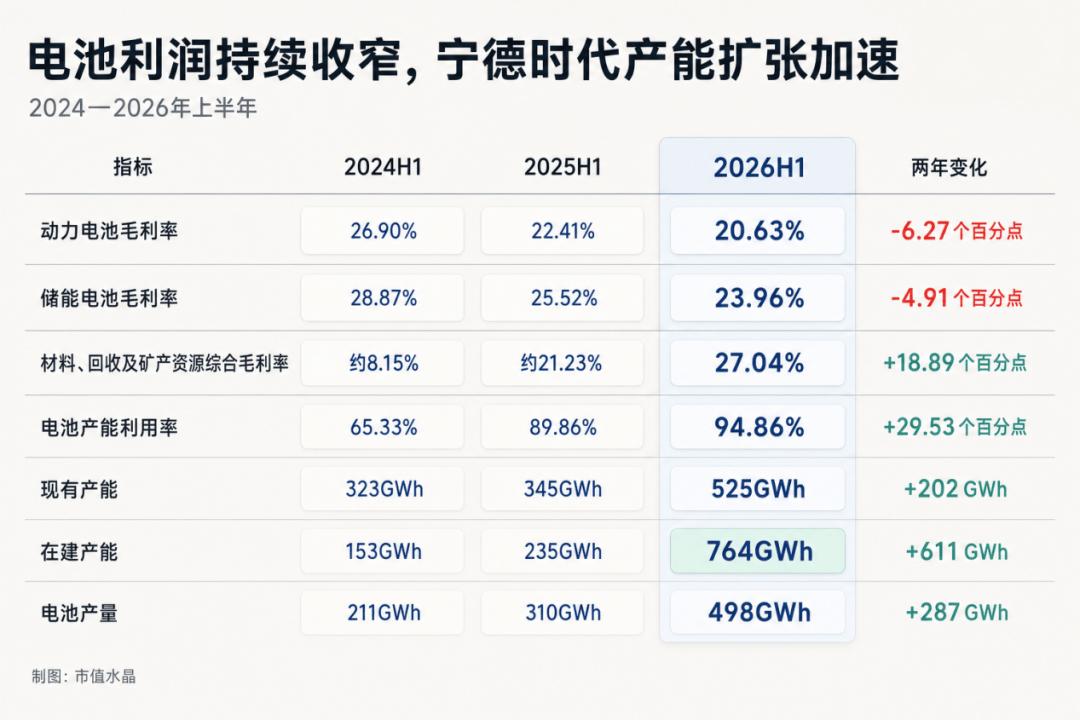
The significance of Jianxiawo has thus evolved from a single mine to a resource insurance for capacity expansion.
Among second-tier manufacturers, Ruipu Lanjun suffered losses for eight consecutive years before recording a net profit of 681 million yuan, with a net profit margin of less than 3%; LIU Jincheng, Chairman of EVE Energy, once said "In the power battery industry, we don't even have the qualification to participate in the cutthroat competition, no one can compete with BYD and CATL." When raw material prices rise, leading manufacturers only lose part of their profits, while second-tier manufacturers face huge pressure on their break-even line.
The Cost of Option Right
Jianxiawo does not lock CATL into a permanent low-cost line. The theoretical 6.57 million tons of lithium carbonate equivalent is only a theoretical value converted from the total resource volume, which does not equal the economically recoverable reserves.
Long before this round of lithium price fluctuations, CATL began to deploy upstream lithium resources. In September 2021, the company announced that it would invest no more than 135 billion yuan in Yichun to build a battery base, with a planned first-phase capacity of 50 GWh; in April 2022, its subsidiary Yichun Times obtained the Jianxiawo mining right for 865 million yuan.
CATL's resilience did not come naturally. In Q1 2022, the price of lithium carbonate quickly broke through 500,000 yuan per ton from about 280,000 yuan per ton at the beginning of the year, CATL's net profit attributable to shareholders fell by 23.62% year on year, and its gross profit margin dropped to 14.48%. The more batteries it sold, the greater the exposure it faced to lithium price fluctuations.
Jianxiawo is a low-grade lithium mica mine. To produce one ton of lithium, a huge amount of ore and tailings need to be moved, so its mining and smelting costs are not inherently lower than purchasing from the market. When the lithium price is low enough, purchasing from external sources may even be cheaper. What CATL really obtained is more options, and Jianxiawo is a suitable one among these options.
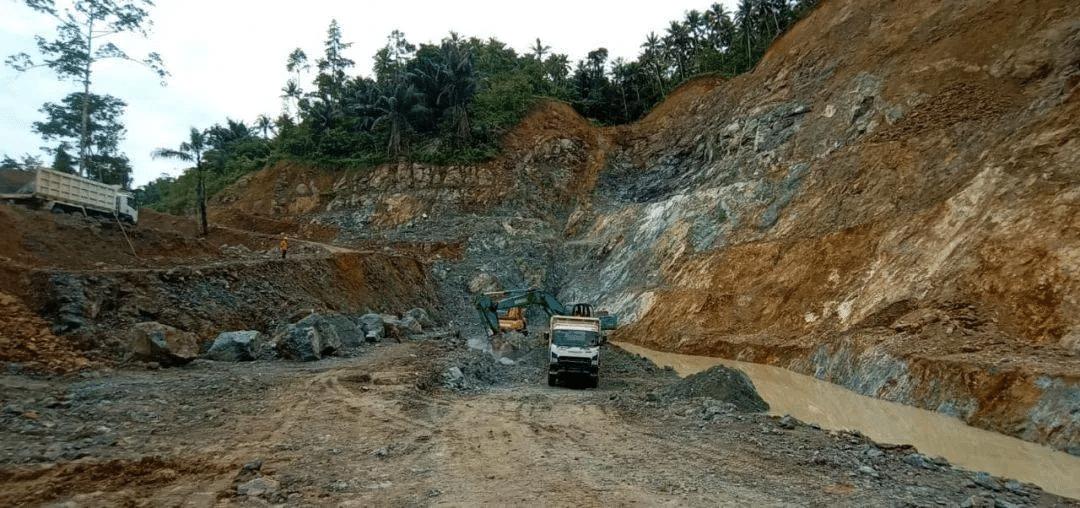
The other options are hidden in the half-year report. The original book value of all the company's mining rights and exploration rights is 8.049 billion yuan, with accumulated impairment provisions of 3.569 billion yuan, and the net book value has dropped to 4.426 billion yuan. The gross profit margin of the "battery materials and recycling, mineral resources" business is 27.04%; the nominal amount of commodity hedging instruments at the end of the period is 19.616 billion yuan, and the combined profit from commodity and foreign exchange hedging and spot positions is slightly positive. Coupled with long-term procurement agreements and industrial chain investments, CATL relies not on a single mine, but a complete resource allocation system to cope with lithium price fluctuations.
Self-owned mines, resource investment, recycling, long-term agreements and hedging together constitute CATL's resource option right. When lithium prices rise, self-supply, recycling and long-term agreements can buffer costs; when lithium prices fall, the company can increase external procurement and reduce the output of low-grade mines. Compared with second-tier manufacturers with fewer resource tools, CATL can more easily control raw material costs within an affordable range, thus having more room to cut battery prices.
This option right will eventually be accounted for together with the 764 GWh of under-construction capacity. The 764 GWh of under-construction capacity is the capacity that CATL deployed in advance based on its judgment that the industry's compound annual growth rate will reach 20% to 30% in the next five years.
The resource system can diversify raw material price fluctuations, but cannot eliminate the depreciation of production lines and capital occupation. As the scale of capacity expansion increases, the risks CATL bears have extended from pure lithium price fluctuations to capacity digestion pressure.
Looking back, Jianxiawo has hardly produced a single ton of new ore in the past year.
But it has left figures on three sets of accounts: the futures market has repeatedly priced in the potential annual output of nearly 100,000 tons; CATL's battery output rose to 498 GWh, with a capacity utilization rate of 94.86%; the company is still building 764 GWh of battery capacity.
The mine shutdown did not stop battery production, and the resumption of the mine will add a new raw material source in addition to external procurement, recycling and self-supply.
After the public notification on July 27 was released, Jianxiawo was brought back to the statutory procedure from the resumption of production rumors. The gap between second-tier manufacturers and CATL has thus extended from a single mine to the complete resource system that supports CATL to operate at near full capacity even after the mine was shut down for ten months.