The newly crowned king of the A-share market, are you ready to work for carmakers?
At the listing appreciation dinner of Changxin Technology, a photo of Li Bin holding a glass of red wine and smiling widely went viral across social media.
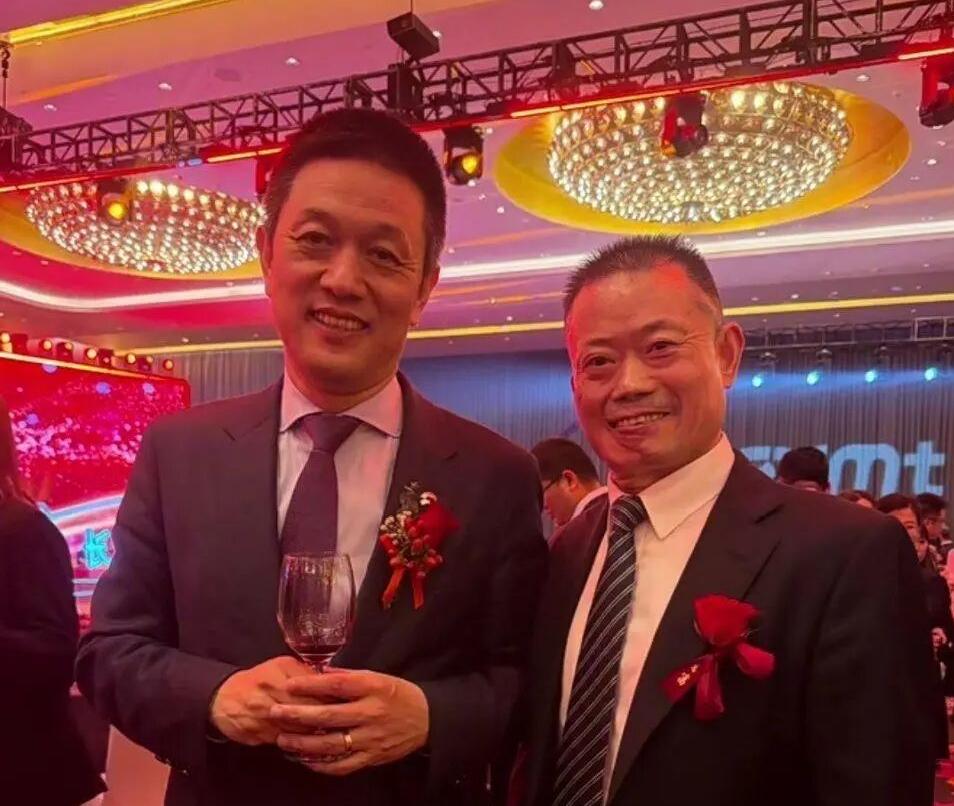
There is a solid reason behind this.
Just a few hours before the dinner, Changxin Technology, a leading domestic storage chip enterprise, was officially listed on the Sci-Tech Innovation Board with an issue price of 8.66 yuan. Its share price skyrocketed immediately after the market opened, triggering multiple temporary trading halts during the session. It finally closed at 49 yuan per share, surging by 465.82%, with a total market value reaching an unprecedented 3.31 trillion yuan.
What does this market value mean? It has surpassed Intel, is equivalent to two times the market value of Kweichow Moutai, and has also overtaken Industrial and Commercial Bank of China, which has long occupied the top spot of A-share market by market value. It has refreshed the historical ceiling and made Changxin Technology the company with the highest market value in the history of A-shares.
In the placement list of this epoch-making IPO, the name of NIO is clearly on the list. It promised to subscribe for 158 million yuan worth of shares, becoming the only new energy vehicle enterprise in the strategic placement list of Changxin's IPO.
If we simply calculate based on the closing price on the first trading day, the book value of this investment has reached 894 million yuan. After subtracting the cost, the floating profit is firmly at the level of 740 million yuan, with an investment return rate of nearly 466%.
Earning nearly 800 million yuan passively in a few hours would make anyone smile.
Some netizens commented: "NIO invested 158 million yuan, and now the value of this investment is between 800 million and 900 million yuan. The money Li Bin earned here is more than the total profit NIO has made since it started making cars."
However, if you only think that Li Bin's gain is just this easy profit, you are missing the bigger picture.
The real intention is far beyond this small profit
According to the disclosure in the issuance announcement, NIO subscribed for 158 million yuan worth of shares with a lock-up period of 18 months. Calculated at the issue price of 8.66 yuan per share, NIO subscribed for about 18.2448 million shares.
The announcement clearly states that the proportion of shares allocated to NIO is 0.27%, but the denominator of this 0.27% is the about 6.688 billion shares initially issued by Changxin Technology this time, not the total share capital after listing.
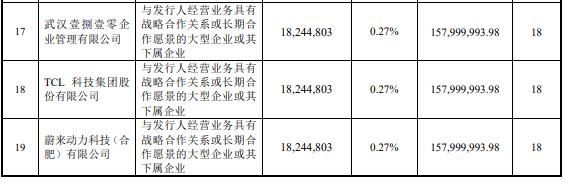
The total share capital of Changxin Technology after issuance is about 66.881 billion shares, which is ten times higher than the initial issuance volume. That means NIO's actual shareholding ratio is about 0.027%. Calculated based on the closing price of about 49.19 yuan per share of Changxin Technology, the book value of this investment has reached 894 million yuan. After subtracting the cost, the corresponding book floating profit is about 740 million yuan, with an investment return rate of nearly 466%.
In terms of book value, the return is indeed considerable, but for the scale of NIO, 700 million yuan is not a huge windfall. After all, according to NIO's financial report, it still held 48.2 billion yuan in cash on its account by the end of the first quarter.
What's more, all the current gains are just "paper wealth". NIO cannot sell any of these nearly 900 million yuan worth of shares, as the announcement clearly stipulates that the placement lock-up period is 18 months. That means NIO cannot sell the shares no matter how much profit it gets for now, and future fluctuations in share price will affect the final return.
Obviously, what Li Bin values is far more than this small sum of money. Then what does NIO pursue? NIO has not disclosed many details, but the industry logic is very clear: automotive-grade storage chips.
As we all know, there was a boom in storage chip price hikes in the first half of this year. According to data from CCTV Finance and industry institutions, from March to June this year, the overall price of domestic automotive-grade storage chips increased by about 180%, and the price of high-end DDR5 models even increased by more than 300%.
The number of DRAM and NAND chips required by a smart car far exceeds that of traditional cars. Specifications such as LPDDR4X and LPDDR5X have also been widely used in smart cockpits and autonomous driving domain controllers. In the past, Chinese carmakers almost fully relied on Samsung and SK Hynix for such chips. Once there was supply fluctuation or trade restriction, the whole vehicle production would be stuck in bottlenecks.
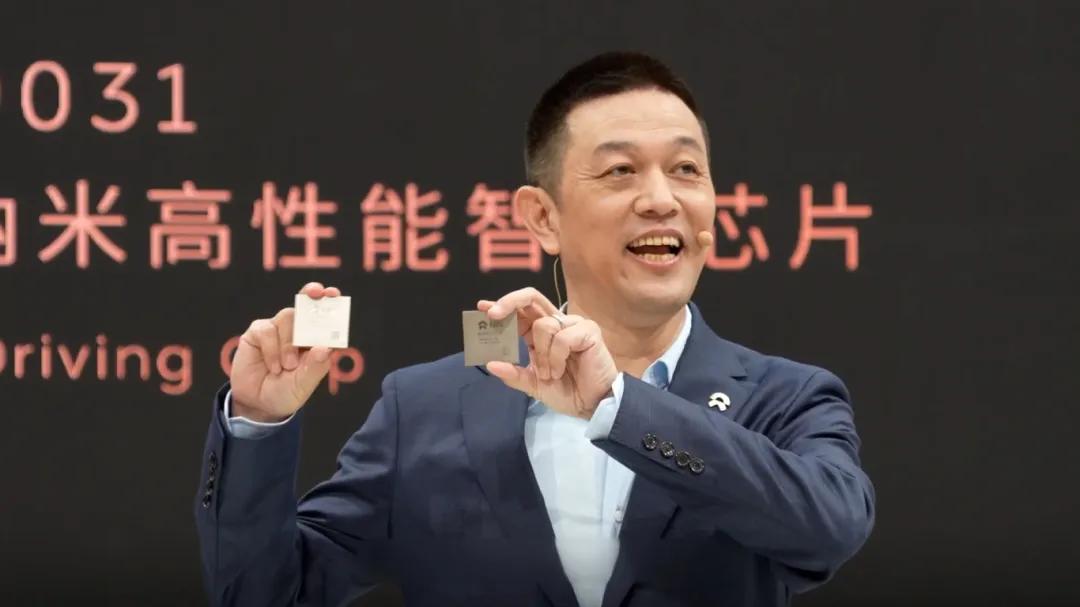
Li Bin once publicly stated earlier that NIO's latest generation of vehicles uses more than 4000 chips per car, covering more than 1000 semiconductor part numbers, and the total value of chips per car exceeds 36000 yuan.
He also said that the rise in memory prices alone could increase the cost of a high-end new energy vehicle by 3000 yuan to 5000 yuan; coupled with the price hikes of other raw materials, the impact on the cost of a single car is close to 10000 yuan.
What worries carmakers more than price hikes is the stability of supply. In 2021, the global automotive chip shortage forced NIO's Hefei factory to stop production for several days, and its monthly delivery volume was directly cut in half. That supply crunch made Li Bin realize a truth: in front of supply chain stability, even the most precise cost control will be wiped out in an instant.
Therefore, this move by Li Bin is to add an insurance to NIO's chip supply chain. The 158 million yuan strategic placement essentially uses capital ties to further consolidate the cooperation that has already entered the product verification stage.
Li Bin's response in media interviews is also very straightforward: cooperation with Changxin Technology helps improve the stability of NIO's supply chain.
He also repeatedly mentioned a detail on many occasions: "Changxin Memory's factory is very close to ours, we can even walk there, both are located in the north zone of the Economic Development Zone."
Automotive-grade chips have inherent problems of long adaptation verification cycle and high cost. The geographically close distance brings qualitative differences in communication cost and verification efficiency. The physical distance of only a few hundred meters is therefore very critical.
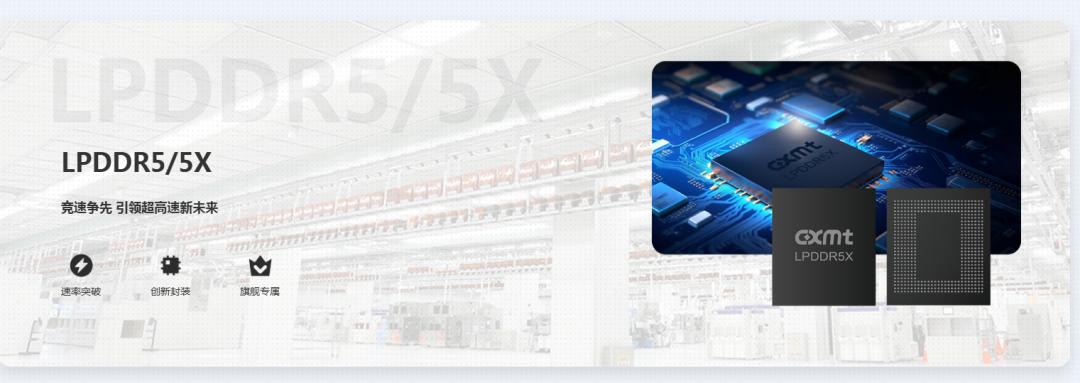
At the product level, Li Bin disclosed the progress at the Science and Technology Exchange Conference in April this year: Changxin's LPDDR5X vehicle memory chips have been installed on NIO's vehicles. The two teams have jointly completed the adaptation, and the on-board verification of the cooperative chips is going very smoothly. It is worth mentioning that NIO's self-developed 5nm intelligent driving chip "Shenji NX9031" is most likely equipped with LPDDR5X memory.
Li Bin used 158 million yuan to lock in the "memory supply right", which will create value far exceeding the current 740 million yuan in the current cycle of automotive storage price hikes.
Two other carmakers also made huge profits
Although Li Bin was the only new energy vehicle enterprise leader who appeared at Changxin Technology's appreciation dinner that night, two other vehicle manufacturing enterprises appeared in the strategic placement list announced by Changxin Technology.
One is Chery, the other is Xiaomi.
The former entered the strategic placement list through its entity Chery Intelligent Automotive Technology (Hefei) Co., Ltd., while the latter used an entity named Wuhan 1810 Enterprise Management Co., Ltd.
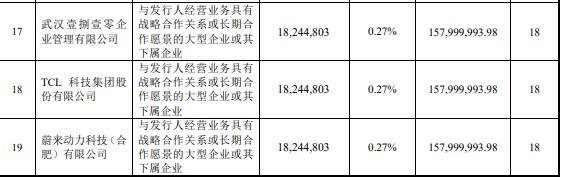
Wuhan 1810 Enterprise Management Co., Ltd. was founded in 2021, with its office located in Wuhan East Lake High-tech Zone. Although many people have not heard of it, it is worth noting that Wuhan 1810 Enterprise Management Co., Ltd. is a wholly-owned subsidiary of Xiaomi Technology. The chairman of Xiaomi Technology is Lei Jun, who holds 97.48% of the shares of Xiaomi Technology.
Everything matches now.
Just like NIO, both of them obtained the 158 million yuan strategic placement, and the lock-up period of the allocated shares is 18 months. Calculated based on the same allocation scale, the theoretical floating profit also reaches the level of 700 to 800 million yuan. Considering that Lei Jun holds more than 97% of the shares of Xiaomi Technology, his personal book profit after conversion is about 717 million yuan. That is why the hot search term "Lei Jun made a huge profit of 700 million yuan from new share subscription" also appeared on social platforms.

It even attracted Xu Jieyun, special assistant to the chairman of Xiaomi Group and deputy general manager of Strategic Marketing Department, to repost and respond: Friends just treat it as a joke and don't take it seriously. In fact, it can't be calculated like this. This is a corporate investment behavior, and the specific subsidiary entity cannot be mixed with personal wealth.
At the specific business level, although Chery has not clearly disclosed the cooperation progress like NIO, it has a similar positioning. As a downstream application enterprise, it participates in the strategic placement, with the same purpose of "seizing the position" for the next generation of smart car computing chip supply, locking in production capacity supply in advance, and reducing the uncertain risks of the future supply chain from the source.
The most special one is Xiaomi. According to public disclosure, Lei Jun's industrial fund entered Changxin's shareholder system as early as the financing stage, which means that Lei Jun's return on strategic investment will most likely exceed the return of the other two companies that only participate in the placement.
Moreover, in terms of business, Xiaomi was one of Changxin Technology's core downstream customers back in the mobile phone era. Many of its flagship models have long been equipped with Changxin's LPDDR series memory products.
What's more, after Xiaomi entered the automotive industry, its demand for automotive-grade DRAM will inevitably expand rapidly. According to the monthly sales volume of Xiaomi cars and the multiple upcoming models to be launched, it can be said that Xiaomi's dependence on storage chips in smart cockpits and autonomous driving is no less than any other new car-making force.
Therefore, for Xiaomi, the investment logic of 158 million yuan is essentially no different from that of NIO and Chery, and what it locks in is also the stable supply right of automotive-grade storage chips. The only difference is that Xiaomi's procurement volume will be larger.
In addition, there is an "absentee" in Changxin Technology's circle of friends that is worth mentioning -- BYD. Although it is not on the strategic placement list, it is one of the carmakers that bet on Changxin Technology the earliest.
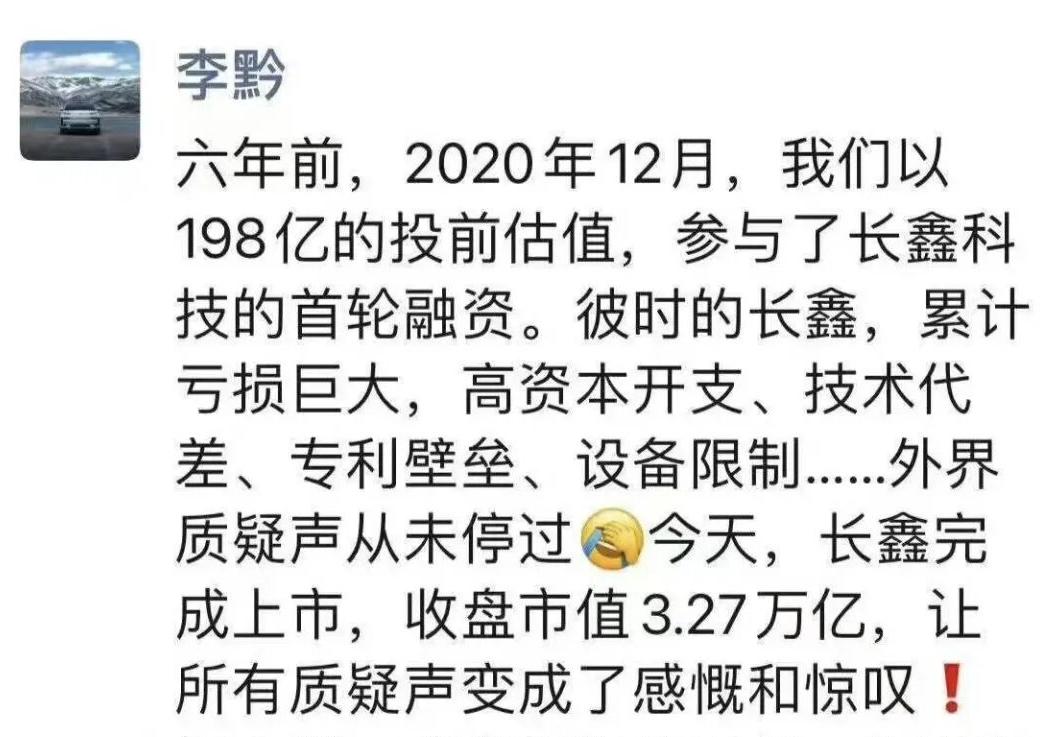
On the day Changxin Technology was listed, Li Qian, Secretary of the Board of Directors and General Manager of Investment Department of BYD, posted on his WeChat Moments, reviewing the investment process six years ago and mentioning that in December 2020, BYD participated in Changxin Technology's first round of financing with a pre-money valuation of 19.8 billion yuan. At that time, Changxin Technology had accumulated huge losses and faced multiple problems such as high capital expenditure, technology generation gap, patent barriers and equipment restrictions.
According to inquiries, at the end of 2020, BYD invested 50 million yuan in Changxin Technology through Yifang Changda - Zhaoyin Yunting, and the pre-money valuation at that time was 19.8 billion yuan.
It is also worth noting that Wang Chuanfu, chairman of BYD, also appears in the list of natural person shareholders of Changxin Technology, with 0.014% of beneficial shares. Calculated based on the total market value of 3.28 trillion yuan on Changxin Technology's first closing day, its book value is about 462 million yuan, with an investment return rate of 165 times.
Closed loop of breakthrough
Although Changxin Technology has grown into a chip giant with a market value of more than 3.3 trillion yuan, and many carmakers have expressed their willingness to cooperate with it.
The relationship between it and carmakers is mutually reinforcing, because the only verification interface for chips such as automotive-grade LPDDR5X can only be held by carmakers.
What it brings to China's automotive industry is far more than "one more supplier".
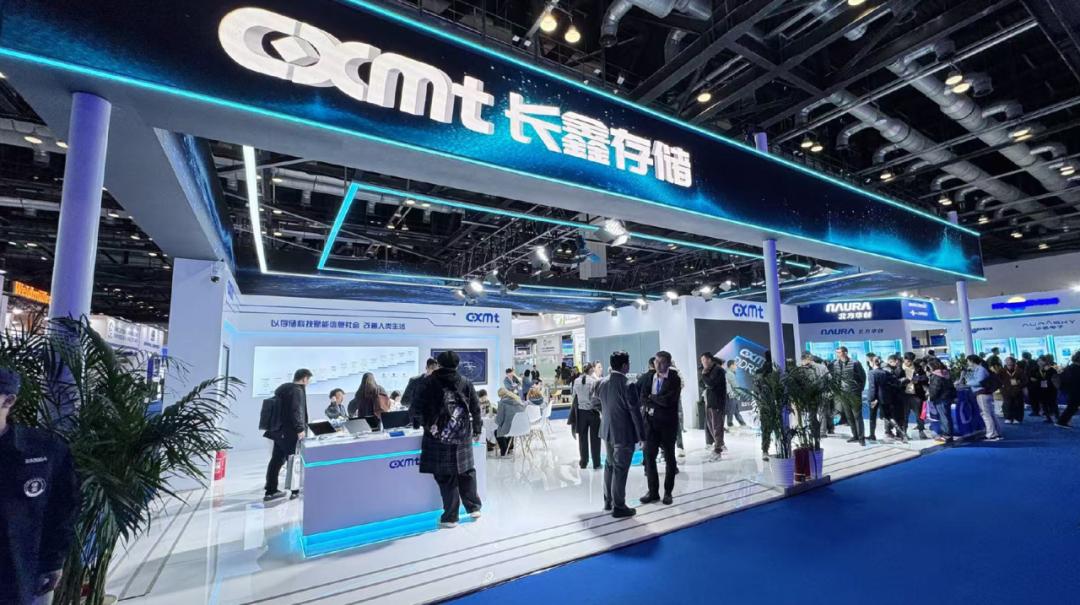
The lifeline of storage chips was long controlled by overseas manufacturers in the past. More than 90% of the global automotive-grade DRAM market share is controlled by the three giants of Samsung, SK Hynix and Micron.
In the past, when carmakers purchased chips from overseas manufacturers, they had to depend on production capacity