The "first listed battery swap enterprise" that Nio invested 400 million yuan in has Nio itself as its largest competitor.
A cross-border move with a contrast as dramatic as "Lao Gan Ma developing rockets" has emerged.
Recently, a rather distinctive unicorn enterprise has appeared in the IPO pipeline of the Hong Kong Stock Exchange: Aulton New Energy.
This is a company focused on the battery swapping business for new energy vehicles. After multiple rounds of financing, Aulton New Energy reached a valuation of approximately 11.9 billion yuan after its last round of financing in 2022. On July 19, it submitted its listing application to the Hong Kong Stock Exchange for the second time, preparing to strive for the title of "the first battery swapping stock" on the Hong Kong stock market.
Source: Aulton New Energy prospectus
Interestingly, this new energy battery swapping company was co-founded by Cai Dongqing, known as the "Father of Pleasant Goat", and Zhang Jianping, an expert in battery swapping technology.
The character "Ao" in the company's name easily reminds people of another company under Cai Dongqing's control: Alpha Group. This company, which owns national-level animation IPs such as *Pleasant Goat and Big Big Wolf* and *Balala the Fairies*, became "the first Chinese animation toy stock" as early as 2009.
While the transition from Pleasant Goat to new energy battery swapping is already astonishing enough, more surprising details lie ahead.
The presence of NIO Capital can also be found in the shareholder list of Aulton New Energy.
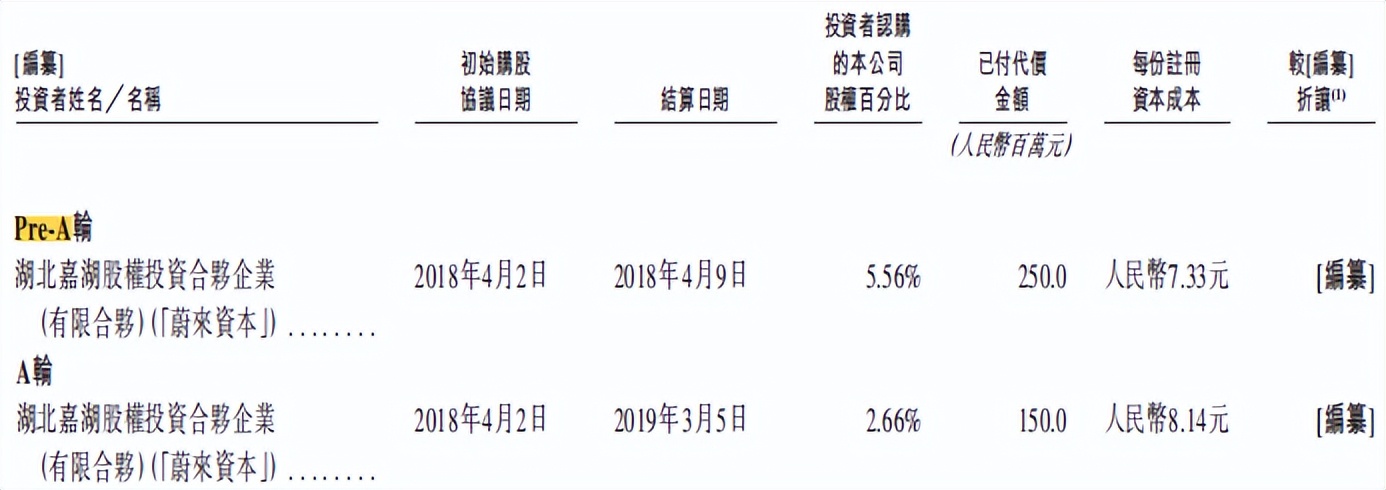
In 2018, NIO Capital exclusively invested 250 million yuan in the Pre-A round; one year later, it added another 150 million yuan, with a total investment of 400 million yuan across the two rounds. After subsequent dilution from follow-up financings, NIO Capital still holds 5.53% of Aulton New Energy's shares at present.
Source: Aulton New Energy prospectus
In other words, NIO, the most steadfast promoter of the domestic battery swapping model, has not only been developing its own battery swapping business, but also invested in a company that may potentially compete with it for market share.
What is more subtle is that NIO was listed on the Hong Kong Stock Exchange as early as 2022. Given its determination and efforts to promote battery swapping, many people believe it is far more qualified to claim the title of "the first battery swapping stock" on the Hong Kong stock market, even though it is a complete vehicle manufacturer.
What is the intention behind NIO Capital's decision to invest capital in such a rival that competes with its own business?
Even NIO has to call it a predecessor
The history of Aulton's battery swapping business actually dates back longer than the company itself.
Aulton New Energy was not officially established until 2016, but Zhang Jianping, its co-founder, and his team began exploring electric vehicle battery swapping as early as around 2000. In 2001, they applied for their first patent related to battery swapping technology; in 2009, Zhang Jianping founded Shanghai Dianba, which was later acquired by Aulton, to continue the R&D of battery swapping stations and battery swapping modules.
After Cai Dongqing joined, this veteran in the battery swapping industry obtained more sufficient capital to promote the technology that had been explored for many years to more cities.
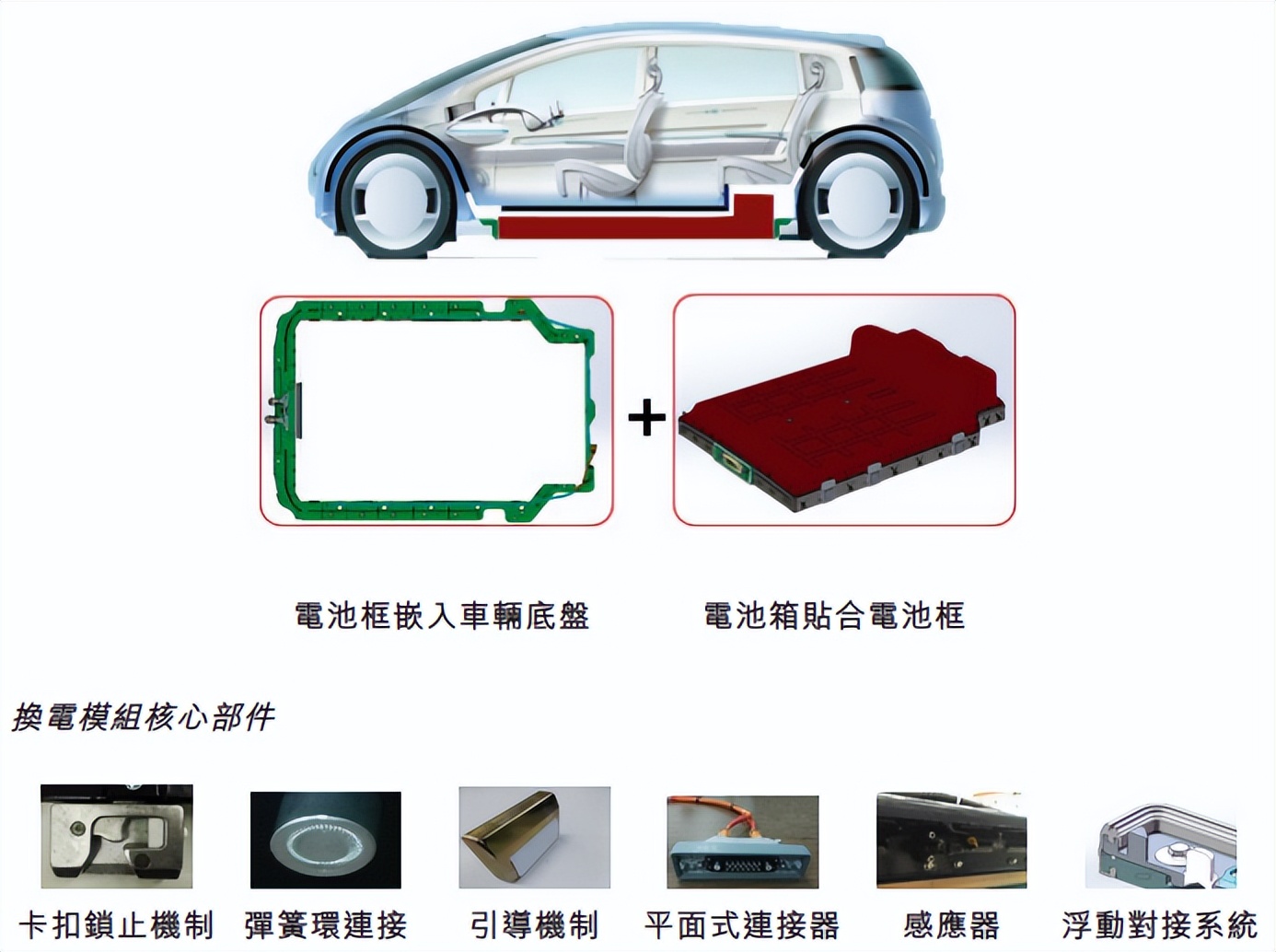
What Aulton chose is a chassis snap-in battery swapping solution.
Source: Aulton New Energy prospectus
After the vehicle is parked stably, the battery swapping equipment supports the battery from below the chassis, releases the snap fasteners that fix the battery, lowers and removes the depleted battery; then it lifts up a fully charged battery, re-fastens the snap fasteners and connects the circuit.
From Audi Double Diamond remote-controlled racing cars to Aulton New Energy, what Cai Dongqing does has changed from toys to automobiles, but the battery swapping action has a wonderful historical continuity: open the bottom snap fastener, take out the depleted battery, and fasten a new fully charged battery in place.
The only difference is that the battery being replaced this time is no longer two AA batteries, but an automotive power battery weighing hundreds of kilograms.
In fact, according to the data released by Aulton, its battery swapping speed is even faster than replacing the battery of a remote-controlled racing car: it only takes 20 seconds at the fastest to complete the disassembly and installation of a passenger car battery.
In effect, this battery swapping method does share certain similarities with the passenger car battery swapping system promoted by NIO: both remove the entire battery from the bottom of the car and install a fully charged new battery.
However, the two companies use two sets of systems that cannot be directly interoperable.
The battery size, locking structure and communication protocol of the two solutions are all different. NIO vehicles cannot directly replace batteries at Aulton's battery swapping stations, and vehicles adopting Aulton's solution cannot enter NIO's battery swapping stations either.
The timeline can also prove this point.
In December 2017, NIO had already publicly demonstrated its first-generation battery swapping station; in April 2018, NIO Capital completed its first round of investment in Aulton. More than a month later, NIO's first battery swapping station was put into operation in Shenzhen.
In other words, before NIO Capital invested in Aulton, NIO's vehicle models, battery packs and first-generation battery swapping stations had basically completed development.
Therefore, it is obvious that NIO Capital's investment in Aulton has nothing to do with Aulton's battery swapping technology; a more reasonable explanation is that NIO Capital is optimistic about the other battery swapping route represented by Aulton.
NIO follows the in-house self-built model by vehicle manufacturers. It designs vehicles and batteries on its own, and then lays out the battery swapping network for its own users. The advantage is that vehicles, batteries and battery swapping stations can be developed in a unified manner, making the user experience easier to control; the cost is that the upfront investment is huge, and the number of vehicle models that a battery swapping station can serve is relatively limited.
Aulton takes the third-party open route. It does not produce automobiles, but tries to connect different automakers and different vehicle models to the same battery swapping network. As long as there are enough connected vehicle models and vehicles, one battery swapping station will have the opportunity to serve more users.
In 2018, the battery swapping model was far from being validated by the market, and it was difficult to predict in advance which of the two routes could succeed.
But precisely because of this, NIO itself placed its bet on the self-built network model by automakers, while NIO Capital spent 400 million yuan to acquire shares in Aulton, which is equivalent to securing a position in the third-party public battery swapping track.
However, is the Aulton battery swapping business selected by NIO really a good business?
Battery swapping generates 100 yuan in revenue but costs 121 yuan
In terms of scale, Aulton has indeed achieved certain results in developing the third-party battery swapping route.
As of the end of April 2026, Aulton's smart energy service platform has connected 531 battery swapping stations, more than 140,000 electric vehicles and 160,000 batteries; it has also cooperated with more than 16 mainstream automakers including FAW, Dongfeng, Changan, SAIC, BAIC and GAC to jointly develop more than 30 battery swapping vehicle models.
Calculated based on the revenue from battery swapping station operation services in 2025, Aulton has ranked the third in China.
Judging only from these figures, NIO Capital's bet back then can almost be praised as "having a unique vision".
However, when we look through Aulton's financial books, the situation is not so optimistic.
At present, Aulton mainly makes profits from two business lines.
The first line is providing battery swapping services for other parties. It sells battery swapping stations and battery swapping modules to local urban construction investment groups, energy companies, automakers and battery manufacturers, and then provides equipment maintenance, daily operation and platform services.
The second line is operating battery swapping services on its own. Aulton invests in and builds its own battery swapping stations, and then collects fees by providing battery swapping services for operating vehicles such as taxis and online car-hailing vehicles.
Aulton's battery swapping operation solution is the most profitable business of the company, with a gross profit margin of 24.5% in 2025. Among them, the battery swapping operation business that provides continuous maintenance and platform services after selling equipment has a gross profit margin of 62%.
Source: Aulton New Energy prospectus
But what troubles Aulton is that its self-operated battery swapping stations have been in a state of loss all the time.
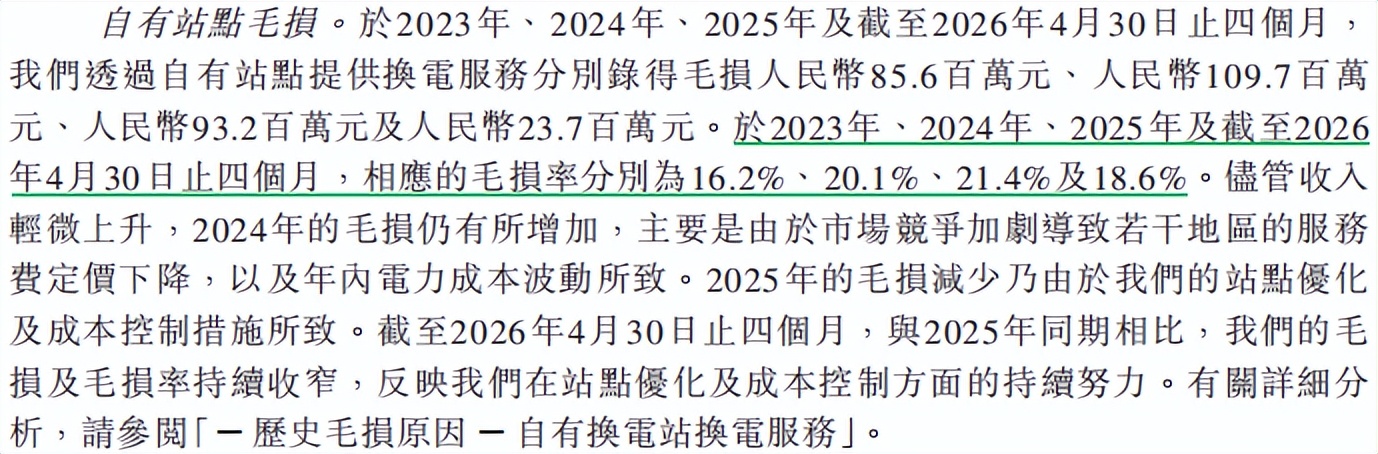
From 2023 to 2025, the gross profit margins of Aulton's self-operated battery swapping stations were -16.2%, -20.1% and -21.4% respectively.
Source: Aulton New Energy prospectus
In other words, in 2025, for every 100 yuan of revenue Aulton generated through its self-operated battery swapping stations, it had to pay about 121 yuan in direct costs. Every time a driver swaps the battery, the revenue Aulton receives cannot cover the costs of electricity, labor and equipment depreciation.
What is more troublesome is that the scale of Aulton's relatively profitable battery swapping operation solution is constantly shrinking.
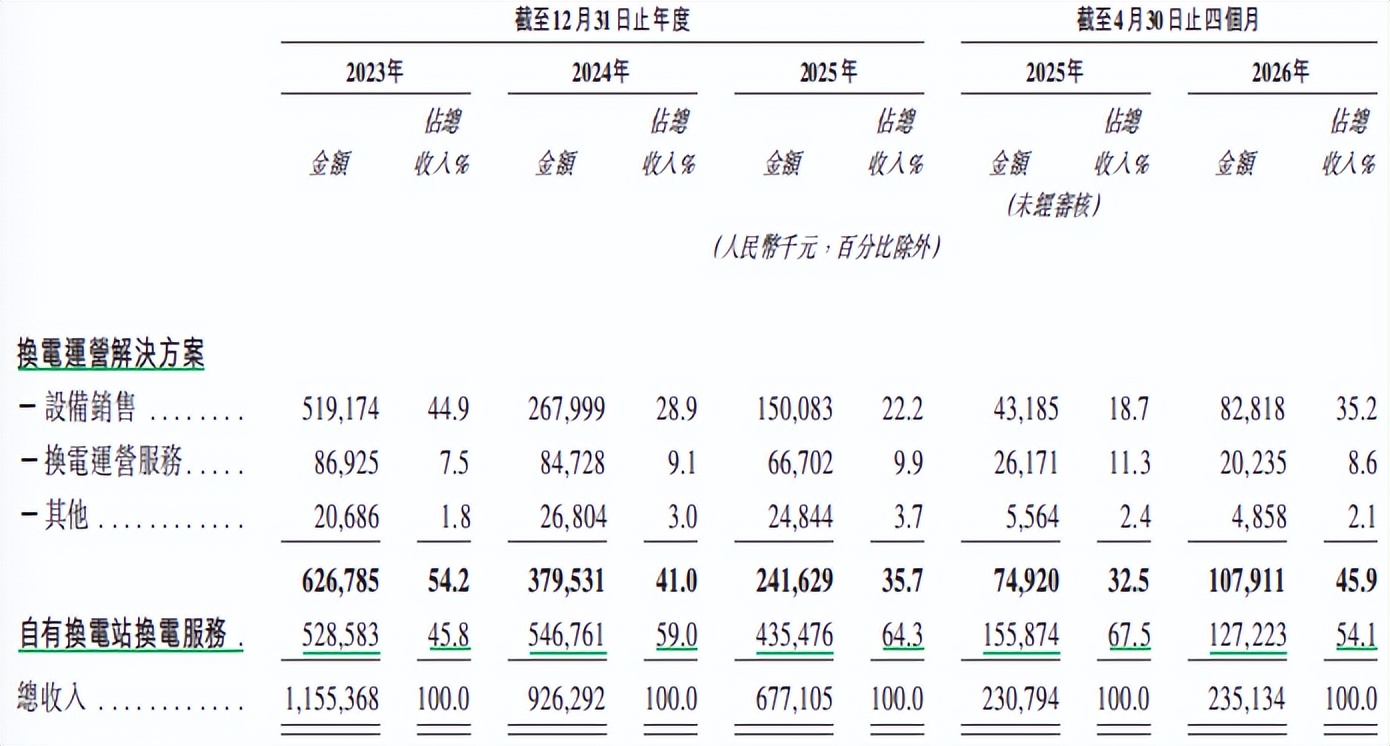
From 2023 to 2025, the revenue of Aulton's battery swapping operation solution dropped from 627 million yuan to 242 million yuan, a decrease of more than 60%. Among them, equipment sales revenue dropped from 519 million yuan to 150 million yuan, a decrease of more than 70%, and its proportion in the company's total revenue also dropped from 44.9% to 22.2%.
Source: Aulton New Energy prospectus
At the same time, the revenue proportion of self-operated battery swapping stations rose all the way from 45.8% to 64.3%.
In other words, the profitable equipment and operation services are getting fewer and fewer, while the self-operated battery swapping stations that continuously generate gross losses have become Aulton's largest source of revenue, which directly drags down the overall performance of the company.
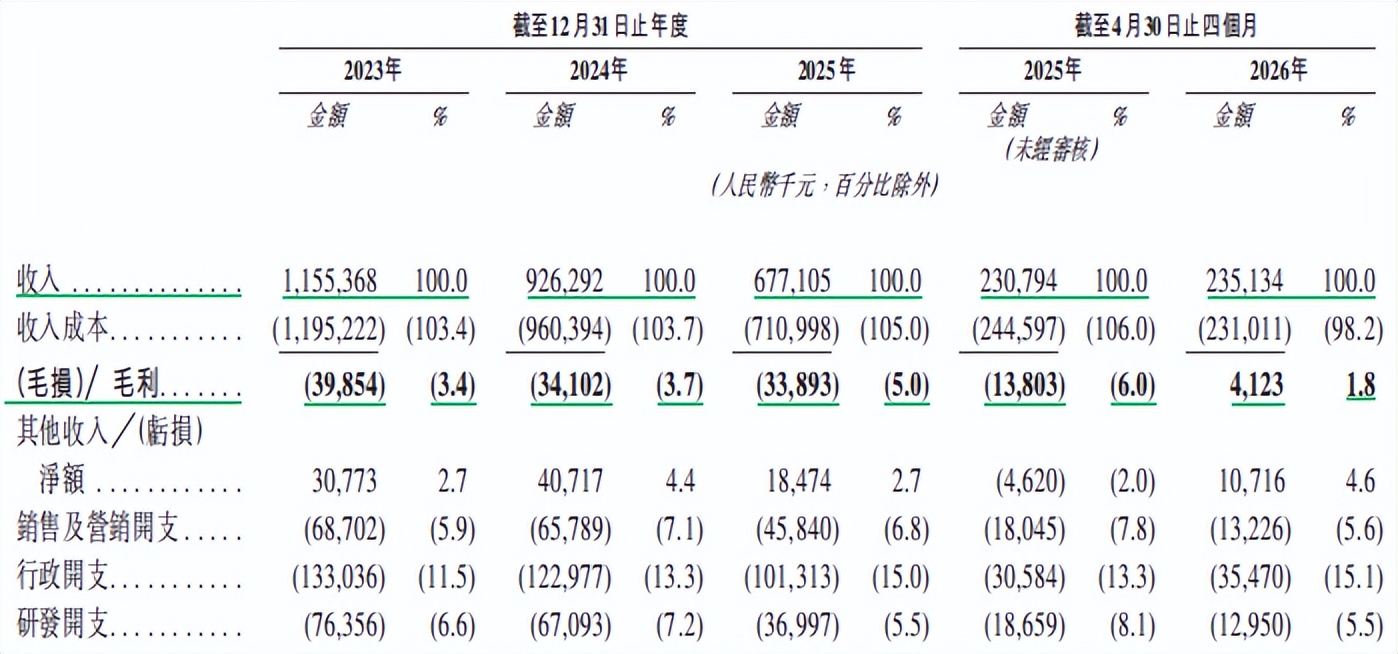
From 2023 to 2025, Aulton's operating revenue was 1.155 billion yuan, 926 million yuan and 677 million yuan respectively, dropping by more than 40% in three years; its net loss in the same period reached 655 million yuan, 419 million yuan and 307 million yuan respectively.
Adding the 91.43 million yuan lost in the first four months of 2026, Aulton has accumulated a total loss of about 1.473 billion yuan in three years and four months.
It is getting harder and harder to sell new equipment, and self-operated battery swapping stations are barely profitable, so Aulton has to adjust its strategy.
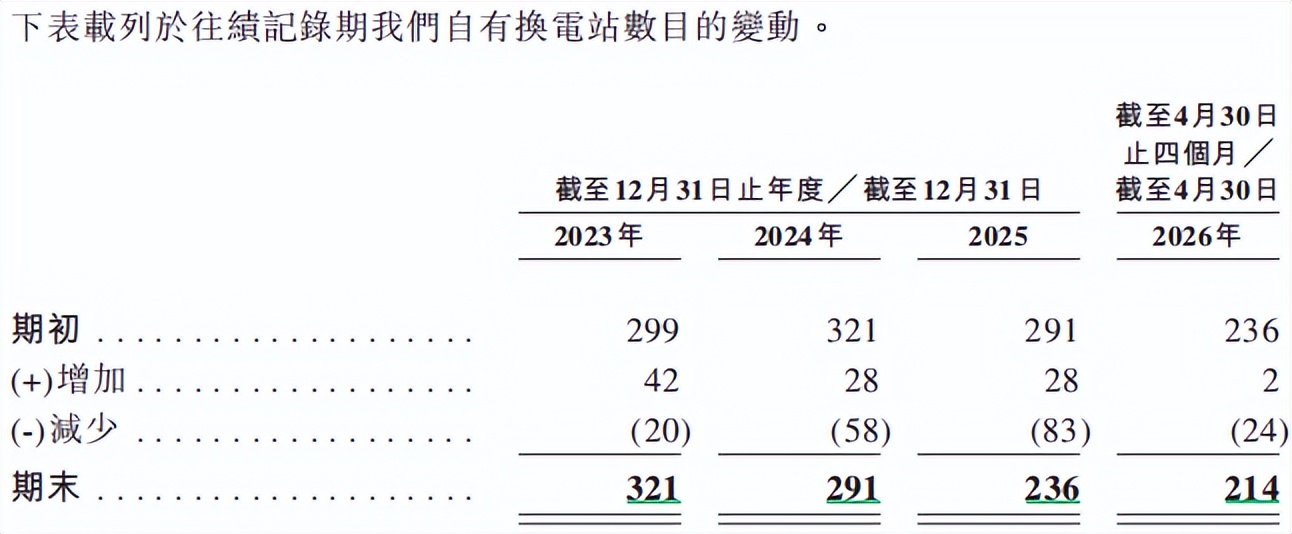
On the one hand, it began to scale back its self-operated battery swapping stations, and has successively shut down 107 self-operated battery swapping stations since 2023, leaving only 214 stations at present; on the other hand, it began to transfer more stations to partners for investment and construction, while it is responsible for selling equipment, maintaining battery swapping stations and providing platform services.
Source: Aulton New Energy prospectus
After a series of adjustments, in the first four months of 2026, Aulton achieved a revenue of 235 million yuan, a year-on-year increase of 1.9%; its overall gross profit margin also rose from -6% in the same period of the previous year to 1.8%, recording a positive gross profit for the first time.
But right at this moment, more severe challenges have emerged in front of Aulton. The parties that pose threats to it include not only CATL's Choco-Swap battery swapping, but also its former "backer" NIO.
Old backer and CATL are both coming to seize its market share
Although Aulton has already ranked the third in China, there is still a considerable gap between the third-place player and the top two.
Calculated based on the revenue from battery swapping station operation services in 2025, the top-ranked NIO generated a revenue of about 3.1 billion yuan, the second-ranked CATL generated about 1.5 billion yuan, and Aulton generated about 502 million yuan.
