The pullback magnitude during South Korea's deleveraging process has caught up with that of the Shanghai Composite Index in 2015 — is the stabilization point around the corner?
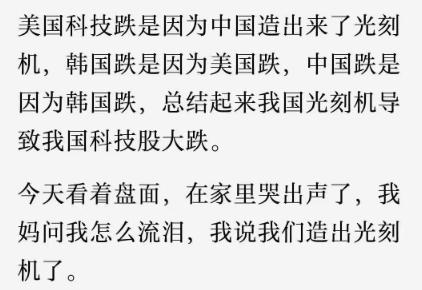
Today is what can be called Black Tuesday for the global silicon-based sector.
The South Korean index plummeted by 10.84%, triggering the eighth circuit breaker this year (note: the 5% circuit breaker applies to the futures index, while the spot market circuit breaker threshold is 8 percentage points).
Since this circuit breaker mechanism was introduced in 2000, there have been 11 occurrences in total, 8 of which have taken place this year.
Japan also saw a sharp decline, US stocks plunged last night and continued to plummet in the overnight session today, while the A-share market likewise failed to stage an independent rally.
Just 6 weeks ago, the "Human Golden Age" story centered on South Korean girls was going viral across the entire internet.
Looking back now, the term "illusion" could not have been more aptly chosen. It captures the social atmosphere under the bubble, with every line oozing an ethereal, almost unbelievable sense of a dreamlike fantasy.
Two days later, the peak of the "Human Golden Age" arrived. Six weeks on, the South Korean index has corrected by 35%, matching the magnitude of the first pullback of the Shanghai Composite Index during China's 2015 stock market deleveraging campaign.
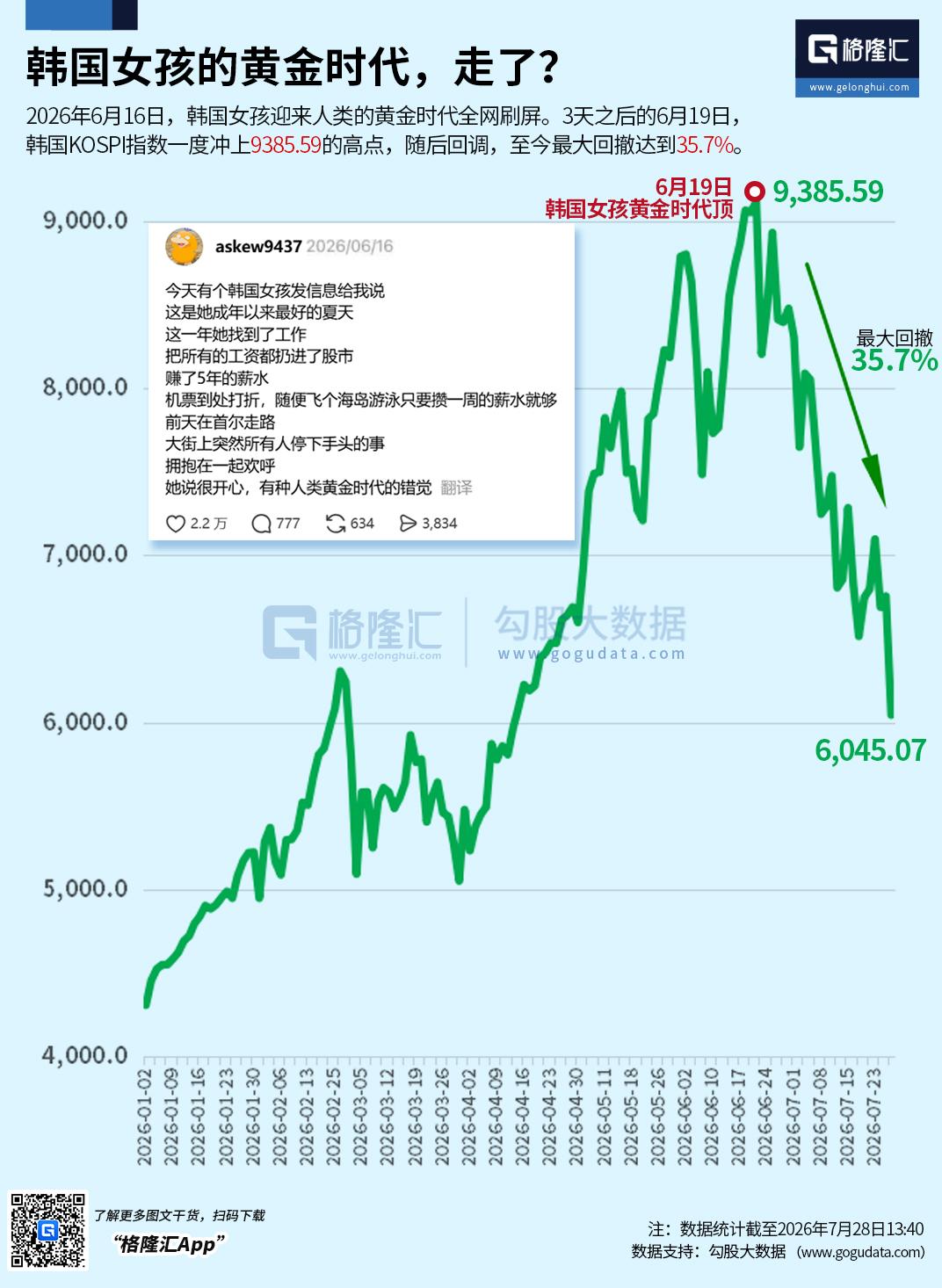
Six weeks ago, the market rallied to such an unbelievable level that no one believed it could fall. Six weeks later, it has plummeted so unbelievably that no one believes it can rally again.
But given that the correction magnitude has matched the 2015 level, it is reasonable to wonder: could a stabilization rally unfold here?
What Are the Causes Behind the Plunge?
To figure out whether the market will stabilize, we first need to understand the root causes of today's sharp decline.
This round of global silicon-based sector bloodbath has three direct trigger factors, or "three daggers".
The first dagger: NVIDIA's "circular financing" is being called into question by the bond market.
NVIDIA is pushing forward AI infrastructure partnerships totaling over $750 billion: it has signed a $500 billion deal with the SK Group, and is still negotiating a $250 billion data center financing guarantee with OpenAI.
What does this mean?
NVIDIA is no longer just selling chips — it is acting as a bank for its clients. You buy my chips, I help you secure funding, and the borrowed money is used to buy my chips. This is what is referred to as "circular financing".
The bond market is not naive.
The CIO of Coherence Credit Strategies put it bluntly: "The capital expenditure required to build AI infrastructure is so massive that the debt market is facing a supply shock. The market is worried that opaque financial structures, off-balance-sheet transactions, and complex relationships between affiliated companies could give rise to 'financial alchemy'."
Put more simply: Doesn't this look a lot like the subprime mortgage crisis?
The 14-basis-point surge in CDS is the bond market asking a question: Are the massive capital expenditures for AI infrastructure a competitive moat, or a credit black hole? Why has Apple overtaken NVIDIA? Because Apple is not pouring money blindly into AI, and prefers "renting computing power" over building its own infrastructure.
The market rewards restraint and punishes reckless gambles.
The second dagger: Changxin's listing has disrupted the global DRAM pricing system.
Last week, Changxin Technology listed on the STAR Market, raising 57.9 billion yuan in capital.
Changxin's global DRAM market share is set to expand from 7.67% to 17%, with monthly production capacity increasing from 280,000 wafers to 500,000 wafers by 2028.
The global DRAM supply landscape has shifted — previously, three oligopolists (SK Hynix, Samsung, Micron) dominated the market, but now a fourth player has arrived to compete for market share.
Morgan Stanley has already warned that the memory chip cycle will peak in the fourth quarter.
Changxin's capacity expansion will first negatively impact consumer-side memory module companies — GigaDevice, Longsys, and Biwin Storage. Some of these stocks hit their daily limit down today, while others posted double-digit percentage declines. While there is no substantive immediate threat to AI-focused HBM products, this represents a long-term risk factor.
The third dagger: The death spiral of South Korean leveraged ETFs.
This is the real reason behind South Korea's particularly severe market slump.
On May 27, South Korea approved 2x leveraged ETFs tied to Samsung and SK Hynix, with 3 trillion won flowing into these products in their first month of listing.
These 2x leveraged products are linked to single stocks and rebalanced daily — adding positions when prices rise and reducing positions when prices fall, acting as a natural amplifier of chasing rallies and selling into dips.
The KOSPI index has fallen 35% from its peak. How much have the 2x leveraged ETFs dropped?
Roughly more than 60%.
South Korea's margin trading balance has hit a record 38 trillion won, with nearly one-tenth of retail investors being required to add margin or even facing forced liquidation.
Goldman Sachs' Seoul team pointed out sharply: the core driving force behind the plunge is the concentrated deleveraging of single-stock leveraged ETFs, not a deterioration in fundamentals.
The three daggers have formed a closed loop: NVIDIA's circular financing risks come to light → global AI capital expenditures are called into question → expectations of a peak in the memory chip cycle emerge → Changxin's capacity expansion accelerates → South Korea's leverage unwinds → global silicon-based sector valuations are reevaluated.
Fundamentals Are Not Collapsing, But Pricing Has Broken Down
The three daggers look intimidating on the surface, but a closer look shows that the "lethality" of each one has been excessively amplified by market pricing.
First, let's look at the first dagger — NVIDIA's circular financing.
This is not a new concept. Last year, when NVIDIA rolled out financing support for its clients, the market already had a full debate on this topic.
The 14-basis-point surge in CDS looks alarming, but at 82 basis points, it is not in a dangerous zone. For investment-grade companies, CDS levels above 200 basis points are considered high-risk.
There is one company that does warrant concern: Oracle, whose CDS has already risen to 203 basis points.
But NVIDIA is not in that category yet. Crossing the 100-basis-point threshold can be seen as a key signal that the crisis is deepening, and we are not there yet.
So what does this all mean?
A 14-basis-point single-day increase is indeed a record, but the absolute level is not high — it has not reached the point of a "credit crisis".
The market is pricing in "fear", not "default", but the stock market is trading as if a default is already unfolding.
Next, the second dagger — Changxin's capacity expansion.
Changxin is expanding standard DRAM production capacity, increasing monthly output from 280,000 wafers to 500,000 wafers, focusing on general-purpose memory for the consumer and server markets.
When it comes to HBM, Changxin's mass production plans are still in the pipeline, and it will initially produce HBM3, which is one generation behind products from players like SK Hynix.
Therefore, Changxin's capacity expansion will negatively impact consumer-side memory module companies like GigaDevice and Longsys, and will not have much substantive impact on SK Hynix's HBM pricing power in the near future.
This is a long-term risk factor, not an immediate one.
Yet the market is currently pricing SK Hynix almost as if the company is on the verge of bankruptcy.
SK Hynix's current forward price-to-earnings ratio is less than 4.
What does a 4x PE mean?
That is bankruptcy-level pricing. If a company trades at 4x PE, the market is essentially saying: you can buy back the entire company in four years using its next year's profits — on the premise that the company does not go bankrupt. This is pricing in the scenario that the company is "about to collapse".
But what kind of company is SK Hynix?
It holds 52% of the global HBM market share, and its share is projected to reach 54% after the next-generation HBM4 enters mass production.
In Q1 2026, its operating profit margin hit 72%, and net profit margin reached 77%.
This company is not on the verge of collapse — it is generating unprecedented levels of profit.
Overall, the market is currently in a state of panic, while there is no real risk of an imminent downturn at the industry level.
The amplifier of this market panic is South Korea's leverage.
However, once leverage unwinds, the process is mostly complete, and it will not lead to an endless downward spiral.
The magnitude of the South Korean index's pullback now matches that of the first phase of China's deleveraging in 2015, and valuations have become extremely cheap.
At this point, we should pay attention to potential market rescue measures that South Korea may introduce.
South Korea's current deleveraging process is very similar to China's experience in 2015: the government first encouraged a bull market, then regulators grew concerned about excessive leverage and implemented tightening measures, which was followed by a market crash.
After the crash, China launched market stabilization measures to shore up liquidity, which eventually led to a market rebound starting on July 9, 2015, with the index rallying by more than 20%. A second round of leverage unwinding occurred later, but that is a separate story.
If South Korea's market stabilizes, what sectors should we prioritize?
Given the already substantial decline in South Korea's market, a stabilization and rebound would not come as a surprise. We need to consider: if such a rebound does happen, which segments of the silicon-based sector in the A-share market should we prioritize?
The most certain bet remains the upstream equipment and materials sector. No matter which sub-segments of the memory chip industry are disrupted by Changxin's capacity expansion, one thing is certain: Changxin will spend heavily to expand its production capacity.
Changxin has raised more than 60 billion yuan in funding. Unlike some listed companies that use raised capital to buy wealth management products for interest income, Changxin will actually deploy the funds, and the primary recipients of this spending will be upstream equipment and material suppliers. These suppliers profit from Changxin's capital expenditures, and their earnings are not dependent on fluctuations in the memory chip cycle.
Additionally, Changxin itself, as an industry leader, is also a sector to consider. If its stock price stabilizes, the rest of the sector will largely follow suit.
For other A-share listed memory chip companies, however, we need to exercise caution.
Changxin's capacity expansion will likely hit these companies first. Their stock prices may rebound after the sharp declines, but this will not be a fundamentally supported rally — it will merely be a bounce from oversold levels, and it will quickly fizzle out because the industry cycle has already peaked.
This is why this round of silicon-based sector correction has hit this particular sub-sector the hardest.
Segments like optical fibers face a similar situation: the barriers to entry are not high, and more new players are entering the market.
Optical module stocks were previously relatively resilient and saw smaller corrections in this downturn, but new unsubstantiated market rumors have emerged recently, making the competitive landscape of this segment highly uncertain.
In summary, this round of correction is driven by a mix of trading-related factors and real, ongoing fundamental shifts.
After this correction, the silicon-based sector will see performance diverge, with the market narrowing its focus to select stocks, rather than the broad-based rally that characterized the previous period.
If you are unsure about individual stock selection, using ETFs as an alternative investment vehicle would be a better choice.
Stock market investments carry risks, and caution is advised when entering the market. None of the investment recommendations in this article shall be construed as a basis for your investment trading decisions. You must make your own independent investment choices and bear the associated risks. Any unauthorized reproduction, distribution, or online reposting of this content by any entity or individual will be deemed an infringement, and our company will pursue legal liability for such violations to the fullest extent of the law.
This article is sourced from the WeChat public account "Gelonghui Finance Hotspot" (ID: glh_finance), authored by the Gelonghui editorial team, and is published by 36Kr with authorization.