Alibaba Investment has taken on a completely new look.
On July 27, major memory semiconductor maker Changxin Technology debuted on the STAR Market, with its opening price surging over 455% and its market cap peaking at over 3.5 trillion yuan.
From its angel round in 2018 to June 2025, Changxin Technology completed nine rounds of financing. By the date of signing its prospectus, 60 institutional shareholders stood behind it, including "national team" players such as local governments and large national funds, as well as a group of industrial capital players.
Among them, Alibaba is the investor that contributed the most capital and drew the most public attention.
According to the prospectus, through two entities—Alibaba Cloud Computing and Alibaba Networks—Alibaba has invested a total of approximately 7.6 billion yuan in Changxin, holding a combined stake of nearly 5%, making it the largest industrial investor in the company.
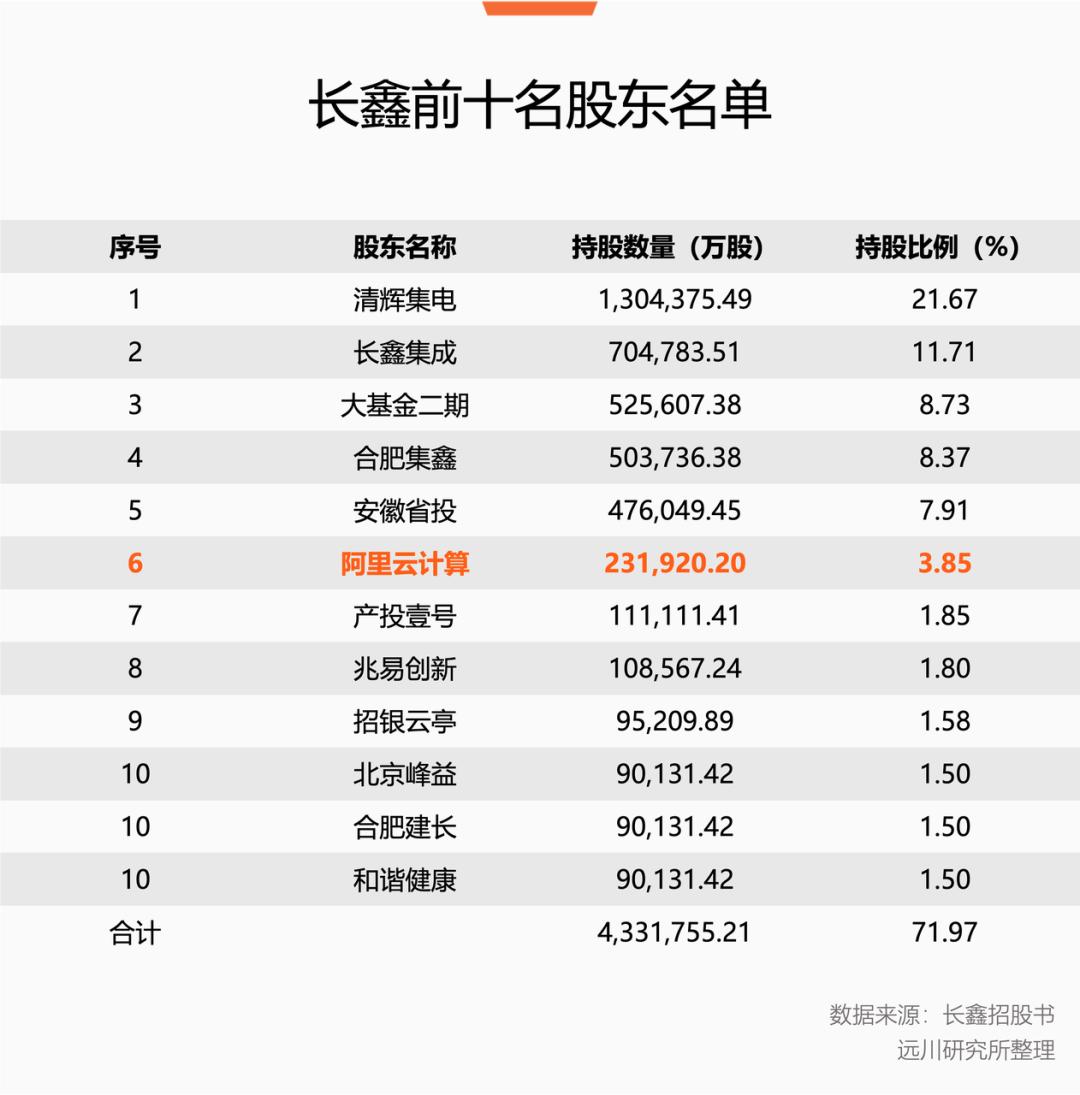
Calculated based on Changxin Technology's market cap on its first trading day after listing, the equity stake held by Alibaba is worth over 170 billion yuan, with a floating investment gain exceeding 160 billion yuan and a total return multiple of more than 20x post-listing.
This investment is a microcosm of the shift in Alibaba's investment style in recent years.
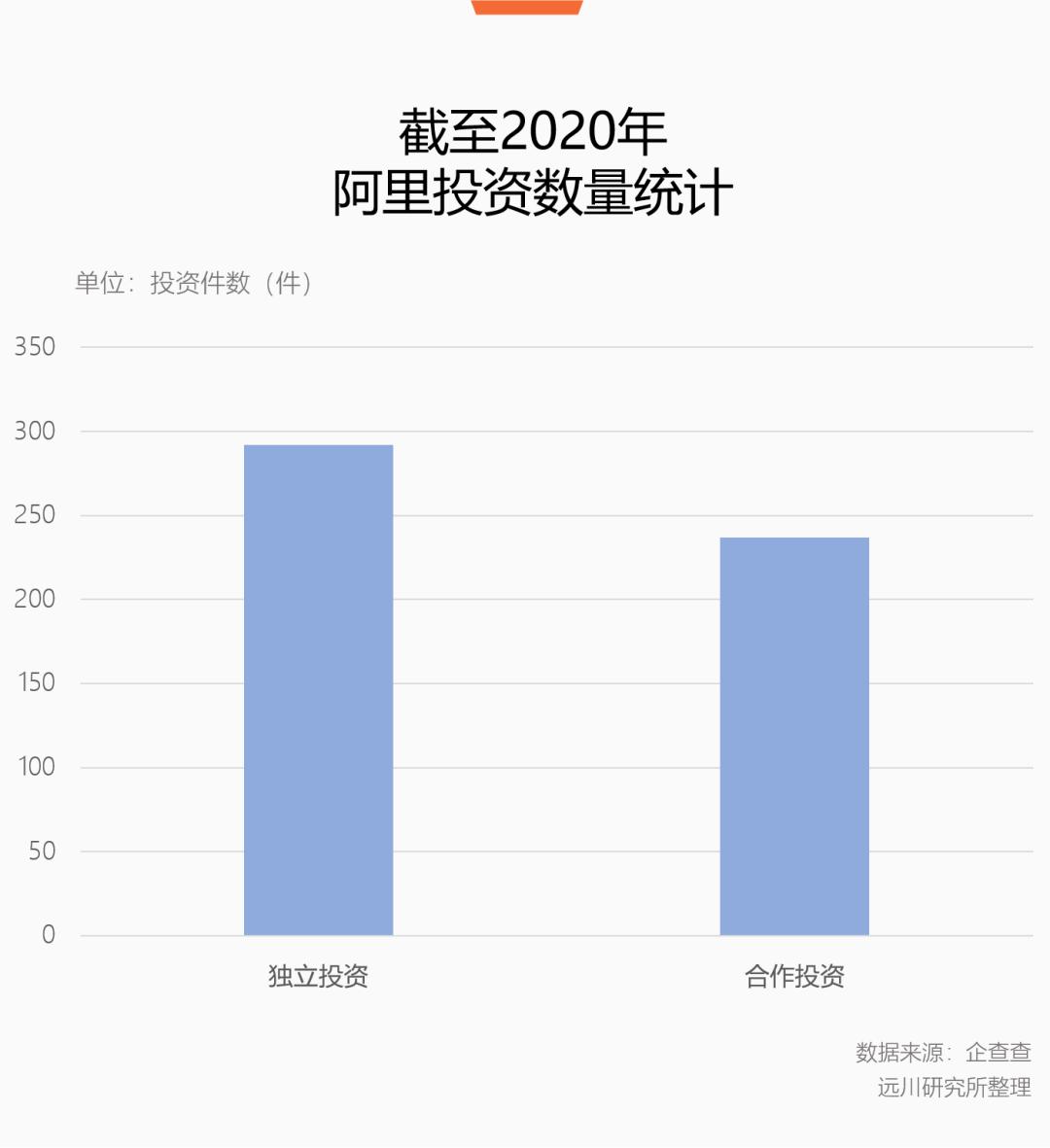
In the past, Alibaba was accustomed to spending heavily to acquire mature, proven businesses, then integrating them through controlling stakes, mergers and acquisitions, and organizational restructuring to bring them into its own business ecosystem.
However, in the years spent catching up with the AI wave, Alibaba's investment approach has quietly transformed. It is deploying capital at increasingly earlier stages, while its demand for controlling rights in portfolio companies has continued to decline. The Alibaba that once acquired everything with decisive, forceful tactics has begun to tolerate appearing on shareholder lists alongside other investors.
Why has Alibaba's investment strategy changed?
A Course Change
In the autumn of 2023, Alibaba was once in a precarious, turbulent position. Externally, competitors launched intense encirclement and interception campaigns targeting its e-commerce business, and the ceiling for revenue growth gradually came into view. Internally, as the AGI wave swept in, the massive corporate ship was still struggling to steer a new course.
Jack Ma, who had rarely made public appearances for a long time, made a rare statement on the company's internal network: "I firmly believe Alibaba will change, Alibaba will reform. Every great company was born in the winter."
Shortly afterward, Wu Yongming took over as CEO of Alibaba Group, and established two core strategic priorities: "User-Centric, AI-Driven".
Over the year that followed, Alibaba began large-scale divestments, rapidly withdrawing capital from the businesses it had acquired at high cost.
In the first nine months of its 2024 fiscal year, Alibaba sold "non-core assets" including its stakes in Liren Lishuang and Enlight Media for $1.7 billion. It then sold Intime Department Store for 7.4 billion yuan, and divested its entire equity stake in Sun Art Retail.
The offline retail, content, and entertainment businesses that were once highly anticipated were removed from its balance sheet one by one. At the same time, capital began to flow intensively into the technology sector, filling the vacated gaps at an extremely rapid pace.
In 2023, Alibaba successively invested in Zhipu AI, Baichuan Intelligence, and 01.AI, and in 2024 it led the financing rounds for Moonshot AI and Minimax. Since then, five of the "Six Little Dragons of Chinese AI" have Alibaba's presence behind them.
Alibaba has also made frequent moves in computing power infrastructure, generative applications, and embodied intelligence. It has invested in semiconductor companies such as Montage Technology, Actions Technology, Horizon Robotics, and Hantro, as well as firms including Ling Technology, Unitree Robotics, and Star Era.
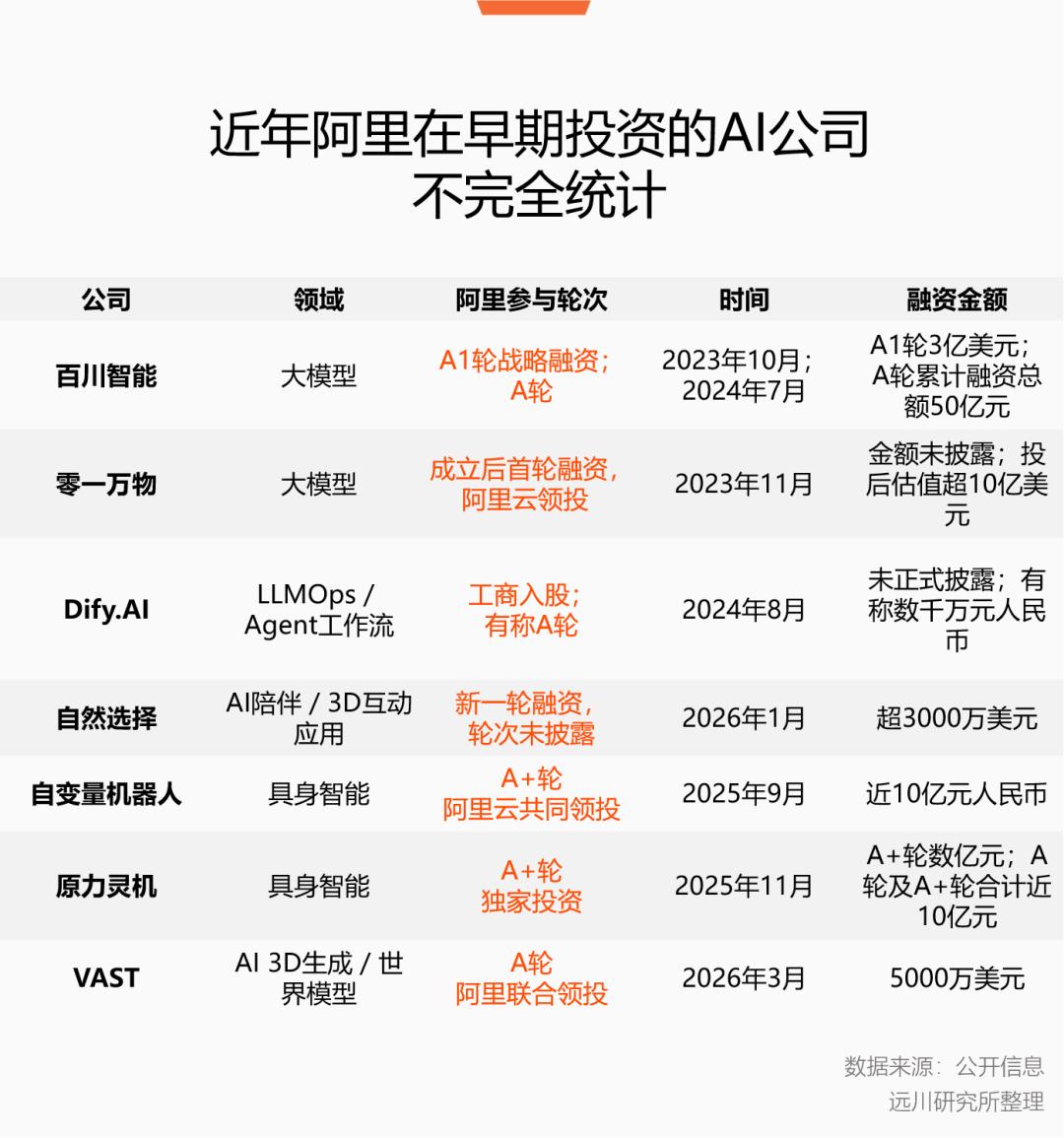
According to incomplete statistics, as of July 2026, Alibaba has invested in 29 companies across the AI sector, with total investment scale reaching approximately 36 billion yuan, covering the full upstream and downstream segments of the AI industry chain.
Throughout this process, Alibaba's investment style has undergone a clear transformation.
The most obvious change is that Alibaba no longer pursues aggressive control over its portfolio companies.
In the past, Alibaba favored heavy-weight mergers and acquisitions and deep post-investment integration. Industry insiders joked that the ultimate fate of every Alibaba-invested company was to become part of Alibaba itself, and this integration process was highly exclusive.
The most classic example is Ele.me. Alibaba took a stake in the company in 2016, completed a full acquisition in 2018, replaced most of its leadership team, and merged it with Koubei into Alibaba's local services business group. In contrast, after Wang Xing of Meituan refused to remove WeChat Pay from its platform, Alibaba fully divested its roughly 7% stake in Meituan for approximately $900 million over the following two years.
But when investing in the five AI "Little Dragons", Alibaba coexists on the same shareholder lists alongside companies including Tencent, Meituan, and Xiaomi. During its investment in Moonshot AI, Alibaba acquired a 36% equity stake for $800 million. This was a preferred stock investment, granting Alibaba no decision-making authority over Moonshot AI's strategy, organization, or personnel appointments. Kimi and Yang Zhilin were not absorbed into the all-consuming "Alibaba Universe".
The second change is that Alibaba's investment timing has quietly shifted earlier.
In the past, Alibaba preferred to purchase mature, proven businesses. Before being acquired, AutoNavi and Youku Tudou were both already listed on US stock markets, while Ele.me and Sun Art Retail were once leading players in their respective industries.
But when investing in AI this time, Alibaba has begun to behave like a traditional VC, frequently appearing in Series A and Series A+ rounds. For example, when Alibaba bet on Baichuan Intelligence's Series A1 round in October 2023, the company had just obtained one of the first public chatbot licenses, and had not yet developed a clear commercialization story.
Returning to Changxin: Alibaba first took a stake in the company at the end of 2021, when the memory industry had just pulled back from its pandemic-era peak. This painful downward cycle lasted for more than a year, before the AI arms race detonated new demand for memory chips.
Just as a dramatic personality shift in a person usually stems from a major life upheaval, Alibaba's style change also boils down to a simple truth:
The times have changed.
The Times Have Changed
In the AI era, the traditional business models of internet companies have begun to lose their effectiveness.
The internet business, in essence, is a rent-collecting business.
Extracting a commission from every connection is the core profit-making method for all internet companies. Whoever builds a larger platform and controls more traffic can create more opportunities to collect rent.
On the other hand, this business model has extremely strong marginal effects.
The more users there are, the richer the supply, and the higher the value of the platform; the marginal cost of internet infrastructure continues to decline, and scale expansion eventually translates into higher profit margins, forming a self-reinforcing "growth flywheel".
As a result, the capital market's judgment on the growth potential of internet companies is highly dependent on metrics such as monthly active users, transaction volume, and payment conversion rate, as these figures directly represent future commercialization potential.
This is why internet businesses naturally have an inherent urge to expand.
Over the past decade, ride-hailing platforms tried to enter food delivery, e-commerce platforms tried to sell fresh groceries, and TV production companies tried to build social networks—all in pursuit of new entry points, new scenarios, and new users, to raise the ceiling for their business growth.
Alibaba was one of the most iconic players in this expansion wave. When e-commerce was the company's core strategy, Alibaba's investment goal was to acquire a continuously expanding map of platform assets, integrating traffic in the most efficient way possible.
Of course there were failed cases, but overall the strategy was relatively effective: every business that Alibaba acquired was integrated into the Taobao-Tmall ecosystem.
But AI has completely changed this playbook.
First of all, the path to commercial returns for AI is completely different from that of internet products.
In the past, as long as a platform controlled a user entry point, it could monetize through advertising, commissions, and value-added services.
But AI applications are still in the exploratory phase today. Most of the business models that are truly recognized by the capital market are currently concentrated in B2B scenarios such as enterprise services and developer tools, whose logic is not collecting tolls, but collecting subscription fees.
This year, Anthropic's annualized revenue has exceeded that of OpenAI. The success of Claude Code proves that as long as AI tools can be embedded into high-value workflows, they can generate considerable revenue even with a limited user base.
On the other hand, AI has weak marginal effects, and could even be described as having negative marginal effects.
In traditional internet businesses, server costs are largely fixed. Each additional user usually brings additional commercial value, while costs are continuously diluted across a larger user base.
But large language models are different: each additional inference call brings additional computing power consumption. Growth in user numbers and usage no longer naturally translates to profit growth, and can even turn into a terrifying source of cost pressure.
SemiAnalysis calculated that for a $200 ChatGPT Pro 20x subscription, the corresponding API usage cost can reach up to $14,000. When an account's usage rate exceeds 11.4%, OpenAI loses money on that user [4].
This means that the old internet-era investment strategy of buying an entry point and not worrying about its operational details, as long as it brings clear traffic gains, is no longer applicable. Today, the capital market rewards efficient CapEx (capital expenditure).
This makes Alibaba's shift in investment logic very easy to understand.
It no longer pursues strong control, because the traffic dividend of buying user entry points no longer exists;
It shifts investments to earlier stages, because AI technology is still iterating rapidly, and spreading bets across multiple companies delivers far better cost-effectiveness than sinking all capital into a single heavy-weight bet.
Alibaba is not the only one making this shift. Tencent has spun off dozens of non-core consumer-facing businesses, pouring hundreds of billions of yuan in accumulated cash into computing power infrastructure; ByteDance has scaled back its gaming and money-losing VR business, and now ranks high on Nvidia's procurement list.
In the previous era, executives slept with constant anxiety about traffic. In the AI era, all major tech companies have developed a shared new "fear of insufficient firepower", shifting their investment focus to computing power, large models, and AI startups.
Google CEO Sundar Pichai's mindset is highly representative [2]:
"For us, the risk of under-investing in AI is far greater than the risk of over-investing."
Presence Equals Opportunity
Every technological revolution redefines the core value segments of the industrial chain.
What matters is not just catching up with the prevailing trend, but judging where new value will be generated. If you make a wrong judgment, even if you remain part of the industrial chain, the share of growth you can capture will only keep shrinking.
Alibaba clearly understands this. Its investment style is closely tied to the core strategic priorities of the company at different stages of development.
In the internet era, Taobao and Tmall were the absolute core of the business, with platform scale directly linked to the business growth ceiling. Integrating user entry points was equivalent to capturing growth opportunities. That's why Alibaba wanted to be part of every business, and spending heavily to acquire mature businesses delivered the best cost-effectiveness.
In the AI era, cloud + AI has become the new growth engine. But this time, Alibaba is facing a gold mine where old experiences no longer work, and which cannot be monopolized by any single player.
From chips, memory, and data centers, to foundation models, development platforms, and application scenarios, massive commercial opportunities are emerging in every segment.
MarketsandMarkets predicts [x] that the data center accelerator market alone will grow to $372.7 billion by 2030. Even capturing just a 10% market share would translate to a large business with nearly $40 billion in annual revenue.
Facing such massive incremental market opportunities, the focus of competition among large tech companies is no longer about who can buy the most companies, but about who can seize positions in the key segments of the AI value chain ahead of others.
Alibaba's investment philosophy has thus shifted from the pursuit of control to the pursuit of presence. Through investments, it expands its connections across the entire AI industry, striving to ensure that Alibaba will not be absent when the new industrial division of labor takes shape.
To achieve this goal, Alibaba is doing two things at the same time:
It is pouring heavy capital into the underlying capabilities it can fully master, striving to become the foundational infrastructure for AI enterprises.
In their letter to shareholders, Joseph Tsai and Wu Yongming emphasized that Alibaba must build "full-stack capabilities" for the AI era. From self-developed chips and cloud operating systems, to the Tongyi large language model and AI developer platforms, Alibaba is striving to keep the core capabilities required for computing, model development, and application development within its own ecosystem.
In addition to investing in industrial chain companies such as Changxin Technology and Montage Technology, to build its presence in fields including memory, memory interface chips, and silicon photonics computing, Alibaba has also continuously invested in computing power infrastructure.
At the 2026 fiscal year earnings conference [1], Wu Yongming clearly stated that to achieve the goal of "breaking through $100 billion in annual commercial revenue from cloud and AI within the next five years", the total computing power center assets owned by Alibaba Cloud in the future will be more than ten times the size of its 2022 baseline, before the AI boom. Future capital expenditures will likely far exceed the previously promised 380 billion yuan over three years.
On the other hand, Alibaba is supporting a large number of startups to expand its cloud computing ecosystem, and cultivate future computing power customers.
The five large language model companies that Alibaba has taken stakes in are potential competitors to Tongyi Qianwen, but they are also computing power customers for Alibaba Cloud.
