Claude Code drastically deleted 80% of the prompts, and Opus 5 immediately added them right back.
Claude Code just announced it drastically cut down its prompt, only for Opus 5 to get caught with a "prompt rebound" red-handed!?
And this rebound is no small increase: 72%. (Laughs)
This seemingly contradictory set of figures comes from both Anthropic's official announcement and a netizen's hands-on test.
A couple of days ago, Anthropic announced that it had removed over 80% of the system prompt content for models including Opus 5 and Fable 5 in one go.
Right after that, developer Chen Cheng (@chenchengpro) conveniently captured the network traffic —
The developer intercepted and counted the actual system prompts received by different models, only to find that Opus 5's prompt is 72% longer than Opus 4.8??
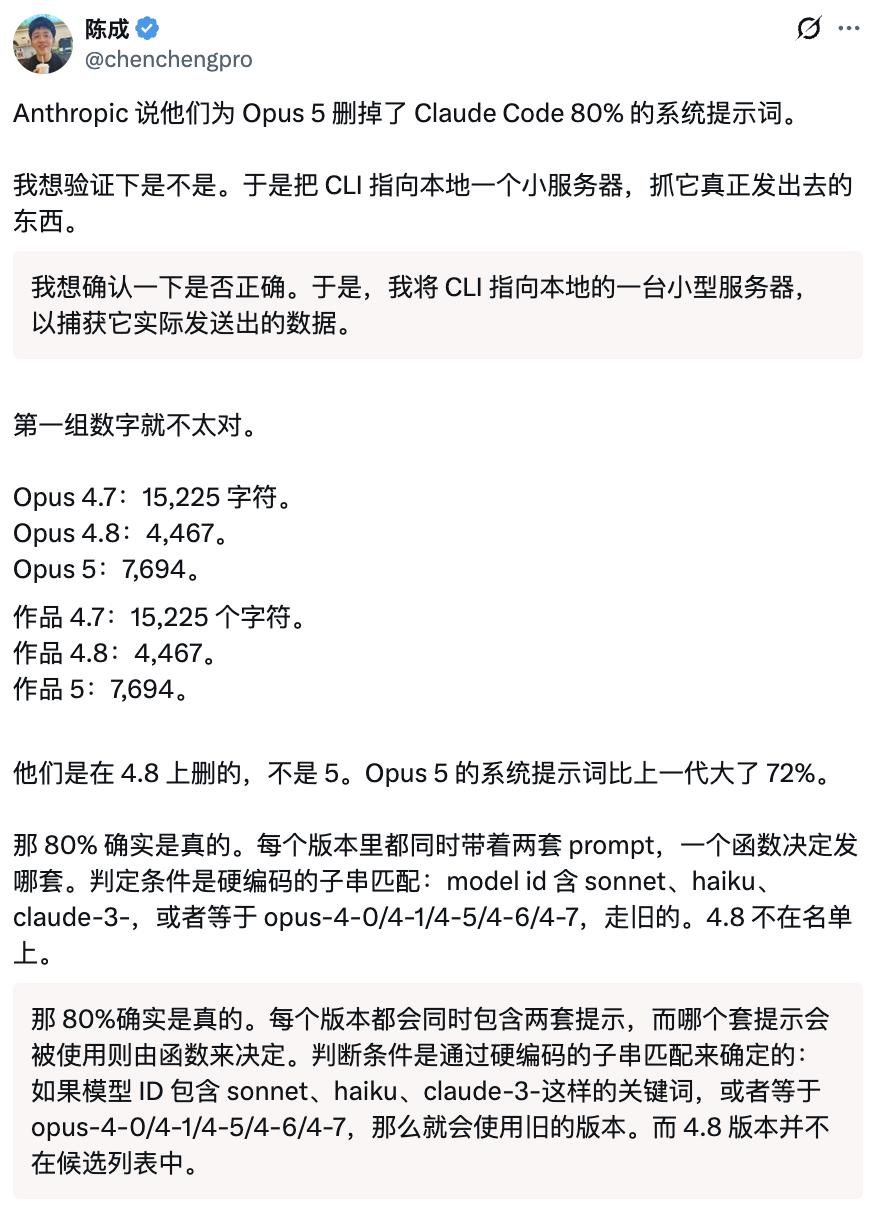
One side cuts 80% aggressively, the other side sees a 72% increase.
Anthropic, are you really putting your prompt on a diet, or secretly adding extra portions behind everyone's back…
Major Overhaul for Claude Code Prompts: Officially Cutting 80% of Content
Let's first break down what exactly Anthropic removed this time.
According to the official post, the early version of Claude Code included a large number of explicit, even absolute rules in its system prompt to prevent the model from making mistakes.
For example, it was set by default not to write comments, not to write multi-line docstrings, and not to create plans and analysis documents unless explicitly requested by the user.
In other words, wherever the model was prone to make mistakes, humans added a pre-emptive rule!!
Over time, the system prompt behind Claude Code became more and more like a thick "Employee Handbook".
This approach worked well for early models, but as Claude's capabilities improved, problems gradually emerged…
The most direct issue was that instructions from different sections of the prompt were very likely to conflict with each other.
Faced with these overlapping and even conflicting pieces of information, Claude had to spend effort figuring out which instruction to follow before even starting to work!!

So Anthropic simply performed a "major surgery" on Claude Code's prompts.
One very obvious change lies in the comment and documentation rules.
The long list of old default rules such as "do not write comments by default" and "absolutely do not write multi-line docstrings" has now been condensed into one single sentence —
Write code that matches the style of the surrounding code, keeping consistency with its comment density, naming conventions, and idiomatic usage.
To put it in more casual terms: Check how the original project is written first, then make your own judgment based on the actual situation~
Of course, there are many other similar changes.
All in all, Anthropic removed over 80% of the system prompt content in new-generation models including Opus 5 and Fable 5…
It is worth mentioning that according to Anthropic's programming benchmarks, this large-scale removal did not cause any measurable performance degradation, so there is no need to worry too much.
(But I still have to ask… after cutting 80% of the prompt, the model's work performance didn't get worse at all? Is that real???)
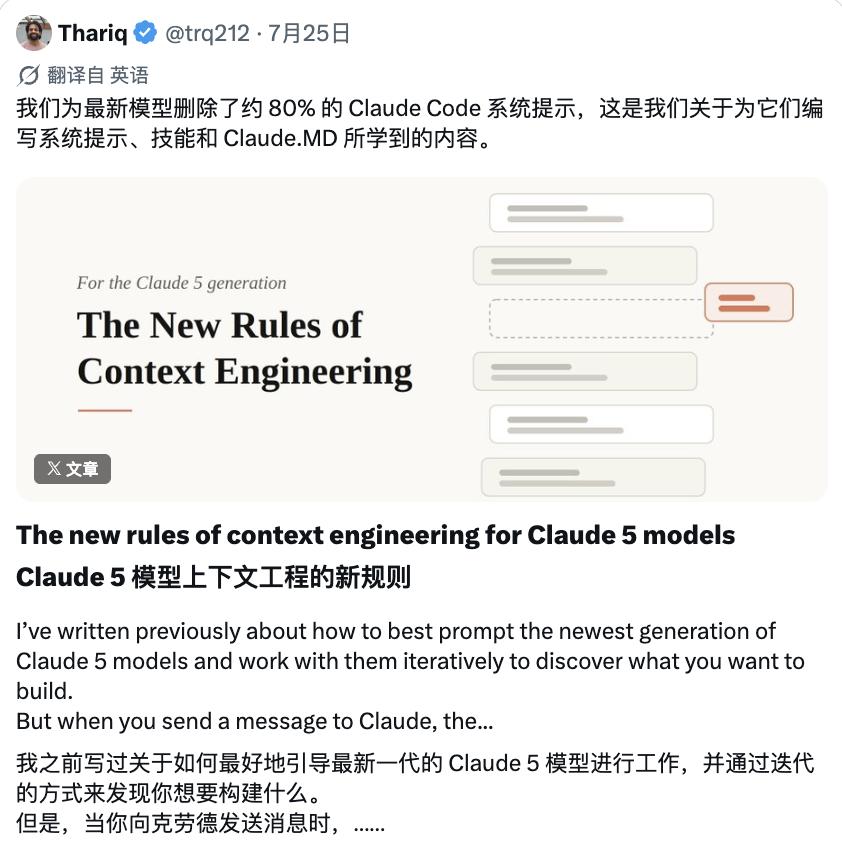
Along with this extreme slimming down, Claude Code's context engineering rules have also been almost completely revamped.
For developers using Claude Code or building Agents based on Claude, Anthropic also provided several more specific adjustment suggestions.
I've also done a quick summary for everyone —
Simplify CLAUDE.md: Only keep special rules for the project, remove information that Claude can discover from the code itself.
Split long instructions into Skills: Store processes like code review, testing, and release separately, and load them only when needed.
Delete duplicate instructions: Write each rule only once. There is no need to repeat content already stated in tool descriptions in the system prompt and CLAUDE.md.
Reduce tool call examples: Clearly define parameter meanings, optional values, and return results, and cut down on fixed call examples.
Provide executable references directly: Developers can hand test cases, existing code, HTML prototypes, or other project files to Claude for reference, reducing long paragraphs of text descriptions.
To sum up, Anthropic's new approach can be condensed into one sentence —
Stop giving Claude an overly detailed employee handbook, and instead put more effort into clearly designing tools, environments, and task boundaries!!
What a vigorous "layoff" for prompts…
Netizen Captures Traffic: How Come Opus 5's Prompt Grew 72% Longer???
At this point, this massive prompt "layoff" for Claude Code seems to have been quite successful.
But a developer, staring at Anthropic's claim of "over 80% removed", suddenly asked a very straightforward question —
Did they really cut that much? (Good question.jpg)
So developer Chen Cheng (@chenchengpro) directly pointed Claude Code CLI to a local server, and captured all the actual system prompts received by different models.
Then, a set of very dramatic data emerged:
Opus 4.7: 15225 characters
Opus 4.8: 4467 characters
Opus 5: 7694 characters
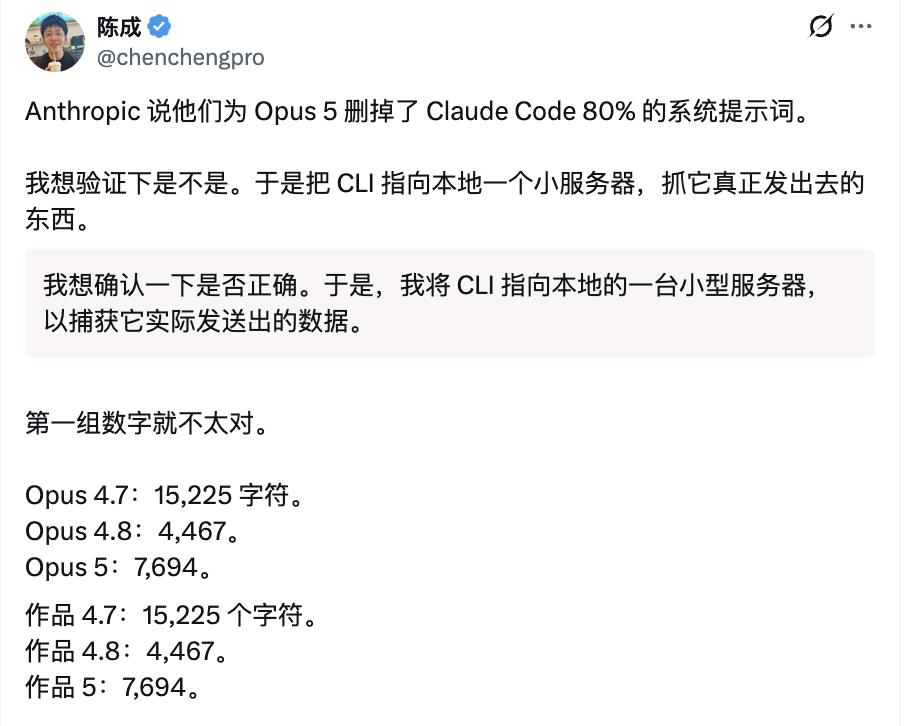
Yes, upgrading from Opus 4.7 to Opus 4.8 did bring a massive cut to Claude Code's system prompt.
The original 15225-character prompt was reduced all the way down to 4467 characters, shedding a huge portion of its length.
However, when it comes to the latest Opus 5, the plot suddenly reversed —
The actual system prompt it received increased from 4467 characters to 7694 characters, nearly 72% longer than Opus 4.8!!!
So Claude Code's prompt slimming did happen, but this large-scale cut mainly took place in the Opus 4.8 phase.
After Opus 5 was released, Anthropic added quite a bit of content back to the streamlined prompt…
Dig deeper! Keep exploring!
Following Claude Code's implementation further, the careful developer found another key "detail" —
Each version actually carries two sets of Prompts at the same time, and a function decides which set to send to the final model based on the model ID.
Sonnet, Haiku, Claude 3, and some older Opus models use the more detailed old Prompt; new models like Opus 5 and Fable 5 use the heavily streamlined new Prompt.
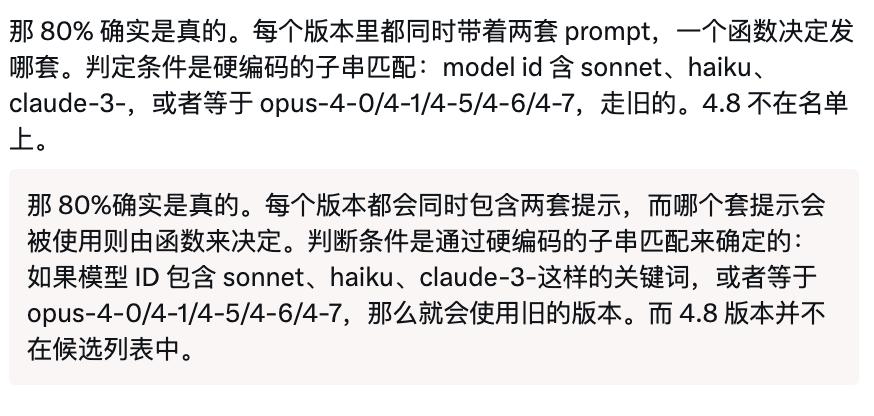
In other words, Claude Code did remove a large number of old rules for new models.
But for Opus 5, the model developed some new behavioral habits, forcing Anthropic to add back more targeted constraints.
In this case, the official claim of "over 80% removed" and the developer's measured "Opus 5 increased by 72%" can both be true at the same time.
The first figure describes the overall change of Claude Code shifting from the old prompt system to the new system; the second figure compares Opus 5 with the immediately preceding Opus 4.8.
Even with part of the length added back, Opus 5's 7694 characters are still only about half of Opus 4.7's length.
Then here comes another question:
What exactly did Anthropic write in those extra thousands of characters for Opus 5?
After further breakdown, the careful developer found that the added content mainly consists of two Opus 5 exclusive sections:
Delivering work: Rules on how to control task scope, report progress, and deliver results.
Corrections: Restrictions on the model repeatedly explaining and correcting its previous mistakes.
The two sections add up to about 3755 characters, which basically covers the difference between Opus 5 and Opus 4.8~
The reason why Opus 5 added back this content is mainly related to the model becoming more proactive —
According to Anthropic's published prompt guidelines, Opus 5 prefers to report progress while executing tasks, usually generates longer responses and documents, and is more willing to call sub-Agents, expand task scope, and repeatedly verify results.
These habits do come in handy for complex long-running tasks.
But if the user only wants to modify a few lines of code, Opus 5 will still spin up a team of sub-Agents, and run several extra rounds of checks, which will drive up token consumption and waiting time…
Therefore, the new prompt added more targeted requirements: when it is appropriate to call sub-Agents, how frequently progress should be reported, what scope the task should stop at, and how to control the length of the final output.
At this point, the seemingly contradictory set of figures makes perfect sense.
Most of what Claude Code removed this time are the tedious operational details left for older models, while the 72% length Opus 5 gained back is mainly used to constrain the proactive behaviors of the new, more powerful model.
The more capable a model is of working independently, the fewer hands-on instructions humans need to give it. But as the model becomes more autonomous, it is still necessary to set clear boundaries in advance on what actions it can take proactively and when it should stop.
From this perspective, Claude Code's prompt did get slimmer, but Opus 5 gained extra weight in a different place.
As expected, AI cannot escape this rule: old flaws are eliminated, but new flaws will precisely pop up somewhere else. (doge)
References:
[1]https://x.com/chenchengpro/status/2081339012632215684
[2]https://claude.com/blog/the-new-rules-of-context-engineering-for-claude-5-generation-models
This article is from the WeChat official account QbitAI, authored by Frontier Tech Focus, published with authorization from 36Kr.