Goldman Sachs: Figure out what AI risks the market is concerned about — the size of the cake, or the distribution?
Over the past month, semiconductor stocks have come under collective pressure, and risk hedging for AI-themed investments has once again become a focal point. However, a more fundamental question is often overlooked amid various hedging discussions—exactly what kind of AI risks is the market worried about?
In its global market commentary released on July 23, Goldman Sachs analyzed that AI investments face two inherently distinct types of risks. One threatens the size of the pie—the total value created by AI shrinks; the other changes how the pie is sliced—the total value remains unchanged, but the winners and losers are reshuffled.
The transmission paths of these two types of risks across asset markets are completely different, and the available hedging tools are also entirely distinct.
01 26 Trillion vs 9 Trillion
This distinction is urgent because the pricing of AI is increasingly reliant on optimistic assumptions.
The market value of AI-related stocks (including private companies) has increased by approximately $26 trillion since November 2022, around $23 trillion after deducting baseline returns. Under Goldman Sachs' baseline assumptions, the present discounted value (PDV) of capital income that U.S. companies can obtain from AI productivity improvements is only about $9 trillion. Even under the most optimistic combined assumptions—higher productivity growth, faster adoption rates, and a larger capital share—this figure is only around $28 trillion.
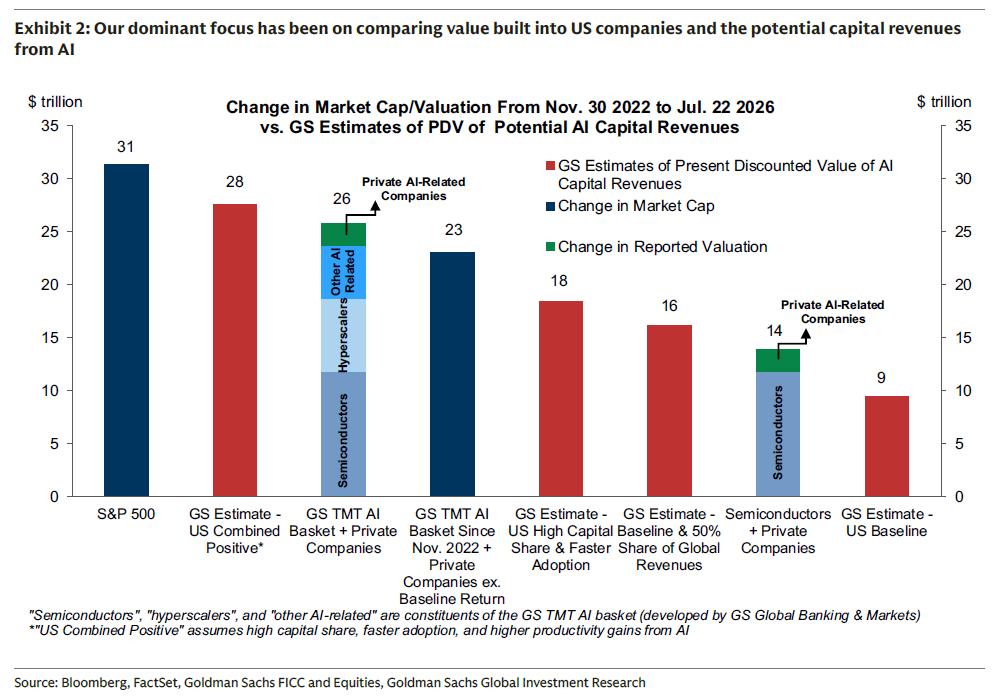
In other words, the current market value growth of AI stocks is already approaching the upper limit that can only be supported if "everything is perfectly fulfilled".
In Goldman Sachs' framework, any downward revision in expectations for the five variables that drive the total value of AI—productivity growth, adoption speed, capital share (corporate monetization capability), international share, and discount rate—will shrink the pie. Macroeconomic shocks (monetary tightening, rising oil prices, weakening employment) will also transmit through profit expectations and discount rates. Given the high valuations, concentrated positions, and large financing needs of AI stocks, macro shocks may have a disproportionate impact on the AI sector.
An easily overlooked boundary: the "pie" here refers to the AI value that the U.S. corporate sector can capture. Even if the total global AI economic value remains unchanged, as long as the value flows from U.S. companies to consumers or non-U.S. producers, the pie for U.S. stocks will become smaller.
The distribution pattern is already changing. So far, AI value has mainly flowed to U.S. AI companies and some key Asian enterprises. Over the past 6-9 months, the market has particularly rewarded the supply side—infrastructure providers such as semiconductors and memory. Since the end of 2025, memory chips have seen significant price increases due to shortages driven by accelerating AI demand, which is essentially a terms-of-trade shock: chip producers benefit while consumers suffer. As the pie grows larger, the way it is sliced is also changing rapidly.
02 The Same Event, Two Completely Different Shocks
How to determine whether an AI risk belongs to the "pie size" category or the "pie slicing" category?
Some judgments are straightforward. Slower adoption and limited use cases—typical pie shrinkage. A decline in market willingness to finance, pushing up the discount rate—also pie shrinkage.
But many situations are far less clear-cut.
Difficulties in monetizing AI products and model competition driving down innovation costs? Gains flow from enterprises to consumers, reducing the pie in the hands of U.S. companies—but enterprise consumers also benefit, and lower costs may even accelerate adoption. Expansion of semiconductor production capacity or improvements in chip efficiency? This hurts producers and benefits consumers. The total size of the pie may remain unchanged, but the way it is sliced changes. AI disrupting traditional industries? Essentially a matter of distribution, but if the winners are not listed on U.S. markets, the pie will also shrink accordingly.
Goldman Sachs cites a key example: large-scale cloud vendors cutting capital expenditures.
The same action—if it stems from pessimism about AI investment returns or tightening financing conditions—shrinks the pie; if it comes from the realization that existing infrastructure is sufficient or that more efficient utilization methods have been found—the pie remains unchanged, and value is simply reallocated from suppliers to the cloud vendors themselves.
Different sources lead to completely different market consequences.
03 The Market Has Already Given Its Answer
Five market events over the past 18 months clearly demonstrate this distinction.
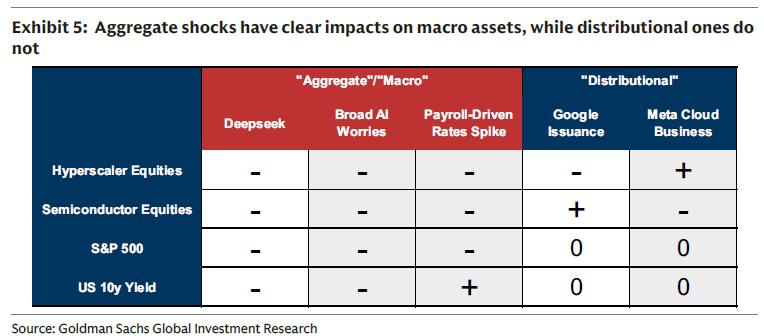
First, consider three aggregate shocks—the DeepSeek incident (January 2025), widespread AI concerns (February 2026, centered on doubts about the ability to sustain high capital expenditures), and the non-farm payroll-driven surge in interest rates (June 2026). The market reactions were highly consistent: the S&P 500 fell by 1.5%, 1.7%, and 2.6% respectively; the VIX soared by 20.5%, 20.9%, and 39.7%; the AI basket and semiconductors significantly underperformed the broader market; credit spreads widened; defensive stocks rose against the trend; and the 10-year U.S. Treasury yield fell by 9 basis points in the first two instances. The third time, the interest rate itself was the source of the shock, so the direction was reversed. The trends in the first two instances were consistent with downward adjustments in growth expectations, and the third with a hawkish policy shock.
Next, consider two distribution shocks—Google's announcement of additional financing for AI capital expenditures (June 2) and Meta's announcement of building a cloud business to sell excess computing power (July 1).
The picture was completely different. The S&P 500 barely moved, U.S. Treasury yields stayed flat, and the VIX did not fluctuate.
But beneath the surface, there was drastic turmoil: on the day of the Google event, semiconductors rose by 5.8% while large-scale cloud vendors fell by 2.4%; the direction was completely reversed during the Meta event, with large-scale cloud vendors rising by 2.5% and semiconductors falling by 6.4%. The drastic switch between winners and losers hedged each other out at the index level, leaving macro assets barely affected.
The classification of the DeepSeek incident deserves a separate explanation. This type of breakthrough that reduces innovation costs may redistribute value to consumers (including enterprise consumers), but at the same time reduces the overall share of AI gains for the U.S. corporate sector—for the world, it is a change in slicing, but for U.S. stocks, it means the pie has shrunk. Therefore, it is classified as an aggregate shock.
Volatility data tells the same story. Currently, the average implied volatility of S&P 500 constituents is at the 99th percentile of the past 15 years, yet implied correlation has fallen to its lowest level in 15 years—individual stocks are drastically diverging, and the consensus on pricing the overall value of AI has not been shaken. Over the past 6-9 months, apart from macro events such as the Iran war, only aggregate shocks have pushed up implied correlation and index volatility.
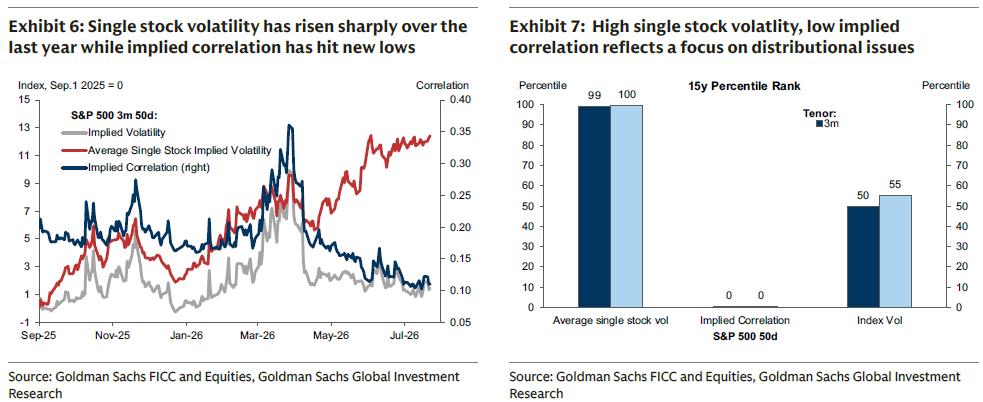
The more dominant distribution shocks are, the more limited the pressure on index volatility will be.
04 Who Can Hedge and Who Cannot
For investors holding broad-based U.S. stocks, the core threat is aggregate shocks. Fortunately, aggregate shocks have clear macro transmission paths—stock indices and interest rates are the most sensitive, while foreign exchange and commodity signals are weaker; except when interest rates themselves are the source of risk, AI aggregate concerns usually push down U.S. Treasury yields. Macro hedging tools are available, and cross-country and cross-industry diversification can also absorb distribution-level volatility.
Investors with AI-specific exposures or overweight positions are in a more tricky situation. Aggregate risks can still be hedged macroeconomically, but distribution shocks also hit portfolios and are difficult to protect against using macro assets—distribution shocks offset each other at the macro level, and the correlation between other assets and core AI positions is unreliable.
If you only hold broad market indices, the size of the pie is your problem, but the way it is sliced is not. However, if you are heavily invested in AI, both types of risks will hit you—and the latter is much harder to guard against.
This article is from the WeChat public account "Hard AI", written by a contributor focused on technology industry research, and is republished by 36Kr with authorization.