Latest: Dissecting the 7 Trillion Yuan Bank-affiliated Public Funds
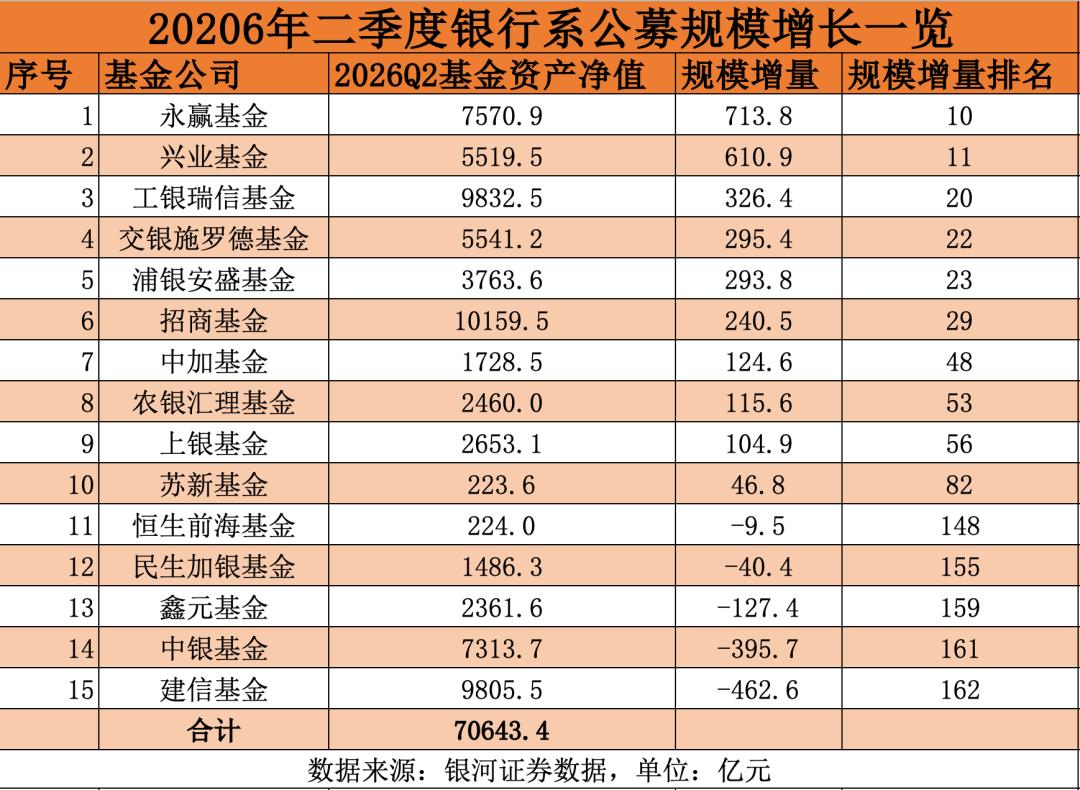
With the Q2 reports fully disclosed, what kind of results will bank-affiliated public funds, leveraging the advantages of their parent banks, deliver? Data from China Galaxy Securities shows that as of the second quarter of this year, the net asset value of 15 bank-affiliated public funds has increased to 7.06 trillion yuan, among which 10 public funds achieved growth in the second quarter. Beneath the surface of numerical growth, a structural differentiation regarding growth quality and development paths is becoming increasingly prominent.
In the past, the "transfusion-style" expansion relying on parent bank channels and institution-customized bond funds was once the core driving force for the scale surge of bank-affiliated public funds. However, under the multiple changing situations of reshaping the channel pattern, the sweeping trend of index products such as ETFs, and the continuous deepening of fee rate reform, this traditional path is encountering unprecedented challenges. As the advantages of parent banks are gradually diluted, the "self-generated hematopoietic" capability of bank-affiliated fund companies has changed from a "bonus item" to a "mandatory question".
Intensified stratification of bank-affiliated public fund scale: head solidification and mid-tier pressure
By the end of the second quarter of this year, the total asset management scale of 15 bank-affiliated public funds has increased to 7.06 trillion yuan, of which 10 public funds saw a month-on-month increase in scale, while 5 recorded a month-on-month decrease.
In terms of absolute volume, the internal echelon of bank-affiliated public funds has been quite stable. China Merchants Fund is the only bank-affiliated public fund with a net asset value exceeding 1 trillion yuan, while ICBC Credit Suisse Asset Management and CCB Principal Asset Management both exceed 980 billion yuan, firmly occupying the first echelon. In terms of scale increment, Yongying Fund has the strongest momentum, with a quarterly increase of 71.38 billion yuan, and Industrial Fund increased by 61.09 billion yuan in a single quarter, also showing significant growth. In addition, ICBC Credit Suisse Asset Management grew by 32.6 billion yuan, and BOCOM Schroders Fund, SPD Bank-AXA Fund, and China Merchants Fund all increased by more than 20 billion yuan.
However, if we shift our perspective to the non-monetary scale indicator with higher gold content, the differentiation becomes even more acute. The total non-monetary scale of 15 bank-affiliated public funds is about 3.5 trillion yuan, which can be clearly divided into three echelons:
The first echelon (non-monetary scale above 500 billion yuan): China Merchants Fund, Yongying Fund, and ICBC Credit Suisse Asset Management. China Merchants Fund ranks first among bank-affiliated public funds with a non-monetary management scale of 642.8 billion yuan in the second quarter of this year, while Yongying Fund and ICBC Credit Suisse Asset Management have non-monetary management scales of 541.7 billion yuan and 518.8 billion yuan respectively in the same period.
However, the three leading public funds have different performances in active equity. Yongying Fund, which ranks second in non-monetary management scale, has an active equity scale of 181.9 billion yuan, leading the bank-affiliated public funds. The proportion of active equity funds in its non-monetary scale is as high as 34%, making it the most "equity-oriented" style among bank-affiliated institutions. ICBC Credit Suisse Asset Management has an active equity management scale of 107.35 billion yuan, accounting for 21% of its non-monetary scale, ranking second in both absolute value and proportion, which can be regarded as a relatively comprehensive representative among bank-affiliated public funds. In contrast, China Merchants Fund, which ranks first in non-monetary management scale, has an active equity scale of 46.15 billion yuan, accounting for only 7% of its non-monetary scale, showing a slight shortboard in active management capabilities.
The second echelon (non-monetary scale from 150 billion to 300 billion yuan): Industrial Fund, BOC Fund, BOCOM Schroders Fund, CCB Principal Asset Management, SPD Bank-AXA Fund, BOSC CCI Fund, and ABC-CA Fund collectively form the backbone of bank-affiliated public funds. In this echelon, except for BOCOM Schroders Fund and CCB Principal Asset Management, the rest of the companies show obvious shortcomings in equity investment and are highly dependent on fixed income products.
The third echelon (non-monetary scale below 150 billion yuan): Five bank-affiliated public funds including CCB-AMC Sino-Canada Fund, Xinyuan Fund, Minsheng Royal Fund, Hengsheng Qianhai Fund, and Sun Fund have a total non-monetary scale of less than 450 billion yuan, which is even less than the scale of China Merchants Fund alone. Structurally, these companies are not strong in both overall scale and active equity business.
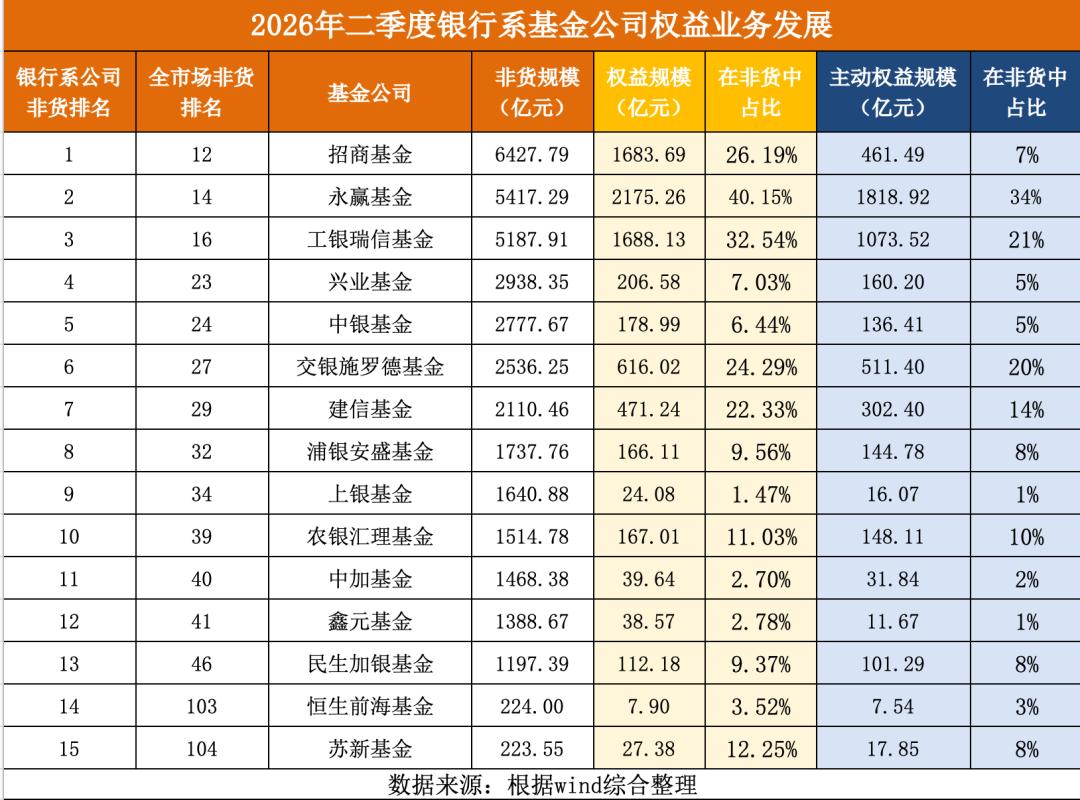
Overall, there is a clear deviation between the non-monetary scale and the active equity scale of bank-affiliated public funds. Only four bank-affiliated companies, namely Yongying Fund, ICBC Credit Suisse Asset Management, BOCOM Schroders Fund, and CCB Principal Asset Management, truly have active equity competitiveness. The rest of the companies generally have an active equity proportion below 10%, and some even less than 2%. The inherent impression of "strong fixed income but weak equity" for bank-affiliated public funds is still being reinforced.
How to break through the solidified label of "strong fixed income but weak equity"?
The "partial subject" characteristic of bank-affiliated public funds is not accidental. The strong empowerment of parent bank resources on the capital side and channel side naturally leads to the expansion of money market funds and bond funds. These products have low risk, small fluctuation, and are easy to rapidly increase scale through institutional capital and retail channels. In the era of low volatility, this model once created a scale myth for bank-affiliated public funds, but also planted long-term hidden worries of "capability partiality".
However, the market environment is no longer what it used to be. For asset management institutions, shareholder resources are empowerment, but to a certain extent, they are also constraints.
With the in-depth reshuffling of the wealth management industry, the market no longer rewards the expansion model that simply relies on parent bank sales and institution-customized bond funds. A set of data is sufficient to illustrate the drastic change in the channel pattern: in January 2026, the retained scale of publicly offered funds sold by banks accounted for 45.3% of the whole market, a decrease of more than 12 percentage points compared with 58.1% in 2020. At the same time, the waves of equity and index products, fee rate reform, investment advisory transformation, and suitability supervision are advancing layer by layer, greatly raising the professional threshold of the industry.
The bank-affiliated public funds that can break through under this background are undoubtedly striving to make up for their capabilities in equity investment, tool-based products, digitalization, and customer companionship, completing the transformation from resource-driven to investment research-driven, and from selling products to selling solutions.
Taking Yongying Fund as an example, its active equity fund scale surged by 97.5 billion yuan by the end of 2025 compared with the end of the previous year, ranking first in the market increment; its "Smart Selection Series" increased by 74.2 billion yuan in scale throughout the year, and its non-monetary scale has steadily risen to 13th place since the beginning of this year, entering the top tier. In addition, the company has significantly accelerated its layout in ETFs and index enhancement, forming a matrix supply of "fixed income as the foundation, equity exerting efforts, and index as supplement".
ICBC Credit Suisse Asset Management has taken a differentiated path of "comprehensive operation + deep cultivation of large asset management". Public information shows that in 2025, the public offering management scale of ICBC Credit Suisse Asset Management was 960.7 billion yuan, the total asset management scale reached 2.37 trillion yuan, and the net profit reached 3.007 billion yuan, a year-on-year increase of 42.51%. Under the circumstance that the public offering structure is still relatively traditional and equity funds are less than 250 billion yuan, the company has formed a second growth curve featuring "thick institutional business, strong comprehensive profitability, and gradually improved product lines" by relying on its pension management scale exceeding 1.2 trillion yuan, annuity management scale of 398.5 billion yuan, ETFs close to 100 billion yuan, and innovative REITs layout.
A public fund observer pointed out that the common feature of these leading bank-affiliated public funds is not to abandon fixed income, but to turn the fixed income basic disk into a cash flow source for investing in equity and innovative businesses. They upgrade the parent bank channel from a single sales channel to an entrance for customer stratification, investment education companionship, and asset allocation solutions, and graft the bank's best-in-class robust risk control and large institutional service capabilities to higher value-added tracks such as ETFs, "fixed income +", technology themes, pensions, REITs, and cross-border businesses.
Excessive proportion of parent bank "transfusion" becomes a hidden reef for scale growth
Further statistics on the position proportion of parent banks in bank-affiliated public funds reveal a more hidden reality: among the 15 bank-affiliated public funds, most companies have a parent bank position proportion exceeding 60%. Excessively high parent bank positions mean that most of the scale growth comes from internal "transfusion" rather than market-oriented growth.
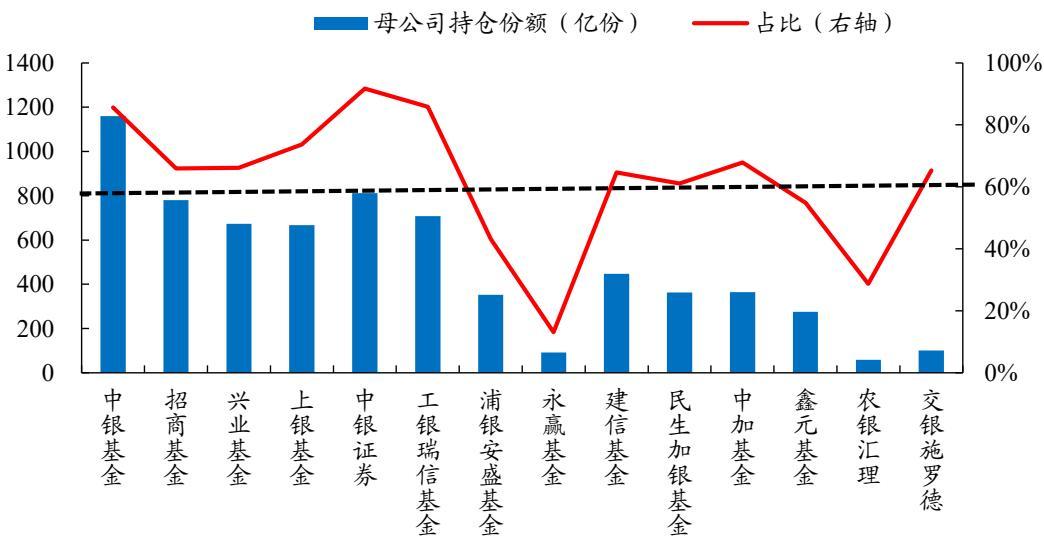
A "secretly kept" rule in the industry is hidden in the data: public funds with a low proportion of parent bank "transfusion" seem to have better development in active equity. From the perspective of parent banks, this conclusion may be biased. After all, many bank financial markets and wealth management subsidiaries not only provide AUM (Asset Under Management), but also empower in channels, compliance, and institutional services.
Public fund professionals further analyze that when bank-affiliated fund companies experience rapid scale growth, what they need to be most alert to is not insufficient growth speed, but artificially boosting scale through forced cultivation, that is, continuing to accumulate AUM with low value-added scale, related party funds such as bank financial market proprietary funds and wealth management subsidiary funds, single fixed income products, and channel inertia, which will eventually expose their vulnerability in the face of fee rate reform, capital constraints, and channel reshaping.
Some bank-affiliated public funds experienced large scale fluctuations in the second quarter of this year, which is related to their excessive reliance on parent banks. Industry insiders said that if fund companies over-rely on parent banks and interbank customized products during the scale expansion period, they must simultaneously handle product penetrability, granularity of information disclosure, end-of-quarter liquidity management, and diversification of customer structures, otherwise it is easy to encounter the problem of "large scale in normal times but large fluctuations at key time points".
It is not "de-banking", but upgrading the bank's genes
Under this background, how should bank-affiliated public funds develop? In the eyes of the industry, it is not about "de-banking", but while retaining the robustness, compliance, and institutional service capabilities of the bank's genes, making up for the capabilities in equity investment, tool-based products, digitalization, and customer companionship, completing the transformation from resource-driven to investment research-driven, and from selling products to selling solutions. Judging from the cases, the path is already quite clear:
The above observer said that if bank-affiliated funds want to get rid of the solidified impression, essentially it is not to create one or two "hit products", but to complete three reconstructions in the organization:
The first is platform-based investment research, reducing dependence on a few star fund managers and a single channel, and strengthening platform-based investment research, digital systems, and multi-asset collaboration.
The second is rebalancing the product structure, creating distinctive "fixed income +", equity, index, pension, REITs, and cross-border tools in addition to money market funds and bond funds.
The third is redefining channel value. Under the new regulations on fee rate reform and sales expenses, transform parent bank resources from sales advantages to the advantages of "customer insight + allocation service + retention operation".
This article is from the WeChat official account "China Fund News" (ID: chinafundnews), written by Yan Jun, and published with authorization from 36Kr.