After scraping over 9 million pieces of university enrollment data, I have found that the gaming industry is increasingly distrustful of creativity.
The annual college entrance examination season is here. Currently, the admission results of higher education institutions across all provinces and cities are being released in batches, and some college entrance examination candidates have already received their admission notices. A new batch of fresh blood is about to embark on their university lives. 3 to 5 years from now, some of them may enter the gaming industry.
For the gaming industry, many positions do not place particular emphasis on the "major" background of campus recruits. HR teams primarily focus on past experiences and the overall performance demonstrated in written tests and interviews. This is especially true for design and operation-related positions, followed by art positions. As long as candidates can present competitive demos and portfolios, their major will not be a barrier.
Even so, when universities set up enrollment majors and allocate planned enrollment quotas, they must consider not only policies and public opinion but also the employment rate of students. As a result, these decisions are inevitably influenced by the development status and prospects of relevant industries.
Game Know-How has filtered and statistically analyzed the planned enrollment data of over 1,600 universities across China from 2018 to 2025, observing the changes in game industry-related enrollment majors across three levels of relevance. We hope to examine the gaming industry from the perspective of talent cultivation and public attention.
From the perspective of talent cultivation demands, it appears that technology, rather than content, is increasingly dominating this industry.
Notes:
1. The data in this article comes from the Sunshine College Entrance Examination Platform, with an undergraduate data coverage rate of approximately 72%. The enrollment information of some universities is not publicly available and thus cannot be included in the statistics.
2. Game Know-How has conducted multiple rounds of deduplication on the statistical results, but minor deviations may still exist. The data is for reference only.
The number of enrollments for strictly matching majors is decreasing
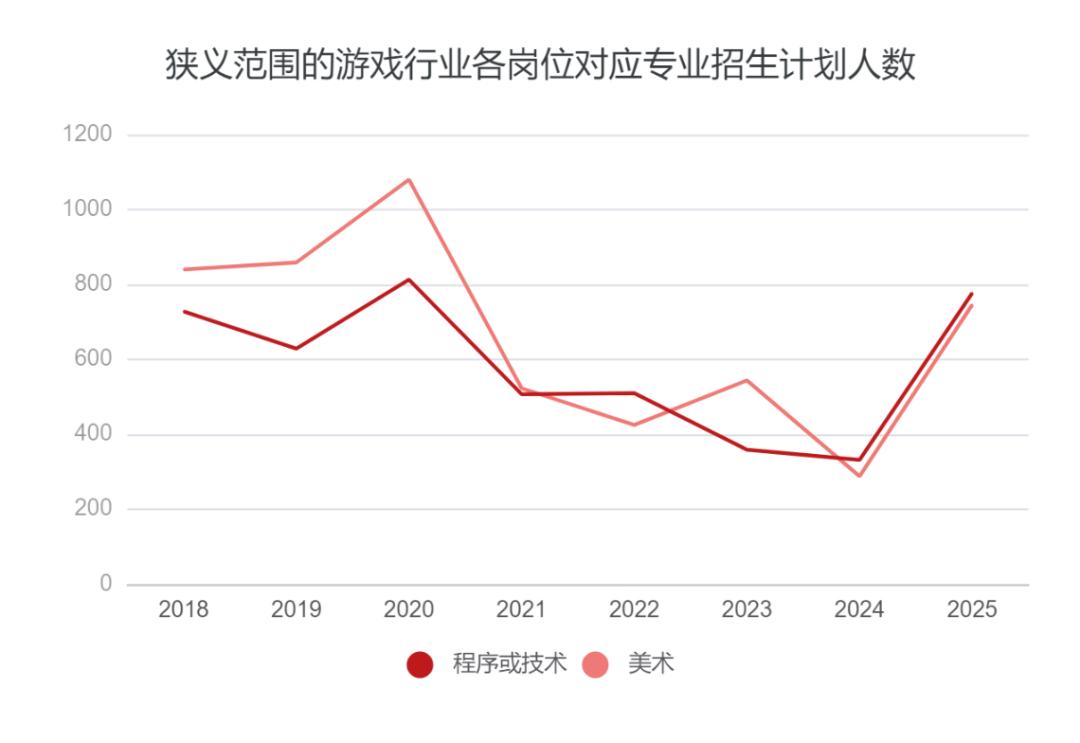
Let's first look at the "narrow scope" — majors that explicitly include game-related keywords in their names or are clearly tied to the gaming industry. These majors are designed to cultivate strictly matched talents specifically for the gaming industry. This strict alignment not only implies a narrower employment scope but also carries a certain promotional connotation.
First of all, whether it is majors corresponding to programming positions or art positions, there has been an overall downward trend. This generally indicates that fewer and fewer majors are strictly tailored to the gaming industry. (There were two counter-trend increases in 2020 and 2025, which are policy-related special cases that will be explained in detail later.)
Among these, the number of enrollments for majors corresponding to art positions was originally significantly higher than that for programming positions. However, starting around 2021, this gap has narrowed considerably and eventually become very close. Compared with art positions, programming positions seem to maintain a slightly more persistent focus on "game specialization".
In addition, there are 0 majors directly corresponding to game design positions. Before 2021, there were some majors named "Game Design", which were more oriented toward art design according to their teaching standards. After the professional catalog for vocational education was revised in 2021, these majors were renamed "Game Art Design" and thus classified into the art category.
However, these data do not mean that the gaming industry is reducing recruitment.
Gradually shifting toward "pragmatism"
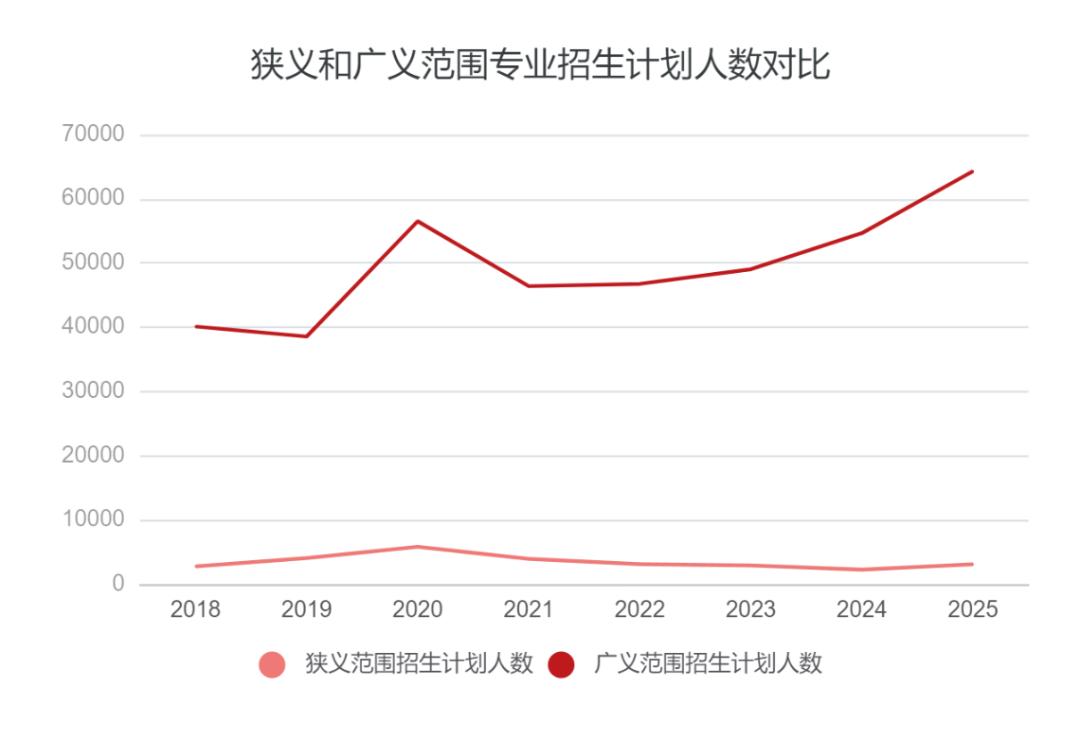
In contrast, we have the "broad scope" scenario — majors that do not explicitly mention games in their names, but whose teaching content is highly related to games, or whose teaching directions explicitly include game-related tracks. These majors usually start with basic skills while maintaining a strong orientation toward game development. They ensure a certain range of employment opportunities while emphasizing the practical application of game-related knowledge, making them a more "pragmatic" choice for candidates aspiring to enter the gaming industry.
Contrary to the downward trend in the narrow scope mentioned above, the planned enrollment numbers in the broad scope show an upward trend. This demonstrates that the talent cultivation demand in the gaming industry is still on the rise.
However, this talent cultivation demand is very different from that of overseas gaming industries, especially those in Europe and America. Overseas countries have a large number of dedicated game-focused institutions that place greater emphasis on cultivating creativity and practical experience, where forming teams with peers from other majors to develop demos is a common practice. Looking at China's enrollment situation, the industry still adheres to, and is increasingly shifting toward, the cultivation of fundamental technical skills — a kind of "pragmatism".
In other words, universities are gradually moving away from training "people who make games" and toward training "people who develop game technologies". The talent supply side is shifting from content creation to technology. This is reminiscent of the increasingly segmented and specialized "screw-like" trend of job content in large tech companies.
Programming majors are twice as large as art majors
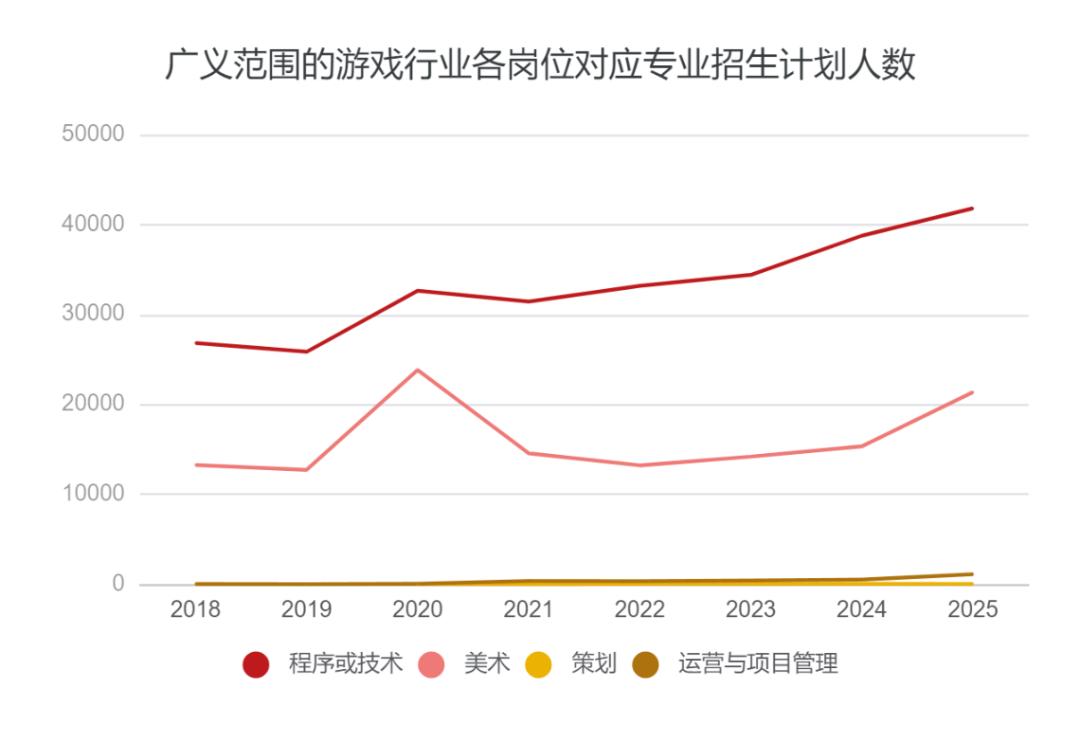
Let's dive deeper into the broad scope. When broken down by position type, the planned enrollment numbers are all on the rise. It seems that the recent downturn in the gaming industry has not yet affected the talent supply side. The good news is that despite the cyclical turbulence and adjustments the gaming industry has experienced, the talent cultivation system in universities has not contracted in sync, and the long-term supply capacity of the industry continues to grow.
Specifically, the planned enrollment numbers for majors corresponding to programming positions have remained almost twice as large as those for art positions. This may indicate that the future focus of talent competition in the gaming industry will still be on the technical front.
Due to relaxed standards, majors corresponding to design and operation positions are now counted in the statistical scope, but their numbers remain quite small. Majors specifically dedicated to cultivating talents for these two positions in the gaming industry are still very rare.
Guangzhou is the talent cultivation hub
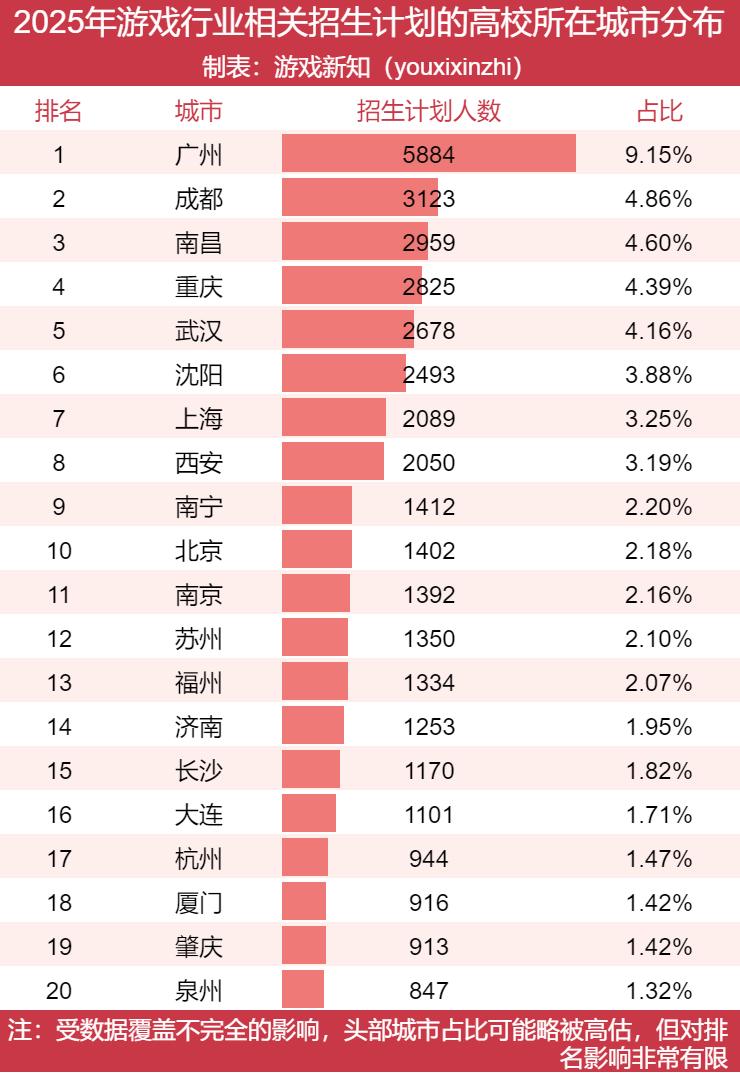
When we count the data in the broad scope by the city where the university is located, we can see that Guangzhou cultivates the largest number of talents for the gaming industry. In addition, the top-ranked cities include not only cities with established gaming industry clusters such as Chengdu, Wuhan, and Shanghai, but also some other cities that we might not typically associate with gaming.
This may be related to local policies. The southwest region has a strong tradition in animation and art-related majors, while the central region has been emphasizing the digital economy in recent years and has intentionally strengthened policy support for education. At least in the gaming industry, the talent pipeline between universities and enterprises is not yet tightly linked enough to be reflected in regional factors.
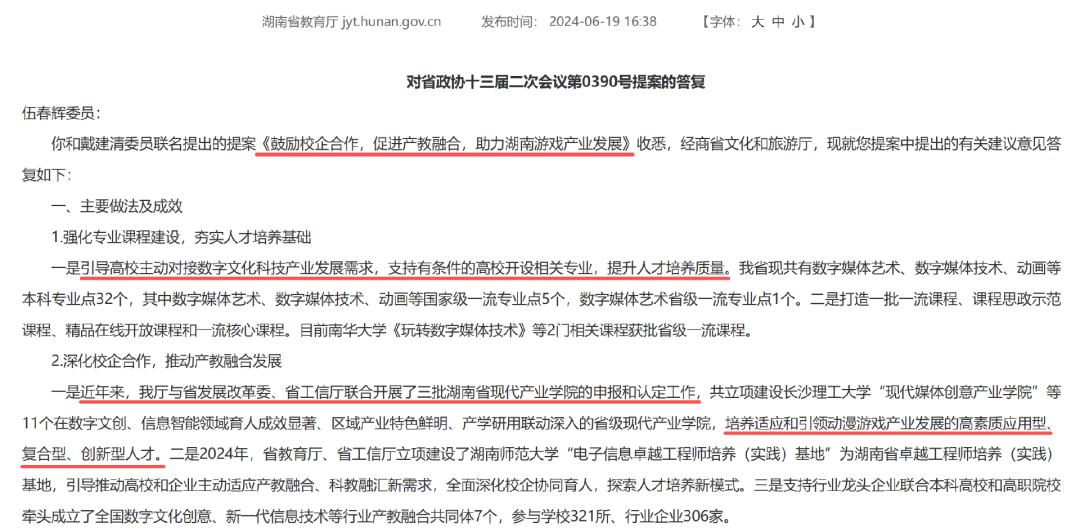
Screenshot taken from the official website of Hunan Provincial Department of Education
Note: Game-related major enrollments show a certain degree of urban concentration. Due to incomplete data coverage from the Sunshine College Entrance Examination Platform, some second- and third-tier cities may be underestimated, while the proportion of top-tier cities may be slightly overestimated. For example, Guangzhou's leading margin may not actually be as large (but this will not affect its ranking). The estimated deviation may cause 0 to 2 changes in city rankings for every 10 positions, and these changes will not alter the overall pattern.
Competitors for talent are outside the gaming industry
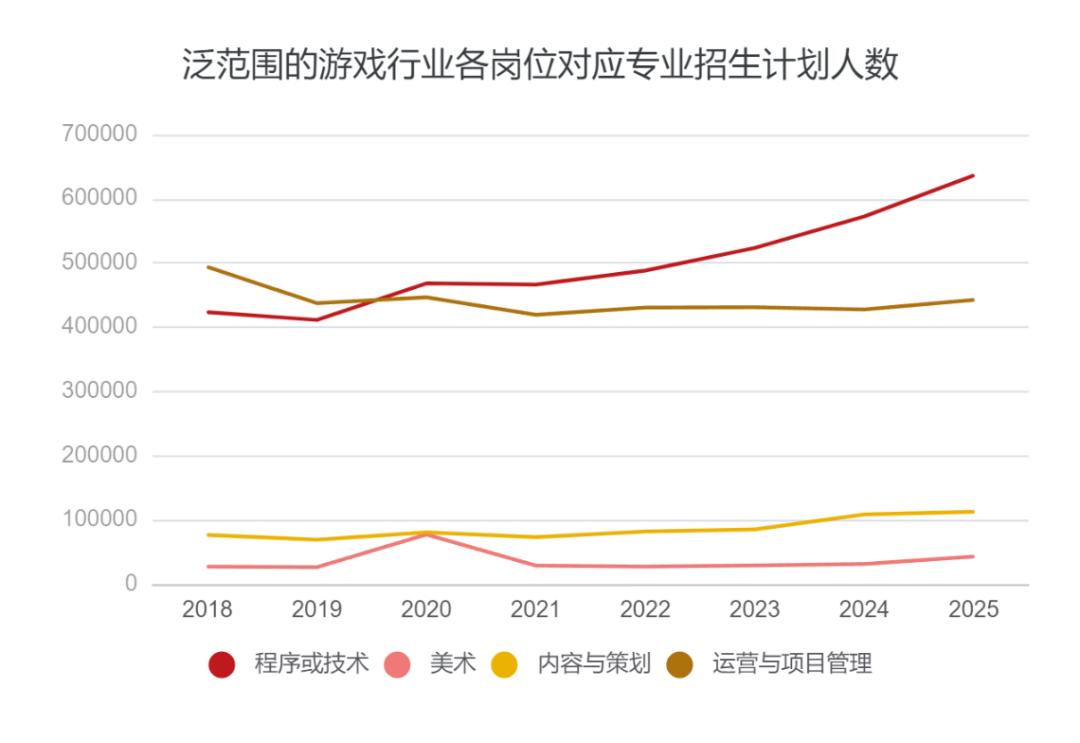
Expanding our perspective further, we can include all majors that allow graduates to pursue careers in the gaming industry in our statistics, tentatively naming this the "pan-scope", to observe the potential talent pool of the gaming industry.
While the number of enrollments for majors corresponding to most positions remains stable, the planned enrollment numbers for programming and technology-related majors have experienced rapid growth. In fact, within the full scope of this year's data, the planned enrollment numbers for programming positions in 2025 account for 7.86% of all majors, demonstrating how popular these related majors have become.
This figure represents the upper limit of the talent pool. The bad news is that within this pool, the gaming industry has to compete for talents with the internet industry and the emerging AI industry. Over the past year, there have indeed been many cases of talents in the gaming industry shifting to the AI industry. For example, Jin Wenyi, the former president of international operations who left miHoYo in April this year, was reported to have joined Moonshot AI last month. According to feedback from practitioners around Game Know-How, countless examples exist at the grassroots level.
Perhaps the biggest challenge for the gaming industry in the future will not be talent cultivation, but talent competition.
Public attention will still exert an impact
From the previous discussion, we can see that no matter what statistical scope we use, no matter which position we specifically look at, the data for 2020 and 2025 show a non-negligible increase. This may be mainly related to relevant policy measures. These policies may not focus specifically on the gaming industry, but the gaming industry has benefited to some extent from the development of high-tech industries and the digital economy.
The growth in 2020 may have been influenced by that year's Government Work Report: "Over the next two years, we will provide more than 35 million vocational skills training sessions and expand enrollment in vocational colleges by 2 million." In practice, these enrollment expansions most easily fall on skill-oriented majors such as digital media, software technology, art design, and e-commerce in vocational colleges, applied undergraduate institutions, and private universities.
The growth in 2025 may be influenced by the 2023 "Reform Plan for Adjusting and Optimizing the Discipline and Major Setup in Regular Higher Education Institutions": "By 2025, we will optimize and adjust around 20% of the discipline and major layouts in universities, establish a number of new disciplines and majors that adapt to new technologies, new industries, new business forms, and new models, and eliminate disciplines and majors that are no longer suited to economic and social development." The emerging artificial intelligence industry and the digital economy industry are both key focus areas, and the gaming industry is among them.
In addition, the widespread social influence brought by "Black Myth: Wukong", which ignited the entire industry in 2024, may also be a potential contributing factor.
The esports industry booms and then cools down
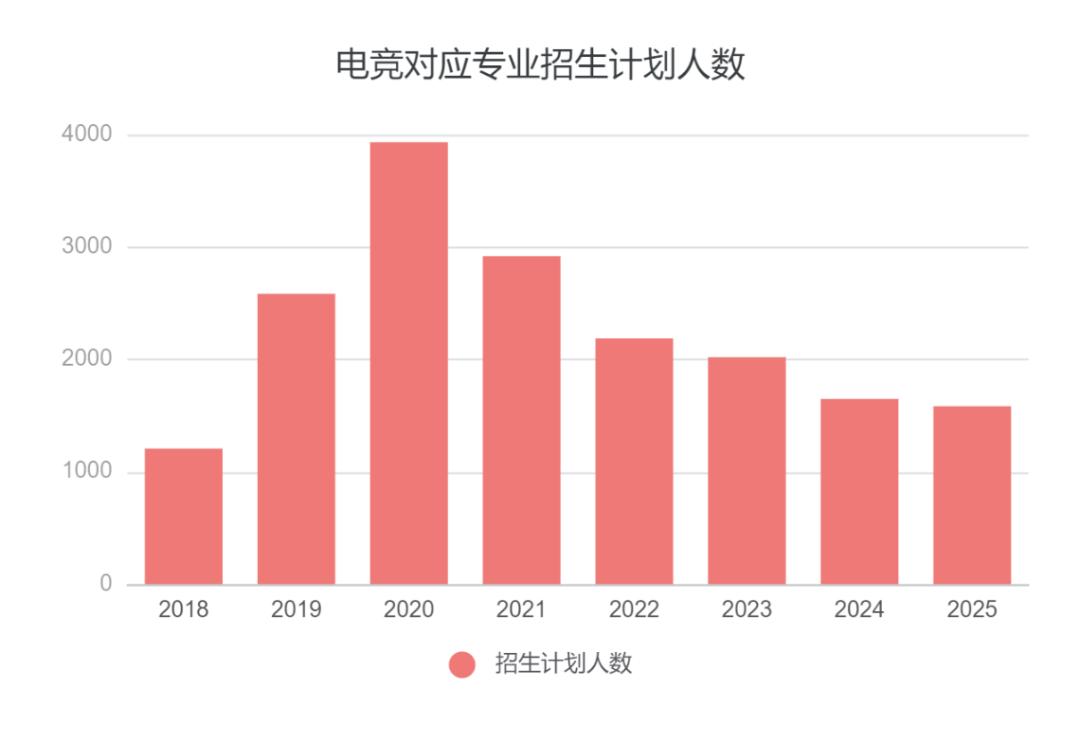
The changes in the scale of talent cultivation in the esports industry largely reflect the state of the esports industry in recent years. As mainland teams and players have achieved successive good results in international esports tournaments for titles such as "League of Legends", "DOTA", and "PUBG", public attention and attitudes toward the esports industry have improved unprecedentedly, driving the development of the industry.
However, the popularity of these tournaments has declined noticeably in recent years. The process of public opinion and capital shifting from demonizing the esports industry, to chasing it, and then to disenchantment, has correspondingly been reflected in the orientation of talent cultivation.
Nevertheless, the good news is that due to the esports industry's unique skill requirements that are difficult for other industries to cover — such as event operation, event commentary, and a certain degree of athletic nature — it has gradually formed a more systematic and large-scale talent cultivation process than the traditional gaming industry, which is also a sign of the industry maturing.
Conclusion
Overall, China's domestic gaming industry started later than its overseas counterparts and has experienced many twists and turns in its development process. Under the influence of multiple factors, the gaming industry has not formed a systematic talent cultivation system. Instead, it focuses on cultivating technical and basic skills, and this trend is increasingly becoming a settled pattern.
Perhaps because of this, part of the practical learning process has been postponed to take place within companies. As a result, companies are paying more and more attention to the past experiences of job seekers during recruitment. Whether it is the duration of work in relevant positions or a portfolio, resumes that can better prove practical experience are more competitive. The reference weight of a candidate's major has thus been decreasing. If you aspire to enter the gaming industry, no matter what your major is, you should probably start building your portfolio and securing internship opportunities early.
It is worth noting that, unlike corporate recruitment data, university enrollment data reflects more long-term industry trends, as the education system focuses more on long-term industrial development rather than short-term market sentiment. However, this also leads to a certain lag — for example, the impact of AI tools may not yet be fully reflected in university enrollment data.
This article is from the WeChat public account "Game Know-How" (ID: youxixinzhi), written by Xinzhijun, and published with authorization from 36Kr.