Over the past two years, more than a dozen "first listed stocks" in the autonomous driving track have emerged, and the autonomous driving industry is still struggling desperately to achieve profitability.
On October 25, 2024, WeRide went public on the NASDAQ. Bearing the halo of "the world's first publicly listed company for general autonomous driving", its stock price triggered circuit breakers twice on the first trading day, with a maximum intraday increase of over 27%. Just one month later, Pony.ai also landed on NASDAQ, claiming the title of "the first publicly listed Robotaxi company".
In the following two years, China's autonomous driving industry ushered in an unprecedented wave of IPOs. Hesai, known as "China's first publicly listed LiDAR company", UISEE as "the first publicly listed company for full-scenario L4 autonomous driving", CIDI as "the world's first publicly listed company for unmanned mining trucks", Huayu as "the first publicly listed company for integrated cabin-driving solutions", In-Driving as "the world's first publicly listed company for unmanned mining operations", and Momenta as "the first publicly listed Physical AI company"... The titles became increasingly resounding, and the "first publicly listed" label almost became a standard feature of listed companies.
However, when the hustle and bustle faded away, these "first publicly listed" companies with halos above their heads faced drastically different fates in the capital market.
The Feast of "First Publicly Listed" Titles
The curtain for autonomous driving company IPOs was raised in 2023. In February of that year, Hesai took the lead in launching its IPO on NASDAQ, entering the U.S. stock market as "China's first publicly listed LiDAR company"; on December 20 of the same year, Zhixing Technology listed on the Hong Kong Stock Exchange at an issue price of HK$29.65 per share, winning the title of "the first publicly listed autonomous driving company on the Hong Kong Stock Exchange".
In the subsequent year 2024, with the listings of WeRide and Pony.ai, the autonomous driving industry saw a genuine IPO boom, as the two companies listed on NASDAQ one after another with an interval of just one month.
The former holds autonomous driving licenses in 8 countries, operates in over 40 cities across 11 countries worldwide, and plans to deploy tens of thousands of units globally by 2030, earning it the title of "the world's first publicly listed company for general autonomous driving"; the latter's Robotaxi fleet size exceeded 1,159 vehicles by the end of 2025, branding itself as "the first publicly listed Robotaxi company".
Apart from WeRide and Pony.ai, AutoX, Huayu, and autonomous driving chip company Black Sesame Intelligence also listed on the Hong Kong Stock Exchange in the same year. AutoX is known as "the first publicly listed autonomous driving operation technology company", while Huayu is recognized as "the first publicly listed company for integrated cabin-driving solutions".
In 2025, two autonomous driving companies focused on mining scenarios went public, namely Boreton, "the first publicly listed zero-carbon mining robot company", and CIDI, "the world's first publicly listed company for unmanned mining trucks".
Boreton was founded by Chen Fangming, an alumnus of Huazhong University of Science and Technology. The company does not manufacture traditional fuel-powered equipment, focusing exclusively on pure electric and unmanned systems, and is hailed as a pioneer in the electrification of construction machinery. CIDI was founded by Li Zexiang, known as the "Godfather of DJI", specializing in the research and development of autonomous driving trucks in closed environments (such as mines and logistics parks), V2X (vehicle networking) technology, and intelligent perception solutions.
In addition, WeRide and Pony.ai completed their Hong Kong stock listings on the same day, November 6, 2025, achieving dual primary listings on both the U.S. and Hong Kong stock markets.
Entering 2026, the listing pace of autonomous driving companies further accelerated.
On May 20, UISEE listed on the Hong Kong Stock Exchange, becoming "the first publicly listed company for full-scenario L4 autonomous driving". The company emphasizes the universality and deployment capability of its technology across different closed/semi-closed scenarios.
On July 8, Momenta landed on the Hong Kong Stock Exchange, securing the title of "Hong Kong's first publicly listed Physical AI company". With a 64.5% global market share among independent intelligent driving solution providers, paired with its R7 world model, Momenta attempts to use Physical AI to tell a story larger than just "autonomous driving".
In the same month, In-Driving, "the world's first publicly listed company for unmanned mining operations", was also listed on the Hong Kong Stock Exchange. Among all 41 open-pit coal mines in China with an annual approved production capacity of over 10 million tons, 19 have deployed In-Driving's solutions.
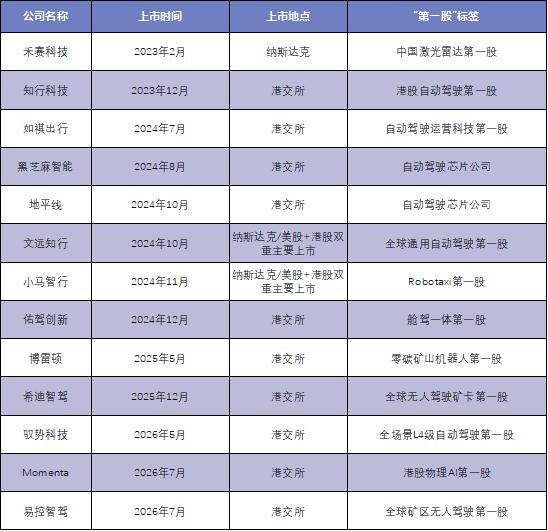
Compiled statistics on the listings of autonomous driving "first publicly listed" companies, compiled by Insight New Research Institute
For a time, the "first publicly listed" label was everywhere. The world's first publicly listed Robotaxi company, the world's first publicly listed general autonomous driving company, Hong Kong's first publicly listed autonomous driving company, the first publicly listed LiDAR company, the first publicly listed full-scenario L4 company, the first publicly listed Physical AI company, the first publicly listed unmanned mining operation company... Every newly listed company seemed able to find an angle to claim the "first publicly listed" title.
But the problem soon arose: they are all "first publicly listed" companies, so why do some see their stock trigger circuit breakers and receive enthusiastic market reception on listing, while others break below the issue price on opening and keep falling all the way?
The Market Votes with Its Feet
Let's first look at a set of data.
On the first day of WeRide's listing on NASDAQ, its stock price closed at $16.55, with a total market value of approximately $4.491 billion, triggering circuit breakers twice during the session. A month later, Pony.ai debuted with a closing price of $12 and a market value of $4.199 billion, quickly fading into obscurity after a brief surge.
An even starker contrast is seen in the Hong Kong stock market. On November 6, 2025, WeRide and Pony.ai landed on the Hong Kong Stock Exchange on the same day: the former had an issue price of HK$27.1 and a closing market value of approximately HK$25 billion; the latter had an issue price of HK$139 and a closing market value of approximately HK$54 billion, meaning Pony.ai's starting point was almost twice that of WeRide. However, by 2026, Pony.ai's Hong Kong stock price plummeted 17% in two days, with its market value evaporating by over HK$6 billion. As of the first quarter of 2026, WeRide's Hong Kong stock market value was approximately HK$14.1 billion, while Pony.ai's was around HK$22.8 billion. The company with a higher starting point fell harder, and the one with a lower starting point also failed to hold its ground.
The most tragic case is Zhixing Technology. As "Hong Kong's first publicly listed autonomous driving company", it issued at HK$29.65 in December 2023 and broke below the issue price on the first trading day. Although its stock price was once pushed to a historic high of HK$115.6 in 2024, it took a sharp downturn in 2025. By June 2026, its share price was hovering around HK$4, down more than 96% from its historical peak, with its market value evaporating by over 80%.
In sharp contrast, RoboSense, known as "Hong Kong's first publicly listed LiDAR company", was included in the Hang Seng Composite Index and the Stock Connect program just 4 months after its listing. Recently, it was also added to the MSCI China All Shares Small Cap Index. It ranks first in China's in-vehicle LiDAR market with a 40.3% share, and its 3D LiDAR shipments for robots have been the world's highest for multiple consecutive quarters. The recognition from mainstream capital is built on its solid market position.
Turning to new stocks, UISEE's public offering was oversubscribed 6,777 times, making it the "oversubscription king" of Hong Kong stocks in 2026; Momenta introduced 14 cornerstone investors including Mercedes-Benz, BYD, GIC, and BlackRock, with its public offering portion oversubscribed by approximately 414 times, and its international offering receiving over HK$100 billion in orders. The primary market remains enthusiastic, but whether the secondary market will buy in still requires time to verify.
They are all "first publicly listed" companies, so why such different treatment? There are two core logics.
First, the value of the "first publicly listed" title depends on the right to define the track, not the order of naming.
The "first publicly listed" title should have been a scarce resource. When there is only one listed company in a track, it enjoys the exclusive pricing power, and investors have no comparable benchmarks, so they can only pay for the track dividend itself. However, when the "first publicly listed" titles become rampant, with labels divided into increasingly granular categories and every niche track finding its own "first publicly listed" company, the scarcity completely disappears.
Judging from the current market situation, the real premium for autonomous driving companies actually comes from the right to define their track. For example, Momenta secured the title of "first publicly listed Physical AI company", while RoboSense firmly holds the top market share in the LiDAR sector. The common point between the two is that they occupy a leading or even monopolistic position in their respective core tracks, not only successfully commercializing their technology but also defining industry standards and pricing systems.
In contrast, Zhixing Technology, although seizing the time window as "Hong Kong's first publicly listed autonomous driving company", its main business is domain controllers. In this track, there are long-listed competitors such as Desay SV and Jingwei HiRain. Zhixing Technology neither defined the track nor established an irreplaceable competitive moat. The premium given by capital was ultimately just a short-lived window brought by its "first-mover advantage"; when the window closed, its stock price plummeted from its peak.
Second, the market's preference has shifted from "focusing on concepts" to "focusing on fundamental quality".
From 2023 to early 2024, the market was still in a stage of "rather invest mistakenly than miss out" for autonomous driving. As long as the track was promising and the story was compelling, capital was willing to pay for the imagination. Back then, Zhixing Technology's share price surged to HK$115.6, and both WeRide and Pony.ai triggered circuit breakers in the U.S. stock market — these events occurred at the hottest time of the industry, when the market had a high tolerance for losses.
But this tolerance is not unlimited. When the financial reports of the first batch of listed companies were released one after another, showing that revenue growth could not keep up with expanding losses and commercial deployment was slower than expected, the market began to vote with its feet.
In the final analysis, the "first publicly listed" label is depreciating, and the essence of the starkly different fates of autonomous driving listed companies is a revaluation of the autonomous driving industry by the capital market, shifting from chasing "who can run out first" to examining "who can keep running sustainably".
The former is a track dividend, while the latter is survival capability. When the track dividend fades, the gap in survival capability determines the fate of these "first publicly listed" companies.
Who Can Break the Profitability Deadlock?
By sorting through these "first publicly listed" companies today, we can find a very severe problem: no matter how dazzling the halo above their heads is, none of these companies have achieved sustainable profitability so far.
WeRide accumulated a loss of approximately 5 billion yuan from 2021 to the first half of 2024. Its 2025 revenue surged 90% year-on-year to 690 million yuan, but after final accounting, it still lost 583 million yuan for the full year.
Pony.ai accumulated a net loss of over 360 million U.S. dollars from 2022 to the first three quarters of 2024. Its full-year 2025 revenue was 630 million yuan, and its net loss reached approximately 645 million yuan RMB.
Momenta accumulated a net loss of approximately 9.234 billion yuan from 2023 to 2025...
Looking across the entire industry, beyond these "first publicly listed" companies, "high losses" have almost become a common label for the autonomous driving industry. So the question arises: after burning so much money, why is it still impossible to make a profit?
The most direct reason is the high R&D investment. Autonomous driving technology is still in a stage of continuous development and improvement, requiring continuous large capital investment for technological R&D.
In 2025, WeRide's R&D expenditure was approximately 1.4 billion yuan; Pony.ai's R&D expenditure was 1.52 billion yuan; Momenta's R&D expenditure was 1.869 billion yuan, accounting for 77.5% of its revenue for the period.
Apart from R&D, the business models of autonomous driving companies are also controversial. For a long time, intelligent driving has been characterized by "high R&D costs, high trial-and-error costs, and high engineering delivery costs". At the current stage, high-level solutions have not yet entered the popularization phase, with long delivery cycles, while basic function solutions face fierce competition, leading to continuous industry price compression and limited revenue contribution per vehicle. This has created the industry status quo where "high-level solutions cannot achieve large-scale deployment, and low-level solutions cannot make money".
Although losses are the main theme for autonomous driving companies at present, the dawn of profitability has already appeared.
2026 is widely regarded as a key turning point for the industry. On the technical side, visual large models and end-to-end algorithms are driving down the cost of replicating solutions in new cities; on the policy side, the unified national management regulations for L3-level autonomous driving have been officially implemented; on the commercial side, the order scale and per-vehicle economic efficiency of leading enterprises continue to improve.
Among numerous autonomous driving companies, Hesai and Momenta may be the first to break the profitability deadlock.
In fact, Hesai has already delivered a profitable performance. Its full-year 2025 revenue reached 3.028 billion yuan, a year-on-year increase of 45.8%; its GAAP net profit was 440 million yuan, and its Non-GAAP net profit was 550 million yuan, making it the first enterprise in the LiDAR industry to achieve full-year GAAP profitability.
However, Hesai's profitability does not represent the profitability of autonomous driving operation companies. Hesai produces hardware products. As a standardized sensor, LiDAR has clear mass production scale, a clear cost curve, and predictable gross profit margins. Its profitability logic follows that of the manufacturing industry: as sales volume increases, costs are diluted, and profits naturally emerge. This path is relatively clear and relatively easy to verify.
The real test lies on the operation side. In the most fiercely competitive and challenging Robotaxi and solution tracks, Momenta has the strongest momentum.
Cao Xudong, Founder and CEO of Momenta, explicitly stated at the time of listing that its 2025 loss had narrowed to approximately 300 million yuan (on an adjusted basis), will further narrow in 2026, achieve break-even in 2027, and realize profitability in 2028. The core logic supporting this judgment lies in the change of its business model, shifting from "selling projects" to "selling products".
On the revenue side, from 2023 to 2025, Momenta's revenue increased from 743 million yuan to 2.413 billion yuan, with an average annual compound growth rate of over 80%.
It is worth noting that during the process of revenue growth, Momenta saw changes in its revenue structure: its license fee revenue was 23 million yuan (accounting for 3.1%) in 2023, and by 2025, this revenue item had increased to 968 million yuan, accounting for 40.1% of total revenue.
Licensing services have low marginal costs, and most of the incremental revenue can be directly