A robotics company that raised 2 billion yuan in financing has announced its bankruptcy.
Amid the robotics boom, a bankruptcy announcement has arrived.
Recently, investors of the well-known U.S. surgical robot company Vicarious Surgical voted to cease the company's operations and initiate bankruptcy liquidation proceedings.
Vicarious is no obscure player. It was once seen as a challenger to the da Vinci surgical system, with prominent figures including Bill Gates and Jerry Yang holding stakes in the firm. It successfully listed on the U.S. stock market in 2021 at the height of its success. However, repeated delays in R&D and deployment turned its PPT-promised products into nothing more than stories, and even total financing exceeding 2 billion RMB failed to keep it afloat.
"The concept is great, but we couldn't build it, and even if we did, we couldn't sell it." This awkward predicament is now being felt across the global embodied intelligence industry. This scenario gives much food for thought.
Founded by Two MIT Students
Raised 2 Billion RMB, Even Bill Gates Invested
Vicarious drew its inspiration from a science fiction film.
The 1966 release *Fantastic Voyage* captivated audiences: in the plot, five doctors are shrunk to a tiny fraction of their original size, injected into a patient's body to perform surgery, and successfully save a critically ill scientist.
"Could we turn this scene into reality?" Inspired by this premise, two Massachusetts Institute of Technology students, Adam Sachs and Sammy Khalifa, teamed up with Barry Greene, a surgeon with years of experience in laparoscopic procedures, to found Vicarious Surgical in 2014.
The team was deeply rooted in engineering: both co-founders held degrees in mechanical engineering. Sachs previously worked in manufacturing engineering at Apple, while Khalifa served as a product design engineer at Apple. From the very beginning, they brought the miniaturization mindset of consumer electronics into the field of surgical robotics.
Vicarious first designed a new robotic arm with 9 degrees of freedom, making it as flexible as a human arm and capable of reaching any corner of a patient's abdominal cavity. For context, the renowned da Vinci surgical robot only has 7 degrees of freedom.
An even bolder move was integrating VR technology. At the time, some in the industry tried connecting VR headsets to surrogate robots to control their 3D movements. This gave Vicarious its eureka moment — "We wanted to make robots more human-like, and VR provided that opportunity."
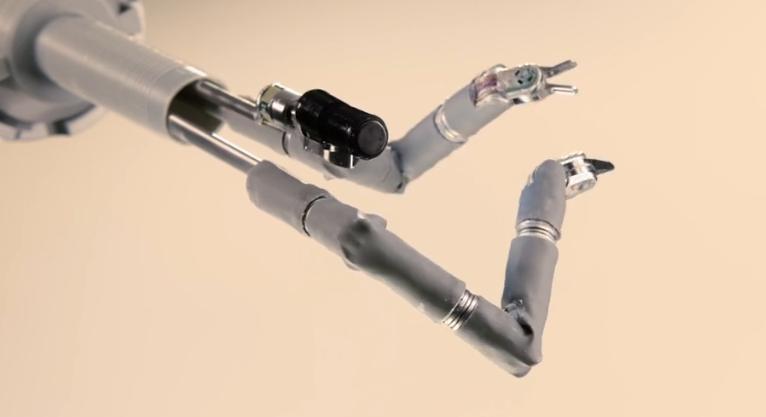
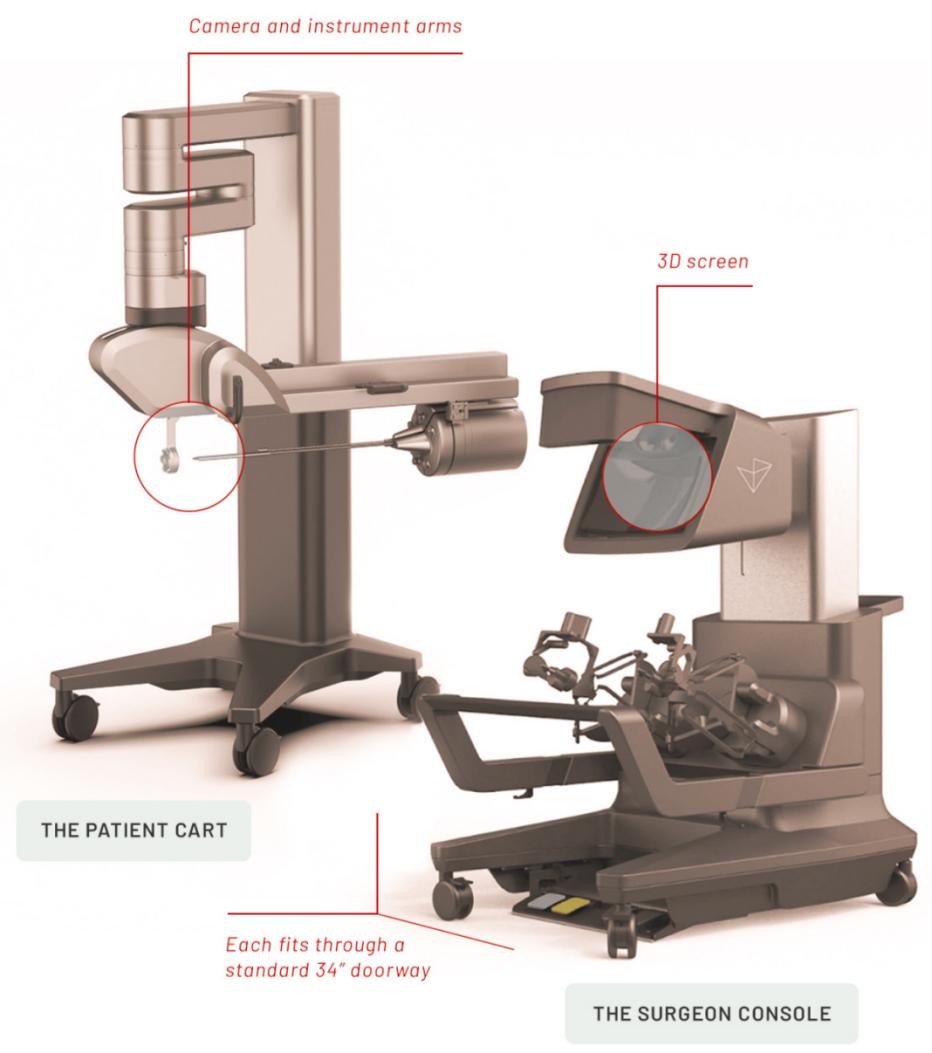
Vicarious's final vision solidified into a tiny robot: two robotic arms for manipulation, with a camera mounted on its "shoulders" delivering 360° real-time footage. During surgery, the robot is inserted into the patient's abdominal cavity through an incision less than 1.5 centimeters long. The doctor wears a VR headset, and the robotic arms fully map the doctor's remote hand movements.
Concept art of the Vicarious surgical robot, sourced from the official website
Such a stunning concept quickly earned Vicarious a large following — high-profile investors including Bill Gates, former Google CEO Eric Schmidt, Yahoo founder Jerry Yang, and Khosla Ventures all poured capital into the firm through their respective funds or investment vehicles.
The company's highlight came in 2021, when Vicarious completed a SPAC listing, with its market value peaking at over $1.2 billion. The following year, its product was named one of *Time* magazine's Best Inventions of 2022, and it became the first surgical robot to receive the U.S. FDA's Breakthrough Device designation.
By rough calculations, Vicarious raised approximately $300 million (around 2 billion RMB) in total funding, all of which will now go to waste as the company heads toward bankruptcy.
What Led to Its Collapse?
No one expected that the listing would turn out to be Vicarious's final moment of glory.
As early as 2023, Vicarious received a delisting warning over its market value, with its stock price having plummeted 90% from its peak. Originally scheduled to conduct its first clinical trial in 2024 and submit a medical device approval application by the end of 2025, these milestones were repeatedly delayed due to unforeseen engineering challenges.
For an unprofitable startup, failing to deliver a viable product two or three years after listing means that no matter how glamorous its past story was, the market's patience will rapidly evaporate.
This March, after trading for 30 consecutive trading days with an average market capitalization below $15 million, Vicarious received a delisting notice from the New York Stock Exchange, closing its last remaining lifeline.
"We couldn't secure additional financing, nor did we find a buyer," Vicarious stated helplessly. By the end of March this year, the company's cash, cash equivalents, and short-term investments on its balance sheet amounted to only around $3.7 million.
Profitability remained a distant dream — Vicarious posted a loss of $7.3 million that quarter, with total losses of $63 million (about 426 million RMB) in 2024 and $50.2 million (about 340 million RMB) in 2025.
Overly idealized technology could not mask the harsh realities of its predicament.
"The technology was too aggressive." To make the robotic arms mimic human hands, Vicarious adopted a decoupled actuation solution, which introduced extreme structural complexity and made yield control nearly impossible. The entire system was as intricate as a Swiss watch, making stable, mass production of products that meet FDA standards practically a fantasy.
Especially in its pursuit of an ultra-small incision, Vicarious only equipped the robot with two robotic arms, which prevented many surgical procedures from being completed smoothly. The VR headset featured in its promotional materials was also criticized for being more of a gimmick than a practical tool, as prolonged use by surgeons increased fatigue.
The two co-founders' engineering-focused mindset also planted hidden risks — the product had impressive specifications and unique features, but it was fundamentally impossible to implement in practice. In other words, they drastically underestimated the deployment challenges of medical devices across R&D cycles, regulatory requirements, and clinical validation stages.
It is not hard to imagine how capital-intensive this process was. "Since our establishment, we have consistently faced operating losses and negative cash flow, and we expect to continue incurring operating losses and burning through substantial cash reserves in the future," Vicarious stated ahead of its extraordinary general meeting of shareholders.
Under the liquidation proposal, the company's assets will be transferred to a third party, "Vicarious Liquidation LLC," to settle its debts. For shareholders who poured massive sums into the firm, they are almost certain to lose all their investments. "We cannot predict whether there will be remaining funds to repay investors," the company previously admitted.
This bleak outcome is truly lamentable.
A Wake-Up Call
Turning our attention back to the other side of the Pacific, the explosive growth of China's robotics sector this year is obvious to all.
In the past, only a handful of companies could complete three to four rounds of financing in a single year, but now this has become common for most embodied intelligence startups. As a result, billion-dollar valuation unicorns are emerging at an unprecedented density.
But there is more to the story than just the hype.
We still remember that last November, K-Scale Labs, a star humanoid robotics startup in Silicon Valley, collapsed. The company had successfully completed three rounds of financing, but its remaining cash could not sustain mass production. Similarly, the U.S. robotics pioneer iRobot filed for bankruptcy protection not long ago.
"We ran out of cash." Similar cases are emerging one after another. Beyond financing gaps, the deeper root cause lies in the failure to achieve viable commercialization.
An unspoken truth within the industry is: "Robot demos all look impressive, but there is no compelling reason to buy them." Currently, the vast majority of robots are sold to laboratories, university robotics departments, science museum exhibition booths, and data collection centers, with very few actually operating on production lines.
The cost math is straightforward — an industrial robot starts at hundreds of thousands of RMB, meaning it may take enterprises four to five years to recoup their investment. The home scenario is even more prohibitive: according to Stanford's 2026 AI Index Report, humanoid robots only have a 12.4% success rate in completing 1,000 household chores in real homes, compared to 89.4% in simulated environments.
"Robots that work well are too expensive, and affordable ones have limited practical use." This situation is undeniably awkward.
At this moment, industry differentiation will become more intense than ever. If the industry's early-stage R&D breakthroughs in single dimensions such as foundation models, motion control, or specific actions were already impressive, companies now have no choice but to fully shift their focus to exploring real-world scenarios. Robotics enterprises that cannot close the commercialization loop will struggle to make it to the next round of competition.
Cao Wei, a partner at BlueRun Ventures, once told us: A burgeoning industry typically goes through two phases. In the league phase, no one gets eliminated, and everyone can secure financing. But when structural shifts occur in the external market, the industry enters the knockout phase, where long-term, hard strengths in productization and commercialization become the ultimate deciding factors.
"The capital market is inherently cyclical. Current embodied intelligence startups still have a gap to cross before achieving mature productization. To survive future risk periods, they must either have ample cash reserves or outstanding products," Cao Wei remarked on the ongoing wave of robotics company failures.
There is no denying that the embodied intelligence track is an infinite game with no clear endgame, and its ultra-long-cycle technology stack fills everyone with anticipation. But the core priority must return to solving real-world problems — companies need to be more pragmatic and down-to-earth.
In this way, even if a startup cannot become an industry-disrupting milestone, it can at least avoid ending up as nothing more than a passing sigh.
This article is sourced from the WeChat Official Account "PE Daily" (ID: pedaily2012), written by Yu Mengying, and republished with authorization from 36Kr.