Issues Beyond the 5.1 Billion Yuan Fine of Trip.com
Half a month ago, a friend and I separately booked the same hotel on Ctrip.
For the same time period and the same room type, the prices displayed on our two mobile phones did not match. Moreover, my friend's order showed a rate of 568 yuan for a one-night stay on Wednesday, and 979 yuan for a one-night stay on Thursday. The total price for booking the two nights separately added up to over 1,500 yuan, but when selecting a consecutive two-night stay, the total price shown on the page was even higher.
No one could provide a definitive explanation. Dynamic pricing, membership level disparities, coupon differences... Every claim holds up on its own, but precisely because they can explain everything, none of them can be definitively proven.
We finished booking the hotel as if we were going through some kind of counter-reconnaissance drill, and what lingered in our minds was not relief over how much money we had saved, but an indescribable sense of discomfort.
Why does booking a hotel room for travel require us to act like detectives, repeatedly comparing, calculating, and trial-and-erroring?
Half a month later, on July 25, the penalty decision from the State Administration for Market Regulation was issued: Ctrip was fined and confiscated a total of 5.179 billion yuan. I immediately thought of those two mobile phones that displayed mismatched prices.
01
This penalty notice is unusually severe
Let's first set the context for this penalty. In 2021, Alibaba was fined 18.228 billion yuan for its "choose one from two" exclusivity practices, which amounted to 4% of its domestic sales in the previous year. In the same year, Meituan was fined 3.442 billion yuan, representing 3% of its relevant sales. In 2022, CNKI was fined 87.6 million yuan, or 5% of its relevant sales.
Ctrip's penalty consists of three parts: confiscation of 1.658 billion yuan in illegal gains, a fine of 3.521 billion yuan calculated at 7.5% of its 2025 domestic sales in China of 46.958 billion yuan, and an order to refund 122 million yuan in mandatory order deposits deducted from hotels.
The 7.5% ratio is significantly higher than in previous major cases, and two details are unprecedented: this is the first anti-monopoly case in the online travel industry, and the first time that "confiscation of illegal gains" has been applied in a case involving a dominant platform economy player.
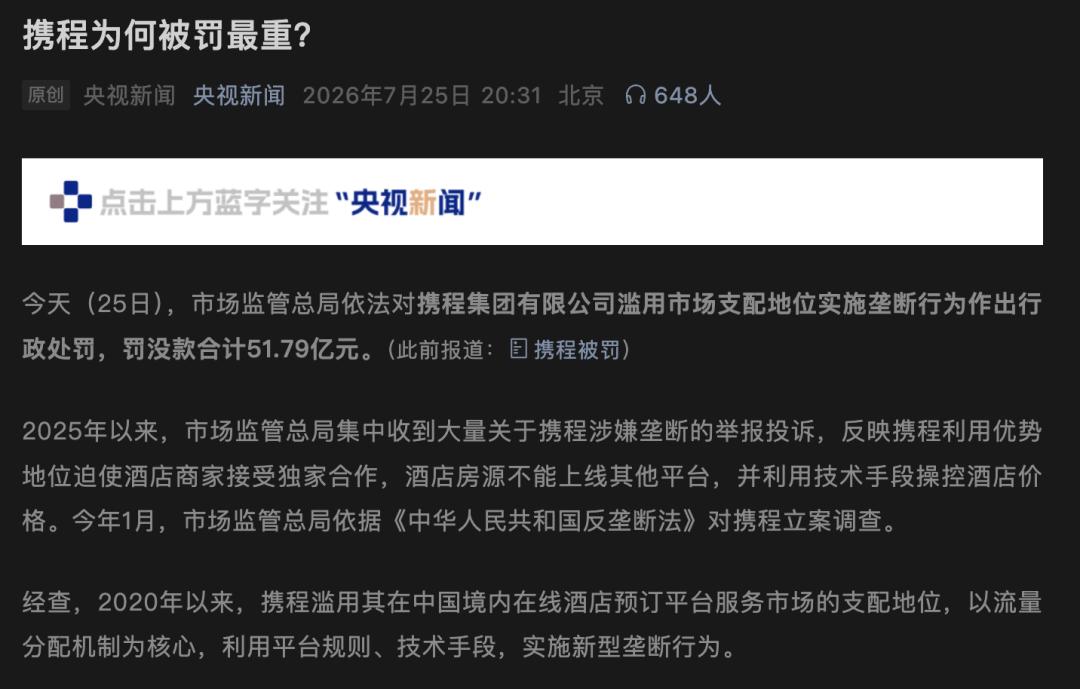
The reasons for the severe punishment can be traced in both the penalty decision and public reports. The illegal activities have continued since 2020. According to Liu Xu, a scholar who has long tracked anti-monopoly issues, Ctrip was investigated and ordered to rectify similar practices in Hong Kong and South Korea back in 2020, but failed to implement corresponding rectifications in the mainland market. Multiple regulatory authorities in Sichuan, Guizhou, Zhengzhou and other places summoned Ctrip for talks in 2021 and 2025, yet no corrective action was taken.
Professor Shi Jianzhong from China University of Political Science and Law pointed out the breakthrough in law enforcement: The focus of platform anti-monopoly efforts has expanded from the single "choose one from two" practice to the "lowest price across the entire network" requirement. The fine amount may fade from memory over time, but what will truly be remembered about this case is the way it establishes legal liability.
Alibaba's monopoly practices were written into contracts, signed and sealed by merchants, and law enforcement focused on reviewing the agreement texts. Ctrip's monopoly practices are embedded in its systems.
The two types of illegal acts identified in the penalty decision share the same core: taking the traffic allocation mechanism as the hub, forming a closed loop through platform rules and technical means. "Special Brand" hotels were induced by preferential traffic distribution to sign exclusive agreements, with an implementation rate of over 90%, effectively locking up high-quality room resources. "Gold Brand" and "Unbranded" hotels were forced to comply with the "lowest price across the entire network" requirement, and Gold Brand hotels were even mandated to have a mandatory price advantage of at least 20 yuan or 5% lower than prices on other platforms.
The agreements required hotels to authorize the platform to adjust prices directly, and a price comparison system monitored prices around the clock. Once a price difference was detected, tools like "Price Adjustment Assistant" and "Listing Manager" would directly modify prices, only lowering them, never raising them. Hotels that refused to cooperate faced traffic restrictions, delisting from the platform, and deduction of their order deposits.
The implementation details are almost ruthless. A B&B operator in Yunnan found that their room prices had a "routine": at 9 a.m., 10 a.m., 12 p.m., 2 p.m., and 6 p.m. every day, the system would check the listing prices on all platforms on schedule, and the prices were automatically adjusted more than a hundred times a month.
A hotel room priced at 480 yuan during holidays was directly changed to 130 yuan by the system. Corresponding to this, law enforcement methods have also been upgraded equally. The easily overlooked statement in the official notice "conducting in-depth big data analysis and algorithm parsing" means that regulators now possess the technical capability to reverse-engineer platform algorithms. Code is no longer a black box, nor a shield to evade oversight.
The outcomes of this pricing machine are reflected in two sets of accounts.
Ctrip's 2025 revenue reached 62.4 billion yuan, with a net profit attributable to shareholders of 33.3 billion yuan. Even after excluding the one-time gain of 19.9 billion yuan from the sale of its MakeMyTrip equity stake, its operating profit of 15.77 billion yuan and gross profit margin of over 80% for many years remain staggering. Its single-quarter net profit in the third quarter once exceeded that of Kweichow Moutai.
The other set of accounts comes from Eastmoney Choice data: in the first half of 2025, 40 listed tourism and hotel enterprises on A-shares, Hong Kong stocks, and US stocks recorded a combined revenue of 90 billion yuan, more than twice Ctrip's revenue for the same period, but their combined net profit was only 5.366 billion yuan.
A B&B operator in Dali provided a more specific breakdown: commissions rose from around 10% to over 25% for some room types. After accounting for rent, labor costs, and utility expenses, the net profit margin was less than 5%.
The regulatory notice's characterization of "exacerbating involution-style competition in the industry" precisely describes this unbalanced cost: low prices did not create incremental market demand, but only accelerated the transfer of profits from the end of the industrial chain to the platform's central control.
02
Was there price discrimination against loyal users?
The lock-in of merchants is only half of this entire system.
The most thought-provoking point in the whole logic is: The algorithm infrastructure that locks in merchant prices and the pricing system for consumers are built on the same technical foundation. For merchants, it sets prices on their behalf; for users, it sets prices specifically for them.
My own experience of "two mobile phones showing two different prices" cannot be proven as price discrimination against loyal users. This is the common predicament of all similar encounters, and the real crux of this issue. But some things do not need my proof — the judgments and records already exist.
In 2020, Ms. Hu, a diamond-level VIP member of Ctrip, booked a hotel in Zhoushan through the platform and paid 2,889 yuan. Upon check-out, she found that the hotel's posted price including tax was only 1,377.63 yuan. She sued the platform, and the People's Court of Keqiao District, Shaoxing ordered Ctrip to refund the payment and pay triple the compensation. The final second-instance judgment at the end of 2021 confirmed that Ctrip had committed fraud.
In July 2024, Huang Yuanpu, the founder of Yiou, booked a flight ticket as a black diamond member, and watched the price jump from 3,868 yuan to 4,408 yuan during the checkout process, only to drop back to the original price after payment was completed. In June 2025, lawyer Wang Weiwei and his colleague booked tickets for the same flight at the same time: the highest-level Black Diamond V7 member paid 1,018 yuan, while the lower-level Diamond V5 member only paid 815 yuan. In May 2026, according to a report by Juli Video, a diamond member in Shanghai was quoted 12,162 yuan for a two-night hotel stay, while his friend's regular member account for the same room type at the same time was only charged 6,568 yuan. After filing a complaint that afternoon, the price "fell back" to the normal range.
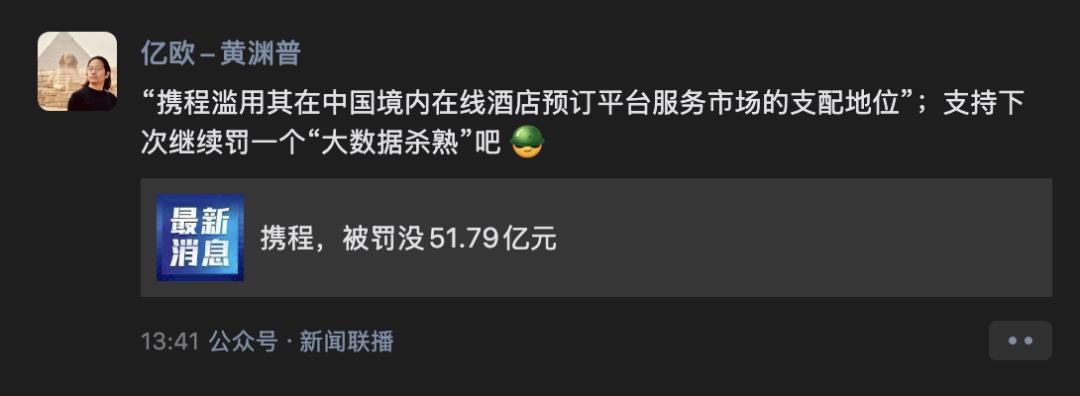
Higher membership levels mean higher prices, more frequent searches lead to higher prices, and consecutive bookings cost more than separate bookings. When consumers are forced to learn these "anti-algorithm survival skills" such as splitting orders, borrowing family and friends' accounts to compare prices, and avoiding frequent refreshes before placing an order, the issue has gone beyond individual cases.
The cornerstone of the market economy is that prices are public signals visible to all: merchants decide their supply based on prices, consumers make their choices based on prices, and competition is differentiated through prices. But when algorithms turn prices into one-on-one private calculations, where everyone only sees the price they "deserve", prices are privatized.
It remains precise, but no longer public; it remains efficient, but cannot be questioned. The 5.179 billion yuan penalty punishes a company's behavior over the past six years, but what it truly aims to safeguard is the legitimacy of price as a public institution.
The efforts to safeguard this principle have already expanded beyond the penalty notice. In January 2026, the State Administration for Market Regulation took action three times within ten days: summoning the polysilicon alliance for talks, launching an investigation into the competitive landscape of food delivery platforms, and announcing the filing of the Ctrip case. In February, the "Negative List of Algorithms for Life Service Platforms (Trial)" issued by the Central Cyberspace Affairs Commission began to be implemented.
The two tracks of anti-monopoly enforcement and algorithm governance have formally converged in this case, drawing a clear line for all companies that rely on algorithmic pricing: helping merchants optimize pricing is allowed, but setting prices on their behalf is not; differentiated services are acceptable, but opaque differential pricing is not.
For Ctrip itself, the 5.179 billion yuan fine is far from a fatal blow to its hundreds of billions of yuan in cash reserves. The real cost lies in its business model. Among the nineteen rectification requirements, the two commissioned distribution models of "Special Brand" and "Gold Brand" have been fully shut down, and the "complete removal of contract clauses allowing the platform to adjust merchant prices" is equivalent to dismantling the core components of its profit engine in recent years. The "Price Adjustment Assistant" was renamed "AI Business Assistant" and shut down in March 2026, while "Listing Manager" was only announced to be discontinued on the day the penalty was issued.
There is another memorable commitment in the rectification list: "Always practice good algorithms, and comprehensively and resolutely prevent big data-enabled price discrimination against loyal users." This discriminatory practice was not explicitly identified in the penalty decision, but it was separately written into the rectification clauses, and everyone can understand the weight of this foreshadowing.
The travel and hospitality market is now at a new competitive juncture. JD announced its entry into the travel and hospitality sector in mid-2025, offering a maximum of three years of zero-commission policy, while Meituan and Douyin are also ramping up their efforts. What Ctrip needs to prove next is how much value its services can still deliver without relying on price locking and traffic coercion.
As for whether this 5.179 billion yuan penalty was worth it, the standard is very simple. The next time you travel, open the same hotel on two different mobile phones, and see if you can get the same price. On that day, the answer will speak for itself.
This article is from the WeChat public account "Singularity Pai", written by Wang Xueran, and published with authorization from 36Kr.