Is there hidden false overheating lurking in the wind power, photovoltaic and CATL concept sectors?
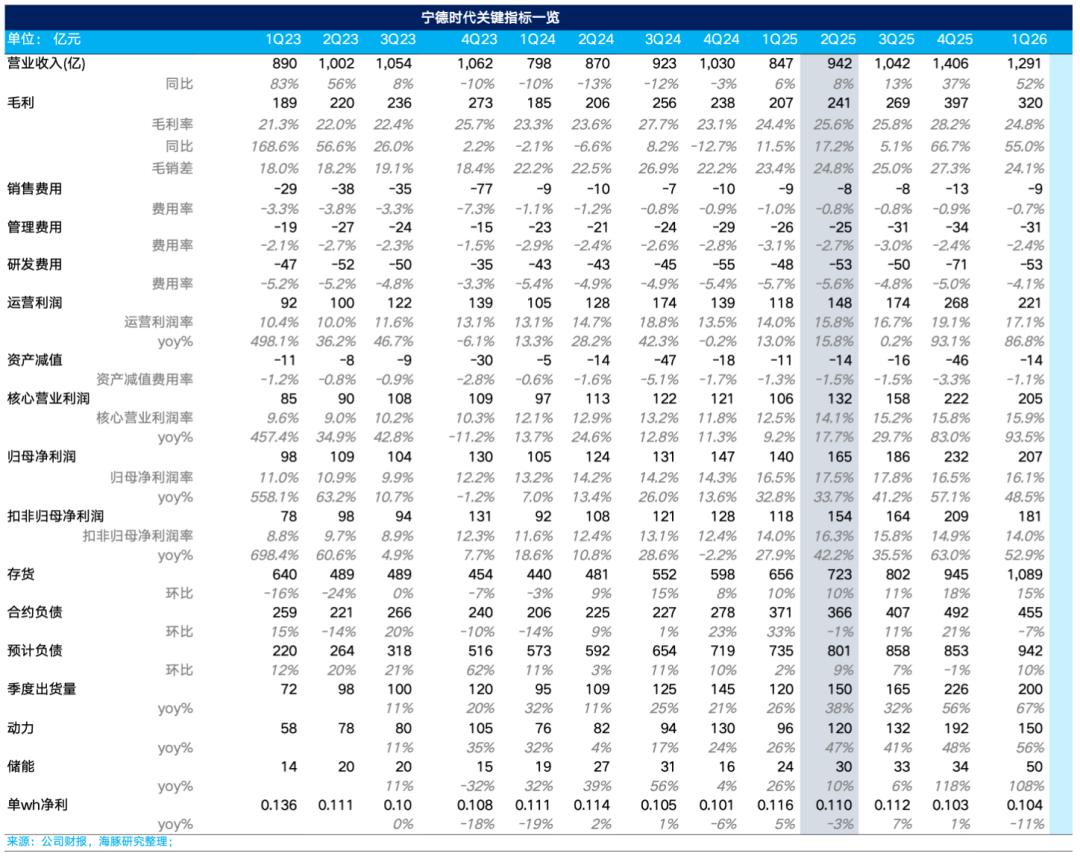
On the evening of July 24, 2026, CATL released its Q2 2026 performance report. Here are the key takeaways:
1) Revenue maintained high growth, in line with market expectations: In Q2 2026, CATL's quarterly revenue reached RMB 1478 billion, representing a 57% year-on-year growth rate, which was largely consistent with the market consensus forecast of RMB 1486 billion. The robust top-line growth was primarily driven by a sharp increase in shipment volume, while battery unit prices remained largely stable amid the rising price of lithium carbonate, with no significant price hikes observed.
2) Shipments grew significantly beyond expectations: In Q2, the company's total battery shipments reached approximately 232 GWh, up 55% year-on-year, exceeding the market expectation of 222 GWh. Breaking this down, power battery shipments hit 174 GWh (up 45% year-on-year), driven mainly by the increase in average battery capacity per new energy vehicle, the leverage effect of "high-capacity batteries" in commercial vehicles, and a rebound in CATL's market share in the power battery segment.
Energy storage battery shipments reached 58 GWh (a substantial 93% year-on-year increase), largely fueled by the surging demand triggered by global solar-storage grid parity, the growing energy storage requirement for AIDC, and the effective release of new production capacity at the company's Jining, Shandong manufacturing base.
3) Battery unit prices remained largely stable quarter-on-quarter: While lithium carbonate prices rebounded to the high range of RMB 150,000–200,000 per ton in Q2, the overall average battery unit price stayed around RMB 0.56/Wh, roughly at the same level as in H2 2025, with no noticeable price increase.
Specifically, the average power battery price was about RMB 0.59/Wh (up 4% quarter-on-quarter), while the average energy storage battery price was approximately RMB 0.49/Wh (down 3% quarter-on-quarter). The absence of significant price hikes can be attributed to three factors: ① the rising proportion of energy storage battery shipments (which have lower unit prices) to 25% pulled down the overall average price; ② the project-based fixed-price mechanism in the energy storage sector led to a lag in price transmission; ③ the company adopted a strategy of "growing volume while keeping prices stable" to prioritize expanding its global market share.
4) Gross margin declined quarter-on-quarter: In Q2 2026, the company's consolidated gross margin was 23.2%, below the market expectation of 25% and down 1.6 percentage points from Q1. The gross margins for power batteries and energy storage batteries decreased sequentially to 20.6% and 24.0%, respectively.
The pressure on gross margin was mainly due to the sharp price increases in non-linked materials (such as copper, 6F, and electrolyte) with transmission lags, as well as the concentrated delivery of previously signed fixed-price energy storage contracts after raw material prices rose, resulting in short-term cost inversion.
5) Net profit slightly missed expectations, and net profit per Wh declined: Q2 attributable net profit was approximately RMB 225 billion, up about 37% year-on-year, but below the market consensus of RMB 234 billion. Net profit per Wh continued to decline to roughly RMB 0.097/Wh (down ~12% year-on-year).
The profit pressure stemmed not only from the incomplete pass-through of rising raw material costs to downstream customers but also from the company's proactive decision to sacrifice partial profits to maintain its market share. At the same time, the company increased R&D investment in cutting-edge technologies (R&D expenses rose by RMB 8 billion quarter-on-quarter to RMB 61 billion), which also exerted a certain impact on short-term net margin.
Dolphin Equity Research's Overall Perspective:
Overall, CATL's Q2 earnings report once again confirms that the lithium battery industry is still in a definite upward cycle:
a. Shipments continued high growth, sustaining the strong revenue momentum: Q2 shipments rose 55% year-on-year to 232 GWh, driving total revenue up 57% year-on-year to RMB 1478 billion.
b. Capacity utilization remained at a very high level: In H1 2026, CATL's capacity utilization reached 95%, about 5 percentage points higher than the 90% recorded in H1 2025, fully demonstrating the strong prosperity of lithium battery industry demand.
c. Capacity expansion drove a further rebound in market share: From January to June 2026, CATL's domestic passenger vehicle market share rebounded from 41% in 2025 to around 47%. Meanwhile, with overseas bases going into operation, the company captured a 33.7% share in overseas markets in Jan-May 2026 (up about 3.7 percentage points year-on-year).
d. Capital expenditure and construction in progress reached historically high levels: CATL's capital expenditure in Q2 2026 amounted to approximately RMB 127 billion, close to the peak level of the previous capacity expansion cycle (a quarterly peak of around RMB 130 billion in 2021–2022).
CATL has revised its 2026 production schedule target upward to 1.2 TWh (representing a year-on-year growth rate of over 50%), corresponding to a substantial expansion of capacity under construction (the current annualized capacity stands at 1050 GWh). At the end of Q2 2026, the company's capacity under construction reached about 764 GWh, roughly 1.4 times higher than the ~320 GWh at the end of 2025, with most of this capacity expected to be completed within one to two years.
e. Inventories continued to surge, stocking up for strong H2 demand in advance: Total inventories directly hit RMB 1308 billion this quarter, a sequential increase of nearly RMB 219 billion, reaching an all-time high!
The company's management clearly stated that the demand trend for H2 is certain, and demand for next year also looks promising. The inventory build-up is primarily to pre-position stock for the peak season in the second half of the year.
Therefore, there is no obvious market disagreement on the view that the lithium battery sector remains in an upward cycle and the certainty of CATL's 2026 shipment volume. However, the main points of divergence lie in: ① the extent of erosion in net profit per Wh caused by higher lithium carbonate prices; ② a potential reversal of the supply-demand pattern triggered by slowing demand growth after large-scale capacity release in 2027; ③ the drag on profit realization from the re-imposition of the battery consumption tax. Details are as follows:
1. Higher lithium carbonate prices erode net profit per Wh:
In Q2 2026, the company's consolidated gross margin was 23.2%, below the market expectation of 25%. Gross profit per Wh declined from RMB 0.18/Wh in Q4 last year to approximately RMB 0.15/Wh in Q2 2026.
In terms of unit profitability, net profit per Wh continued to drop to about RMB 0.097/Wh this quarter (down ~12% year-on-year), which was also lower than the market expectation of RMB 0.106/Wh.
Dolphin Equity Research believes that the main reason for net profit per Wh missing expectations is that, amid the headwind of rapidly rebounding prices for raw materials like lithium carbonate, the company cannot fully pass the increased upstream material costs through to downstream customers:
a. Transmission of non-linked materials involves lags and exposure risks: In battery material costs, metals such as lithium carbonate, nickel, and cobalt can be smoothly passed through via linkage mechanisms. However, price increases for non-linked materials (such as copper, 6F, separators, and electrolyte) need to be negotiated case by case, leading to transmission lags and cost exposure that the company has to partially absorb on its own.
b. Project-based fixed pricing in the energy storage sector leads to short-term cost inversion: A large number of fixed-price energy storage contracts signed when lithium carbonate prices were low are being delivered in a concentrated manner after lithium prices rose, forcing the company to bear the corresponding cost increases without being able to immediately pass them on via price hikes. This directly compressed the unit gross margin of energy storage batteries in the current period and further dragged down the overall gross margin.
2. Potential supply-demand pattern reversal caused by slowing demand growth following massive capacity release in 2027
Since the market is already fully aware of CATL's 2026 production target of 1.2 TWh (with a year-on-year growth rate above 50%), the core issue is no longer whether battery demand can maintain high growth in 2026.
Accordingly, strong 2026 shipment volumes are no longer sufficient to drive a significant upward revision to CATL's profit forecasts (which are already priced into stock valuations) or valuation expansion — investors are increasingly viewing strong earnings reports as opportunities to lock in profits rather than add positions, especially after lithium battery valuations have risen sharply over the past 6–9 months.
In the absence of new growth catalysts or significant earnings upside surprises, the market appears reluctant to push valuations substantially higher purely based on 2026 earnings realization.
As a result, the market debate has shifted to 2027 demand growth, with key concerns centered on:
a. Slowing new energy vehicle growth: With the phasing down of purchase tax incentives and domestic NEV penetration already at a high level (projected at 59% in 2026 and 64% in 2027), a subsequent slowdown in growth is widely expected (domestic NEV sales growth is estimated at ~11% in 2026 and further down to ~8% in 2027).
b. Uncertainty in energy storage demand growth: There is major market disagreement on whether the ultra-high growth of the energy storage sector over the past two years can extend into 2027. During the early stage of the "15th Five-Year Plan" period from 2026 to 2027, some policies (such as subsidies and priority dispatch rules) may face adjustments or gradual phase-out in 2027.
According to JP Morgan forecasts, domestic energy storage demand growth could slow to around 25% in 2027 and further drop to ~4% in 2028. Since energy storage battery shipments typically lead installations by about six months, the risk of slowing shipment growth could emerge as early as H2 2027.
c. Concerns about oversupply brought by a new round of capacity expansion: Starting from H2 2026, the industry will enter a new phase of concentrated capacity release. Estimates suggest that effective industry capacity could increase by roughly 40% in 2027, sparking worries that the sector may re-enter an oversupply cycle. The market still clearly remembers the severe overcapacity episode of 2023–2024, when the industry fell into fierce price wars, putting pressure on gross margins across the entire value chain and leading to sharp downward earnings revisions.
Nevertheless, based on current market expectations, global lithium battery demand growth exceeding 20% in 2027 remains a high-probability event, with an optimistic scenario seeing growth reach 25% — although this represents a clear slowdown from the 45% growth projected for 2026.
At the same time, the government has introduced measures to regulate the industry's supply side (e.g., centralizing approval authority for battery capacity expansion and implementing categorized enterprise management), which will lead to a tightening of new capacity approvals starting from H2 2027. Therefore, while easing capacity constraints may cause profit margins to retreat from peak levels, a 2023–2024 level price shock and sharp earnings contraction is unlikely.
3. The drag on profit realization from the re-imposition of the battery consumption tax:
On July 17, 2026, China's Ministry of Finance, General Administration of Customs, and State Taxation Administration jointly issued the "Notice on Adjusting the Consumption Tax Policy for Certain Battery Products". Effective September 1, 2026, a consumption tax will be reinstated for lithium primary batteries and lithium-ion batteries, with an initial tax rate of 2%, which will rise to the standard 4% rate starting from September 1, 2027.
Next-generation battery technologies (sodium-ion batteries, solid-state batteries, fuel cells, and advanced photovoltaic technologies) will be temporarily exempt from this tax from September 1, 2026, to December 31, 2028.
Although CATL is one of the most resilient players, calculations using the 2%/4% tax rate imply a unit tax of RMB 10/20 per kWh. Given that over 30% of CATL's shipments go to overseas markets (which are exempt from this consumption tax), if the tax cannot be passed through to downstream customers, the estimated drag on profits would range from 7% to 14%. If half of the tax burden can be passed downstream, the profit drag would be around 3.5%–7%.
Accordingly, Dolphin Equity Research forecasts CATL's full-year 2026 shipments to reach approximately 980 GWh, representing a ~48% year-on-year increase. Breaking this down, power batteries will account for roughly 760 GWh (+41% YoY), and energy storage batteries about 220 GWh (+82% YoY).
However, considering the erosion of unit net profits from rising lithium carbonate prices and the impact of the battery consumption tax, full-year 2026 net profit per Wh is projected to reach only RMB 0.10/Wh, corresponding to a 2026 net profit of RMB 980 billion, up ~36% year-on-year.
Looking ahead to 2027, under our neutral assumptions, we expect CATL's battery sales to grow by ~25% year-on-year to 1,225 GWh. Full-year 2027 net profit per Wh is projected at RMB 0.096/Wh (a further 4% decline from 2026), corresponding to a 2027 net profit of RMB 1,176 billion, up ~20% year-on-year.
Therefore, Dolphin Equity Research believes that although CATL remains a high-conviction stock in the upward lithium battery cycle, the implied upside in its current valuation is relatively limited, given the potential deterioration in supply-demand conditions in 2027.
The market is also closely monitoring the progress of CATL's discussions with upstream material suppliers regarding 2027 capacity planning (these talks typically start in December, but were brought forward to September 2025 this year), with the current market focus remaining on the visibility of 2027 demand.
Dolphin Equity Research holds that future upward revisions to CATL's fundamental performance will mainly depend on a substantial easing of the net profit pressure from lithium carbonate costs, as well as its 2027 production schedule significantly exceeding market expectations.
Detailed contents are as follows
I. Revenue met expectations, but gross margin declined
1. Revenue maintained strong growth, validating the ongoing lithium battery upward cycle
In Q2 2026, CATL's quarterly revenue hit RMB 1478 billion, marking a 57% year-on-year growth rate. This strong revenue performance further confirms the start of the lithium battery industry's upward cycle, largely in line with the market consensus of RMB 1486 billion.
The robust revenue growth was primarily driven by surging shipment volumes (2Q26 shipments increased by ~55% YoY), while battery unit prices remained largely stable amid the rising lithium carbonate price environment, with no obvious signs of significant price hikes.
