Rubin full-liquid cooling technology has achieved mass production, and this track is entering the payoff period.
On June 21, 2026, NVIDIA published a set of understated technical details on its official blog: Every chip and every network component in the Vera Rubin platform is fully cooled by a closed liquid loop, with no fans in the entire system, and the coolant temperature reaches as high as 45 degrees Celsius.
The ripple effect of this news in the industry is far greater than it appears on the surface. Because it not only announces a parameter upgrade, but also formally establishes liquid cooling as a "ticket to entry" rather than an "optional feature".
Moreover, this trend of full liquid cooling is not limited to NVIDIA — the recently released super nodes from domestic players Huawei and Sugon are all fully committed to full liquid cooling solutions.
Viewing Liquid Cooling Through the Macro Cycle: An Irreversible Infrastructure Shift
To understand why liquid cooling has suddenly become a hot topic, we need to place it in a broader context: this is not a single-product replacement cycle, but an infrastructure transformation driven by the exponential surge in computing power density.
In the past few years, GPU power consumption has followed an almost vertical upward curve: the H100 peaks at 700W, the B200 rises to 1200W, the B300 reaches 1400W, and the latest VR200 is pushed to 1800 to 2300W; the 2028 Feynman is projected to hit 5000W.
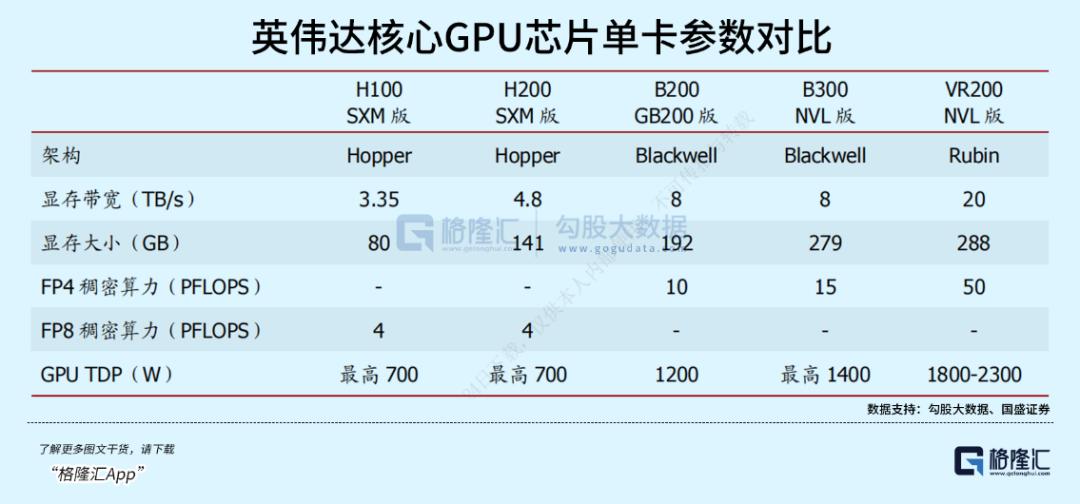
Behind these numbers lies a simple truth: The more powerful the chip, the more extreme its heat output.
The GB300 NVL72 packs 72 GPUs and 36 CPUs, pushing the single-rack power consumption to 130 to 140 kW; while the limit of traditional air cooling is only 15 to 20 kW.
Why has liquid cooling managed to turn the tide?
Air has extremely poor thermal conductivity, with a coefficient of only 0.026, while the heat-carrying capacity of coolant is 3500 times that of air.
By switching cooling from "blowing" to "immersing", the cooling energy consumption of data centers can plummet from 43% of total energy consumption to 9%, the PUE can be reduced from above 1.5 to below 1.2, and immersion cooling can even achieve a PUE as low as 1.05.
Not to mention the driving force from policy.
Germany, Singapore, and the European Union have successively set strict PUE red lines, and Beijing also requires the PUE of new intelligent computing centers to generally not exceed 1.25.
Liquid cooling is evolving from a "cost-saving choice" to a "compliance threshold".
Looking at the current situation, the Vera Rubin platform entered full mass production at the end of May 2026, with order shipments starting to ramp up in the third and fourth quarters of 2026, and is expected to contribute to annual performance in 2027.
Furthermore, domestic super nodes are also collectively "liquid-cooled" in 2026.
The real unit of Huawei's debut Atlas 950 is a clear "full-liquid-cooled data center super node".
Sugon's ScaleX640 is even more aggressive, directly adopting immersion phase-change liquid cooling, boosting the computing power density of a single rack by 20 times.
Disassembling the Liquid Cooling Industry Chain: Who Takes the Lion's Share and Who Gets the Leftovers
Liquid cooling may sound like a single product, but it is actually a complete system engineering. To clarify investment opportunities, we must first figure out: Who captures the value along this chain.
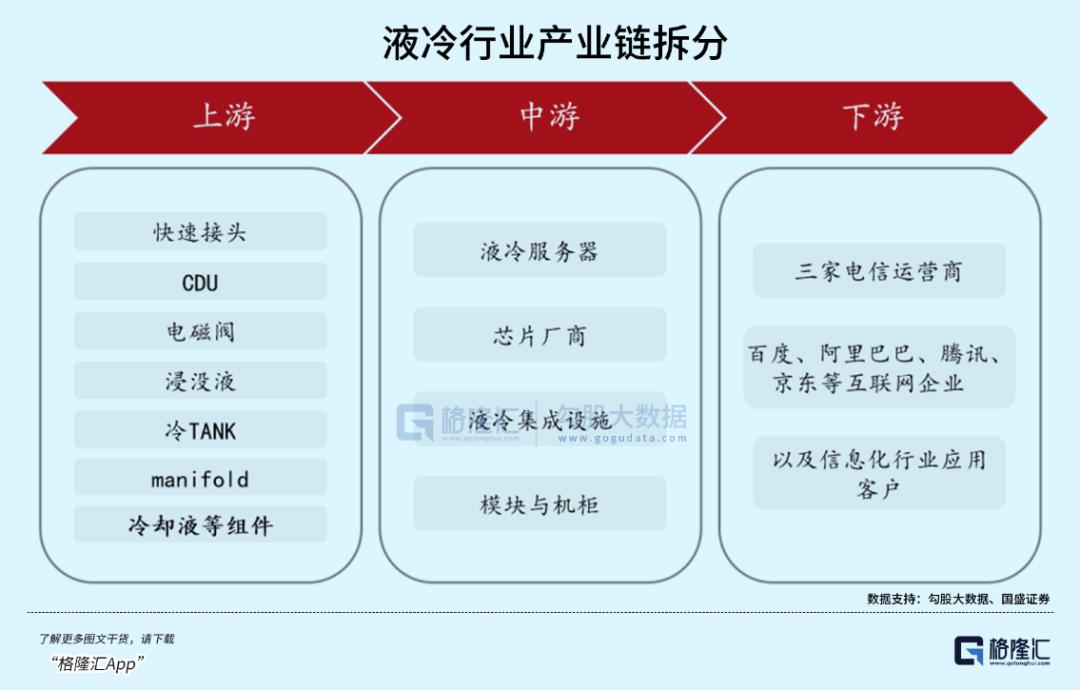
The liquid cooling industry chain can be roughly divided into three segments:
The upstream consists of basic components such as quick connectors, CDU, solenoid valves, and coolant, which form the hardware foundation;
The midstream manufactures liquid-cooled servers, computing power facilities and integrated systems to form complete sets of equipment;
The downstream includes operators, major internet companies, and industry clients, who are the payers.
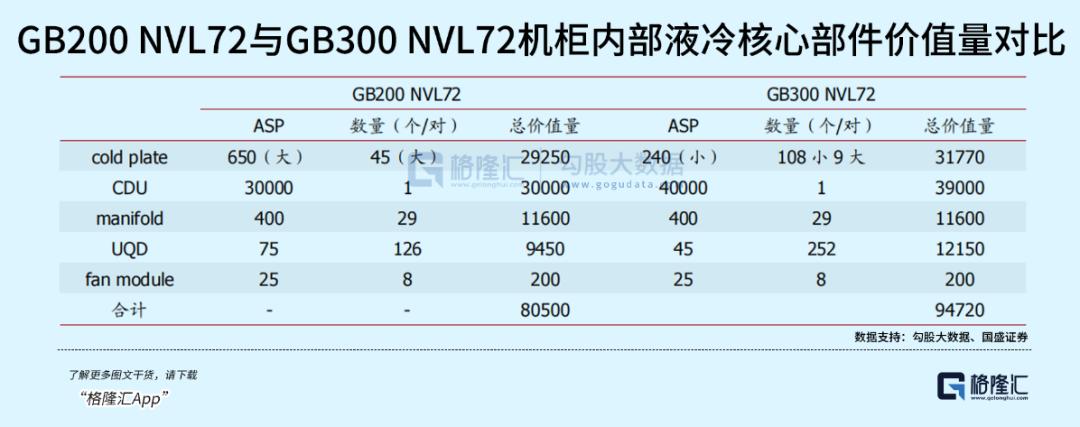
The value distribution is determined by four core components: Cold plate, CDU, Manifold (liquid distribution manifold) and UQD (quick disconnect connector), which account for over 90% of the total value of a full liquid-cooled rack.
The cold plate is attached directly above the chip, extracting heat directly through microchannel coolant, acting as the first line of defense, accounting for 30% to 35% of the total value;
The CDU is known as the "heart" of liquid cooling, responsible for pumping, temperature control, and differential pressure monitoring, accounting for 25% to 75% of the rack's total value;
The Manifold performs the "liquid distribution" function;
The UQD is the precision interface connecting pipelines and cold plates.
The higher the power consumption of the rack, the higher the total value of its liquid cooling system.
The liquid cooling system for a GB200 NVL72 single rack costs around $80,000; for the GB300, this rises to approximately $94,700; and for the Rubin level, it jumps directly to $140,000 to $160,000.
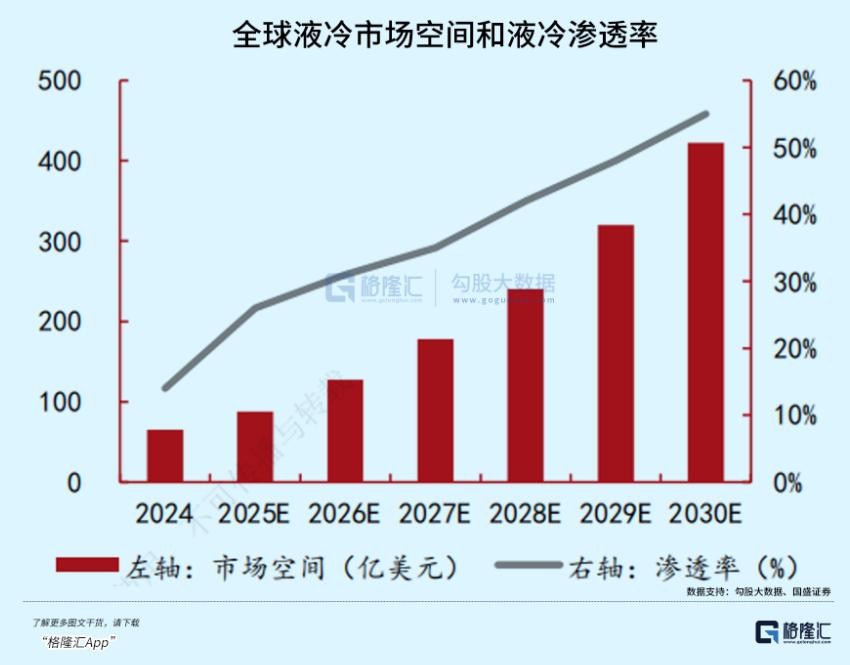
The market space is equally staggering.
The global liquid cooling market is projected to grow from approximately $12.7 billion in 2026 to $42.2 billion in 2030, with a compound annual growth rate of around 35%.
In terms of technical routes, "cold plate cooling takes the lead, while immersion cooling serves as a supplement": cold plate cooling features low transformation cost and good compatibility, occupying around 90% of the market share and becoming the mainstream for new data centers; immersion cooling submerges servers in insulating coolant, enabling a PUE as low as 1.02 to 1.05 and a single-rack power limit of 400kW, but with high initial investment and difficult transformation, it is mainly used in supercomputing and top-tier AI training scenarios.
In terms of the competitive landscape, overseas manufacturers still hold the first-mover advantage.
North America and Europe account for more than 60% of global demand, and Taiwanese ODMs have been collaborating with NVIDIA since 2017.
But the real highlight is: Domestic manufacturers are crossing the threshold from "sample submission and validation" to "mass delivery".
Investment Logic: Which Segment Should We Bet On
When we lay out the full industry chain landscape, the main investment themes become clear.
The current focus of the liquid cooling sector lies in the performance realization brought by Rubin mass production, and the profit transfer from the increase of domestic market share.
Following this logic, we can identify three main investment lines.
The first line, which is relatively certain: target system integrators with full-chain capabilities.
The liquid cooling system spans two procurement systems: server manufacturers and data centers. A single component supplier can hardly capture the full value. Only enterprises that master both the core components inside the rack and the CDU and cold source outside the rack can expand from one client to multiple product lines.
INVI's product chain is relatively complete with sufficient overseas validation, while Shenling Environmentally Friendly Energy has outstanding facility-side capabilities, with orders and profits entering a high-growth channel and strong backlogged order support.
The second line: focus on the technical premium of core components.
Although CDU has the highest value share, NVIDIA has opened up the MGX architecture to OCP, and there are already more than 80 partners worldwide. The CDU market share is likely to shift from concentration to dispersion, with margin pressure risks.
The segments that face minimal price pressure and can generate technical premium are cold plates and quick connectors.
Cold plates need to be redesigned for specific chip platforms, constrained by mass production yield;
Quick connectors bear the leakage risk, and clients will not gamble on the safety of the entire rack just to save a small cost.
These two segments have smaller revenue scale than CDU, but higher return on capital.
The third line: track targets with second growth curves.
Tongfei Co., Ltd. has a solid performance foundation, and AI liquid cooling is expected to become its second growth curve beyond energy storage. Yidong Electronics entered the liquid cooling heat dissipation module sector by acquiring Shenzhen Guanding, while Jinfu Technology expanded into liquid cooling copper pipes and water cooling head fields through the acquisition of Zhuohui Metal and Lianyi Thermal Energy. These companies currently have a low proportion of liquid cooling revenue, but with high flexibility, their future growth depends on client onboarding and order fulfillment pace.
Several key nodes need to be tracked in the follow-up.
First, the delivery rhythm of Rubin, the second half of 2026 is the order fulfillment period, and 2027 will see full annual contribution;
Second, the sequential order of domestic share increase, Manifolds and pipelines will see the first volume growth, followed by quick connectors and cold plates;
Third, the implementation pace of domestic super node liquid cooling solutions, the large-scale delivery of Huawei Atlas 950 and Sugon's 100,000-card cluster will directly drive orders and market share for the local liquid cooling supply chain.
Of course, risks cannot be ignored.
Rubin's mass production and delivery pace falling below expectations, cloud vendors slowing down capital expenditure, intensified competition in the liquid cooling industry compressing profitability, and reliability validation risks of key products, all these factors may affect the industry's boom rhythm.
Overall, however, the underlying logic that liquid cooling has shifted from "optional" to "necessary" remains unchanged, which is a certainty determined by the laws of physics.
Conclusion
From air cooling, to cold plate liquid cooling, to the Rubin era's 100% full liquid cooling and zero-fan architecture, the evolution path of data center heat dissipation has become increasingly clear: this is not an ordinary technology upgrade, but a forced rewrite of infrastructure driven by the exponential surge in computing power density.
Note: The companies mentioned in this article are for industrial case analysis only, and do not constitute any investment advice. Market risks exist, and investment requires caution.
This article is from WeChat official account "Gelonghui Finance Hotspot" (ID: glh_finance), author: Gelonghui Editor, published with authorization from 36Kr.