The AI toy market sees stark polarization: some products have become runaway hits, while the rest are left idle gathering dust.
AI toys are booming. Stuffed toys integrated with large language models can now chat, desktop pets nuzzle against your palms, and children's robots can tell stories and teach English. As a result, many people claim the entire toy industry is about to be completely reinvented by AI.
This statement is only half true. After recent conversations with several friends in the toy business, I've uncovered a harsh truth: mid-tier toy brands are being squeezed out of the market.
What exactly is this "mid-tier space"? These products have a screen and Bluetooth connectivity that traditional toys lack, but they still fall short of true AI toys. They offer some limited interactivity but are not particularly smart, possess basic "intelligence" but cannot truly understand users, are priced at a mediocre range, and their features feel largely unremarkable.
These brands will soon be crushed between two extremes. On one side are traditional industry giants, who hold valuable IP resources and mature distribution channels and are enjoying healthy profits. On the other side are genuine AI toys that truly deliver on the "companionship" promise, and they are rapidly winning over early-adopting users.
Those stuck in the middle face the greatest danger. This article discusses three key topics: the longstanding flaws in the traditional toy industry, whether AI can effectively address these issues, and why mid-tier brands will be the first to collapse.
Failing to retain users is the biggest chronic problem in the toy industry
Traditional toy manufacturers rely on a limited set of tactics: attractive designs, licensed IP, novel gameplay, and widespread distribution. These strategies have worked in the past and still deliver results to some extent.
However, they only solve one problem: getting customers to make their first purchase. They completely fail at the far more critical task: making users keep the product long-term. The greatest challenge for the toy industry is not getting someone to buy once, but making them want to keep using the product and even make repeat purchases.
For far too many toys, the relationship with the user ends the moment the product is sold. Children lose interest after just a couple of days of play. Adults take a single photo and then leave the toy forgotten on a shelf. Parents purchase these toys expecting "someone to keep their child company", only to realize in the end they still have to sit beside their kids the whole time.
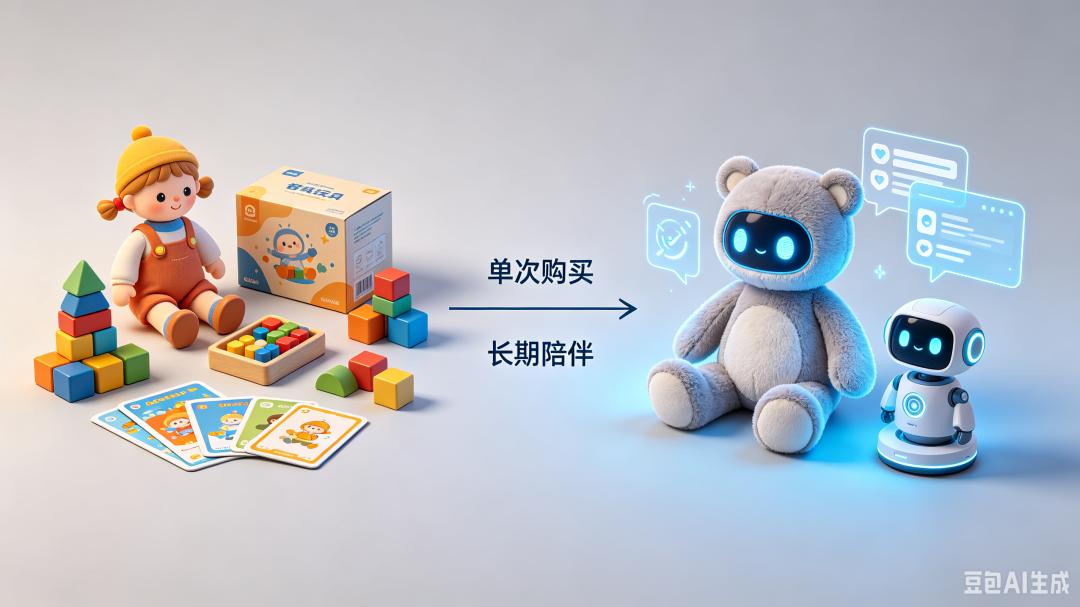
These toys can grab your attention temporarily, but they cannot foster long-term emotional attachment. That's why the toy industry constantly has to rely on launching new products, rotating IP licenses, and releasing limited-edition collaborations to stay alive. When old products are forgotten, brands rush to create new ones, growing increasingly exhausted in this endless cycle. Consumers are becoming more discerning, children now spend hours on short-video platforms, and parents are increasingly questioning what actual value these toys provide.
Products that only deliver a fleeting moment of interactive excitement are finding it harder than ever to hold onto users. A toy gets forgotten not because it failed to capture attention at first.
On the contrary, many toys are incredibly engaging the moment you first get them. But the novelty quickly wears off. Once that initial excitement fades, the toy can no longer offer anything new. It cannot evolve, cannot remember your preferences, and cannot adjust its behavior just because you are in a bad mood that day.
Unlike coffee or sugar-free tea, which can seamlessly integrate into people's daily routines, toys do not have that luxury. They are not essential daily items, nor do they necessarily get frequent use. Toy brands can only keep churning out new gimmicks, but the core question of why users should keep their toys long-term has never been properly answered by the industry. This is exactly where AI finds its perfect entry point. AI is not just about adding extra features to toys — it is about granting toys genuine "interactive capabilities". In the past, toys were inanimate objects that only came to life when a human interacted with them. AI toys flip this dynamic entirely, proactively reaching out to initiate conversations. Shifting from being a passive object you use to becoming something that "stays with you" represents a far more transformative change than most people realize, and unlocks enormous new opportunities.
Among three existing development paths, only one leads to real success
AI toys have so far evolved along three distinct trajectories.
1. Stuffed toys integrated with AI: this seems like the most natural path, but it has a fundamental awkward flaw.
The idea is to embed AI conversational capabilities into traditional stuffed toys. Previously, when you talked to a stuffed toy, you were just imagining that it was listening — now it can actually respond to you. But the core value of a stuffed toy lies in being hugged and touched. To make it "speak", you often have to free one hand to press a button, which completely breaks the immersive feeling of holding it. The real challenge is not installing the chip, but figuring out how to make the "speaking" function not disrupt the comforting experience of hugging the toy.

2. Educational robots: these have the strongest value proposition to make parents pay, but children may not actually enjoy them.
These robots can talk and facilitate learning, seemingly offering the perfect balance of education and entertainment. The investment logic behind these products directly answers parents' top concern: "What benefits will this bring to my child?" But the reality is that while these products fulfill parents' value expectations, they need to satisfy two completely different groups of people at the same time.
It is not enough for children to love the product if parents see it as a fancy electronic toy and restrict playtime. It is also not enough for parents to find it educationally useful if children treat it like a boring learning machine and abandon it after a couple of uses. With a price range of $200 to $400, this is a major purchasing decision for most families. Children grow up fast and their interests change quickly, and no one can guarantee how long a single robot will keep them company.
3. Adult companionship toys: this sounds appealing, but no one knows if it can achieve long-term sustainability.
These are plush companionship toys that can move and nuzzle against you, do not focus on constant chatting or educational content, and are designed to deliver a calming, comforting feeling simply through physical touch. In this new social era, adults crave "light" relationships: something warm and present beside them, without the emotional weight and obligations that come with a full human relationship.
But the biggest unanswered question is whether this solves a genuine real-world need, or if it remains nothing more than a concept that sounds good on paper. How long will the scenario of an adult coming home to hug a robotic pet actually last in real life? No existing retention data can provide a convincing answer to that.
Among these three paths, one has a clear usage scenario but a very awkward interaction model, one has a solid purchasing logic but worrying user retention rates, and one has an attractive concept but no proof that it is not a false demand.
Mid-tier brands are constantly jumping between these three paths, trying to get a piece of every market but never fully mastering any single one — which is exactly why they are the most vulnerable.
The mid-tier segment will be the first to be wiped out
There are two particularly troublesome pain points for AI toy manufacturers.
The first major challenge is the complex supply chain. AI toys require integrating electronic components, structural parts, and plush exteriors, making them far more complex than traditional toys. Chip procurement, battery safety, mold development for outer shells, and software iteration all create bottlenecks at every step. Traditional giants have mature supply chains, massive shipment volumes, and strong negotiating power with upstream suppliers on pricing. Startups, however, cannot reach sufficient production volumes to drive down costs, which creates major operational headaches for small businesses in this category.
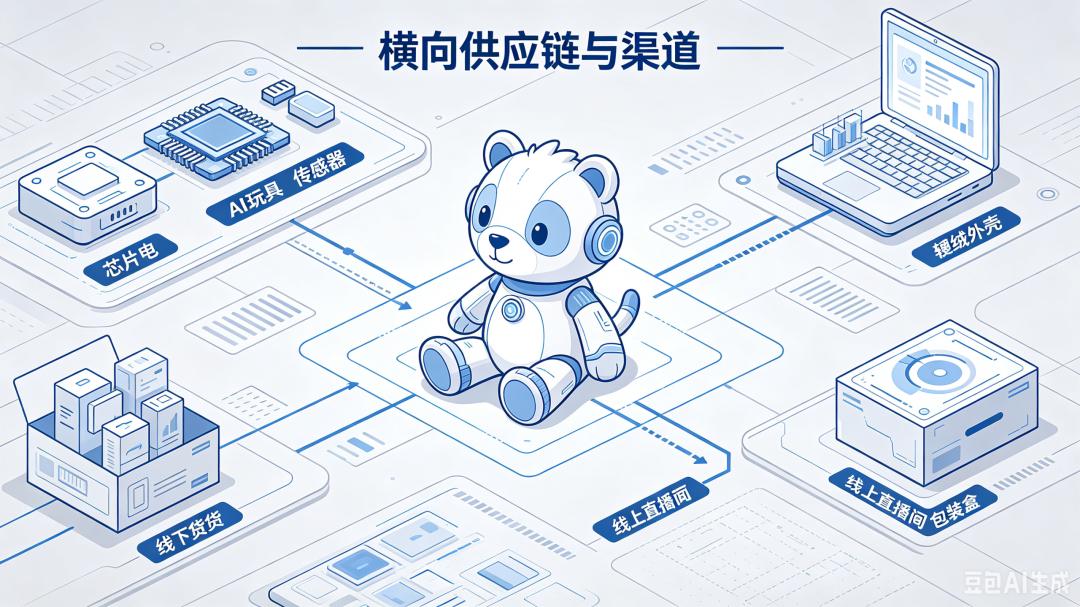
The second major challenge lies in distribution channels. AI toys are a completely new product category, and most users will not feel confident buying one until they can touch and test it in person. Offline experience stores are highly effective for this, but they are slow to roll out and extremely costly to operate — expenses that most startups simply cannot afford. While short-video platforms and live-stream sales can drive online shipments, the return rates are shockingly high. Traditional giants, by contrast, have decades-long partnerships with supermarkets and maternity stores, giving them immediate access to pre-existing shelf space.
All the players rushing into this market have different motivations. Startups are the most willing to bet on innovative new products, but they are also the most cash-strapped. Traditional giants hold valuable IP and shelf space, but they are slow to pivot and adapt. Tech companies have strong technical foundations, but they lack the inherent "toy-like" warmth and playfulness that defines the category. Companies like Disney and Sanrio have it easiest — they simply license their IP and collect revenue shares without manufacturing anything themselves.
Over the next two to three years, startups will face the greatest risk. They may successfully develop the product, validate the concept, burn through all their funding, fail to streamline their supply chain, struggle to open distribution channels, and then find their path completely blocked by giants — rendering all their previous efforts completely wasted.
Finally, I (Longmao Jun) believe there is one critical financial equation that simply does not add up
The financial math is far more challenging for AI toys than traditional products. The cost structure is extremely complex: hardware requires chips, sensors, batteries, and communication modules, while software incurs ongoing API fees for large model calls and costs for maintaining teams to iterate the product. Continuous investment is also needed to develop new content. Traditional toys typically maintain gross profit margins of 40% to 60%, but AI toys have heavy spending on both hardware and software, which drastically compresses their gross margins.
If you price the product too high, no one will be willing to try it; if you price it too low, you cannot cover the ongoing service costs. The most logical solution seems to be a subscription model — sell the hardware at little to no profit, and generate steady recurring revenue through content and services. But no one can guarantee that Chinese consumers will be willing to pay a monthly subscription fee just for a toy, and user willingness to pay for ongoing digital services remains one of the biggest hurdles in this market.
If the subscription model fails to gain traction, the entire industry will get stuck in an extremely awkward position: the products are clearly better than traditional toys, but the numbers will never add up to a profitable business. Once the capital market loses its patience, a huge number of companies will collapse right before the market finally matures.
There are only three viable paths to survival
So, in my opinion, there are only three remaining lifelines for businesses in this space, and I would like to share a few bold predictions.
First: Obsess over specific niche scenarios, avoid empty grand claims. The vague concept of "companionship" is far too broad. Do children need bedtime story functions, or oral English practice? Do working adults want a small moving companion to greet them when they get home, or a lively little companion sitting on their office desk? Only by locking down a specific clear scenario can the product truly become a natural part of people's daily lives. Scenario segmentation will determine life or death for these products, and the more rigid the user demand, the longer the product will survive.
Second: Fully develop a distinct character identity, do not just pile on random features. An AI toy must have a clear "persona". Just like humanoid robots need to be perceived first as "beings" rather than cold machines — which is exactly why most embodied intelligence products have failed to gain mass appeal so far. An AI character toy must first feel like a living, distinct character.
It is not about what the toy looks like on the outside, but about its speaking tone, the right moments to initiate interaction, and the nature of the relationship it builds with you. When the character identity is clear, the emotional bond with users stays strong; if the character feels vague, users will always see it as nothing more than a cold piece of equipment.
Third: Make users feel that the toy is "growing" alongside them. The biggest flaw of traditional toys is that they never change. AI toys need to make users feel that the toy is becoming more familiar with them, that its way of speaking is evolving, and that it remembers exactly where you left off in your last conversation. Users should feel that this product is changing specifically because of their unique interactions with it. Brands that successfully execute these three steps will earn the right to stay in the game long-term.
One final prediction
AI toys will not completely replace all traditional toys. Puzzles, building blocks, and model kits do not need AI functionality at all. AI toys are an entirely new product category, not a universal replacement for existing toys.
This market will eventually split into three distinct tracks: high-priced children's educational companion robots targeted at parent decision-makers, mid-range adult emotional companionship hardware focused on premium design, and more affordable smart stuffed toys that rely heavily on IP. These three tracks operate on completely different business logics, and it is nearly impossible for a single product to dominate all three.
A large number of brands will collapse within the next three years. This will not happen because of technical failures, but because they cannot get their financial math right, fail to get their supply chain under control, or build their entire product around a non-existent fake demand.
The companies that end up surviving in the long run may not be the AI startups at all — they could very well be traditional toy giants who already own valuable IP and established distribution channels. These giants seem slow right now, simply because they have not yet fully grasped the market potential. Once they do, they will slap their existing IP onto these new AI products, flood their existing distribution channels with them, and effectively reap all the rewards from the paths that startups painstakingly blazed.
But startups still have a real window of opportunity. That window is the two to three years while the giants are still hesitating. If startups can embed their brand identity deep into users' hearts, making users stay loyal not because of a cartoon character printed on the shell, but because "this thing actually seems to understand me", they can build an unbreakable moat.
The ultimate competition among AI toys will not be about technological superiority. It will be about that intangible, hard-to-describe feeling of "I want to spend a little more time with it". A toy that can talk is nothing special. But a toy that remembers you and makes you genuinely look forward to interacting with it — that is the truly rare product that will win the market.
This article is from the WeChat public account "New Consumer Insider" (ID: cychuangye), written by Longmao Jun, and published with authorization from 36Kr.