With a total loss of 35.6 billion yuan in five years, SenseTime is poised to build an AI computer room in space.
After losing 35.6 billion yuan over five years, SenseTime is taking its new story to space.
At a recent forum during the World Artificial Intelligence Conference, SenseTime unveiled a slew of AI infrastructure plans in one go: launching four computing-power satellites in partnership with SpaceTycoon within the year, building five 10,000-GPU-scale domestic computing clusters in the next two years, continuing to expand its Lingang computing center in Shanghai, and rolling out domestic computing centers in Hong Kong and overseas markets.
The most eye-catching part, of course, is the computing-power satellites.
While terrestrial AI companies are still grappling with chips, power supply, and data centers, SenseTime is already preparing to send part of its computing power into space. According to the plan, the four satellites are only for technical verification, with a longer-term goal of building a constellation of 1,000 satellites within five years to provide space computing power of at least 10,000P scale.
But SenseTime's ambitions go far beyond launching satellites.
It has also brought together 15 domestic chip and computing enterprises including Cambricon, Huawei Ascend, Biren Technology, Moore Threads, and Moffett AI, trying to connect chips from different manufacturers into a unified model adaptation and scheduling system, then package the previously scattered computing power into directly salable services.
Putting these plans together, SenseTime is no longer aiming to be just a large model company. It wants to become the power plant, power grid, and operator of domestic computing power.
Satellites can fly to the sky, but money still has to come from the ground.
Satellites, 10,000-GPU clusters, and computing centers are all money-burning projects. From 2021 to 2025, SenseTime has recorded consecutive losses for five years, with a cumulative net loss of about 35.67 billion yuan.
SenseTime may not lack technology, talent, or imagination. What it really needs to prove is: can the cash on its books keep up with its ambitions that have already flown into space?
Sending Computing Power to Space
Space computing power, which sounds like science fiction, has actually been attempted long ago.
In 2020, the European Space Agency launched the Φ-sat-1 equipped with an AI chip, allowing the satellite to directly filter cloud images in orbit and only transmit valuable data back to the ground. Elon Musk's SpaceX is also advancing AI computing-power satellites, hoping to turn orbits into new data centers.
Early satellite computing was more like "on-site processing", mainly filtering data collected by satellites. The scale envisioned by SenseTime and SpaceX is larger, aiming to let satellites undertake more AI inference and data processing tasks.
According to the plan of SenseTime and SpaceTycoon, four satellites will be launched in 2026 to complete technical verification, and eventually a 1,000-satellite constellation will be built within five years to provide space computing power of at least 10,000P scale.
Satellites generate massive amounts of remote sensing, communication, and observation data every day. If all the data is transmitted back to the ground for processing, it will not only be slow but also occupy a large amount of communication bandwidth. By embedding computing power directly into satellites, processing can be completed in space first, and then valuable results can be transmitted back to the ground.
However, from four verification satellites to a 1,000-satellite constellation, there are still obstacles including launch costs, chip radiation resistance, communication bandwidth, technical stability, and commercial orders. In the short term, this project can hardly generate considerable revenue quickly, and it is more like a pre-emptive move in the next-generation computing infrastructure.
In contrast, SenseTime's terrestrial plans are closer to generating actual business.
The company has gathered 15 domestic chip and computing enterprises including Cambricon, Huawei Ascend, Biren Technology, Moore Threads, and Moffett AI, planning to build a "Token Operation Center" and construct five domestic computing clusters with more than 10,000 GPUs in the next two years.
The current problem facing domestic AI chips is that the software ecosystems of different manufacturers are not unified. Different vendors use different chip architectures, compilers, and operator libraries. When a large model switches to a different chip, it often needs to be re-adapted and optimized.
This is like there are more and more models of generators in the market, but their interfaces and usage methods are all different, making it difficult to directly connect to the same power grid.
What SenseTime wants to do is to connect chips from different manufacturers into a unified model adaptation and computing power scheduling system, and then package the scattered domestic computing power into services that customers can purchase directly. Chip enterprises are responsible for building "generators", and SenseTime hopes to build "power plants" and "power grids", conduct unified scheduling, and then sell computing power uniformly to the outside world.
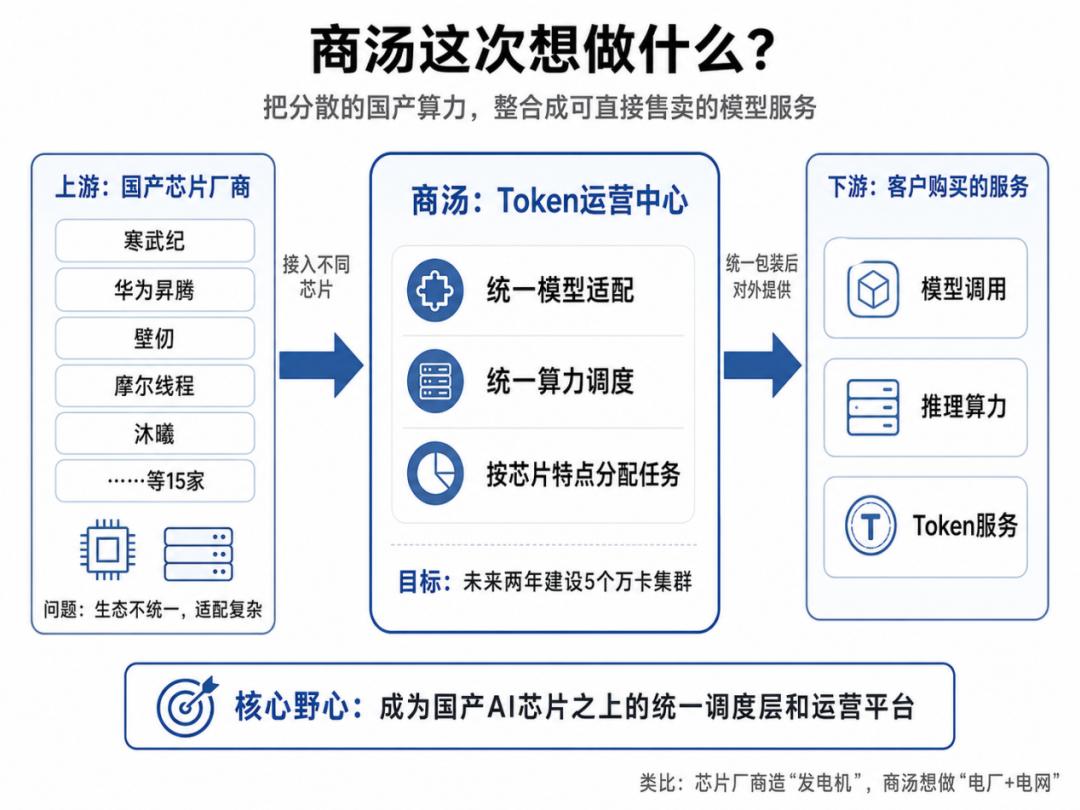
Around this goal, SenseTime also plans to continue expanding its Lingang computing center in Shanghai, and deploy domestic computing centers in Hong Kong and overseas markets.
According to SenseTime's own statement, its system currently supports an average of 2.4 trillion Token calls per day, and this number will be increased to 10 trillion by the end of 2026. After optimization, the cost-effectiveness of some domestic computing chips on specific tasks such as Prefill has already reached more than twice that of NVIDIA's H-series.
SenseTime's plan is very clear: shift from selling one-time customized projects to continuously selling Tokens and computing power. Every time a customer calls a model, generates an image, or runs an agent, SenseTime can charge according to the package or actual usage.
This business does have more room for imagination, but the premise is that customers are willing to continuously use SenseTime's models and platforms.
However, in the currently most high-profile large model market, SenseTime's presence has not kept up with its ambitions that have flown into space.
SenseTime's Awkwardness: Talents Scattered Like Stars in the Sky
SenseTime took a seat at the large model table very early, but now it rarely appears in the most bustling positions.
At the end of 2022, ChatGPT ignited the global large model wave. Just a few months later, SenseTime launched its "SenseNova" large model system in April 2023, almost at the same time as Baidu's ERNIE and Alibaba's Tongyi Qianwen. In August of the same year, SenseTime became one of the first eight large model enterprises to pass the regulatory filing.
In terms of technical accumulation, talent reserve, and entry time, SenseTime was dealt a very good hand of cards.
But three years later, the domestic large models that attract the most market attention have changed a batch of names. DeepSeek, Kimi, Tongyi Qianwen, and Doubao are frequently trending, while SenseTime's presence is getting weaker and weaker.
Earlier this year, according to observations from the self-media "Capricorn Business Review", in a SuperCLUE general large model evaluation at that time, SenseTime SenseNova V6.5 Pro scored 51.67 points and tied for sixth place, categorized into the third tier, falling behind competitors such as DeepSeek, Kimi, Huawei, and Baidu.
At almost the same time, in public lists such as Artificial Analysis and LMArena, other domestic models also appeared more frequently in the top ranks. Even in the government and enterprise market, where SenseTime used to excel, its performance was not outstanding. The "Monitoring and Insight Report on China's Large Model Winning Bid Projects (2025)" released by Intelligent Hyperparameters showed that SenseTime did not enter the top 10 vendors for application-oriented large model winning projects that year.
For a company that once had the aura of "AI Four Dragons" and was one of the earliest to bet on large models, this gap is somewhat glaring.
What's more awkward is that SenseTime has never lacked talents. A group of technical backbones who left SenseTime quickly gained market attention after starting their own businesses.
The most typical example is MiniMax.
Its founder YAN Junjie once served as Vice President of SenseTime and CTO of the Smart City Business Group. Yun Yeyi, who rang the bell for MiniMax's launch together with him, also worked at SenseTime as Manager of the Financing and Strategic Investment Department, CEO Assistant, and Director of the Innovation Business Department.
LIU Yu, former Executive Research Director of SenseTime and head of the "Miaohua" AIGC product, left to start his own business in 2025. Multiple media outlets pointed to the company he founded as Vivix AI based on public information. Liu Yu's personal homepage shows that the project completed Series A financing about 10 months after its establishment, with investors including HSG and IDG, and a valuation exceeding 1.32 billion US dollars.
SHI Jie, co-founder of RightBrain Tech, also came from SenseTime. After leaving, he participated in founding an AI image and video creation company, and launched Vega AI in 2023, which exceeded one million users in less than two months after launch.
The success or failure of these startups still needs time to verify, and conclusions cannot be drawn solely based on financing and user numbers. But an undeniable contrast has emerged: SenseTime has gathered a large number of technical talents internally, but there are not many products that truly reach the top ranks of the market; after some talents leave, they are more easily noticed by the market.
To sum up in a slightly harsh way: when gathered in SenseTime, their influence is limited, but after spreading out, they become "stars all over the sky".
This shows that what SenseTime really lacks may not be technology and talents, but the ability to turn technology into hit products and turn talent advantages into market share.
Therefore, SenseTime now needs a sufficiently grand new growth story that can attract enough market attention.
Satellite computing power and the unified domestic chip scheduling platform undoubtedly have such room for imagination, and they indeed align with the long-term trend of domestic computing power substitution and AI infrastructure construction.
But the grander the story, the higher the requirements for capital, technology, and execution capabilities. Against the backdrop of continuous losses and continuous reliance on financing to supplement cash, there is still a huge question mark over whether SenseTime can truly implement these plans.
The Story Goes to Space, But Where Does the Money Come From?
Before the satellites even fly to the sky, the bills are already laid out in front of SenseTime.
From 2021 to 2025, SenseTime recorded consecutive losses for five years, with net losses reaching 17.14 billion yuan, 6.045 billion yuan, 6.44 billion yuan, 4.278 billion yuan, and 1.766 billion yuan respectively, with a cumulative loss of about 35.67 billion yuan.
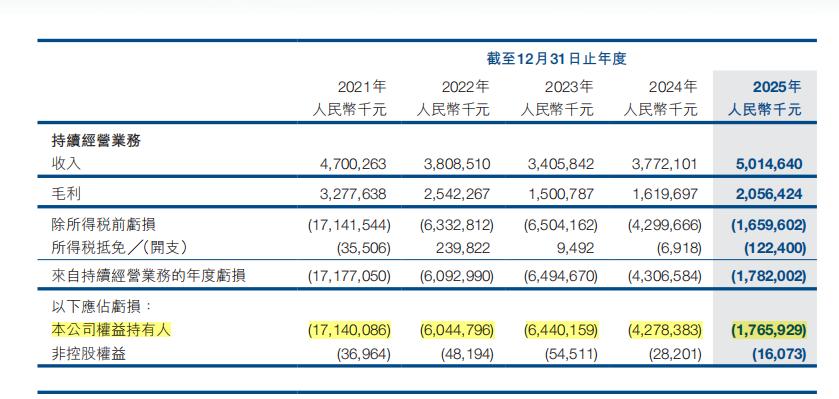
What does this mean? It is equivalent to SenseTime losing an average of nearly 20 million yuan every day as soon as it opens its eyes over the past five years.
The good news is that the company's losses are narrowing. Especially in 2025, the net loss has dropped from 4.278 billion yuan in 2024 to 1.766 billion yuan.
However, a considerable part of this loss reduction result also comes from non-operating sources. The financial report shows that SenseTime's "net other gains" in 2025 was close to 2 billion yuan, compared with only 539 million yuan in 2024. Among them, the sale of subsidiaries and associates brought in 1.313 billion yuan in gains, and the rise in the fair value of financial assets contributed another 646 million yuan.
In other words, the significant narrowing of SenseTime's losses in 2025 is largely due to the profits from selling companies and the appreciation of its financial assets. Unless SenseTime is prepared to transform into an investment company, the market can hardly believe that asset sales and financial asset appreciation can become a long-term and stable source of profit.
On the other side of loss reduction, SenseTime's employee scale has shrunk significantly.
In 2021, SenseTime had a total of 6,113 employees; by the end of 2025, the number of employees dropped to only 2,472, a decrease of nearly 60% in four years. For an AI company that relies on algorithms, engineers, and scientific research talents to compete, such a large-scale staff reduction will also make the market worry whether SenseTime is simultaneously losing key talents and organizational capabilities.
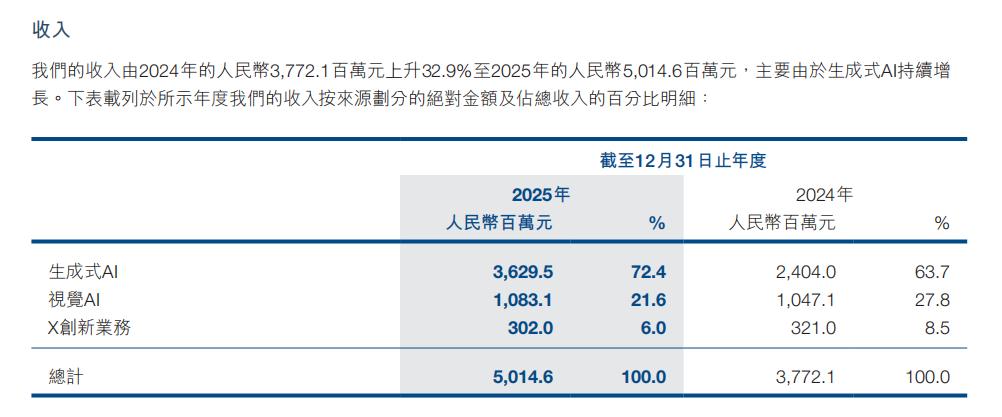
From the current business perspective, SenseTime can almost be said to be "all in" generative AI. In 2025, this business segment contributed 3.63 billion yuan in revenue for SenseTime, accounting for 72.4% of total revenue; in 2024, these two figures were 2.404 billion yuan and 63.7% respectively.
The direction is certainly not wrong, and large models are also one of the stories that the capital market is most willing to believe in now, but this is an extremely money-burning business. In 2025, SenseTime's investment cash outflow for "purchases of property, plant and equipment" alone reached 3.399 billion yuan, compared with a net outflow of 935 million yuan in 2024.
In addition, the cash flow statement shows that from 2024 to 2025, SenseTime's operating cash flow had net outflows of 3.927 billion yuan and 301 million yuan respectively, and its investment cash flow had net outflows of 2.796 billion yuan and 3.507 billion yuan respectively.
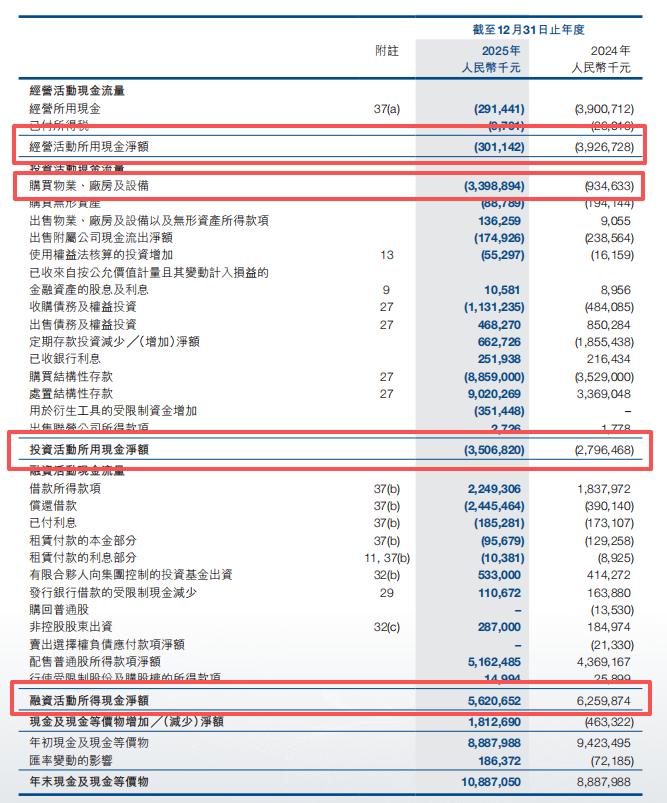
What really supports SenseTime's operation is the continuous inflow of financing funds. In the same period, SenseTime's financing cash flow reached 6.26 billion yuan and 5.62 billion yuan respectively, totaling more than 11.8 billion yuan in two years.
Among them, share placement has played an important role.
In 2025, SenseTime raised a net of 5.162 billion yuan through the placement of common shares, and also raised 4.369 billion yuan through placement in 2024, totaling about 9.53 billion yuan in two years. In addition, entering 2026, SenseTime is continuing to raise funds through share placement. In April this year, the company placed 1.7 billion new shares again, raising a net of about 3.23 billion Hong Kong dollars.
Equity financing does not require principal and interest repayment, but the cost is borne by existing shareholders: the more new shares are issued, the more the existing shareholding is diluted.
Moreover, this financing method is highly dependent on market confidence. The higher the stock price, the fewer shares the company needs to issue to raise more funds; the