Exclusive | PICO Founder Zhou Hongyi to Step Down, Li Xiaokai Appointed as New Business Head
Article by Li Zhaofeng
Edited by Zhang Yuxin
Intelligent Emergence has exclusively learned that PICO, ByteDance's XR (Extended Reality) business, has recently completed an adjustment to its business leadership: due to personal career planning, founder Zhou Hongyi will no longer serve as the head of PICO. Li Xiaokai has taken over the position, assuming full responsibility for the PICO business.
It is understood that this management transition will not affect PICO's established strategic direction, R&D work, and product plans. This year, PICO will launch a brand-new Mixed Reality (MR) product as scheduled.
As the founder of PICO, Zhou Hongyi has made significant contributions to PICO's growth over the past 11 years. PICO has issued an internal notice confirming that Zhou Hongyi will leave the company, and expressed gratitude for his long-term dedication and efforts.
Li Xiaokai has many years of experience in R&D and management of consumer electronics and hardware products. Since joining PICO in 2021, he has overseen the development of PICO's core products and technologies, led the team to advance R&D and exploration in MR products and cutting-edge product directions, and continuously improved PICO's technical capabilities in fields such as optical displays, chips, perception, and system architecture.
An internal source at ByteDance also stated that the company's judgment on the long-term value of XR has not changed, and it will continue to support PICO in advancing core technology exploration and product innovation.
From Zhou Hongyi to Li Xiaokai
Public information shows that Li Xiaokai graduated from Zhejiang University with a bachelor's degree, then obtained his doctorate from Yale University, where his doctoral research focused on optoelectronic materials and devices.
When Li Xiaokai joined ByteDance, the company was at a critical juncture in advancing the acquisition of PICO.
At that time, he was responsible for the acquisition coordination between ByteDance and the PICO team, and recruited talents in fields such as display optics, sensors, human visual systems, color and image technology in Beijing, Shanghai, and Shenzhen.
In August 2021, ByteDance officially completed the acquisition of PICO. After that, Li Xiaokai joined the PICO organization, and his scope of work expanded to cover core product development and underlying technology construction.
Zhou Hongyi worked at GoerTek for nearly a decade and served as its Vice President. In 2015, he led the original GoerTek hardware team to found PICO, focusing on the R&D of all-in-one VR headsets.
In fact, after PICO was founded, GoerTek has long been PICO's supply chain partner. Before being acquired by ByteDance, PICO had already launched products including the PICO Neo series, and became a major manufacturer in China's all-in-one VR headset market.
After being acquired by ByteDance, Zhou Hongyi continued to serve as the head of the PICO business, and successively promoted the launch of products such as PICO Neo 3, PICO 4, and PICO 4 Ultra.
In August 2024, Zhou Hongyi attended the PICO 4 Ultra new product briefing as the President of PICO. At the meeting, he revealed that the PICO App Store had more than 900 applications, over 500 partner developers, and its business covered more than 60 countries and regions.
PICO 4 Ultra has also become a major hardware product launched during Zhou Hongyi's tenure. Now, as the new generation MR product enters its release cycle, the baton of PICO's product iteration has officially been handed over to Li Xiaokai.
PICO Shifts to a New Generation of MR Products
In March this year, PICO officially announced its new generation operating system PICO OS 6, and for the first time previewed its new flagship MR device codenamed "Project Swan". PICO previously confirmed that this product will be released within this year.
Public information shows that Project Swan will adopt a MicroOLED display solution, and be equipped with a PICO self-developed MR chip.
The product has an average angular resolution of approximately 40 PPD, with over 45 PPD in the central area. Angular resolution mainly measures the number of pixels that users can actually see within a certain field of view angle; the higher the value, the clearer the display of text and images.
PICO stated that its self-developed chip mainly handles real-time perception, spatial computing, and imaging tasks, reducing the system perception latency to 12 milliseconds. Project Swan will also adopt a dual-chip design, where another main chip is responsible for general-purpose computing and graphics rendering.
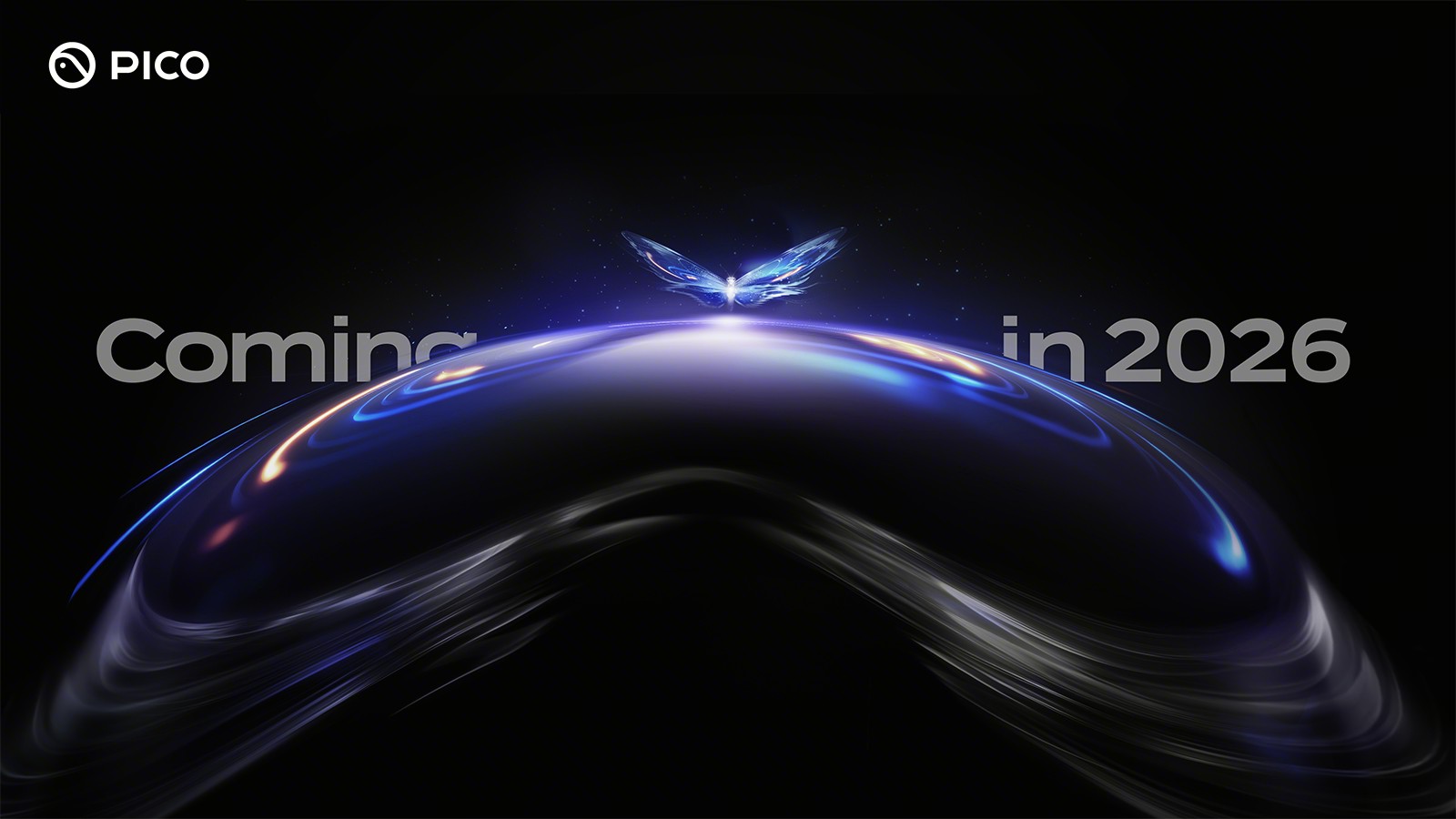
PICO is shifting to a new generation of MR products
PICO OS 6 further expands the product positioning from single VR applications to spatial computing.
The new system supports simultaneous operation of Android apps, browsers, and 3D content in a spatial environment, and is compatible with development and application ecosystems such as OpenXR, WebXR, and PC VR streaming. PICO also provides developers with a desktop simulator, allowing some spatial applications to be debugged without the need for a headset device.
Some analysis points out that Project Swan's product form is closer to high-end MR devices such as Apple Vision Pro and Samsung Galaxy XR, and PICO is also expanding its usage scenarios from VR games to multi-task office work, spatial applications, and content consumption.
This product direction is consistent with ByteDance's internal positioning of PICO over the past three years.
In November last year, at the 5th ByteDance Scholarship Award Ceremony, Yang Zhenyuan, Vice President of Technology at ByteDance, for the first time systematically disclosed the two product routes that ByteDance adopted after acquiring PICO.
Yang Zhenyuan stated that ByteDance's development is closely related to hardware innovations; large-screen smartphones and high-definition cameras have formed the foundation for the development of products such as Douyin and TikTok, while XR may bring a new generation of interactive experiences.
According to Yang Zhenyuan, after ByteDance acquired PICO, it simultaneously advanced two routes: one focused on investing video, live streaming, and marketing resources around the product form at the time; the other invested in underlying technologies to drive core experience upgrades.
"In 2023, we decided to cut marketing budgets, focus on refining our products, and invest more resources into technology and experience innovation," Yang Zhenyuan mentioned the changes in PICO's business route at the event. "This adjustment also led to some misunderstandings, with many people saying ByteDance was no longer working in this direction. On the contrary, starting from 2023, ByteDance's technical investment in XR has been greater than before."
He stated that PICO decided to launch self-development of XR chips in 2022; the chip was taped out in 2024 and has entered mass production. The team simultaneously advanced technologies such as MicroOLED displays, microlenses, gesture recognition, and spatial perception.
From the perspective of market landscape, PICO is still the manufacturer with the highest market share in China's consumer-grade VR market.
Data from CINNO Research shows that sales of consumer-grade XR devices in China reached approximately 567,000 units in 2024, of which PICO accounted for about 54% of China's consumer-grade VR market, ranking first. PICO 4 Ultra was one of the major new products in China's VR market that year.
In the global market, Counterpoint data shows that PICO's shipment share of XR headsets ranged from approximately 5% to 10% in multiple quarters of 2024. Meta still occupies the major share of the global VR market, and PICO is one of the few manufacturers outside Meta that continuously launches consumer-grade all-in-one headsets.
Currently, global XR product forms are diversifying. Traditional VR headsets still focus on games and entertainment, MR devices are starting to expand into spatial computing, office, and enterprise scenarios, and AI glasses have become another growth route. Amidst these market changes, Project Swan undertakes PICO's mission to extend from existing all-in-one VR headsets to a new generation of MR products.
After Li Xiaokai takes over, the launch of the new generation MR product, as well as the transition of PICO OS 6 from early developer access to official application, will become the primary product tasks he needs to advance.