Entering the AI shopping guide arena, Kuaishou is a latecomer
No one expected that it would be Kuaishou to truly bring AI shopping right under users' noses.
On July 20, Kuaishou E-commerce quietly launched the "AI Shopping Assistant", with its entry directly pinned to the bottom right corner of the product search results page. Users can click it immediately after searching and start using it right away.
The most striking part is its logic: no need to browse product details, no need to compare parameters, and no need to jump to other pages. State your needs, get results, add items to cart with one click — the entire shopping process has been streamlined to the extreme.
In daily use, it almost addresses all common pain points of ordinary people's online shopping experiences.
For example, when selecting products within a budget, you only need to type "Buy an iPhone17E within 5000 yuan", and the AI will immediately filter out supplies at different price ranges: a new domestic unit with 12-month interest-free installments priced at 4499 yuan, a subsidized near-new unit priced at 4299 yuan after coupons, displayed as horizontally scrollable cards for easy browsing.
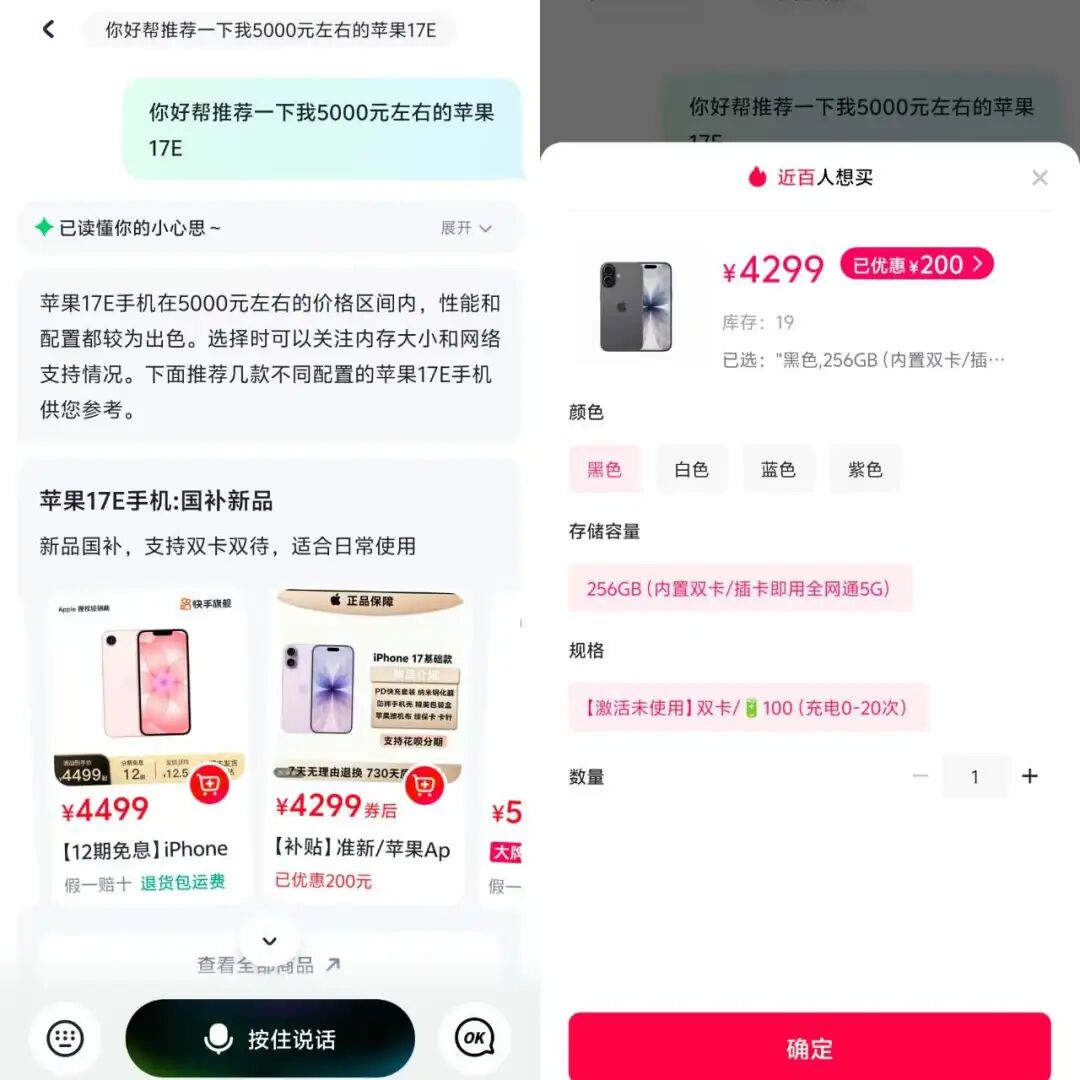
After selecting the color and storage configuration, click the shopping cart icon on the card to add the item directly to your cart. You don't even need to enter the product detail page throughout the process.
For categories like 3C electronics and home appliances that require repeated comparisons, it saves even more time.
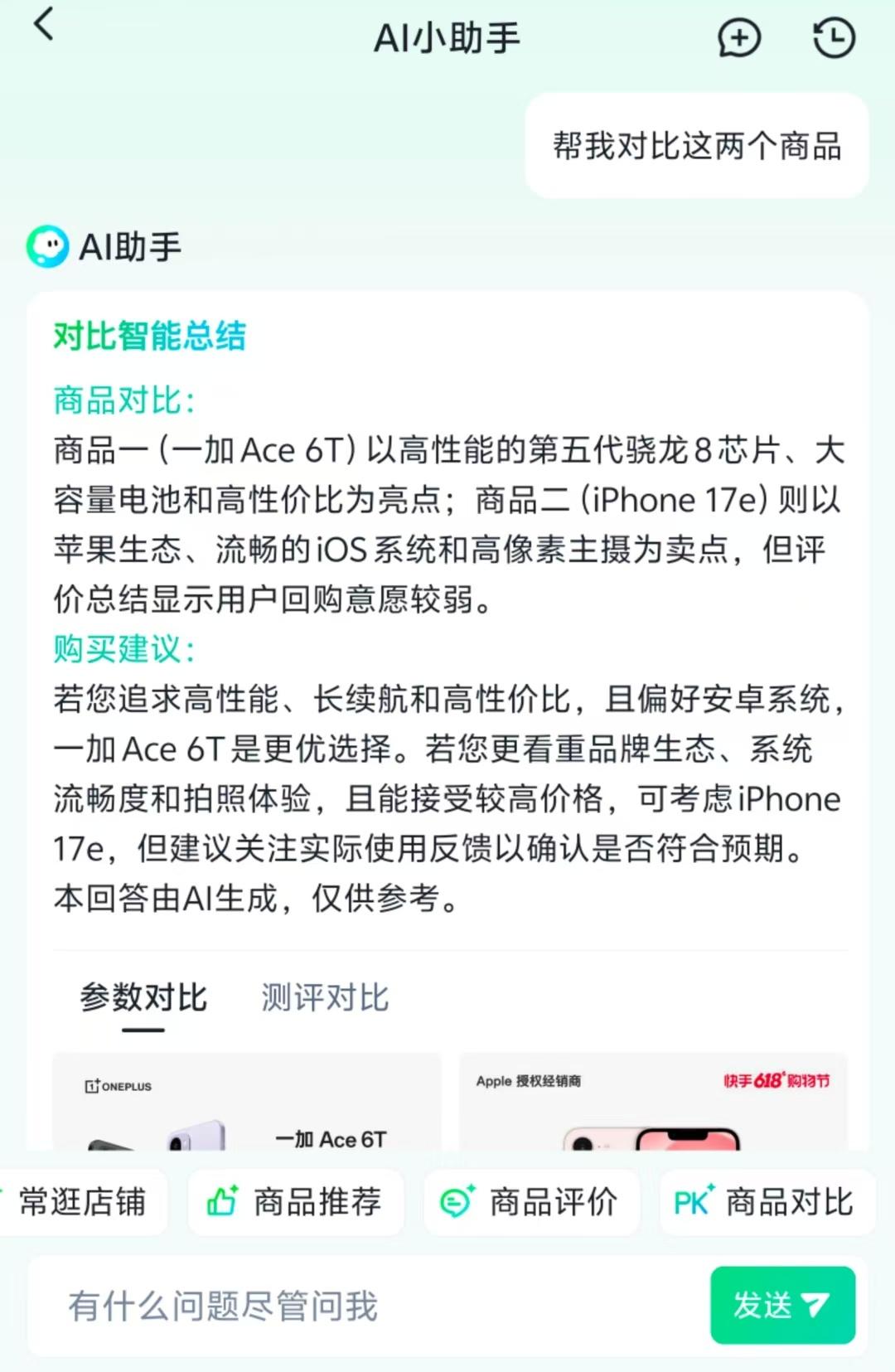
If you are unsure whether to choose the OnePlus Ace6T or iPhone17e, you don't need to switch back and forth between pages to check parameters. The AI will directly generate a split comparison table, clearly listing core specifications, final purchase price, sales volume, public praise, advantages and disadvantages — the time saved is enough for you to watch two more short videos.
Even if you casually say something like "affordable good items for the kitchen" or "sun protection gear for trips", it will directly sort the list by sales volume and public praise, so you don't have to browse through each category one by one.
What's more thoughtful is the price drop alert. The AI will proactively notify you whether products you browsed before have been reduced in price and if they have after-sales guarantees, turning your easily forgotten browsing history into tangible discount clues.
Want to know real user feedback? You don't need to go through thousands of comments either — just ask the AI, and you can see the core points of positive and negative reviews and common pitfalls at a glance.
This is not Kuaishou's first attempt at AI e-commerce, but this time it's completely different in significance.
Over the past year, Kuaishou's AI features were all hidden in the merchant backend: AI image-to-video generation, E-commerce Smart Assistant, live stream clip editing — during the Double 11 shopping festival, these features helped merchants produce 1.5 million videos per day on average, driving an average daily GMV of 53 million yuan, representing a 140.9% year-on-year increase.
However, these are all "backend tools" that ordinary users cannot perceive. This AI Shopping Assistant is the first time Kuaishou has placed its AI capabilities directly in front of consumers.
And its approach is very "Kuaishou" — no fancy multi-round conversations, no lengthy lectures on product selection, focusing on simplicity and directness, which precisely caters to the usage habits of users in the sinking market.
To put it plainly, while other companies' AI shopping guides act as "your consultant", Kuaishou's focuses on "saving you steps", following the efficiency-oriented route of its loyal user ecosystem.
But across the entire industry, Kuaishou's move is not the first of its kind, but it is sufficiently aggressive.
Alibaba was the earliest to make arrangements. At the end of 2023, Jack Ma set the tone to fully bet on AI e-commerce, starting with empowering merchants, launching Business Manager, Shop Assistant and other tools one after another. During the 2025 Double 11 shopping festival, it exploded with full force, launching 6 AI shopping guides in one go, covering home decoration, apparel, and maternal and child products, and completing semantic reconstruction of 2 billion products, increasing search relevance by 20%.
However, up to now, the full-link closed loop between independent AI products in the Taobao system (such as the Qianwen App) and in-platform transactions is still being improved.
Douyin took the "blossoming outside the wall" approach. In October 2025, Doubao was connected to Douyin Mall. When users ask for recommendations on beauty or digital products in Doubao, they directly get product cards with prices and sales volumes, and clicking the card jumps directly to Douyin to place an order, which is equivalent to opening a search traffic cheat code for its e-commerce business. Later, it also launched the Doubao Mobile Assistant to test the capability of cross-app price comparison and order placement, with ambitions extending beyond its own in-platform ecosystem.
JD.com directly teamed up with Tencent. Just five days before Kuaishou launched its feature, on July 15, JD.com's AI Agent was officially connected to Tencent Yuanbao's mini-program ecosystem, making JD.com the first comprehensive e-commerce platform to access Yuanbao.
When users ask in Yuanbao "Which refrigerator under 2000 yuan is quiet?" or "Recommend perfumes for men", the AI provides purchase suggestions while simultaneously popping up JD.com product cards. Clicking the card jumps directly to the JD.com mini-program to place an order, with logistics and after-sales services fully handled by JD.com, no app switching required throughout the process. In addition to Tencent Yuanbao, JD.com also accessed mobile-side intelligent agents such as Huawei Xiaoyi and OPPO Xiaobu through the A2A model, which is equivalent to covering all mainstream AI entrances.
Different from Douyin's "own AI diverts traffic to own mall" strategy, JD.com follows the "wide network of access points" route, relying on its supply chain and fulfillment capabilities to capture dividends, with AI serving only as a traffic pipeline.
Kuaishou's decision to enter the C-end AI shopping guide market at this time is essentially driven by the need for growth.
The financial report data speaks for itself: Kuaishou E-commerce's GMV reached 1.6 trillion yuan in 2025, a 15% year-on-year increase. While this figure seems decent, compared with the 78% growth rate in 2021, it has dropped by 63 percentage points in five years.
Growth on the user side has also slowed down. In 2025, the average daily active users reached 410 million, with a year-on-year increase of only 2.76%; the number of monthly active buyers in the first quarter of 2025 was 135 million, with a visible gap compared to Douyin E-commerce.
The industry generally estimates that Douyin E-commerce's GMV in 2025 is about 4.4 trillion yuan, roughly 2.75 times that of Kuaishou.
The traffic dividend is no longer sufficient, shelf e-commerce has not achieved a clear competitive edge after several years of development, and white-label products and industrial belts still form its core foundation. At this moment, AI has become one of the few new growth stories to tell — improving conversion internally, telling a positive growth story externally, and leaving room for imagination in the capital market.
In the first quarter of 2026, Kuaishou's revenue was 33.72 billion yuan, a 3.4% year-on-year increase, and China Securities predicted that the annual growth rate would only be 4.5%. AI investment is still burning cash, and Kuaishou's AI content generation platform Keling saw revenue exceed 650 million yuan in the first quarter, but it is still in the investment stage overall.
E-commerce, as its core business, must step up. No one can guarantee right now whether the AI Shopping Assistant can help Kuaishou break through its current bottleneck.
Across the entire industry, AI shopping guides are currently only "icing on the cake" — slightly increasing conversion rates and saving a few operation steps, far from disrupting the industry. Whether users will get used to "buying things by speaking to AI" still needs gradual verification.
But one thing is certain: the dividend of live streaming e-commerce has been exhausted, and the pattern of shelf e-commerce has been largely settled. The next round of competition will focus on who can further improve the efficiency of matching people with products using AI.
Alibaba has its supply chain, ByteDance has its traffic, Tencent and JD.com are in a strategic partnership, and Kuaishou is holding onto its loyal user base. Each has its own hidden strengths, and each has its own shortcomings.
This tough battle of AI e-commerce has only just begun.
Source: Xinghe Business Observation
This article is from "ZAKER Finance", and is republished by 36Kr with authorization.