30,000 Steps a Day: VCs Care Less About Model Parameters, More About Whether AI Can Enter Real-World Scenarios
"Over the past two days, I've walked almost 30,000 steps each day," Wang Bin said.
At the 2026 World Artificial Intelligence Conference (WAIC), numerous investment and research personnel from VC (Venture Capital) / PE (Private Equity) institutions were present, and Wang Bin is one of them. He is the Investment Director of the AI (Artificial Intelligence) division at a venture capital fund.
He shuttled between the booths of various AI R&D and application enterprises to learn about their AI R&D progress and practical application results. In Wang Bin's view, in the past, the competition of large AI models was more focused on parameter scale, reasoning ability and generation effect. Nowadays, the focus of the capital market is rapidly shifting to two directions: whether AI can step out of the digital world and enter real scenarios; whether AI can truly solve practical problems in the industrial production field and create industrial value. Especially under the pressure on A-shares caused by the correction of AI sector stocks in the global financial market, this exhibition is an opportunity for domestic capital to find undervalued AI enterprises at "zero distance".
"Compared to purely competing on model capabilities, we prefer to invest in AI enterprises that can integrate artificial intelligence into their production and business processes, serve real needs and form sustainable productivity," Wang Bin told the Economic Observer reporter.
According to statistics from the technology think tank Jiazi Guangnian, among the more than 1,000 exhibitors at this year's WAIC, there are 130 enterprises in the large model and generative AI track, of which 83 have focused on launching AI Agent, covering 17 practical application scenarios.
Wen Zhi, General Manager of Shanghai State Investment Pilot Fund, frankly said that from the world model to embodied intelligence, from AI Agent to AI physics, technology must eventually return to scenarios. Technology that cannot empower industries is just a castle in the air. Only by going deep into real scenarios can technology release its vitality.
Seeking Opportunities in Three Major Sub-tracks
In the view of Wu Yuanda, a senior investment consultant at Huizheng Finance, the three major AI software and hardware development trends demonstrated at this WAIC will bring new impacts to the capital market's investment in the AI track: First, domestic computing power enterprises have shifted from competing on single-card performance to cluster deployment and super-node construction; Second, robots are no longer limited to performances and have begun to enter practical application scenarios; Third, embodied intelligent robots still face challenges such as insufficient flexibility and slow movement in the application process of real scenarios, which has aroused the capital market's attention to investment opportunities in the robot "brain" (general world model) track.
During WAIC, investment institutions paid special attention to low-valued asset opportunities in sub-tracks such as advanced packaging, general world models, and embodied intelligence. Zheng Tianyi, Vice President of Investment at Inno Fund, also confirmed this observation to reporters: The number of projects in the exhibition hall has increased significantly this year, and the entrepreneurial directions are more diverse. New entrepreneurial teams are emerging continuously, from AI Agent and AI native applications to AI hardware and embodied intelligence.
Wu Liming, Chairman of Huamao Technology, said at a roundtable forum that the explosive growth of AI is changing the product and technical requirements of the semiconductor market. At the same time, the cost-effectiveness of advanced processes has begun to peak, and the baton of chip performance is being passed to advanced packaging.
"Last year, the sales of advanced packaging exceeded that of traditional packaging for the first time. Advanced packaging seems to only account for 7.4% of the packaging volume, but it contributes 48% of the total industry sales," Wu Liming said. As the computing power bottleneck shifts from the chip's own performance to the extreme of chip peripheral logistics — interconnection, power supply and heat dissipation, Huamao Technology is taking optical communication and advanced packaging as fulcrums to promote end-to-end delivery of CPO (Co-packaged optics) / NPO (Near-packaged optics), complement system-level supporting facilities such as heat dissipation and power supply, and achieve large-scale supply.
After Wu Liming's speech, analysts from many funds and asset management institutions quickly gathered around to ask whether this technology can break the barriers between optical module manufacturers and packaging and testing factories, and whether advanced packaging can drive optoelectronic co-packaging to further improve chip production capacity and performance.
A similar scene also happened to Liu Yulong, Co-President of Zhishen Technology, an embodied intelligence R&D enterprise.
Liu Yulong said that this exhibition brought explosion-proof quadruped inspection robots and brand-new humanoid robots: The former is oriented to high-risk environments such as petrochemicals, energy stations, and industries, with "wheel-foot composite movement + high-level explosion-proof certification + full-scene intelligent perception" as its core capabilities, solving the safety risks and operation blind spots of traditional inspection methods in high-risk and complex terrain scenarios; The latter is continuously improving the capabilities of the robot's brain and cerebellum, and will be applied in scenarios such as industry, shopping malls and hotel services in the future.
"As of June this year, our cumulative mass production has exceeded 15,000 units. In June alone, our monthly mass production exceeded 5,000 units, indicating that we have passed the 10,000-unit-level actual combat verification in supply chain management, production line yield, quality consistency, and delivery system," When Liu Yulong introduced the enterprise's latest production capacity status to reporters, two investment directors from venture capital institutions interrupted to ask about the specific application scenarios and application effects after the large-scale mass production of the enterprise's embodied intelligence.
One of the investment directors of a venture capital institution revealed to reporters that after three years of embodied intelligence technology verification and performance iteration, the inflection point of large-scale mass production of embodied intelligence has arrived. At the industry's inflection point, they are paying attention to who can take the lead in completing the closed loop from technology verification to mass-produced product quality delivery, so as to seize market opportunities.
"At present, the valuation of the US stock AI sector has corrected, making the pre-money valuation of embodied intelligence R&D enterprises drop by more than 10% compared with the beginning of the year, so we want to find embodied intelligence enterprise targets with mass production capabilities during WAIC," the investment director told reporters.
The WAIC World Model "Six Dragons" Summit Forum held on the afternoon of July 19 attracted more than 20 investment and research personnel from asset management institutions and investment institutions. They believe that as the software and hardware of the embodied robot's "cerebellum" matures, the R&D and application of the "brain" will become the next investment hotspot.
Wang Bin said that the current R&D of general world models has four major schools: representational, generative, interactive, and integrated understanding-generation-prediction. However, the first three schools generally have the shortcoming of fragmented capabilities, and it is difficult to meet the integrated needs of embodied intelligent robots for world understanding, state deduction, and action prediction in the application process of industrial scenarios. Therefore, his task at this exhibition is to get to know more enterprises that are good at R&D of the "integrated understanding-generation-prediction" general world model, as an important investigation target for institutional investment.
Wang Xiaogang, Chairman of Daxiao Robotics, told reporters that mistakes in the digital world model can at most affect the generation of images and texts, but once the intelligent body in the physical scene has a prediction deviation, it will cause irreversible real losses. In this case, the robot's "brain" must rely on multi-modal high-density information extraction and sufficient state anchoring of control to ensure that the embodied intelligent robot minimizes the cost of action trial and error in a complex and uncertain environment.
During WAIC, Daxiao Robotics launched the Kairos 3.1 World Model, the environmental data collection solution 2.0, and a complete set of solutions covering scenarios such as instant retail and hotel services, to promote the large-scale commercial application of embodied intelligent robots.
Wang Xiaogang gave an example that in real family scenarios such as laundry, relying on the Kairos 3.1 World Model, the robot can accurately identify the spatial relationship of components, disassemble more than a dozen operation steps relying on spatiotemporal memory and thinking chains, and independently plan the whole-link solution from taking clothes, putting clothes in, starting the machine to sorting; Moreover, the robot also has the ability to trace task status, verify the execution result of each step in real time, and once an abnormality occurs, it can accurately locate the failure node and restart the corresponding step to achieve independent closed-loop operation.
When Wang Xiaogang finished introducing the performance of the Kairos 3.1 World Model in spatial understanding, navigation decision-making, operation execution, and progress evaluation, Wang Bin stepped forward to talk with him about how the Kairos 3.1 World Model breaks through the technical barriers of understanding, generation, and prediction, builds a full-link self-evolving intelligent closed loop of "understanding-deduction-execution-reflection", and then promotes the world model from a single capability to industrial implementation.
Wu Yuanda also found that during this WAIC, many investment institutions have strong interest in investing in the robot "brain" track. But he reminded that to make robots think and make decisions like "humans", major breakthroughs are still needed in chip computing speed, data transmission efficiency, independent computing capability, and storage capacity.
Focus on the Effectiveness of AI Applications
Reporters noticed that investment institutions previously paid more attention to the model capabilities and parameter scale of exhibitors, but now they focus on the practical application effects and customer feedback of AI as a "new basis" for evaluating the investment value of AI enterprises.
On the morning of July 19, a group of overseas merchants came to the booth of LL Vision, an AR (Augmented Reality) glasses R&D enterprise. In addition to inquiring about the specific performance and application scenarios of the Hey2 AR translation glasses and the "Listener" subtitle glasses, they also took time to understand the development trend of AR+AI glasses evolving from single-point capabilities to systematic scenario capabilities.
"What these overseas merchants are most concerned about is how our GLXSS SE, Leion Pro AR terminals and ARISE enterprise service platform build an enterprise-level capability system covering on-site operations, business collaboration, and knowledge precipitation, so that AR+AI glasses can cover industrial inspection, remote collaboration, and intelligent recognition in industrial, energy, and manufacturing business scenarios," a staff member at the LL Vision booth told reporters.
Investment researchers from two venture capital institutions also gathered to inquire about the overseas merchants' initial evaluation of the application effects of Chinese AR+AI glasses in industrial scenarios, as well as their procurement intentions.
Wang Bin has been paying attention to investment opportunities in the AR+AI glasses track. He said that with the continuous penetration of AI into the real economy, the competition logic of the current AI+AR glasses industry has changed significantly. In the past, capital paid more attention to the weight, display effect, battery life and model capabilities of AR+AI glasses, but now, capital is focusing on which enterprises can continuously introduce AR+AI glasses into real physical world scenarios, solve practical problems and continuously create productivity value.
During the WAIC Artificial Intelligence and Industrial Green Low-Carbon Transformation Innovation and Development Forum, the "Source-Grid-Load-Storage + Virtual Power Plant + AI Scheduling" intelligent system constructed by Shanghai Lingang Green Innovation Economic Development Co., Ltd., the auditable computing system in the carbon accounting field built by Cotecna (China Switzerland Group) through AI, the "exands AI supply and demand prediction model" with "pay by effect" launched by Xingrong Information, and the power station operation and maintenance doctor and power trading trader intelligent system built by Sige New Energy have also attracted the attention of investment institutions.
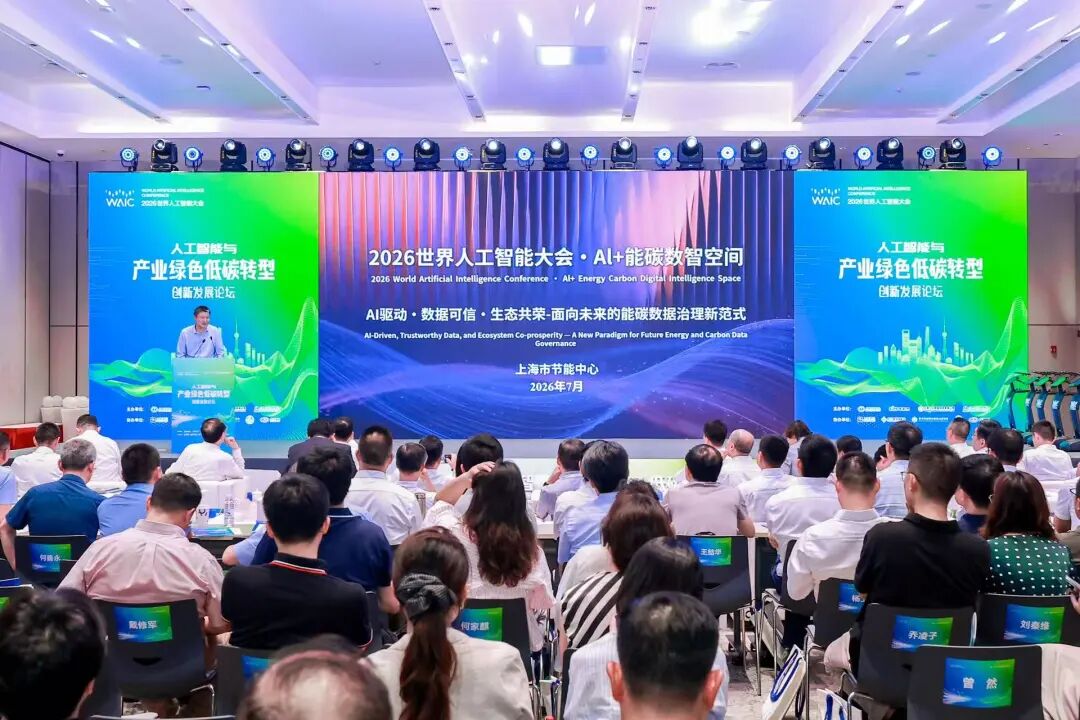
Photo provided by the interviewee
After Wang Bin noticed that the exands AI supply and demand prediction model can achieve an energy saving rate of more than 30% in scenarios such as commercial complexes, he found the relevant person in charge of Xingrong Information and made an appointment for an on-site investigation.
He Kebin, an academician of the Chinese Academy of Engineering and Dean of the Tsinghua University Institute of Carbon Neutrality, told reporters that carbon peaking and carbon neutrality are profoundly reshaping industrial logic, and there is an urgent need to promote the deep integration of artificial intelligence and industrial green low-carbon transformation. However, in the process of AI driving the green and low-carbon transformation of various industries, data confirmation of rights and the construction of a trusted space are key links in carrying out carbon footprint management and digital construction of energy and carbon. It is necessary to straighten out the data rights and responsibilities of all entities, promote the realization of trusted and controllable, interconnected and value co-creation of energy and carbon data. Behind this, there are also broad investment opportunities.
Gao Jian, a senior consultant at Huizheng Finance, said that reviewing the previous focus of the capital market on AI and embodied intelligence enterprises during WAIC, we can sort out that the investment strategy of the capital market is changing. In previous years, capital paid more attention to investment opportunities in model capabilities, computing power support and the rapid development of upstream components of embodied intelligence. But during this WAIC, capital began to focus on the practical application breakthroughs of embodied intelligence and AI technology.
This article is from the WeChat official account "Economic Observer", author: Chen Zhi, 36Kr is authorized to release it.