Before the next model is released
Like all AI industry professionals, Yang Zhilin, founder of Moonshot AI, likes to use the phrase "One day in AI, one year on Earth" to describe the rapid iteration of AI. For the newly released Kimi K3, there seems to be no more fitting description than this. Moonshot AI has been established for three years, but all the accumulation over the past three years may not compare to the sensation of these three days.
Since the release of ChatGPT, China's AI industry has had many moments that shocked the world. Some came from real technological breakthroughs, while others were self-entertainment by media and manufacturers. The release of Kimi K3 seems to be the only one that can rival the "DeepSeek Moment".
Similar to the general decline in the US chip industry after the release of DeepSeek-R1 earlier last year, the Philadelphia Semiconductor Index, including NVIDIA, Broadcom, and Micron, plummeted by 10% last week, marking the largest single-week decline since April 2025 and entering a technical bear market. Media statistics show that the US stock market's AI sector collectively lost $470 billion in market value within 72 hours, equivalent to over 3 trillion RMB.
More than one overseas media outlet and research institution has used terms like "DeepSeek 2.0" to describe Kimi K3. *Fortune* called it the "second DeepSeek shock", the *Wall Street Journal* emphasized that Kimi intensified the sell-off of chip stocks on Wall Street, while Bloomberg stated that "Kimi subverts the traditional perception that the United States leads China".
Panic continues to spread, even calling OpenAI and Anthropic into question, as the performance of a Chinese open-source model seems to be approaching that of top closed-source models. Both are already at a critical juncture before going public, and leading model performance is the key to their high valuations and high pricing. Some US developers are already questioning why they still have to pay such high prices for Claude and GPT.
In the past few days, Anthropic announced that it would open Claude Fable 5 to all Max and Team Premium users, but with a 50% quota limit. Previously, they had planned to completely remove this model from subscription plans due to computing power constraints. OpenAI, on the other hand, reset the Codex quota multiple times last week, and even temporarily lifted the 5-hour usage limit.
It is hard to say that all these events are caused by the impact of Kimi K3. Before that, the semiconductor industry had been under continuous pressure for several weeks, and Wall Street analysts were eager to find a striking and easy-to-understand excuse for this decline — foreign forces are naturally a universal scapegoat. Not to mention that OpenAI and Anthropic are already in fierce competition, which has evolved into a full-blown price war.
But this does not seem to affect the US tech industry's surprise at Kimi K3. Even though Kimi admits that its overall performance still lags behind Claude Fable 5 and GPT-5.6 Sol, many overseas evaluation institutions have not spared praise for K3 in their tests, often placing it at the top of their rankings.
Arena.ai stated that Kimi K3 took the top spot in the front-end code arena with a score of 1679, surpassing Claude Fable 5. The institution said that the last time a Chinese model was so close to the leading position was DeepSeek-R1 in 2025.
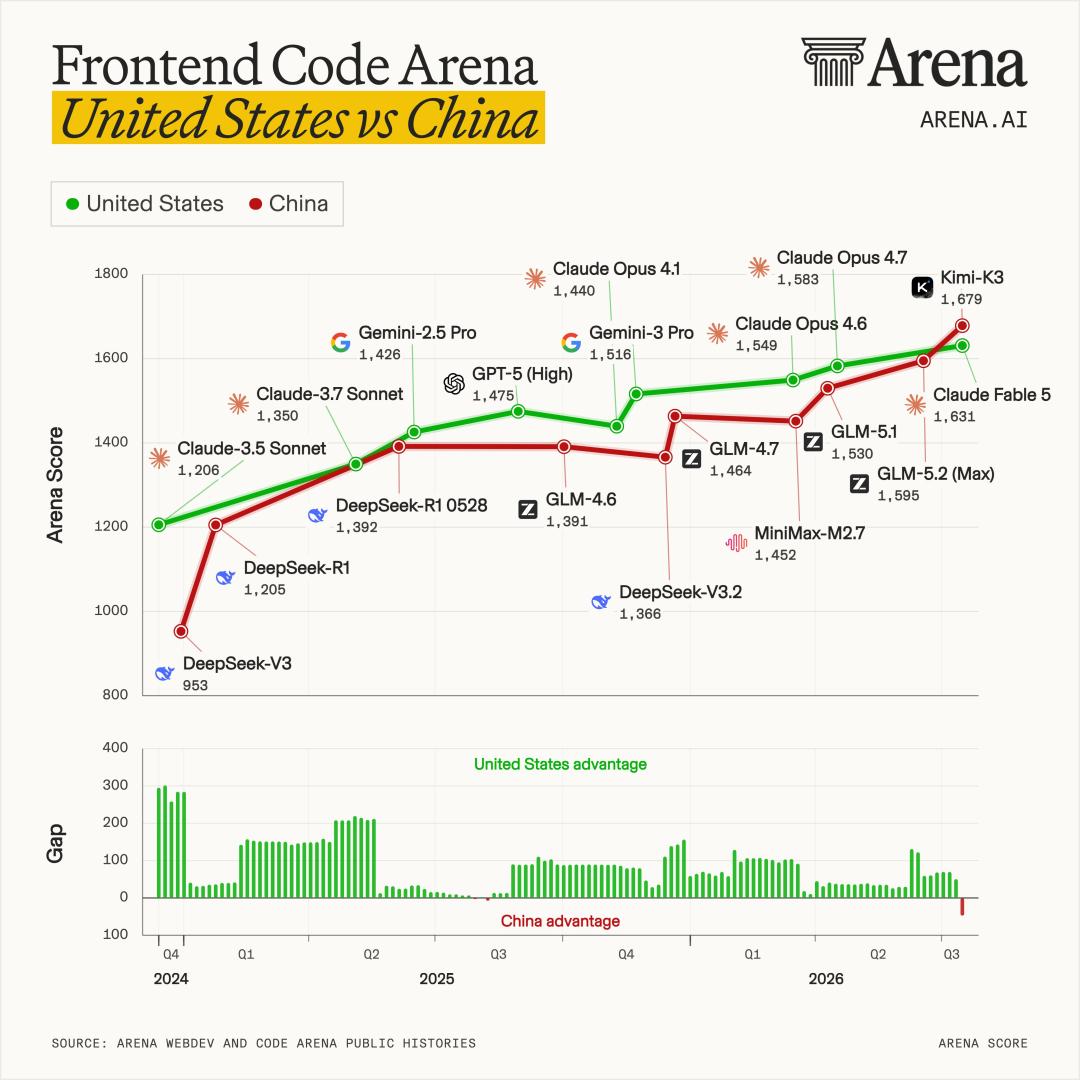
Arena's Statistics on China-US AI Comparison
Amid the soaring market enthusiasm, even Yang Zhilin has become a new idol figure hotly discussed in US tech circles. People on the other side of the ocean are wondering why he did not stay in the United States back then, but returned to China. Yang Zhilin's doctoral supervisor had to publish a special article to explain, clarifying that Yang did not return to China due to visa or immigration issues, but because he was determined to go back and start a business.
The large model industry still follows the simplest law of survival of the fittest: as long as the performance is sufficiently leading, price is not an issue. Even though both the input and output prices of the K3 model have risen more than 3 times compared to the previous generation K2.6 model, and are significantly higher than GLM-5.2 and DeepSeek V4 Pro, making it the most expensive domestic model on the market, Kimi still faces a shortage of computing power.
On the evening of July 19, Kimi announced that due to a shortage of computing power, it would suspend new user subscriptions for the C-end effective immediately. They also adjusted their membership benefits, splitting the original universal membership, which covered the Kimi web version, App, and Kimi Work, from the Kimi Code membership for separate sales. Zhang Yutong, President of Kimi, stated that the day after the K3 release, the company's ARR recorded the largest single-day increase in history.
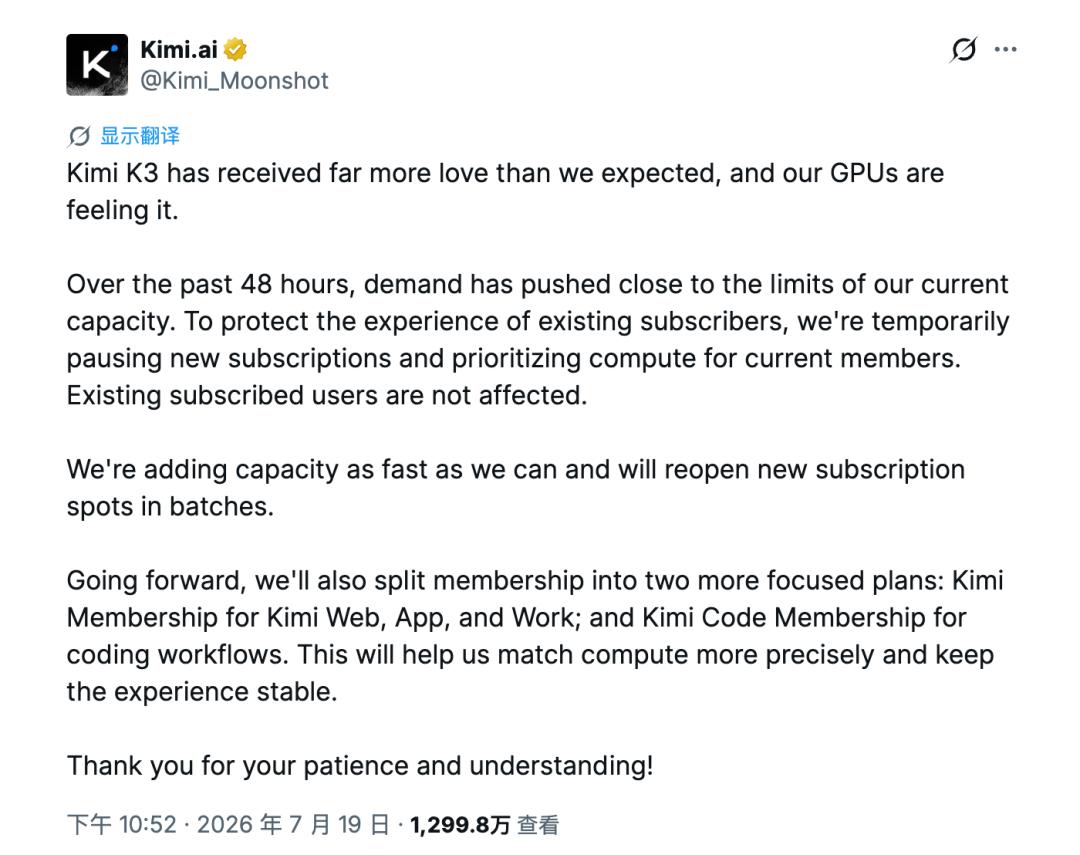
Kimi's Official Tweet
The shortage of computing power may also be related to the Token efficiency of the K3 model itself. In Artificial Analysis's evaluation, K3 output 130 million Tokens to complete the entire test, nearly twice the average level of similar models. Longer output usually means higher reasoning costs, which may further increase Kimi's computing power pressure.
On social media, many developers have also complained that Kimi K3 is a heavy Token consumer, with some saying that they exhausted their 5-hour quota after running for 15 minutes.
The breakout success of K3 seems to prove once again the fragility of models in the AI era. Just two weeks ago, the most promising player in China's large model market was the publicly listed Zhipu AI. The GLM-5.2 model released by Zhipu AI in the first half of the year was hailed as the pride of domestic open-source models, and it remained in high demand even after several substantial price increases. In the half-year since its listing, Zhipu AI's stock price has risen more than 24 times, and its total market value once exceeded HK$1.3 trillion.
But since last week, Zhipu AI's myth seems to have loosened. Last Friday, Zhipu AI's stock price fell by 28.49%, and on Monday this week it dropped another 19.56%. The cumulative decline in stock price over the two trading days exceeded 40%, and its market value fell below HK$500 billion.
Kimi K3's lead may not last long. On July 19, Alibaba released the preview version of Qwen3.8 Max, with a parameter scale of 2.4 trillion, claiming that its comprehensive ability is second only to Claude Fable 5 worldwide. Elon Musk said that the new Grok model with 2 trillion parameters is about to complete initial training, and it may surpass Kimi while maintaining high operating efficiency.
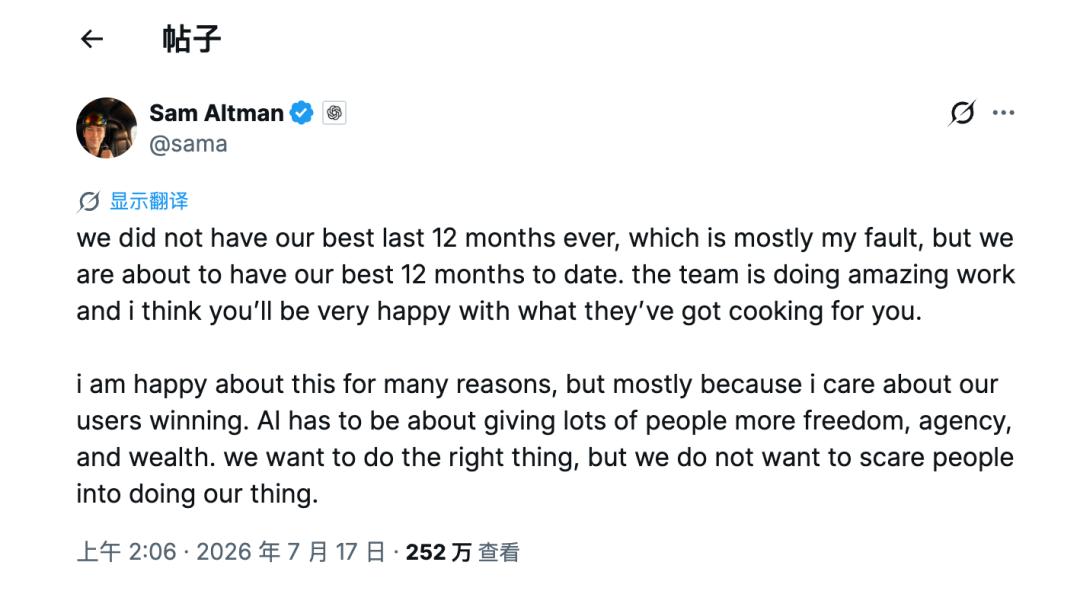
On the day of K3's release, Sam Altman stated that he knew they had not been at their best in the past 12 months, which he blamed mainly on himself, but they are about to usher in the best 12 months so far. "The team is doing excellent work, and I believe you will be very satisfied with the surprises they have in store for you."
The chip industry has followed Moore's Law for many years, where chip performance roughly doubles every 18 to 24 months at a roughly constant cost. But just like the phrase "One day in AI, one year on Earth" that AI industry professionals often mention, model performance improvements in the AI era may be measured in weeks or even days.
Last year, Google's Gemini model once caused Sam Altman to sound a red alert within the company, but now Gemini is more popularly known as "North American Doubao". Bloomberg reported that the release date of Gemini 3.5 Pro has been delayed for several months because the model failed to meet expectations in programming and code generation capabilities.
After the sharp decline in two trading days, market sources said that Zhipu AI may skip GLM-5.3 and directly launch GLM-5.5, which is expected to be released as soon as August, reportedly with a parameter scale of over a trillion. Zhipu AI's employees have already started leaking rumors on Twitter, saying that now may be the best time to subscribe to the GLM Coding Plan.
DeepSeek, which has just completed its first round of financing, has been exposed to be about to launch the official version of the DeepSeek-V4 model, with the outside world saying its performance will approach GPT-5.6 while continuing to maintain its advantage of extremely high cost-effectiveness.
The past era has repeatedly proven the importance of time. Whether it was the PC Internet or the mobile Internet, as long as a company started early enough and ran fast enough, it had the opportunity to establish a first-mover advantage before the window closed. As the user base and market scale continued to expand, the leading position would not be diluted, but would instead continue to amplify, making it increasingly difficult for latecomers to catch up.
But in the AI era, advantages do not always stand on the side of time. All leading positions are built on the iteration of model performance, and there are always latecomers continuously launching newer models to narrow the gap with the former. If the most difficult thing to catch up with in the Internet era is scale, then the most prominent advantage in AI is the model. But the shelf life of this advantage is often only one version.
Zhipu AI, whose stock price fell by 40% in two consecutive trading days, saw its intraday increase once exceed 35% today. Market sources said that Zhipu AI has launched the construction of a 1GW-level domestic AI computing power data center.
The competition continues.
This article is from the WeChat Official Account "Shanshang", author: Xue Xingxing, published with authorization from 36Kr.