South Korea's stock market triggers a circuit breaker roughly once every less than four days.
Since the start of this year, the South Korean stock market has experienced massive volatility. The KOSPI index climbed in choppy fashion from 4244.53 points at the beginning of the year, hitting an all-time high of 9385.59 points on June 19. Since then, the KOSPI has gradually pulled back, closing at 6747.95 points as of July 21, down roughly 28.10% from its peak.
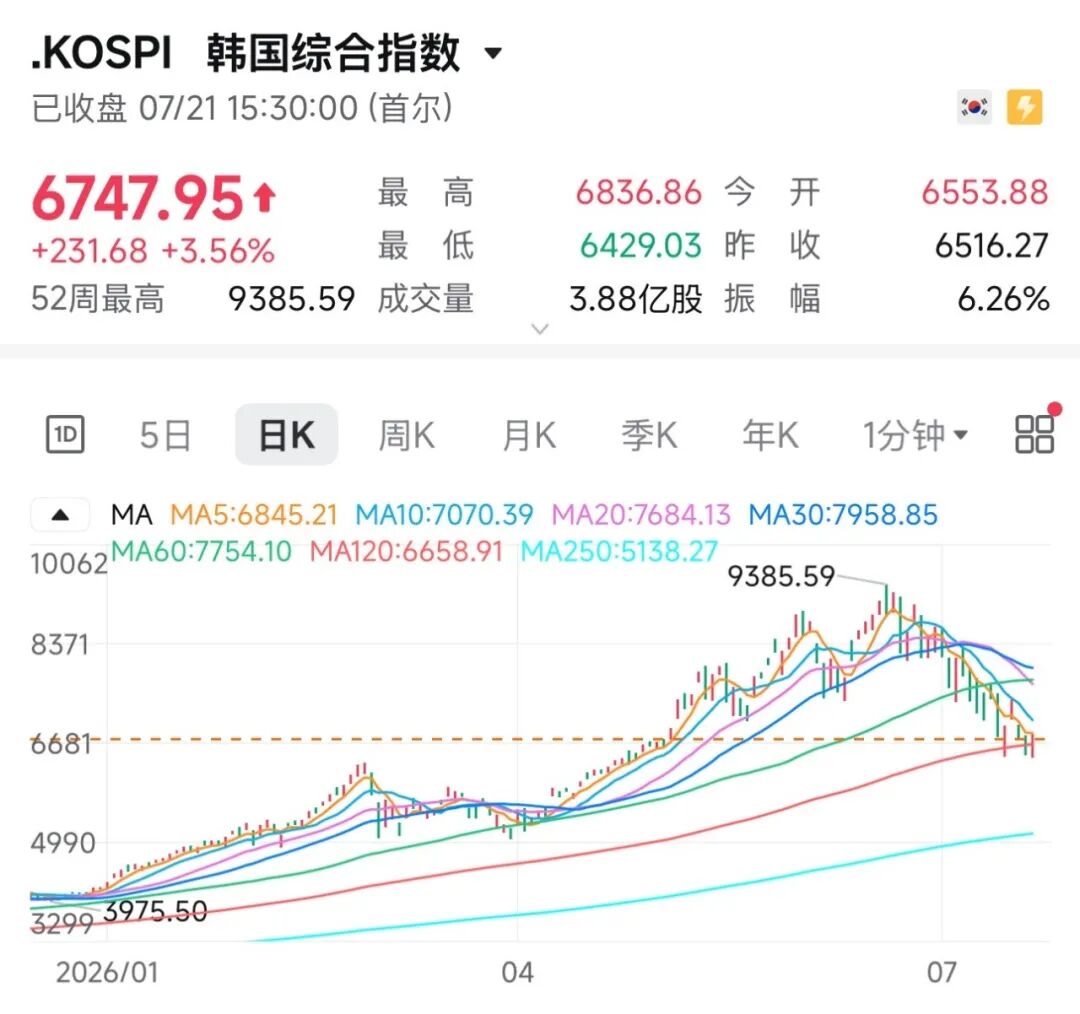
Year-to-date trend of the KOSPI Index Source: Futu
Since 2026, the South Korean stock market has repeatedly triggered the full-market circuit breaker mechanism and the Sidecar mechanism, which are designed to mitigate risks from extreme full-market volatility and algorithmic trading shocks respectively. According to statistics from China News Finance, the South Korean stock market has triggered full-market circuit breakers 7 times so far this year, averaging once every 19 trading days. The Sidecar mechanism has been triggered even more frequently on the KOSPI and KOSDAQ markets, with the KOSPI triggering it on average every 3.53 trading days.
Full-market circuit breaker triggered once every 19 trading days
Specifically, South Korea's full-market circuit breaker mechanism is only triggered during market declines, and will not be activated in the last 40 minutes before market close. The mechanism has three tiers: Level 1 circuit breaker is triggered when the KOSPI index falls by ≥8% compared to the previous day's close and remains at that level for 1 minute; Level 2 circuit breaker is triggered at a 15% decline, pausing trading across the entire market for 20 minutes; Level 3 circuit breaker is triggered at a 20% decline, resulting in an immediate market close for the day.
The Sidecar mechanism applies to the KOSPI 200 futures index and the KOSDAQ 150 futures index. The trigger threshold is a rise/fall of ≥5% sustained for 1 minute, and the response is to pause algorithmic trading in the corresponding direction on the relevant market for 5 minutes, with a maximum of one trigger per day.
According to a review by China News Finance, since 2026 (as of July 21), South Korea's full-market circuit breakers have been triggered 7 times in total; the KOSPI market has triggered the KOSPI Sidecar mechanism 38 times, and the KOSDAQ (Growth Enterprise Market) market has triggered the KOSDAQ Sidecar mechanism 22 times.
Specifically, the 7 full-market circuit breaker dates are: March 4, March 9, June 8, June 23, June 26, July 7, and July 13.
The KOSPI market triggered the Sidecar mechanism 38 times. The buy-side trigger dates are: March 5, March 10, March 18, April 1, April 8, May 6, May 11, May 21, May 27, June 1, June 9, June 12, June 15, June 25, July 3, July 10, July 15, July 21.
The sell-side trigger dates are: February 2, March 3, March 4, March 9, March 23, April 2, May 15, May 18, June 5, June 8, June 10, June 23, June 26, July 2, July 7, July 8, July 13, July 14, July 16, July 20.
The KOSDAQ market triggered the Sidecar mechanism 22 times. The buy-side trigger dates are: February 19, March 5, March 6, April 1, April 8, May 21, May 22, June 9, June 11, June 29, July 10, July 15.
The sell-side trigger dates are: March 4, March 9, April 2, June 8, June 23, July 2, July 8, July 14, July 16, July 20.
As of July 21, the South Korean stock market has recorded 134 trading days this year. Based on this calculation by China News Finance, South Korea's stock market sees a full-market circuit breaker on average every 19 trading days, the KOSPI market triggers the Sidecar mechanism on average every 3.53 days, and the KOSDAQ market triggers the Sidecar mechanism on average every 6 days.
Regulators have held multiple meetings and made public statements
Around several previous full-market circuit breakers in South Korea, relevant South Korean authorities have repeatedly held emergency meetings or issued public statements.
On March 4, Lee Eok-weon, Chairman of South Korea's Financial Services Commission, stated that authorities were closely monitoring the stock market and would actively deploy a market stabilization plan worth up to 100 trillion won if volatility became excessive. This plan was officially announced by South Korean President Lee Jae-myung on March 5.
Ahead of market open on June 8, the Korea Exchange stated that it had convened an emergency market assessment meeting to address intensifying stock market volatility. At the meeting, participants reviewed market movements including the sharp decline in U.S. stocks and overnight futures on the previous trading day, and discussed market management plans.
On July 8, South Korea's Minister of Economy and Finance Choo Kyung-ho met with the Governor of the Bank of Korea and other officials, agreeing to closely monitor risk factors that could exacerbate stock market volatility. The South Korean Ministry of Economy and Finance stated that intensifying stock market volatility stemmed from profit-taking by foreign and institutional investors, portfolio rebalancing, and shifting expectations in the global AI sector. The growing concentration in the semiconductor industry has become a factor amplifying financial market volatility, with the impact of chip sector fluctuations on the broader stock market expanding.
On July 13, the Bank of Korea released a report pushing back against concerns that the chip cycle has already peaked. The bank stated that the global semiconductor market remains in a state of supply shortage, and the AI-driven chip supercycle is expected to continue for some time.
On the 13th, at a meeting with heads of major asset management firms, Lee Chan-jin, Governor of South Korea's Financial Supervisory Service, stated that as the size of the exchange-traded fund (ETF) market has nearly doubled this year, the role and responsibility of asset management companies in selling and managing ETFs are becoming increasingly significant, calling on these firms to ensure the accuracy of investment information when promoting such products.
On the morning of July 14, South Korea's four major economic authorities, the "F4" (Ministry of Economy and Finance, Financial Services Commission, Bank of Korea, and Financial Supervisory Service) held an emergency joint meeting on the plunge of single-stock leveraged ETFs tracking core chip stocks such as Samsung Electronics and SK Hynix, to discuss response plans, including whether to tighten regulations or allow the products to continue operating.
On July 20, the first trading day after the announcement of supplementary measures for single-stock leveraged products, the total trading volume of 16 leveraged products (including two inverse products) linked to Samsung Electronics and SK Hynix exceeded 12 trillion won (approximately 54.84 billion RMB). However, due to the sharp price decline of 14 single-stock leveraged products that day, their total market value fell to the lowest level since June 11. The South Korean stock market also saw significant volatility that day, with both the KOSPI and KOSDAQ markets triggering the Sidecar mechanism.
According to a report by Yonhap News Agency, Kang Jin-hyuk, an analyst at Shinhan Securities, commented: "Despite improvements to the system for single-stock leveraged ETFs, changes in the South Korean stock market remain limited. These measures have failed to reverse the market sentiment that was previously driven higher by only a handful of stocks."
Retail capital in South Korea is rapidly receding
"If regulators cannot solve the problem, they should directly delist these leveraged products. They are creating chaos in the market," a user recently posted on Naver's stock investment community, as reported by The Korea Times on July 20. Another user said, "I have lost nearly 60% of my investment in these leveraged ETFs. These measures do nothing to restore market order."
These comments reflect the frustration of South Korean stock investors, who have experienced the harsh reality of the stock market in just one month during the hot summer.
The latest liquidity tracking data from CITIC Securities' international strategy team shows that as of July 10, the margin balance of South Korean individual investors fell rapidly by 9.4% in the previous week, marking the largest single-week fluctuation record in the past 10 years, indicating that retail capital is rapidly receding. At the same time, the margin trading balances on the KOSPI and KOSDAQ have fallen sharply, and leveraged capital in the market is contracting at an accelerated pace.
According to official South Korean statistics, as of the most recent full-market circuit breaker (July 13), the cumulative forced liquidation volume in July reached 344.2 billion won (approximately 1.57 billion RMB), and more than 1.2 million leveraged retail accounts hit the margin call line, of which about 320,000 to 360,000 accounts have been fully force-liquidated by brokerages, with some accounts even ending up owing money to their brokers.
The core shock came from the two semiconductor giants that the market is highly dependent on. On July 13, SK Hynix's stock price plummeted 15.37%, marking its largest single-day decline in history; Samsung Electronics fell by 10.70%. The prices of related single-stock leveraged ETFs all hit new lows since their listing.
Yonhap News Agency quoted Kim Byung-yeon, an analyst at NH Investment & Securities, as saying: "It is too early to talk about the semiconductor industry 'peaking'. Under the current environment, an expected price-to-book ratio (PBR) of about 1.3 to 1.4 times represents a reasonable 'bottom', corresponding to the KOSPI index level of 6000 points."
Seo Sang-young, Managing Director of Mirae Asset Securities, analyzed: "In the short term, the South Korean stock market is likely to continue fluctuating as supply and demand dynamics readjust and the market digests existing selling pressure."
However, he added that the earnings performance of large-cap tech stocks, especially the semiconductor sector, is expected to be a key variable determining the future direction of the market. Given that the recent market pullback has largely digested earnings concerns, better-than-expected results will likely boost investor sentiment.

The views in this article are for reference only and do not constitute investment advice. Investing involves risks, and caution is advised when entering the market.
This article is from the WeChat official account "China News Finance" (ID: jwview), written by Dong Wenbo, and published by 36Kr with authorization.