Intern, monthly income of 120,000
"The compensation is absolutely mind-blowing."
The story stems from a trending Weibo topic this week: a student from the Yao Class at Tsinghua University shared their internship offer, with a pre-tax daily pay of 5,500 RMB.
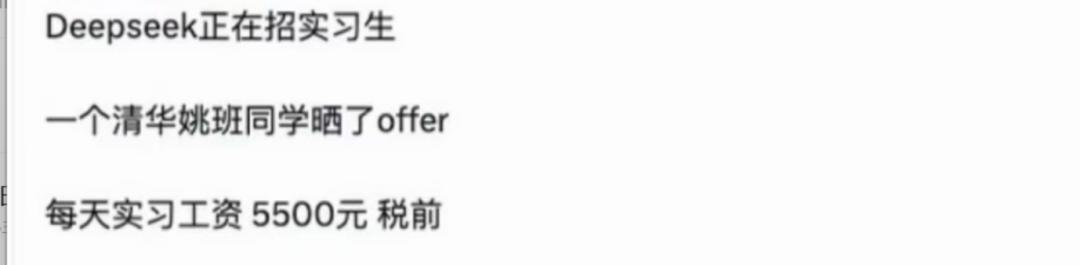
Calculated based on 22 working days per month, the monthly salary exceeds 120,000 RMB.
Although this salary package is only offered to a small group of elite students like those from Tsinghua's Yao Class, it still offers a glimpse into the cutthroat competition for top AI talent. The AI wealth-creation wave is sweeping across the industry, where talent has become the most critical asset that can often shift the entire tide of development.
DeepSeek Intern
5,500 RMB Daily Pay
After securing a 500-billion-yuan Series A funding round, DeepSeek is now flexing its financial muscle.
But considering the exceptional background of these talents, this daily pay for interns may not be as exaggerated as it sounds. The Yao Class at Tsinghua University was founded in 2005 by Turing Award winner Academician Andrew Chi-Chih Yao, with the original goal of cultivating the world's top computer science talents. It only admits dozens of students each year, all of whom are exceptionally rare high-potential individuals.
As a friend working as an AI headhunter frankly put it: "It sounds a bit over the top for domestic large model companies to offer such sky-high pay, but it's not surprising coming from DeepSeek. People might even be discussing whether they're offering too little."
This statement comes against the backdrop that Liang Wenfeng is going all out to recruit new employees.
Not long ago, DeepSeek published a job posting through its official WeChat account, planning to expand the headcount of every department by at least double. They have opened 33 positions across 7 categories including algorithm, R&D, operation and maintenance, product, data engineer, and functional departments, with all positions accepting intern applicants.
"Humanity is standing at the dawn of AGI right now. Join DeepSeek, witness the evolution of AGI firsthand, sit in the front row of the era, and see the birth of a new epoch," DeepSeek wrote emotionally on its recruitment poster.
This kind of manifesto strikes a chord with young people who carry big dreams.
Even earlier, Cui Tianyi, head of the Harness team at DeepSeek, posted that as a newly established department, Harness is still "extremely understaffed", and he himself is "conducting interviews every day and posting small recruitment ads across all platforms".
This comes as no surprise.
The Bloomberg Billionaires Index shows that Liang Wenfeng's personal wealth has soared from around 16.7 billion USD to 36 billion USD (approximately 244 billion RMB), surpassing Anthropic co-founder Daniela Amodei and OpenAI co-founder Brockman to become the world's wealthiest AI model founder.
Tech Giants Are Racing to Recruit Interns
These AI internship offers are simply too irresistible to turn down.
"I'm more than willing to work overtime." A self-identified Huawei summer intern undergraduate student posted online recently, saying their offer includes a base monthly salary of 10,000 RMB, with hearty late-night snacks and a wide selection of fruits and treats provided after 8:30 PM.
This year, Tencent announced its Qingyun Intern Program, which removes grade limits and sets no upper cap on compensation. Interns get the chance to directly participate in, or even lead core projects including the Hunyuan large model, Yuanbao AI, and WeChat ecosystem, while reaping considerable rewards.
ByteDance is not falling behind either, as it launched its largest-ever "ByteIntern" conversion-focused internship program early, offering over 7,000 positions with a conversion rate higher than 50%.
Before students even graduate from campus, major tech firms are scrambling to extend their offers, because in today's increasingly fierce AI competition, there's no time to waste when it comes to tapping into high-potential young talents.
In fact, as early as the end of 2025, Business Insider revealed a set of data: a 4-6 month AI internship and short-term research program already pays a monthly salary in the range of 7,000 to 18,000 USD, equivalent to about 49,000 to 126,000 RMB.
Looking back at the domestic market, companies are even reaching out to students at much earlier stages: Tencent launched the Spark Program targeting high school students, ByteDance established the Zhichun Innovation Center in 2025 planning to recruit 30 "full-time pre-researchers" aged 16 to 18 every year; similar elite youth AI talent training programs have also emerged at JD.com.
Another impressive move is that Moonshot AI announced the launch of its Kimi Top Talent "Leapfrog Program", which grants company stock options to interns who haven't graduated yet. It is reported that all students currently interning at Kimi and those who will join as interns later, regardless of their graduation year, who perform well during the 3-6 month internship period and pass the conversion assessment, will receive an official offer from the Kimi "Leapfrog Program". The company will grant them stock options at the current unit price starting from 2026 when their internship begins, lock in the number of shares, and start calculating the vesting period.
After all the twists and turns, the talent war has finally reached young people who haven't even stepped out of campus.
Shifting the Tide Direction
Each Generation Has Its Own Historic Opportunities
The AI talent market is experiencing its most frenzied year ever.
Looking back, the annual salary for AI researchers was generally around one million RMB, but today compensation reaching ten million RMB is becoming increasingly common. The rapid rise of DeepSeek over the past few years has made the industry realize that a tiny handful of top talents can often deliver disruptive outcomes, and companies should spare no expense to secure world-class experts.
This scenario has already played out overseas. Talents flow rapidly between giants like OpenAI, Anthropic, Google, and Meta, while major tech firms rush to bring high-potential individuals into their own business lines. They are not just competing on compensation packages, but also on speed.
An internal Meta email even revealed that Mark Zuckerberg personally drafted an "AI talent hunting list", targeting elite talents under 30 with experience from top labs.
At this point, traditional recruitment methods no longer apply — today, major companies including ByteDance, Huawei, Pinduoduo, and Tencent always kick off their seasonal hiring or internship recruitment plans far in advance. The traditional "Golden September, Silver October" hiring peak has shifted to "Golden July, Silver August", or even earlier.
Their total annual compensation packages for fresh graduates are generally at the million-RMB level, with top performers receiving several million RMB. According to a report by LatePost, ByteDance's Top Seed graduate hires in 2024 had an annual salary of about 1.5 million RMB, which rose to 3 million to 5 million RMB in 2025, and some core positions in 2026 are even offering up to 6 million RMB, doubling year over year.
After sorting through all these trends, today's AI talents show distinct characteristics: young, graduated from top universities, high-potential, and highly adaptable. They usually grew up as AI Natives, carrying little historical baggage, and can easily keep up with the rapid iteration pace of the AI era.
A landmark event was when Tencent appointed 27-year-old former OpenAI researcher Yao Shuny u as its Chief AI Scientist, taking full charge of large model infrastructure. Almost at the same time, 95-born Luo Fuli, the large model lead who joined Xiaomi, stepped into the spotlight — Lei Jun once publicly stated that he hoped to recruit her to lead large model research with a ten-million-yuan annual salary.
Quietly, the young generation has quickly taken center stage.
In the final analysis, AI competition is never just a race between models and computing power, but a competition of talent density. A more decisive change is that more and more highly educated young people are moving to the core of the industry — they will determine how the next phase of the AI landscape gets reshaped.
This article is from the WeChat official account "Pedaily" (ID: pedaily2012), written by Yu Mengying, and published with authorization from 36Kr.