Multiple players are making aggressive moves to seize the AI entry point
Anyone walking into the 2026 World Artificial Intelligence Conference (WAIC) could hardly ignore three things: the massive crowds, the sweltering heat, and the striking similarity among the showcased terminals — for instance, the booths of computing power vendor MetaX and large model provider Stepfun both featured vehicles; Alibaba's Qwen and iFlytek — two major players focused on large models — placed giant AI glasses at their booth entrances; and just a few steps away, visitors could spot robots busy making coffee or brewing tea.
Two years ago, the spotlight at WAIC was on the "hundred-model battle" and the race for larger parameter sizes; one year ago, the industry was still mired in debates over computing power shortages and the difficulty of launching viable applications. This year, the most crowded booths belonged to physical devices that are being equipped with artificial eyes, ears, limbs, and hands.
According to the official statistics of the conference, more than 300 products made their global debut during this WAIC, with consumer-grade AI products and embodied intelligent terminals accounting for a significant proportion. If the AI development over the past three years was marked by rapid expansion in the cloud, the 2026 WAIC marked the beginning of a shift: large model companies, traditional terminal giants, and startups have started real commercial competition in specific directions, striving to pull AI out of the cloud and into the physical world.
All parties are fiercely vying for AI entry points — in this battle, hardware is no longer just a container for computing power, but the physical anchor for the commercial closed loop and data flywheel of large models. However, the most crucial change at this WAIC is not that AI finally has a "body", but that every such physical form is now being asked: what exactly is it responsible for?
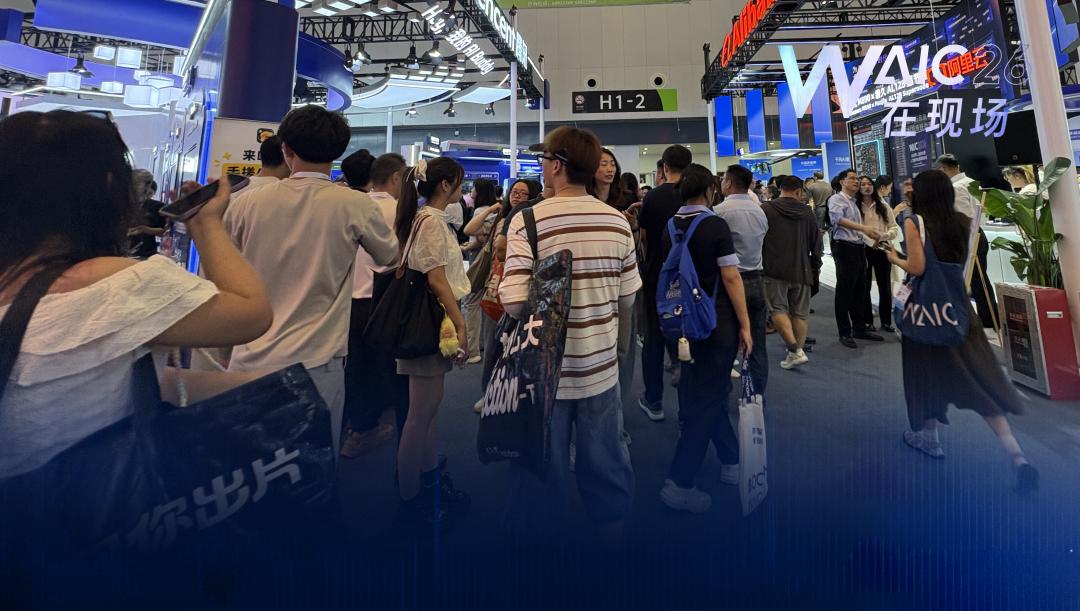
The packed WAIC venue.
01
Agent Phones: The Battle for Underlying System Permissions
The mobile phone is the computing center closest to users, and also the market with the most intense competition.
At the main forum of the opening ceremony of this WAIC, Yin Qi, Chairman of Stepfun, summed up the next-stage changes brought by agents as "new systems, new carriers, and new networks". This is first and foremost a route judgment from a model company, but it also shows that beyond the mature ecosystems of Apple, Huawei, Honor, and others, large model companies can hardly give up attempts to develop terminals, even if their sole goal is not to sell more phones.
Guided by this judgment, Stepfun exhibited STEPX Neo, the first AI terminal under its STEPX brand, at WAIC. Tencent Technology observed on site that this was the product with the longest queue of visitors at the Stepfun booth, bar none.
A similar scene took place at the booth of ZTE, a veteran communications manufacturer. Around the period of this WAIC, Doubao, a brand under ByteDance, collaborated with ZTE's Nubia to launch the "second-generation Doubao Phone". A consumer who experienced the product told Tencent Technology that he tried the voice-operated flight booking function, the entire process was fully connected, and the experience felt very novel, though a bit slow — "a task that takes one minute manually takes several minutes for AI to complete".
The reason why model companies are determined to manufacture mobile phones lies in the structure of the existing mobile ecosystem. Over the past decade, super apps have built their own data silos on top of operating systems. If a large model only exists as an individual app, it cannot easily cross these silos to understand users' cross-platform intentions. And any attempt to access the core data of other apps often triggers defensive pushback.
Therefore, model companies are trying to bypass super apps to directly obtain underlying system permissions. Stepfun has independently developed the agent-native operating system Step AOS, while Doubao has chosen the GUI Agent path, enabling AI to read the screen and simulate clicks to reduce reliance on application vendors' APIs.
Yin Qi proposed at the WAIC main forum that computers, mobile phones, vehicles, and robots will become different "bodies" of the same agent in different scenarios; at the same time, the industry must also answer who the agents act on behalf of, and who is responsible for the consequences of their actions. This explains the motivation of model companies to compete for terminal entry points: hardware is not only the starting point of data, but also the possible foothold when the AI business model shifts from simple token-based charging to hardware shipment sharing or subscription systems.
In response to the moves of model companies, traditional mobile phone manufacturers are also adjusting their strategies. During WAIC, Honor released the Robot Phone and announced the upgrade of MagicOS to a "partner-like multimodal agent operating system (Agentic OS)".
Different from the paths of Stepfun and Doubao, Honor chose to cooperate with Alibaba's Qwen large model and proposed the architecture of "one general model with multiple specialized variants, three-end collaboration". The Robot Phone is the visual manifestation of this architecture: it is equipped with a 4-DOF gimbal system that rotates in rhythm when playing music; in the official demonstration, it showed the ability to continuously complete tasks such as ordering a cake, hailing a taxi, and booking a KTV room.
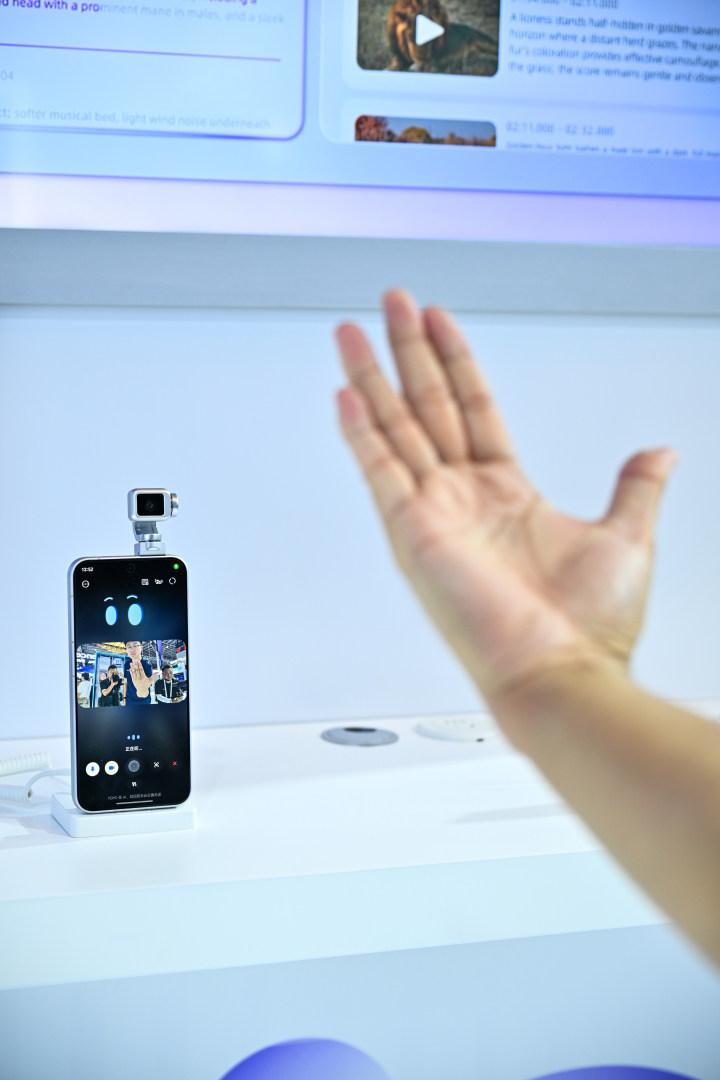
Honor Robot Phone. Source: Honor
Honor CEO Li Jian said at the forum that the evolution of AI will "break away from the cold attribute of tools", move from operating systems to embodied interaction, and fully advance towards a "partner-like" human-like living entity. This corresponds to the mobile phone manufacturers' redefinition of system entry points: they no longer only host applications, but try to undertake users' continuous intentions.
Whether it is STEPX Neo or Robot Phone, both point to the same fact: the competition for AI phones has escalated from pre-installing smart assistants to vying for system-level permissions and cross-application execution capabilities.
However, a product manager at the exhibition site pointed out to Tencent Technology that to truly realize a cross-application operation closed loop, it is not only necessary to break through the memory and power consumption bottlenecks of end-side models, but also to establish new permission governance rules. When a large model schedules data across apps, how should it explain the data flow to users? Are super apps willing to cede core business flows to operating systems?
In simple terms, if a model wants to step out of the chat box, it must get closer to the system permissions and service invocation links; but this is exactly the benefit that is hardest to redistribute in the existing mobile ecosystem, and cannot be solved simply by increasing the model's parameter count.
02
AI Glasses: Competing for the "Wearable Perception Layer"
AI glasses represent another attempt to find incremental entry points.
At the 2026 WAIC site, AI glasses were the category with the most noticeable surge in the number of exhibitors. More than 20 manufacturers including iFlytek, Alibaba's Qwen, Li Weike, Rokid, and Moonix brought over 40 glasses products of various forms.
Behind these products, the competitive dimensions of AI glasses have transformed. In the past few years, AR/VR headsets were plagued by weight, battery life, and motion sickness, making it difficult to cross the gap from niche geek products to mass consumer goods. Most of today's AI glasses have abandoned the pursuit of building complex virtual spaces, and instead focus on lightweight design and daily usability.
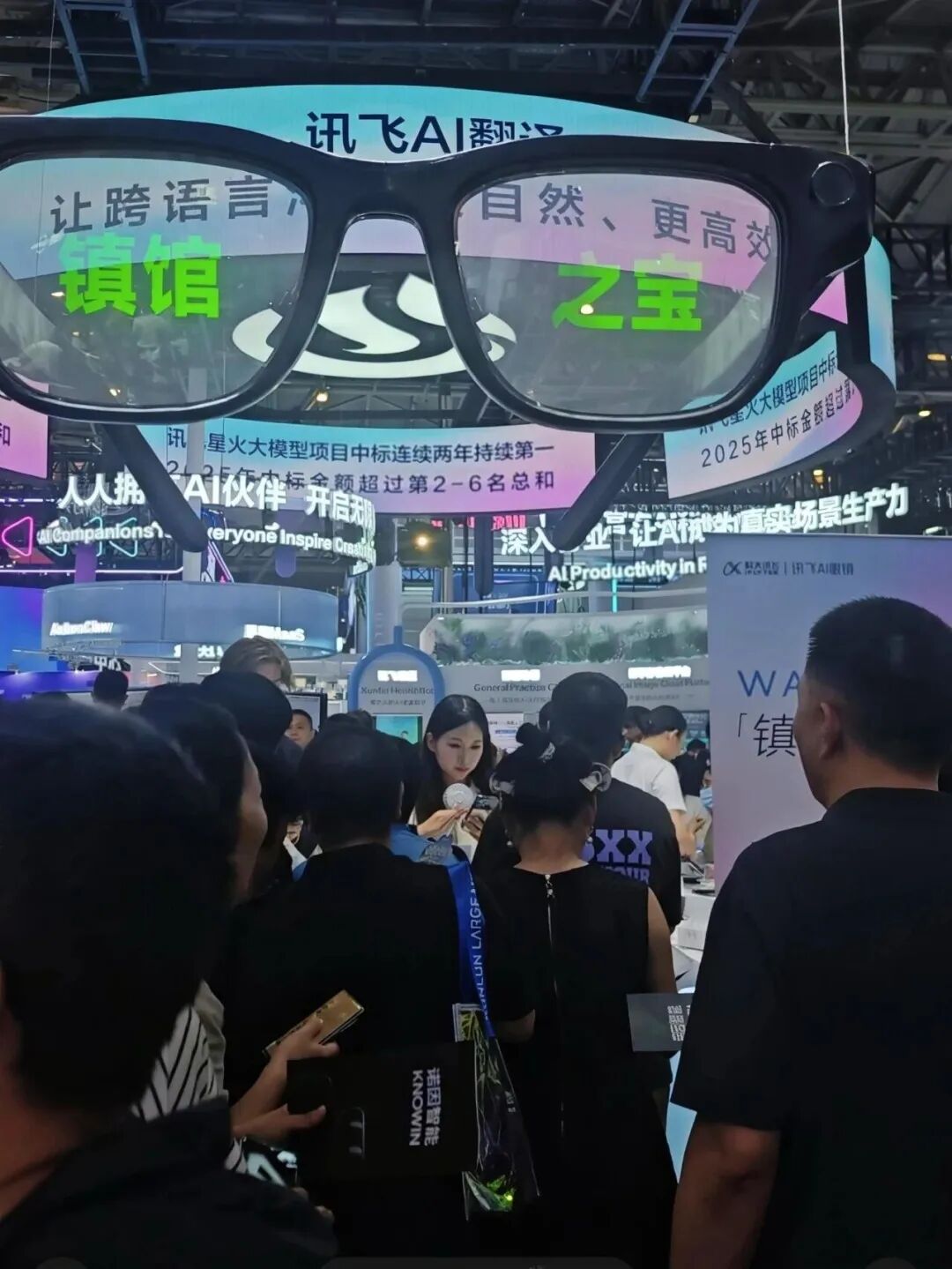
Visitors queuing up to experience iFlytek's AI glasses. Photo by Gu Lingyu
At its main booth, iFlytek positioned its approximately 40-gram AI glasses as the entry point for its integrated software and hardware ecosystem, with key functions in translation and office assistance. The Monet AI glasses showcased by Moonix are claimed to weigh only 14.9 grams, focusing on non-intrusive recording. On the interaction level, manufacturers such as Rokid have connected their products to payment applications, trying to complete purchases directly via voice commands.
Going a step further than individual products is the collaboration across different hardware forms. At the WAIC site, HGR demonstrated a "human-glass-robot dog" collaborative system. The human eye level is about 1.6 meters, while the robot dog's camera is only 0.4 meters above the ground, resulting in a difference in their viewing perspectives. When a user wearing glasses stares at the location of a takeout order and gives the instruction "go there", the system needs to align the two perspectives, convert the user's line of sight target into the robot dog's navigation goal, and complete the pickup and delivery tasks. This shows that the scheduling of smart hardware in the future may no longer rely on remote controls, but on line of sight and natural language.
However, real-time processing of visual and voice data consumes a large amount of cloud computing power and brings latency. Therefore, end-side models have become a key support for wearable devices. For example, new architectures such as RWKV try to reduce memory usage through state compression; while Wall Intelligence announced at this WAIC that its end-side model has been installed on Samsung mobile phones, and demonstrated end-side applications such as smart cockpits. Deploying AI capabilities to the end side is the foundation for devices like glasses to maintain high availability in weak network environments.
IDC predicts that the shipment volume of China's smart glasses market will reach 4.508 million units in 2026.
From an industrial perspective, AI glasses are the terminals closest to the "wearable perception layer", but they are also the most restricted by physiological and social norms. In the short term, single-point functions such as audio, translation, and first-person perspective shooting are easier to form user habits; but defining them directly as "mobile phone substitutes" ignores the thresholds of wearing duration, privacy consensus, and offline fitting requirements. Whether glasses can truly become an entry point not only tests the supply chain and distribution channels, but also depends on whether people around are willing to accept the fact that "they are being seen by the glasses".
03
Embodied Robots: The Goal Is Not to Look More Human, but to Be Less Restricted by Human Forms
Similar to 2025, embodied robots capable of fighting and dancing remained the most popular exhibition area. However, a more prominent change in 2026 is that all manufacturers are looking for differentiated scenarios that can be clearly explained; in other words, embodied robots without solid scenario support are losing their narrative appeal.
Unitree Robotics moved an entire production line into the exhibition hall, demonstrating the continuous process of robots completing material loading, finished product boxing, and full-box transportation. Leju Robotics had its humanoid robots handle scenarios such as carton depalletizing, plastic box depalletizing, and small-part loading, with automatic calibration when the boxes are offset. Its Stone Navigation replicated automotive wiring harness operations with a circular assembly line on site, demonstrating processes like "picking up the wire - routing the wire - inserting the connector". Its A1 wiring harness intelligent robot solution is equipped with the self-developed AWE embodied large model, and is fitted with a 21-DOF DexHand dexterous hand.
A client of Its Stone Navigation told Tencent Technology that their wiring harness production line has started trial operation, and he believes that the wiring harness scenario is a "very clever" entry point: although wiring harness operations involve flexible materials and precise insertion, the workstations, material flows, and quality standards are relatively clear, allowing complex operations to be broken down into teachable and verifiable steps such as "picking up the wire - routing the wire - inserting the connector". Compared with general services in open environments, robots can more easily accumulate data in such repetitive, rhythm-clear tasks, and demonstrate their benefits through leasing and pilot programs.
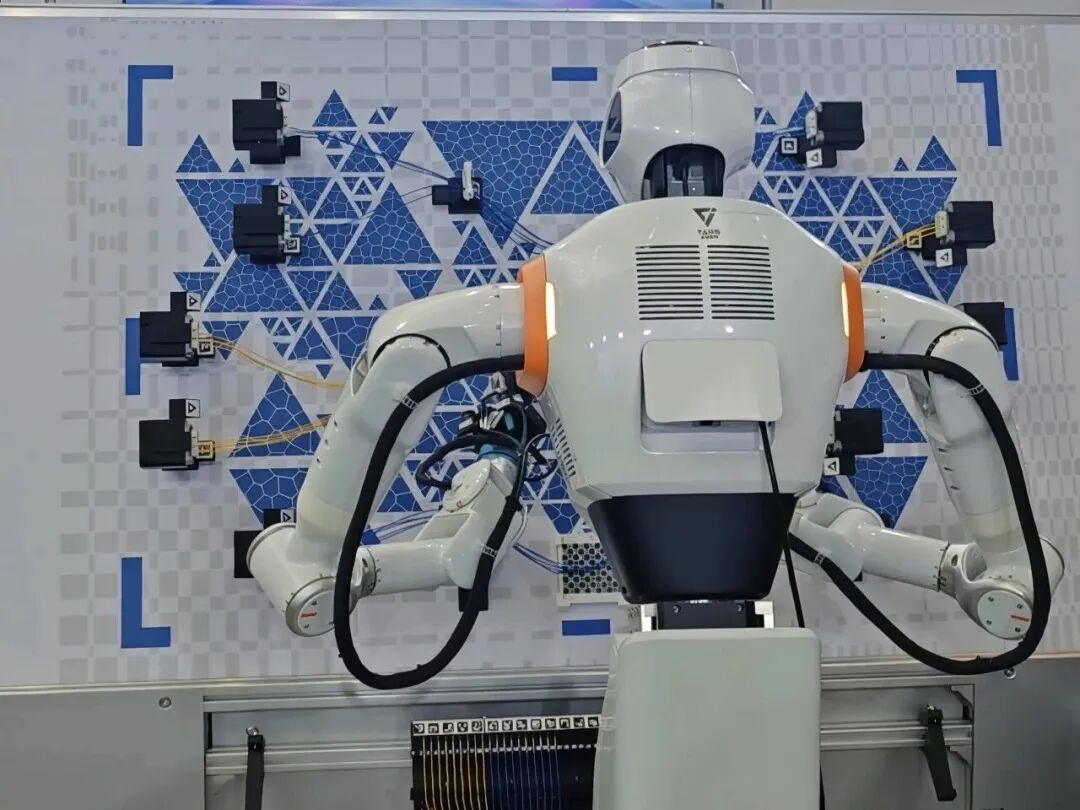
The robot of Its Stone Navigation at work. Photo by Gu Lingyu
In addition to heavy industry, new retail and service scenarios are also key areas of focus. The Lingbo large model of Ant Group cooperated with Guoda Pharmacy to showcase a collaborative system of three robots with different configurations for order receiving, medicine picking, and packaging, claiming that one order can be completed in about 90 seconds. Sharpa, which participated in WAIC for the first time, demonstrated robots taking photos autonomously. Its staff told Tencent Technology that the difficulty lies in the fine manipulation of the robotic hand, and in the future, it can be adapted to various hand-held tools.
However, all these demonstrations are based on a common premise: the routes, materials, lighting, and personnel division in the exhibition hall are relatively controllable. After actually entering factories or stores, robots still need to handle exceptions such as missing materials, deformed boxes, ambiguous instructions, network fluctuations, and manual takeovers.
This is also the biggest change at this year's exhibition: manufacturers have proactively shifted their evaluation criteria from "can it move" to "can it work continuously". Nevertheless, completing one demonstration, running one pilot, and forming a replicable commercial deployment are three completely different stages. Compared with non-standard household scenarios with low fault tolerance rates, industrial assembly lines and standardized retail counters are currently more feasible landing options.
The industry generally expects that mass-producible products will be launched first this year, but they will inevitably start with tasks with clear boundaries such as handling and transportation, instead of gaining general labor capabilities overnight.
Yao Maoqing, Partner and Senior Vice President of Unitree Robotics, said at the WAIC roundtable that simple tasks in simple scenarios that are "high-frequency, rigid-demand, environment-controllable, highly deterministic, and have a certain fault tolerance margin" are easier to implement in the short term. Chen Yilun, Founder and CEO of Its Stone Navigation, believes that the manufacturing industry has high data density, clear task completion standards, and accumulated human operation data, making it a friendly early environment for embodied intelligence; while a real physical world model still requires signals that are hard to obtain from videos, such as force and contact.
04
The Real Threshold for AI Hardware Is Not Intelligence, but Responsibility
Whether it is agent phones striving to obtain system permissions, AI glasses aiming to integrate into daily life, or embodied robots testing operational capabilities in specific scenarios, the hardware exhibits at WAIC 2026 all point to an emerging change that is still in its early stage: AI is gaining perception and execution interfaces that are closer to the real world.
In this process, data no longer only comes from users' clicks on the screen, but also from vision, hearing, spatial coordinates, and motion trajectories. As a result, hardware is no longer just a terminal that receives instructions, but has begun to participate in the chain of perception, reasoning, and execution. However, these three types of hardware do not share the same commercial closed loop: mobile phones need to solve the problems of service invocation and permission governance; glasses need to establish high-frequency wearing habits and social acceptance; robots require customers to pay for their reliability, maintenance costs, and safety responsibilities.
A practitioner who switched from the hardware industry to agent entrepreneurship told Tencent Technology at the exhibition site that based on his years of experience in the hardware industry, the current AI hardware supply chain is still immature. He drew an analogy with the history of smartphone development: the iPhone changed the interaction paradigm, and then the supply chain rapidly matured. In the current context, this does not mean that AI hardware must wait for a certain "iPhone moment", but reminds the industry that only when a certain form of hardware simultaneously realizes user value, software capabilities, and supply chain efficiency, will the component, distribution, and service networks around it be deployed on a large scale. This is also why his team is currently focusing on software systems and not venturing into hardware manufacturing for the time being.
Therefore, a more likely path is that no single device will take over all entry points in the short term,