The Rise of SK Hynix: A Ridiculous and Dramatic Chaebol Story That Holds the Global AI Industry by the Throat
On July 10th, South Korean memory chip giant SK Hynix officially listed its American Depositary Receipt (ADR) on the New York Nasdaq Exchange. Its share price surged 12.76% on the first trading day, with an intraday peak gain exceeding 19% at one point. This IPO raised a total of 26.5 billion US dollars, breaking the record of U.S. financing for overseas enterprises that Alibaba had held for more than a decade. It also became the second largest stock issuance in U.S. history, pushing SK Hynix's total market capitalization above 1 trillion US dollars.
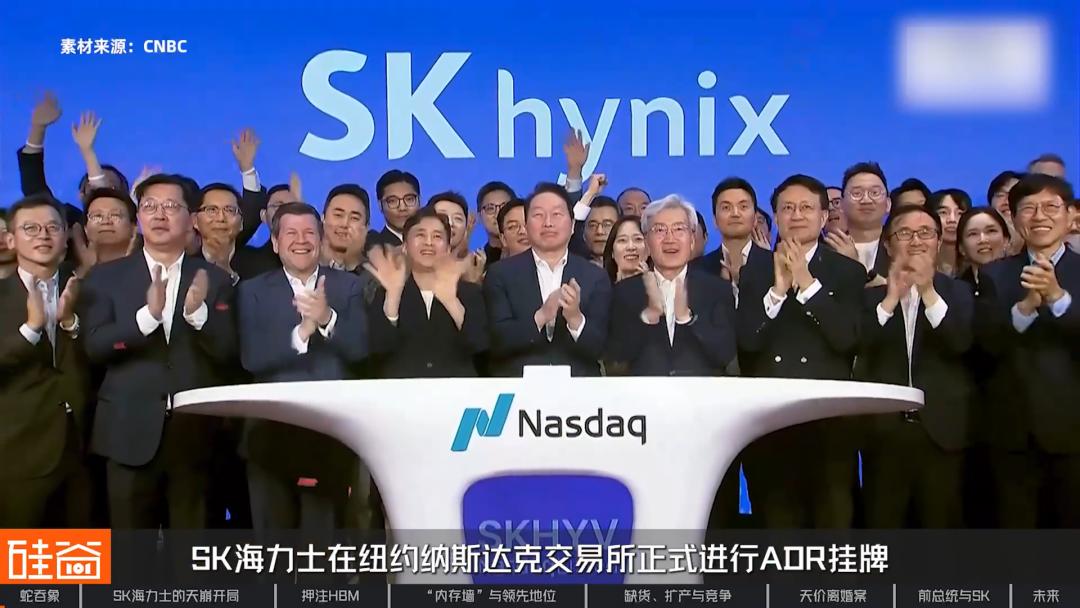
When you become the company that holds the global AI industry's lifeline, no amount of limelight is excessive. South Korean media have reported that nowadays, as long as you wear an SK Hynix work uniform, you will receive VIP treatment anywhere in South Korea, whether you are going on a blind date or entering a luxury store.
The skyrocketing price of memory chips has spread to downstream consumer electronics. Phones, tablets, laptops, and game consoles are all raising prices. The crazy magnitude of price hikes has even triggered collective lawsuits from consumers.
During Jensen Huang's visit to South Korea a few weeks ago, he met again with Chey Tae-won, the chairman of SK Hynix. This was their fourth meeting in half a year, and the two seem to have become close friends. The U.S. IPO will bring SK Hynix capital for AI capacity expansion, solve the "Korea discount" problem to boost valuation, and further expand its reach to a broader base of international investors.
In this article, we review how SK Hynix rose to prominence, the interplay between South Korean chaebols and politics behind the scenes, why HBM technology is so critical to AI, its rivalry with Samsung and Micron, as well as the dramatic drama and high-profile divorce case that are more entertaining than any Korean drama.
The "SK" in SK Hynix refers to the SK Group, South Korea's second-largest chaebol second only to Samsung. Like all South Korean chaebols, SK started out in a very unassuming business.
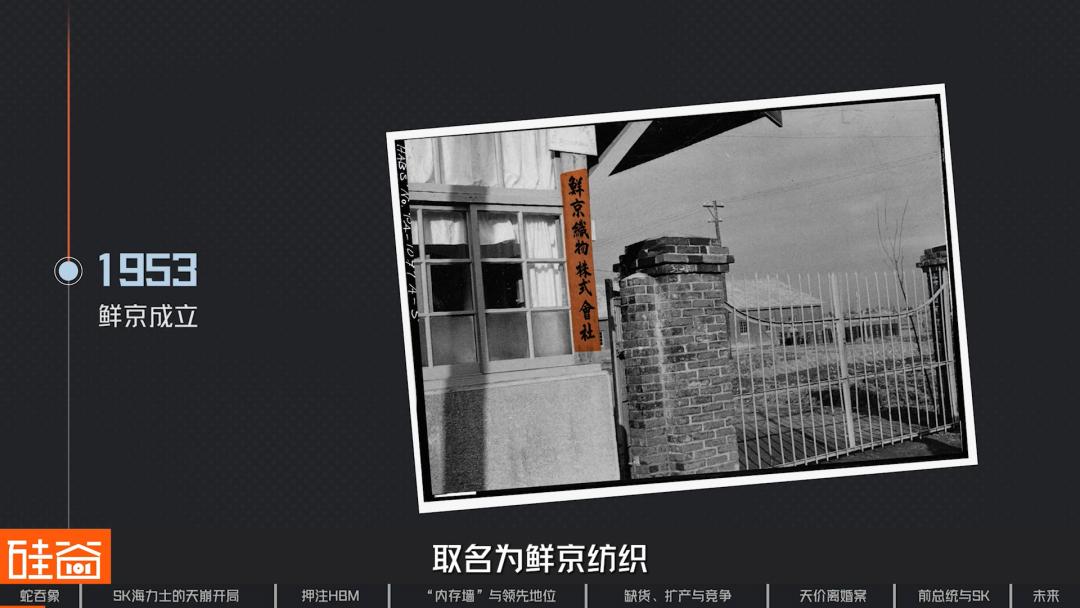
In 1953, founder Chey Jong-gun took over a dilapidated textile factory and named it Sunkyong Textile. When it was first founded, the entire factory only had a dozen textile machines, all reassembled from parts collected from the ruins of war. Its main business was producing semi-synthetic fiber, a raw material used for bedding at that time.
Over the next two decades, Sunkyong Textile began to expand vertically, completing vertical integration from fabric to finished products in the textile industry, and its main products shifted to synthetic fiber refined from petroleum. During this period, Sunkyong Textile acquired Sunil Textile, South Korea's second-largest textile enterprise at that time.
In 1980, Sunkyong completed the most important acquisition in the company's history, buying out Korea National Oil Corporation, South Korea's only state-owned oil refinery with a high degree of monopoly. South Korean media generally regard this acquisition as the most critical turning point for SK to transform from a textile enterprise into a top chaebol.
In 1994, Sunkyong took another step forward and acquired Korea Mobile Telecom, which was the only mobile communication operator in South Korea at that time, completely monopolizing the South Korean mobile communication market and owning the country's only mobile communication network.
Since then, Sunkyong had become a dual monopoly giant in two key sectors of energy and communication, bringing stable and huge cash flow every year, which became the capital for SK to bet big on semiconductors later.
If we analogize this to China, these two magical acquisitions are equivalent to a private textile raw material enterprise acquiring PetroChina and China Mobile one after another. How did Sunkyong accomplish this snake swallowing an elephant feat? We will discuss that later.
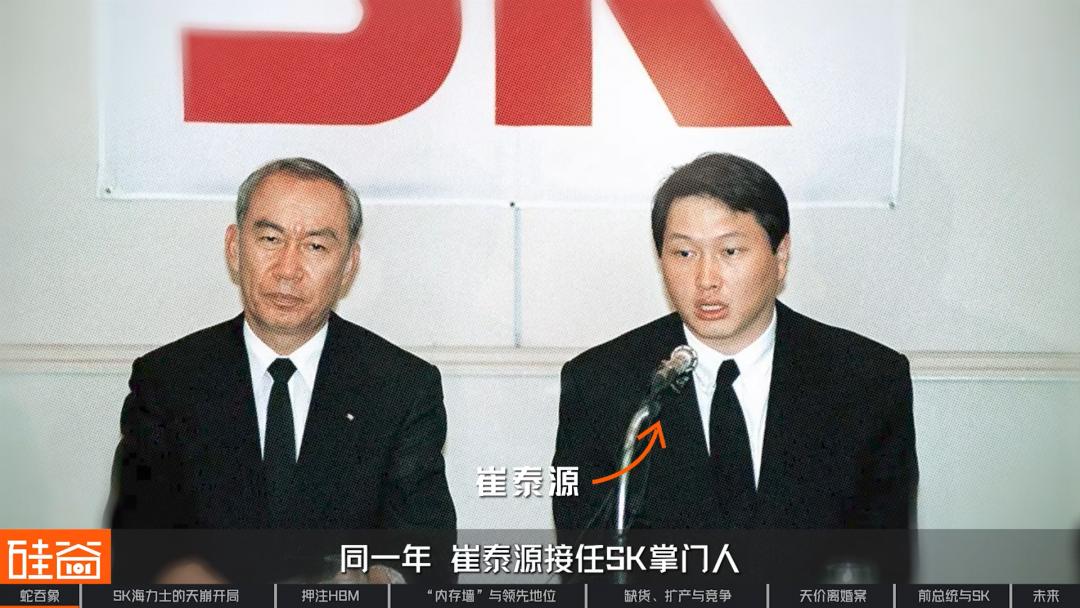
In 1998, Sunkyong Group officially changed its name to SK Group, with SK being the abbreviation of Sunkyong. In the same year, Chey Tae-won took over as the chairman of SK, a position he holds to this day.
Let us turn our attention temporarily to another South Korean chaebol: Hyundai.
In the 1980s, the South Korean government listed semiconductors as a strategic industry. State-controlled banks provided huge loans to the semiconductor industry, along with tax and investment incentives, to compete with the dominant Japanese enterprises at that time.
Against this background, Hyundai Electronics was founded in 1983. Over the following years, Hyundai Electronics built a DRAM mass production system from scratch.
In Chinese public discourse, chaebols seem to be omnipotent in South Korea, even presidents have to obey them. We will not discuss whether this is the case now, but it was definitely not like this during the South Korean military government era.
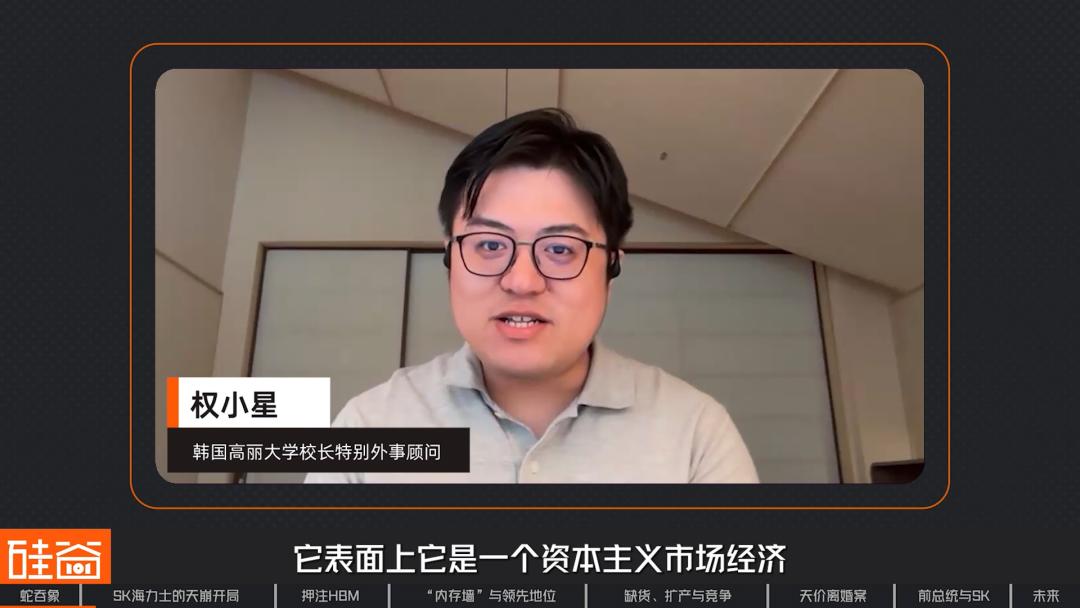
Kwon So-sung
Special Foreign Affairs Advisor to the President of Korea University
Why do we always say South Korea has a very special economic system? It looks like a capitalist market economy on the surface, but especially during the military government era, enterprises needed government support to rise.
In this era where administrative power trumped everything, the government could control the lifeblood of enterprises. There is even a classic case: during the Chun Doo-hwan era, there was a local chaebol called Kukje Group in Busan. When the government forced chaebols to make donations, Kukje was the least willing to contribute, which enraged Chun Doo-hwan. The company collapsed in just over 20 days.
Chaebols in this era were more like tools for the South Korean government to realize national will. The government allowed chaebols to control the lifeblood of the national economy, and in return, chaebols had to represent the country to participate in high-input, high-risk international industrial competition.
If chaebols just wanted to earn easy money, their best choice would be to monopolize factor industries like oil and telecommunications, and invest profits in the U.S. capital market, rather than entering the memory chip business. So before the AI boom, memory chips were never considered a good business.
Building factories, purchasing equipment, researching technology, training engineers all require huge capital investment. At the same time, before HBM emerged, memory chips were very standardized products, it was hard to achieve differentiation, which inevitably led to the cyclical nature of the memory industry. To even enter the game in the memory industry, you need extremely high capital expenditure in the early stage. When the industry is booming, you need to burn money to expand production; when the industry is in a downturn, you have to endure huge losses for "counter-cyclical investment", just to outlast your competitors.
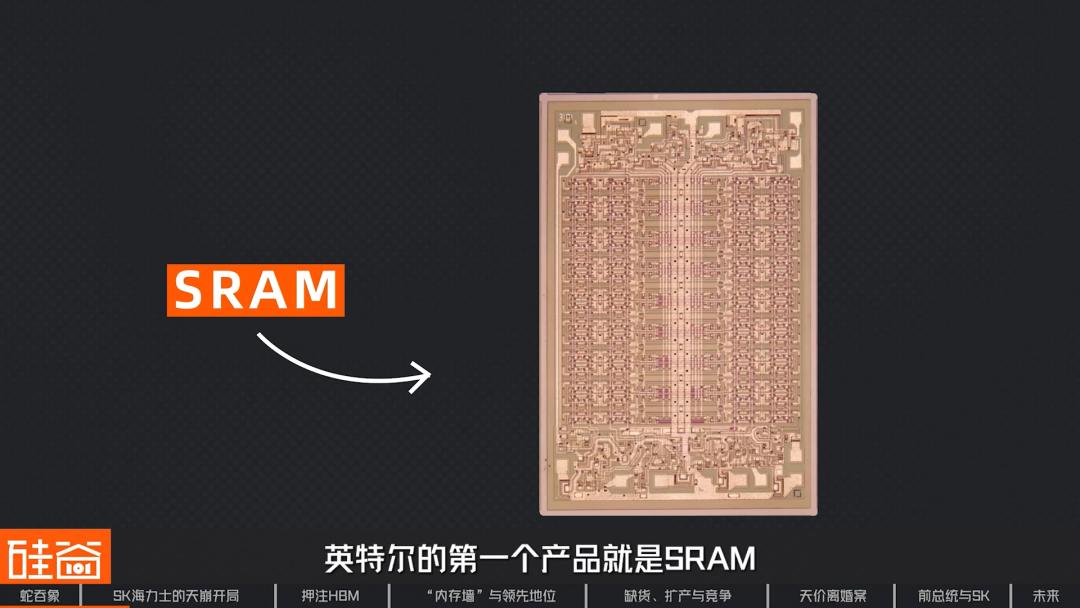
The early memory industry was dominated by American enterprises. Intel's first product was SRAM, and Intel also launched the first commercial DRAM product. But American enterprises focus on capital efficiency, pursuing high gross profit and product differentiation. After Japanese enterprises rose, Texas Instruments and IBM withdrew from the memory industry one after another.
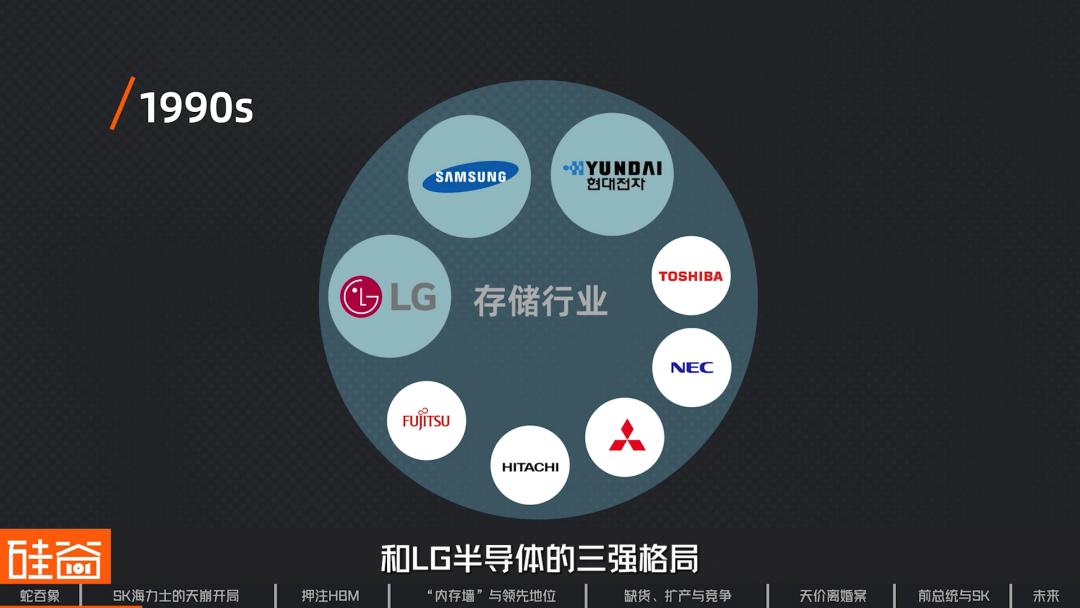
After American enterprises exited, the memory industry was dominated by five Japanese enterprises: NEC, Mitsubishi, Hitachi, Toshiba, and Fujitsu.
As latecomers, South Korean enterprises continued to invest heavily over the next decade, leveraging up to the maximum. Entering the 1990s, they began to continuously squeeze the market share of Japanese enterprises, forming a top three pattern of Samsung, Hyundai Electronics and LG Semiconductor. Back then, the players in the memory industry also included Infineon, split from Siemens, and Micron, the only remaining American player.
Starting from 1996, the memory industry experienced cyclical overcapacity and prices plummeted. Then in 1997, misfortunes never come singly, the Asian financial crisis hit, and South Korean enterprises with debt-to-asset ratios generally exceeding 300% faced huge crises.
As one of the conditions for accepting IMF aid, in 1998, the South Korean government forcibly pushed for the merger of Hyundai Electronics and LG Semiconductor. LG was unwilling at first, but the government threatened to cut off loans for the entire LG Group, and the presidential spokesperson even bluntly said that the merger would proceed no matter what.
Kwon So-sung
Special Foreign Affairs Advisor to the President of Korea University
The second-generation chairman of LG is Koo Bon-moo. After he passed away, I heard from LG insiders that the biggest regret of Koo Bon-moo's life was that LG Semiconductor was forcibly handed over to Hyundai. The building of the Federation of Korean Industries (FKI), which led this major merger, is located on Yeouido, it only takes five minutes to walk there from LG's Gemini Tower. But after this incident, Koo Bon-moo never went to the FKI building again until he died. Because he believed that LG's perennial lagging behind can be attributed to this merger, and he was expressing his dissatisfaction to FKI.
In May 1999, Hyundai Electronics completed the acquisition of LG Semiconductor for 2.1 billion US dollars. While it was already heavily indebted, it also inherited the huge debt of LG Semiconductor.
Unfortunately, the newly merged Hyundai Electronics encountered the burst of the dot-com bubble the next year, and memory prices crashed again. This time, Hyundai Electronics could not hold on any longer.
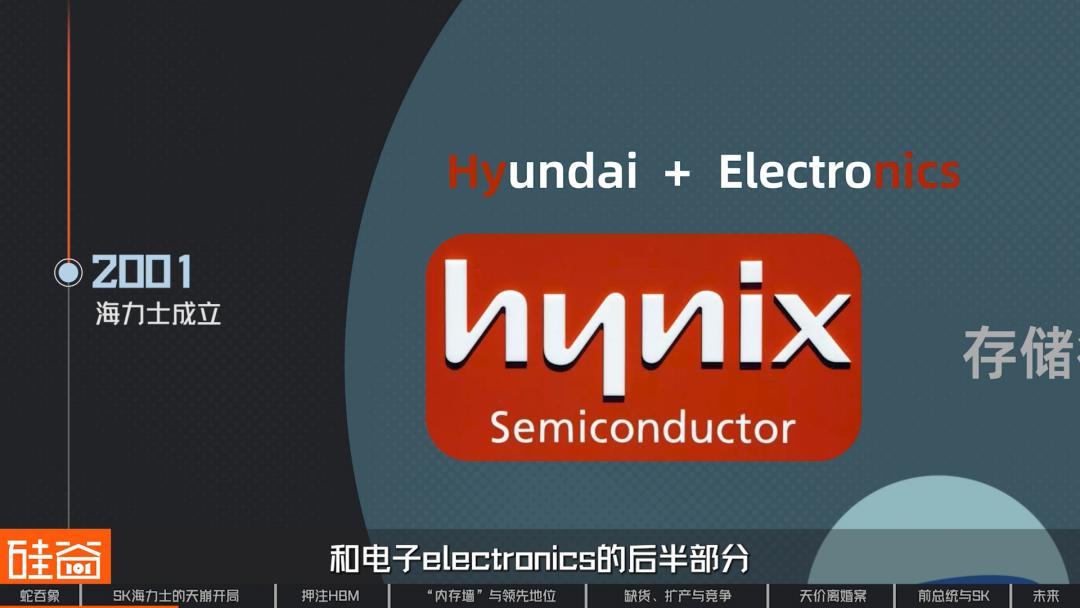
In 2001, Hyundai Electronics was split and renamed Hynix Semiconductor. Hynix comes from the first two letters of Hyundai and the last part of electronics, hence the name Hynix.
The newly established Hynix got off to a disastrous start. In November of the same year, Hynix, which was already seriously insolvent and had defaulted on debt multiple times, was taken over by a creditor bank consortium.
2002 was the most dangerous moment for Hynix as an independent company: Micron proposed to acquire Hynix through a stock swap.
At that time, this deal seemed like a win-win: creditor banks could offload bad assets, and if Micron acquired Hynix, it would eliminate a major competitor and expand its market share.
But Micron's acquisition offer was quite harsh. Micron did not offer cash, but about 100 million shares of Micron stock, worth about 2.9 to 3.4 billion US dollars at that time. Micron wanted Hynix's production capacity and market share, but did not want to inherit all of Hynix's debt, nor did it guarantee that all employees would keep their jobs. Micron even required creditor banks to continue providing new huge loans after the acquisition was completed.
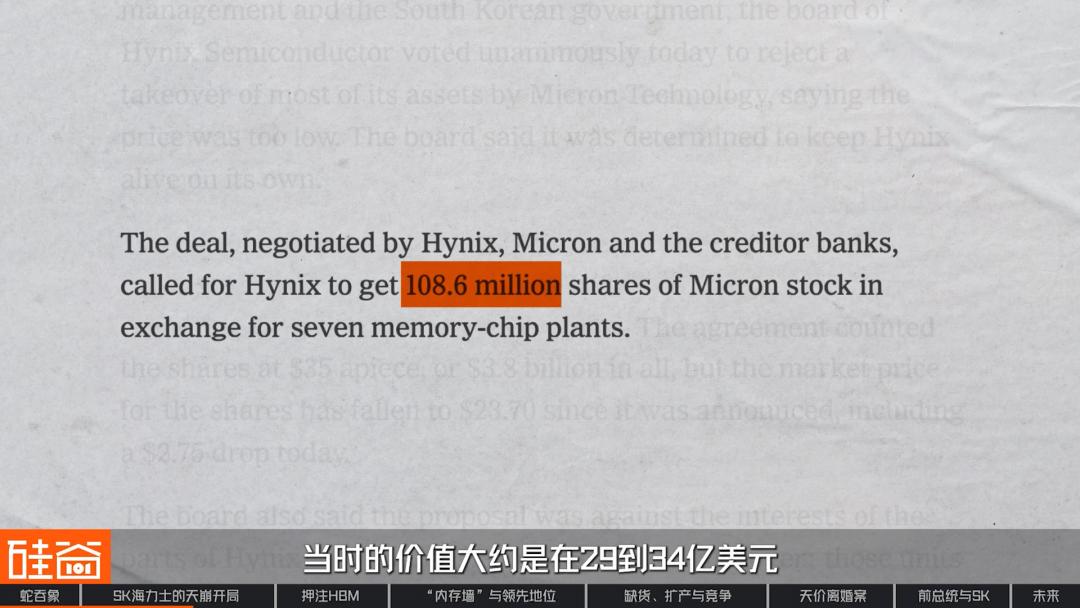
As expected, Micron's acquisition plan met strong opposition from Hynix's board of directors and trade union.
The board of directors reasoned that: the price offered by Micron is too low, and Micron's stock price fluctuates too much, so the stock swap payment method is not ideal. Micron only wants the core memory business, other business departments cannot survive after the acquisition. Moreover, DRAM prices have already started to rebound from the bottom, and the company has a chance to survive independently.
The Hynix trade union threatened that if the acquisition succeeded, they would launch a full strike. Semiconductor factories cannot be started or stopped at will. Once the factory shuts down, yield and equipment will be affected, and customers will also be scared away.
Although the creditor bank consortium agreed to the acquisition plan, it was rejected by the Hynix board of directors the next day, with all 10 directors voting against. Subsequently, Micron withdrew its acquisition of Hynix, and turned to trade litigation, accusing the South Korean government and creditor banks' bailout of Hynix constitutes subsidies, demanding that the U.S. government impose punitive tariffs on