The juice favored by the middle class doesn't even contain any fruit?
Juice lovers have been hit with another disheartening revelation.
Following the exposure that a certain line of NFC juice from a popular brand had water listed as the first ingredient on its label, NFC juice is now facing a new scandal. Recently, an undercover investigation by a media outlet into multiple juice contract manufacturers in Henan found that there were no fresh fruits or cold-pressing equipment in the workshops at all. The so-called "NFC juice" was actually made entirely by mixing water with concentrated puree.
Soon, multiple topics such as #NoFruitsInNFCJuice# became trending searches on Weibo.
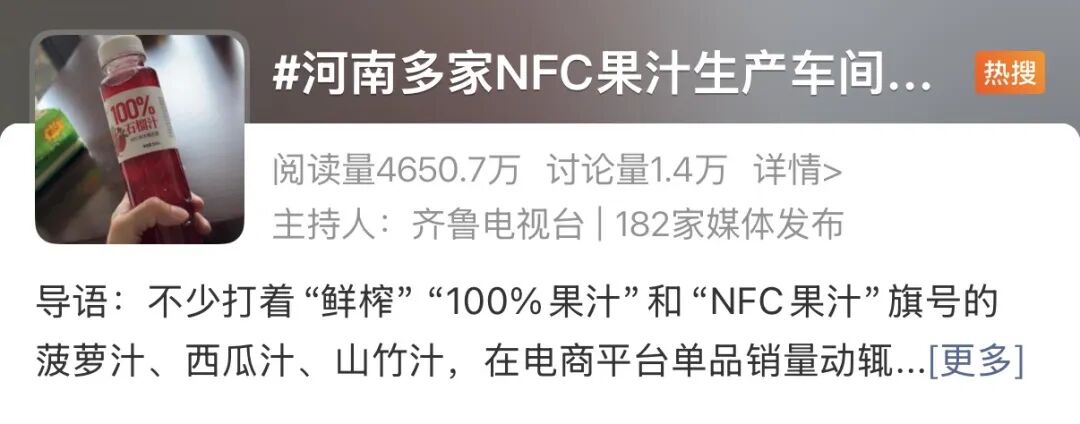
Image Source: Weibo
On July 16, the Luohe Municipal Government announced in a notice that among the 5 involved enterprises, Henan Zanyang Beverage Co., Ltd. and Luohe Shennong Biotechnology Co., Ltd. are suspected of false labeling, and legal cases have been filed against them to recall all non-compliant products; the remaining 3 enterprises are under in-depth investigation.
In the past two years, NFC juice has thrived with labels such as "cold-pressed, 100% pure juice, no additives": brands like Nongfu Spring, Huiyuan, Weichuan, and Zero Fruit Farm have all entered the market, while instant retail platforms such as Freshippo and Sam's Club have also launched their own private-label products. On Xiaohongshu, the #NFCJuice# topic has accumulated up to 170 million views.
However, the glossy facade shattered quickly. As more and more NFC juice products were exposed and called out for fraud, consumers complained: "There isn't even any fruit in the juice. Who would dare to pay for NFC juice anymore?"
Low Price and Cold-Pressed Freshness Cannot Coexist
There is an invisible hierarchy in the juice industry: from regular juice drinks, FC juice, NFC juice to HPP juice.
Among them, regular juice drinks are mostly made with water, sugar, and other additives as their base.
FC juice (From Concentrate) is produced by first squeezing the fruit, then concentrating and dehydrating the juice, and adding water to restore it after transportation, during which the flavor and nutrition will be partially lost.
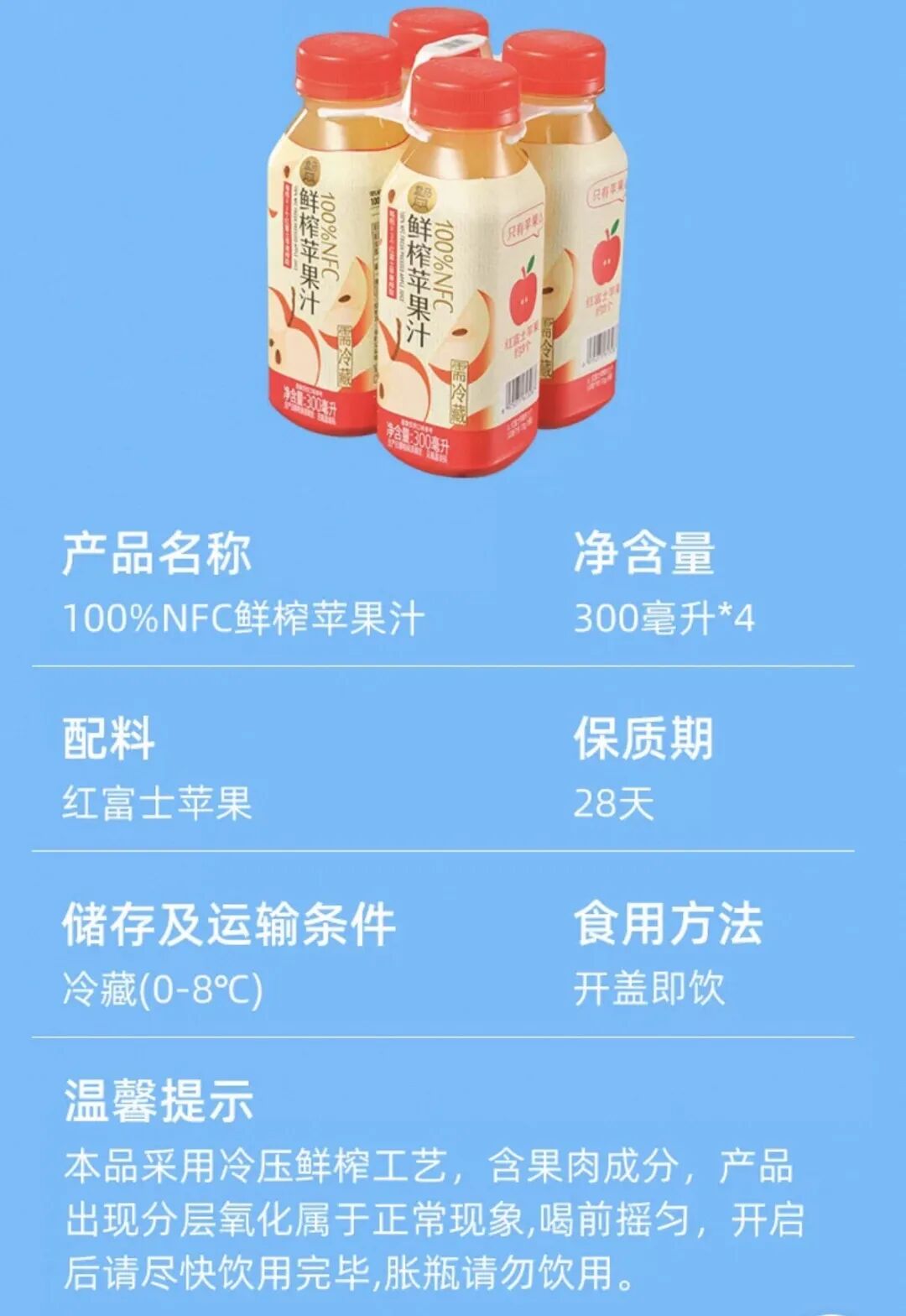
Ingredient list of common NFC juice | Image Source: Freshippo
NFC juice, on the other hand, is produced by washing fresh fruits, pressing out the juice, performing instant sterilization, and then directly bottling it, without any concentration or reconstitution process. HPP (High Pressure Processing) takes it a step further by using ultra-high pressure instead of high temperature for sterilization, to preserve the flavor and nutrition of freshly pressed juice as much as possible.
This means that the cost of NFC juice is inherently higher than that of FC juice and regular beverages.
According to our understanding from *Interesting Report*, NFC juice has high requirements for the ripeness and freshness of fruits, and the entire transportation process requires cold chain, leading to a short shelf life, high product loss, and overall high transportation cost. In contrast, FC juice has low requirements for fruits, and its storage and transportation costs are relatively lower.
A juice merchant revealed that to ensure the quality of NFC juice after delivery, they always pack the products in insulated foam boxes with ice packs before shipping, and remind customers to refrigerate the juice immediately upon receipt.
"Overall, the total cost of FC juice is at least 50% lower than that of NFC juice," Lin Yue, Chief Consultant of Lingyan Management Consulting, told *Interesting Report*. According to industry estimates, the raw material and cold chain cost for a 300ml bottle of NFC juice is usually more than 5 yuan.
This also determines that the retail price of genuine NFC juice is very difficult to be lowered.
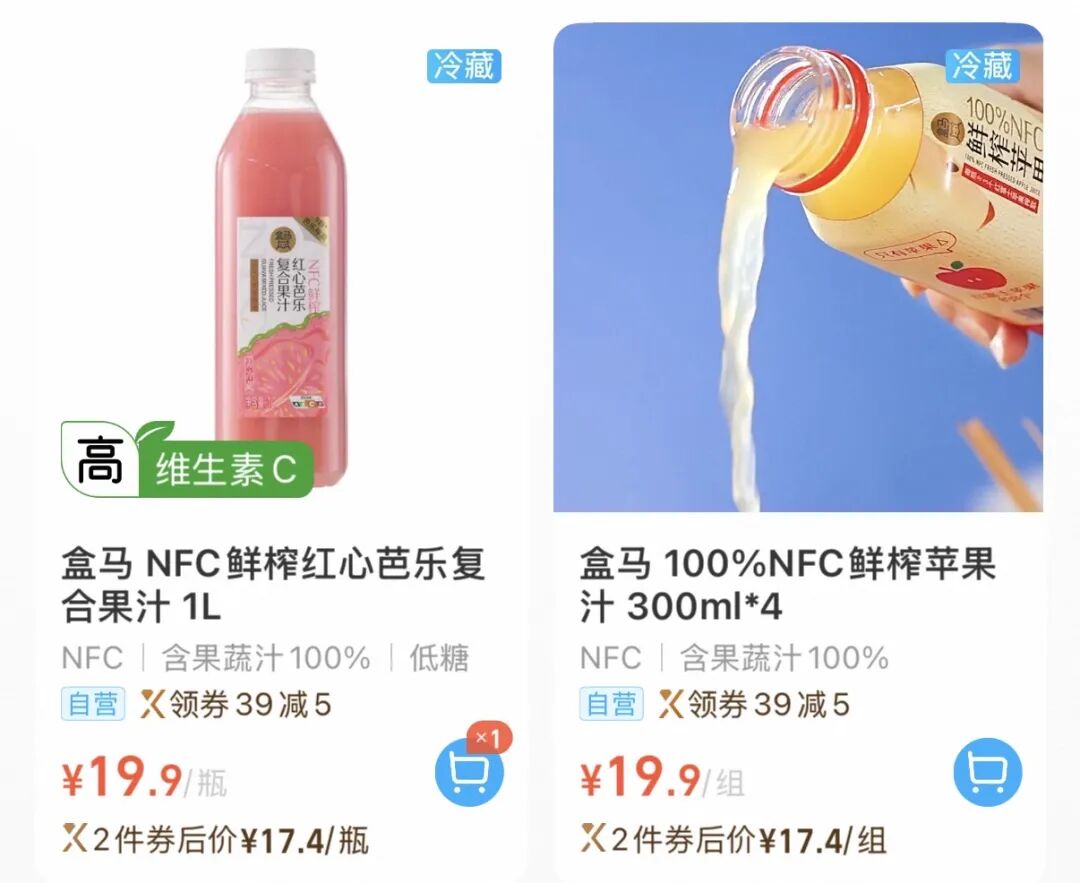
Image Source: Freshippo
According to the query from *Interesting Report*, a 1L bottle of NFC cold-pressed red guava blended juice from Freshippo is priced at 19.9 yuan; the 300ml NFC juice products of brands such as Nongfu Spring and Weichuan in offline supermarkets are priced between 7 yuan and 9 yuan. However, on e-commerce platforms, many juice products labeled as NFC are priced at only 2 to 3 yuan per 255ml, showing a significant price gap.
A manufacturer confessed to the undercover media: "Products sold at such low prices can never be made from freshly pressed fruits."
For this reason, many adulterated, fraudulently labeled, and borderline "NFC juice" products have entered the market to cut costs and earn profits.
Why Are These Chaotic Behaviors Rampant?
The reason why these fraudulent practices are so prevalent essentially stems from two major shortcomings in the industry.
First, there is currently no clear and mandatory national standard for NFC juice.
Zhu Danpeng, a food and beverage industry analyst, told *Interesting Report* that NFC juice currently follows the recommended national standard of "Fruit and Vegetable Juices and Their Beverages" (GB/T 31121-2014), rather than a mandatory standard. Although the standard defines the concept of NFC juice, it does not specify its production process, nor does it set a minimum required proportion of NFC juice content.
As a result, many borderline operations have emerged in the market. For example, some products are made by adding water to reconstitute concentrated juice, but they still claim to be NFC juice; other products only add a tiny amount of NFC juice to the total juice content, yet use labels such as "NFC+" or "Contains NFC" on the packaging to charge a premium.
Previously, according to a report by Red Star News, a grape blended juice product from Arctic Ocean that claimed to contain NFC juice showed that the added NFC grape juice content was only 0.005%, which was ridiculed by netizens as "the NFC content in a bottle of juice is even less than a drop of water".
On the other hand, the cost of violating the regulations is not high.
Lin Yue said that the current penalties for enterprises that violate laws and regulations are not severe. Some enterprises can change their names and move to another location to restart their business after being punished, and continue to take risks under the assumption that "many consumers cannot tell the difference". Retailers also lack awareness of the issue, and most of them choose to turn a blind eye to these borderline products to obtain low-cost supply.
Some of the involved enterprises in Henan this time have been punished multiple times in the past. Tianyancha data shows that Henan Aizaozao Food Co., Ltd. was fined more than 110,000 yuan in June this year for labeling "100%" prominently on the product package even though its birch sap, pineapple juice, and cherry juice products were not 100% "fruit and vegetable juice", and the ingredient lists did not truthfully reflect the actual raw materials used.
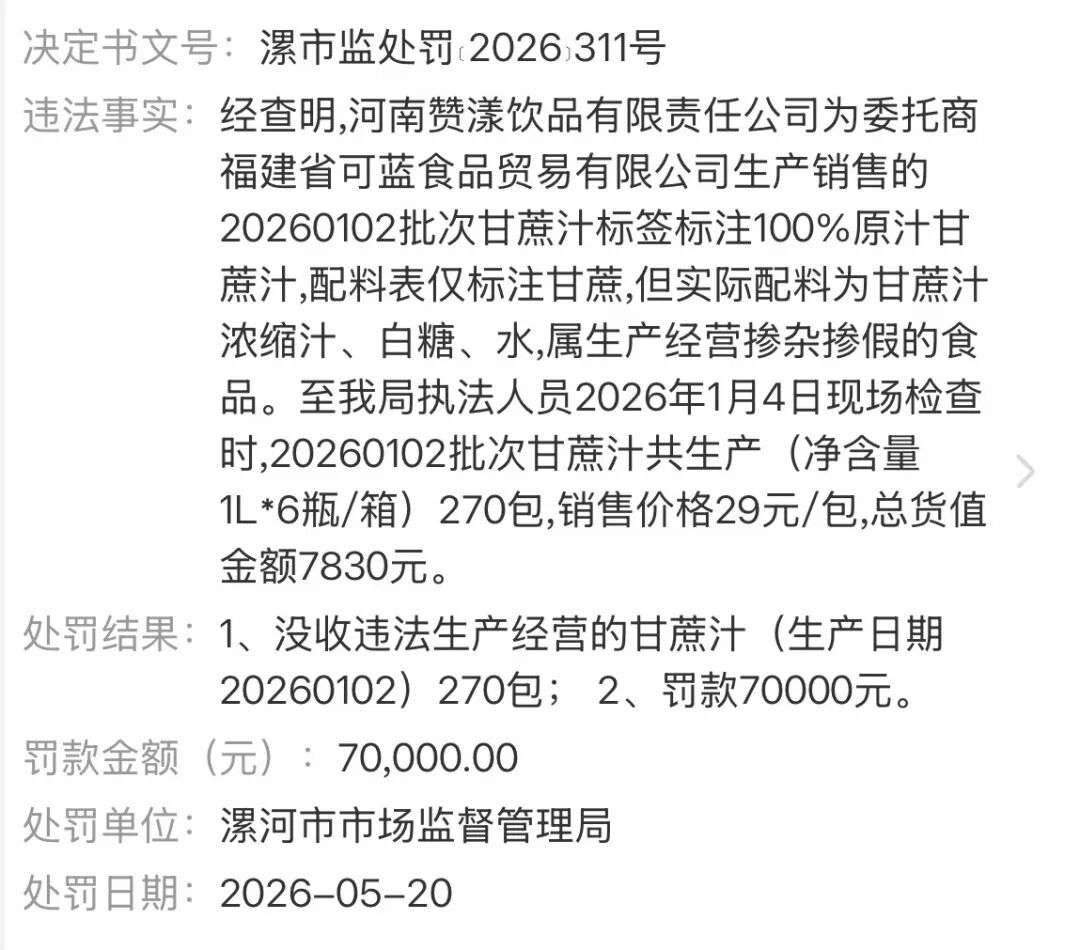
Image Source: Tianyancha
Henan Zanyang Beverage Co., Ltd. was also punished twice in May this year, with a total fine of 107,000 yuan, involving non-compliant products such as its 100% grape juice, apple juice, and sugarcane juice.
In the long run, these chaotic behaviors will cause a huge impact on the entire NFC juice industry.
Liu Yingying, an office worker in Beijing who has purchased NFC juice many times, revealed that she originally chose NFC juice as a substitute for bubble tea — she wanted something tasty, sweet, and made from 100% freshly pressed fruits without any additives. Whenever she passed by a convenience store on her way, she would always buy two bottles of juice on impulse.
But now, she no longer buys NFC juice: "Instead of spending a lot of time studying the ingredient lists to figure out which ones are real and which ones are fake, it's much easier to just not buy any of them at all."
Liu Yingying's thought represents the voice of many consumers. Lin Yue pointed out that there are too many low-quality, counterfeit, and cheap blended products on the market, the concept of NFC has been "ruined", the high-end premium attribute has been broken, and consumers no longer know who to trust. Rebuilding this trust will require a huge amount of effort.
He added that many inferior products seize the market by selling at low prices and focusing on cost-effectiveness. Their existence squeezes the living space of enterprises that have been strictly adhering to production process standards for a long time, reducing the survival space of high-quality products, leading to a decline in the overall quality of industry supply, and even endangering the development of the entire industry.
Zhu Danpeng holds a similar view: "These frequent chaotic behaviors not only harm the rights and interests of consumers, but also erode the credibility of the entire product category."
It is worth noting that the "Food Label Supervision and Administration Measures" issued by the State Administration for Market Regulation will be officially implemented in March 2027, which clearly stipulates that the labels of pre-packaged food must not deceive or mislead consumers.
"The introduction of the new regulation can specifically address the current loopholes and curb the occurrence of illegal and non-compliant behaviors at the institutional level," Zhu Danpeng said.
At present, the top priority is to clearly define the regulatory boundaries, strengthen supervision and penalties. Otherwise, when NFC is reduced to a mere marketing gimmick, the "cold-pressed freshness" facade will be completely shattered, and it will be impossible to win back consumer trust.
Author: Gao Yue
Editor: Andy
Duty Editor: Liwu
This article is from WeChat Official Account "Interesting Report", written by Gao Yue, and authorized for release by 36Kr.