What else is real when "NFC juice" contains no actual fruit?
"There isn't a single box of fruit in the workshop."
When reporters from Shandong Radio and Television Station delved into multiple contract manufacturing facilities in Henan, they found no fresh-fruit-scented production lines, but rows of plastic buckets and concentrated puree. The so-called "cold-pressed fresh fruit juice" is entirely blended from water and concentrated puree.
The manufacturers were even candid: "You cannot get real freshly squeezed juice at rock-bottom prices."
Soon, the topic of "No fruits in NFC juice production workshops, products blended from puree" topped trending search lists, sparking widespread public outrage among internet users.
But this is far from the first time the NFC juice category has faced a public trust crisis.
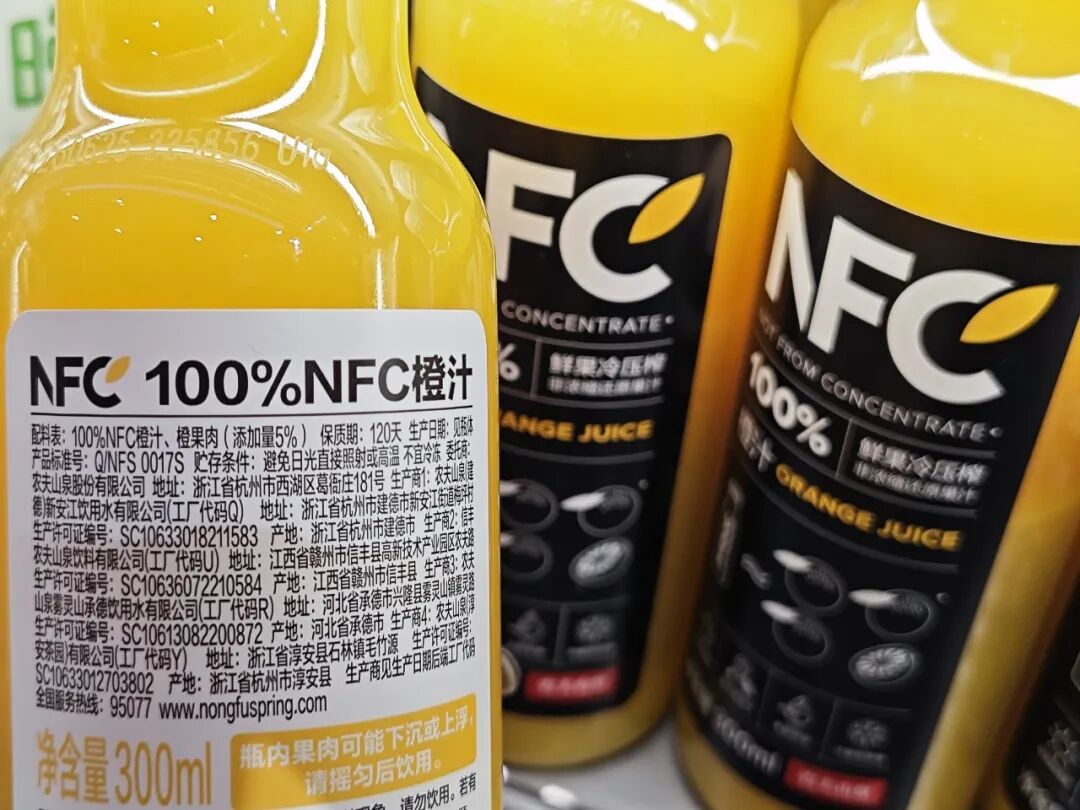
Back in May this year, the CCTV program *Oriental Horizon* exposed widespread labeling irregularities in the juice industry. The report noted that a juice product from the snack brand "Haoxianglai" prominently printed "NFC Not From Concentrate" on its outer packaging, yet the first two ingredients listed on its label were water and concentrated juice, with the actual NFC raw juice content being extremely low. Many commercially available products labeled as "added with NFC juice" contain barely a trace of NFC content, with some as low as a few parts per hundred thousand.
The three letters "NFC" are being completely gutted of their original meaning.
△ Photo source: Food & Beverage Supply Chain Guide
Meanwhile, the overall market for this category continues to expand. According to data from Frost & Sullivan, the size of China's juice market reached approximately 158.4 billion yuan in 2024. Among this total, pure juice (including both FC and NFC types) accounts for roughly 23% of the entire juice market. It is projected that from 2024 to 2029, the compound annual growth rate of China's juice market will remain at a low single-digit level, while the growth rate of the pure juice segment is expected to reach nearly 10%, significantly outpacing the industry average.
In reality, most consumers still cannot tell the difference between NFC and FC juice. A category that lacks unified national standards is already flooded with "cold-pressed fresh fruit" products priced as low as 9.9 yuan per liter. Fierce price wars are raging across the market, even as the very foundation of the industry quietly begins to crumble.
The Rise and Fall of a Bottle of "Real Juice"
NFC juice is by no means a new concept.
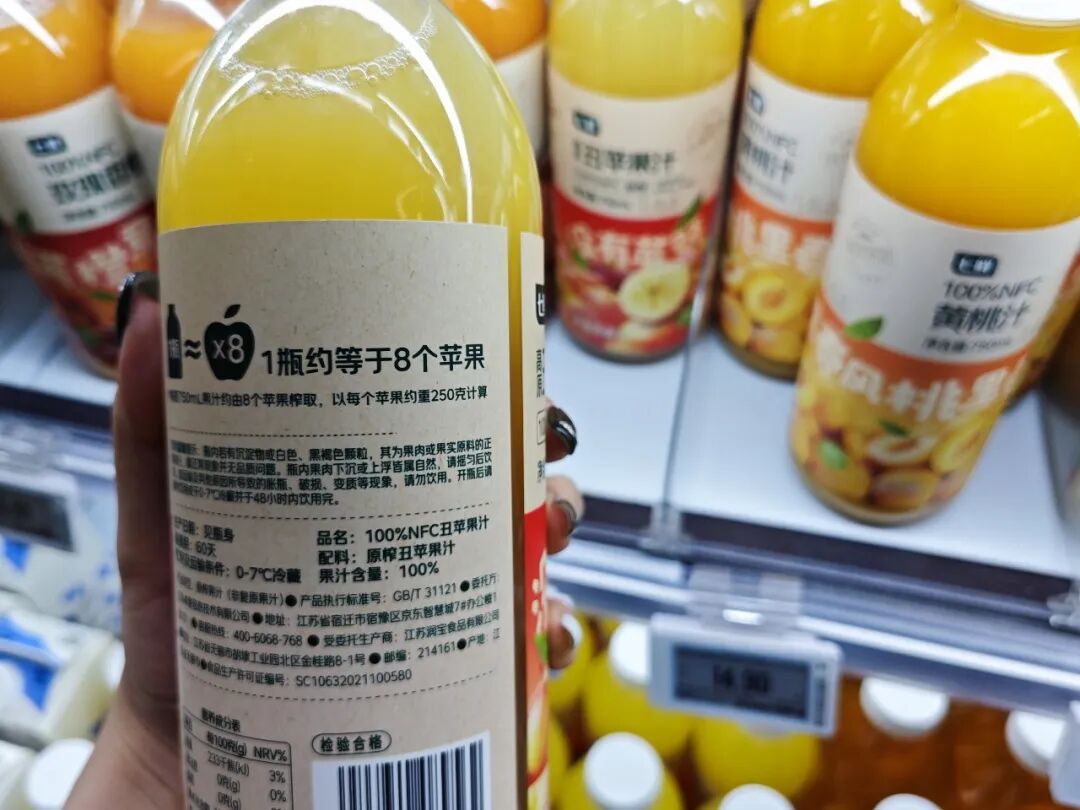
The term NFC is short for "Not From Concentrate", meaning juice that has not been reconstituted from concentrate. Per the national standard *Fruit and Vegetable Juices and Their Beverages*, it refers to juice made directly from fresh fruit via mechanical extraction methods without any concentration process. Its ingredient list can only contain fruit or juice, with no allowed additions of water, concentrated juice, or food additives of any kind.
△ Photo source: Food & Beverage Supply Chain Guide
The corresponding FC category, by contrast, refers to "From Concentrate" juice — produced by first concentrating juice and then reconstituting it with added water. Both NFC and FC products can meet the 100% juice standard, but their production processes and associated costs are drastically different.
LIAO Xiaojun, Dean of the College of Food Science and Nutritional Engineering at China Agricultural University, once explained that in 2004, the establishment of Chongqing Pusenbai company marked the launch of China's very first bottle of NFC orange juice, officially ushering in the inaugural year of China's NFC fruit and vegetable juice industry.
However, NFC juice only truly entered the mainstream public consciousness after 2011.
That same year, Shanghai Jiajun Beverage launched its "Zero Degree Fruit Workshop" series of NFC fruit and vegetable juices. Shortly thereafter, Zero Degree Fruit Workshop became one of the early industry pioneers to implement the "Five Zeros Standard" for NFC juice: zero additives, zero added water, zero added sugar, low-temperature storage and cold chain transportation at 0-6°C, and 100% fresh-pressed with no reconstitution.
In 2015, Huiyuan launched its "Fresh Press Workshop" NFC fruit and vegetable juice series; in 2016, Nongfu Spring 17.5° NFC juice hit the market. According to data provided by SUN Jun, founder of Zero Degree Fruit Workshop, more than 30 NFC juice brands once flooded the market at that time.
As more and more large established brands entered the sector, NFC juice gradually expanded from niche professional circles to reach ordinary consumers. Yet during the same period, the rise of modern tea drink chains left NFC juice at a disadvantage in terms of product innovation and pricing, pushing the industry into a volatile shakeout phase where many small and medium-sized enterprises were eliminated from the market.
A major turning point arrived after 2020. As consumers' health awareness fully awakened, they began to carefully scrutinize ingredient lists when making purchases. "No additives, all-natural, minimally processed" became the new purchasing logic, and NFC juice perfectly aligned with this consumer demand. At the same time, the widespread rollout of cold chain networks, the gradual popularization of HPP high-pressure cold sterilization technology, and the rise of direct sourcing models from upstream producing regions further drove the development of the NFC juice market.
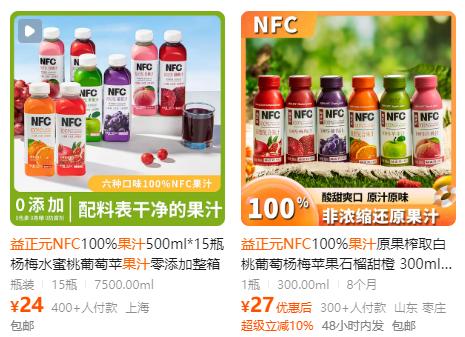
Also starting from 2020, Yizhengyuan — an enterprise that originally grew rapidly riding the lactic acid bacteria beverage trend — fully pivoted its business to the juice sector, positioning itself to focus on "affordable NFC juice". Leveraging a full industrial chain model of "upstream direct sourcing + self-built factories", the company successfully brought the price of NFC juice below 10 yuan. In 2025, Yizhengyuan's total sales volume exceeded 500 million yuan.
△ Screenshot from an e-commerce platform
During this period, as an early market cultivator, the parent company of Zero Degree Fruit Workshop — Luyuan Biological — also developed into a prominent NFC juice contract manufacturer, providing OEM production services for retail channels such as Freshippo.
The emergence of the OEM model allowed new market entrants to bypass the exorbitant costs and complex technical barriers associated with building their own production facilities. At the same time, mature OEM capabilities enabled retailers to launch high cost-performance private label products. This gave a group of cross-industry players the confidence to test the waters in the NFC juice sector. Over the past few years, tea brands including Heytea and Nayuki have successively launched bottled NFC juice products, seeking to unlock a second growth curve in the packaged beverage market.
NFC juice has thus completed its transformation from an "exclusive product" found only in premium supermarkets to a mainstream consumer staple. It has become increasingly ubiquitous in neighborhood restaurants, chain supermarkets in commercial districts, livestream shopping platforms, and community group buying lists.
Yet beneath this bustling surface, industry irregularities have never ceased.
When Standards Lag Behind, Counterfeiters Step In
The industrial chain barriers for NFC juice are far higher than most people realize.
Genuine NFC juice follows an extremely short full-process chain from orchard harvesting to pressing and bottling. After fresh fruits are harvested, they must undergo cleaning, pressing, sterilization, and bottling within just a few hours. This places extremely high demands on cold chain transportation and storage, resulting in a typically short shelf life of 20 to 40 days. Even with aseptic cold bottling technology, the maximum achievable shelf life is only 6 months. Any oversight at any stage of the process can lead to the entire batch of products being discarded.
This explains why in the early days, only companies with fully integrated supply chains such as Nongfu Spring, Zero Degree Fruit Workshop, and Huiyuan were able to establish a solid foothold in this sector.
Yet the inherent value of the three letters "NFC" gets easily diluted in the face of commercial traffic and hype.
The most common trick is playing word games.
Manufacturers print oversized, bold "NFC" and "100% Cold-Pressed from Fresh Fruit" on the front of bottles, placing these premium-sounding concepts in the most immediately visible position. Meanwhile, critical fine print disclaimers such as "with a small amount of added NFC raw juice" or "formulated from concentrated juice" are shrunk down to tiny font sizes and tucked away in inconspicuous corners on the side of the bottle. Most consumers only notice the prominent "100% NFC" labeling and rarely take the time to carefully examine the full ingredient list.
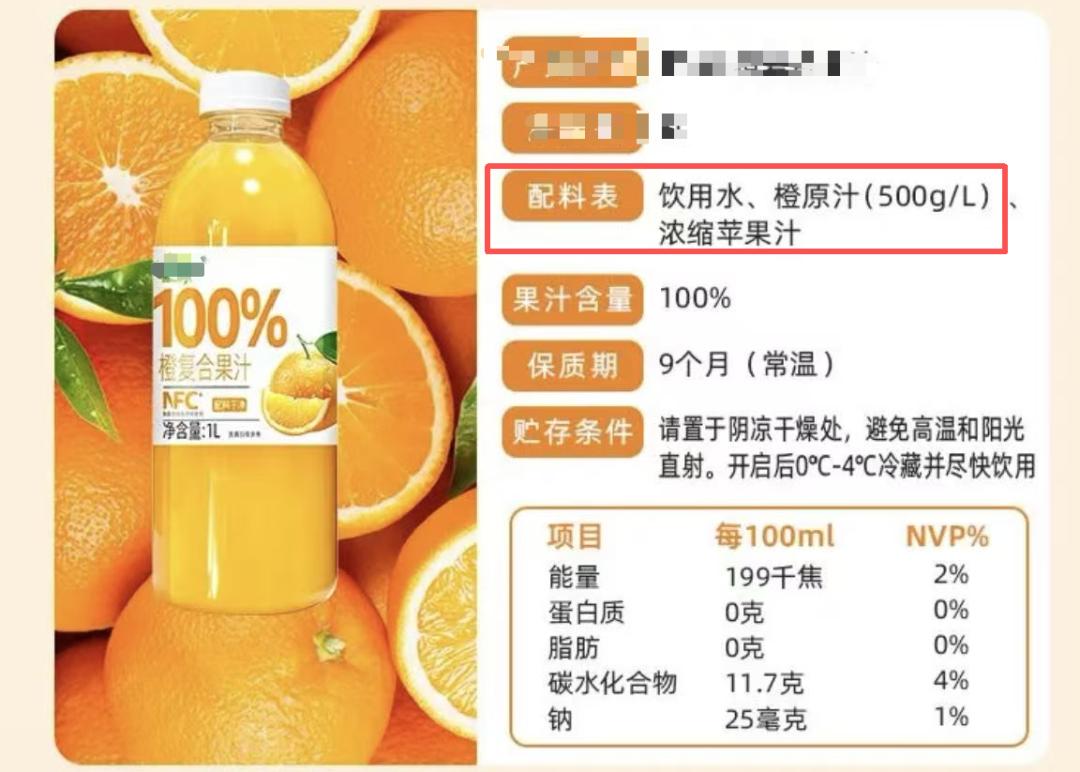
There are even more covert tactics: manufacturers add an almost invisible "+" sign next to the NFC logo, advertising the product as NFC juice on the surface, while a close inspection of the ingredient list reveals that water and concentrated juice remain the main components.
△ Screenshot from an e-commerce platform
Some merchants and salespeople claim that "NFC+" means the product has added pure NFC juice. However, industry experts point out that the "NFC+" classification does not exist in official juice categorization systems at all, and it is nothing more than a pure marketing gimmick.
There are even more extreme cases, just like the ones exposed in this latest undercover investigation: there are not even any fruits present in the production workshops.
In the production areas of multiple contract manufacturing facilities in Henan, there are no fresh fruits at all, nor any equipment for fresh fruit cleaning or mechanical pressing. The so-called "cold-pressed fresh fruit juice" products are entirely blended from water and concentrated puree.
According to a report from Qilu Channel of Shandong Radio and Television Station, the shelves of Luohe Weichun Food and Beverage Co., Ltd. are lined with a wide variety of juice samples, including apple, pomegranate, lychee, and grape juice, covering every conceivable flavor. In addition to its own private label products, the company also handles OEM production for brands such as Yiteng and Zhijue, with staff openly admitting "it's just a matter of sticking a label on". Personnel from Luohe Shennong Biotechnology Co., Ltd. also stated that customers can freely customize their own branded products through OEM arrangements.
After conducting research via the Food & Beverage Supply Chain Guide, we found that Henan Aizaoqi Food Co., Ltd. — one of the exposed manufacturers — was fined more than 110,000 yuan back in June this year for intentionally labeling products with a prominent "100%" claim on their packaging, even though their birch sap, pineapple juice, and cherry juice products were not 100% fruit and vegetable juice as advertised.
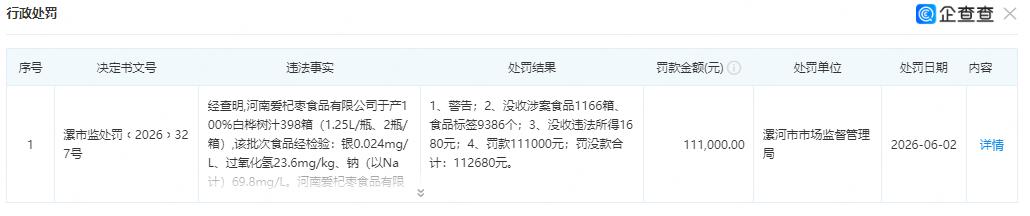
△ Penalty information displayed on Qichacha
Another exposed enterprise, Henan Zanyang Beverage Co., Ltd., was penalized three separate times in May this year, with total fines amounting to 144,000 yuan.
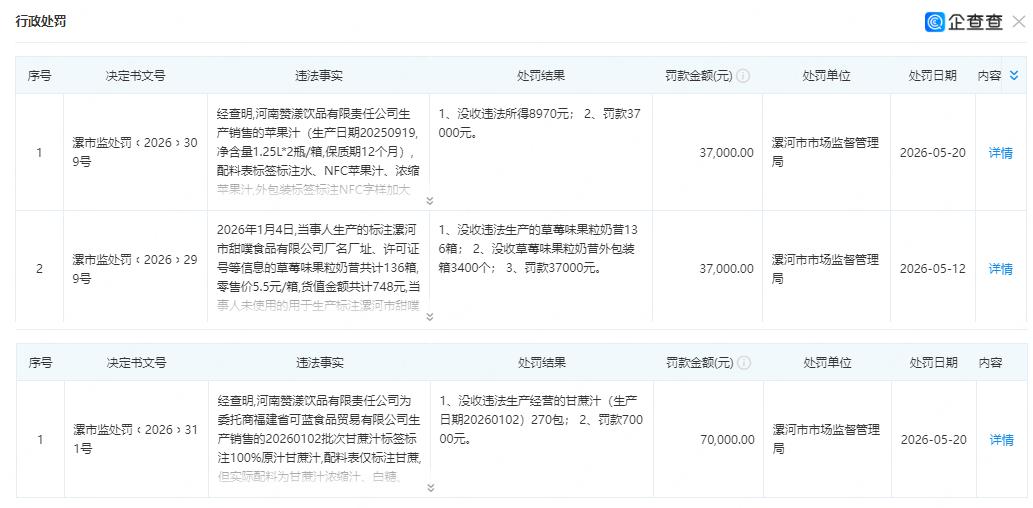
△ Penalty information displayed on Qichacha
It is abundantly clear that previous penalties have done nothing to stop these counterfeit operations. Undercover footage shows that even after these enterprises were ordered to suspend production for rectification, their related products remained available for sale online, and some product outer packaging labels had not been modified at all.
Beneath this chaotic quality landscape lies a complete vacuum at the standard-setting level.
Currently, there are no unified national or industry standards governing NFC juice processing. The only existing relevant standard — the "Not From Concentrate Orange Juice" (QB/T 5627-2021) — specifies technical requirements exclusively for NFC orange juice, while all other juice categories such as apple and grape juice still lack unified regulatory specifications.
Certain industry associations and organizations have released their own association-level group standards for NFC juice. While these group standards are more targeted in some aspects, they are typically only applicable within their respective member organizations or local regions, with very limited binding force.
As a result, two bottles of juice both labeled "NFC" could represent completely different realities: one could be directly pressed from fresh fruit, the other reconstituted from concentrated juice and water, and the third could be FC juice with merely a single drop of NFC raw juice added. Consumers have no way to tell the difference, and regulatory authorities also face major challenges in enforcing oversight.
Furthermore, as brands like Yizhengyuan popularize "affordable NFC" products, consumers' purchasing mindsets are shifting. They tend to prioritize low prices and the vague concept of "real juice", paying little attention to which brand the product comes from. This creates a very practical problem: as soon as a competing product with a similar formula and an even lower price enters the market, consumers can easily be lured away.
When the Food & Beverage Supply Chain Guide searched for "9.9 yuan 1-liter NFC juice" on e-commerce platforms, we found a large number of products available for sale, with individual SKUs such as apple juice, peach juice, and grape juice recording hundreds of thousands of units in sales. Calculated backward based on the actual supply chain costs of producing genuine NFC juice — including fresh fruit procurement, cold chain freshness preservation, aseptic bottling, and distribution for short-shelf-life products — this price point alone is a highly suspicious red flag.
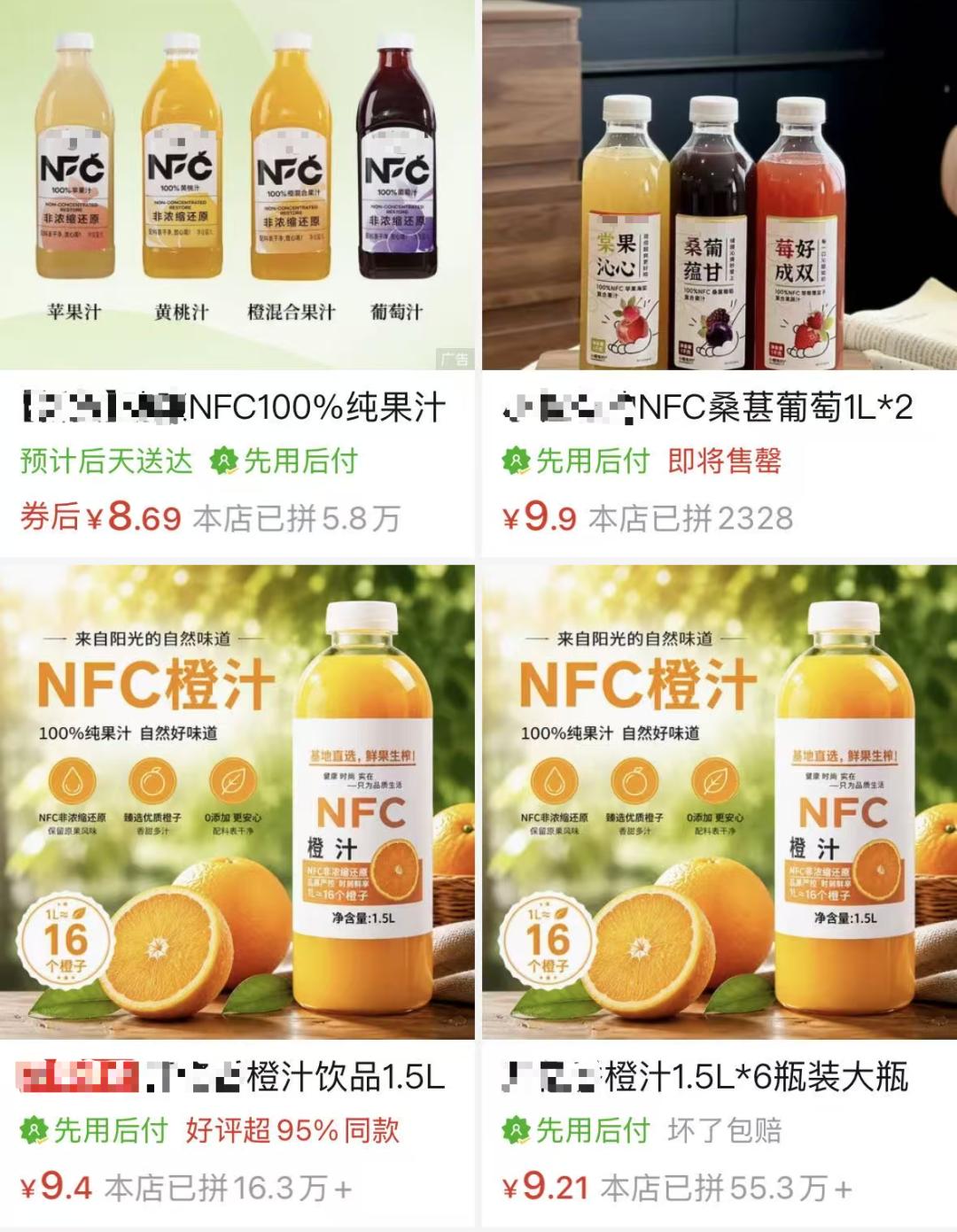
△ Screenshot from an e-commerce platform
At the end of the day, most consumers do not even know what authentic NFC juice is supposed to taste like, making it extremely difficult to assess quality differences through flavor alone. When the