With performance exploding, why aren't brokerages thriving yet?
On July 3, Cathay Haitong became the first brokerage to disclose its H1 2026 preliminary performance announcement, with results that could only be described as "explosive." Subsequently, leading firms including CITIC Securities, GF Securities, Huatai Securities, and China Merchants Securities followed suit, all joining the "10-Billion-Yuan Net Profit Club."
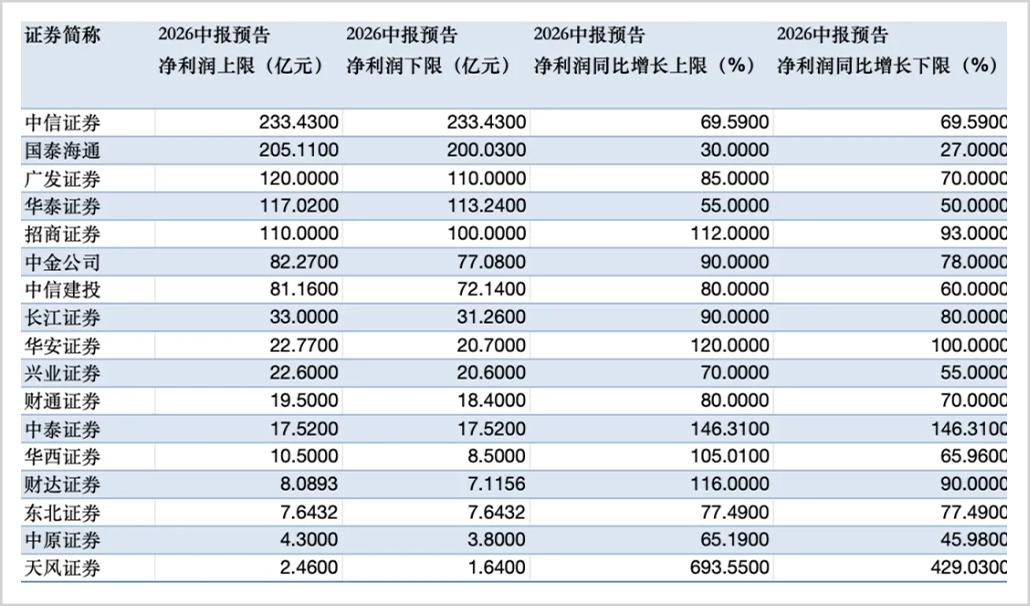
▲ Brokerage H1 Preliminary Performance Announcements (as of July 16), Source: Wind
Multiple brokerages reported sharp sequential and year-over-year profit growth in the second quarter, confirming the sector's strong prosperity amid the active A-share market. Coupled with low PB valuations, could the brokerage sector stage a recovery in the second half of the year?
Profit Surge Doubled
Following the merger of Cathay and Haitong, the combined entity has ranked first in China across multiple dimensions including total assets, net assets, brokerage market share, margin trading business, and IPO pipeline. Its revenue and net profit still slightly trail CITIC Securities, but the gap has been gradually narrowing since 2026.
In H1 2026, Cathay Haitong reported attributable net profit of 20-20.5 billion yuan, representing a 27%-30% year-over-year increase. On a non-GAAP attributable net profit basis, the figure surged 164%-171% year-over-year.
Breaking down the results, Q2 alone generated attributable net profit of 13.6-14.1 billion yuan, up 290%-304% year-over-year, marking the highest quarterly profit in the company's history.
Cathay Haitong's performance explosion stemmed from two core drivers. First, active capital market trading drove rapid growth in traditional businesses such as brokerage commissions and net interest income, a trend widely shared across the brokerage sector.
In H1, the A-share market recorded an average daily trading volume of 2.74 trillion yuan, nearly doubling year-over-year. Looking back at history, average daily turnover was only over 800 billion yuan in 2020, 2022, and 2023, slightly above 1 trillion yuan in 2021 and 2024, and rebounded strongly to 1.66 trillion yuan in 2025. This year's figure has climbed even higher, closely tied to the market's sustained upward trend.
Notably, after the merger of Cathay and Haitong, its brokerage market share rose significantly to 8.56% in 2025, ranking first in the market.
The margin trading business also saw explosive growth. As of June 30, the A-share margin trading balance reached 2.9971 trillion yuan, compared with under 2 trillion yuan in the same period last year.
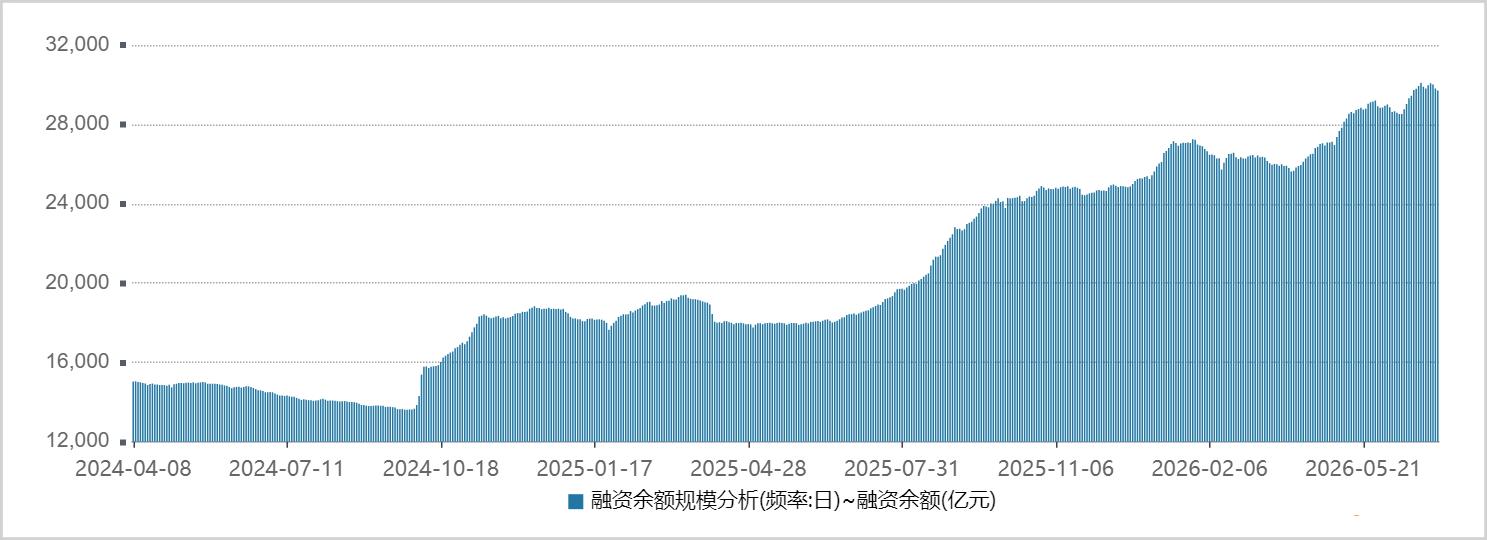
▲ A-Share Margin Trading Balance Trend, Source: Wind
As of the end of Q1, Cathay Haitong's margin trading balance stood at 254.5 billion yuan (with a market share of nearly 10%), up 35% from the start of the year, driving substantial growth in the company's net interest income.
Second, equity holdings in tech innovation companies became the biggest source of performance elasticity for Cathay Haitong in Q2.
In H1, the STAR 50 Index and ChiNext Index surged 64% and 35.6% respectively, far outperforming other major indices. Against this backdrop, multiple tech stocks held by Cathay Haitong delivered huge returns.
Among them, co-invested projects including Hua Hong Grace, Advanced Photonics, and Dapu Micro delivered unrealized gains of 4.66 billion yuan, 400 million yuan, and 800 million yuan respectively, contributing a total of 5-6 billion yuan to performance.
In addition, the IPOs of Changxin Technology and Unitree Robotics have been approved, with issuance expected to complete in Q3, which will continue to generate considerable investment returns. The company has also participated in projects such as Super Fusion and Landspace, with tech innovation investments expected to sustain performance contributions in the future.
It is also worth noting that the operating performance of CITIC Securities, China Merchants Securities, Caitong Securities, and Huaan Securities reached all-time highs in H1 2026. CITIC Securities' H1 attributable net profit is expected to reach 23.34 billion yuan, surging 70% year-over-year, driven by strong growth in brokerage commissions and net interest income, as well as favorable unrealized gains from proprietary investments and STAR Market IPO co-investments, which made significant profit contributions.
Intensified Internal Divergence
In fact, the brokerage industry, including Cathay Haitong and CITIC Securities, has seen fundamental improvement and recovery since 2025 alongside the sustained warming of the capital market. However, the brokerage sector, known as the "bull market flag bearer," has declined instead of rising.
Why?
From the perspective of Market Value Observer, the dominant capital in the A-share market has undergone earth-shaking changes.
From 2014 to 2015, the capital market was extremely euphoric, and brokerages were regarded as the "bull market flag bearer." At that time, the investor structure was dominated by retail investors, hot money, and leveraged capital, while brokerages accounted for over 12% of the CSI 300 index weight, making them a pure emotional carrier and amplifier.
In today's A-share market, major capital categories including public offering active equity funds, passive ETFs, insurance funds, northbound funds, and QFII each hold over 3 trillion yuan, with a combined size exceeding 15 trillion yuan, accounting for about 40% of free float market capitalization. They hold absolute sway over market trends and the brokerage sector. For brokerages, the dominant driving force has shifted from sentiment to real fundamentals.
Since 2015, the continuous decline in the profitability of the brokerage sector is an undeniable fact. The ROE of the brokerage sector stood at 21.3% in 2015, 9%-10% from 2020 to 2021, 5%-6% from 2022 to 2024, and 7.3% in 2025.
Behind this trend lies the continuous decline in brokerage commission rates and margin trading interest rate spreads.
According to data from the Securities Association of China, the net commission rate of the securities industry in 2025 was 0.0178%, down 15.3% year-over-year, and a cumulative drop of over 70% from the 0.068% level in 2015.
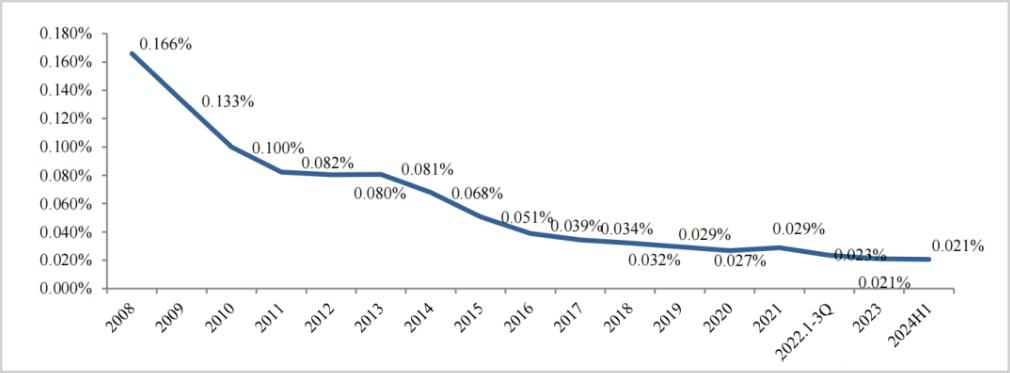
▲ Brokerage Commission Rate Trend in Selected Years, Source: Eastmoney
The "price war" in the margin trading business is equally fierce. The margin trading interest rate was around 7.5% in 2015, but by 2025, some brokerages had rates below 4%, with leading firms even offering preferential rates under 3%.
This has led to a substantial increase in brokerages' loaned-out funds, but the growth in net interest income has lagged significantly. In 2025, the loaned-out funds of CICC and CITIC Securities surged 40%, while interest income only grew by around 15%.
With homogeneous traditional businesses compounded by price wars and no substantial fundamental recovery, the institution-dominated market naturally no longer chases brokerages as enthusiastically as it did in 2014-2015.
Therefore, after 2015, brokerages have transformed from high-elasticity, strong-cyclical stocks into low-volatility value stocks, with significant internal divergence across the industry.
Currently, the business models of top-tier brokerages have opened a considerable gap with smaller peers — the former have found new growth points through the "Three-Investment Synergy" strategy, while the latter remain stuck in traditional businesses such as brokerage and margin trading.
The so-called "Three-Investment Synergy" refers to research, investment banking, and investment, covering the entire lifecycle of enterprises from startup, growth, IPO to post-listing. There are three implementation paths:
First, early-stage investment before IPO, where the private equity subsidiary of a brokerage intervenes with the dual identities of early shareholder and sponsor.
For example, a private equity fund under CITIC Securities invested in Unitree Technology in 2024, holding nearly 4.5% of its shares. The shareholder list of Changxin Technology also includes top-tier brokerages such as Cathay Haitong, CICC, and CITIC Construction Investment.
Second, IPO sponsorship and co-investment. According to Wind data, the total co-investment amount of brokerages in the STAR Market reached 1.12 billion yuan in 2025, with a first-day listing return rate of 261%, generating co-investment returns of 2.92 billion yuan, up 180% year-over-year. In 2026, the co-investment returns of leading brokerages could boost annual net profit by up to 10%.
Third, secondary market proprietary shareholding increase. After an enterprise goes public, brokerages can choose to continue increasing their holdings to enjoy medium- and long-term growth returns.
Through in-depth pre-investment research, early-stage investment in enterprises, subsequent IPO underwriting and sponsorship, and post-listing co-investment or proprietary position increase, brokerages can achieve "multiple gains from one fish," a model very different from the traditional one that only focuses on IPO underwriting.
However, this new model is only accessible to leading brokerages. In Q1 2026, the top five brokerages by underwriting amount were CITIC Securities, CITIC Construction Investment, Cathay Haitong, Huatai Securities, and CICC, collectively accounting for over 80% of the total market share.
Moreover, these leading brokerages have expanding advantages in the market share of brokerage and margin trading businesses, with overall profitability higher than the industry average and typically higher valuations.
Nevertheless, Eastmoney, which adheres to traditional businesses, has taken a differentiated path, boasting the industry's highest valuation with a PB ratio of 3.3x (as of July 17). Leveraging its massive traffic pools including Eastmoney and TianTian Fund, it earns "market returns" from commissions and margin trading during bull markets, and "user returns" from fund distribution and data services during stable markets, with growth potential even outperforming top-tier brokerages.
In short, internal divergence in the brokerage sector is an inevitable trend, with individual operational alpha becoming increasingly important.
Mid-Term Prosperity Remains Intact?
Whether it is the new "Three-Investment Synergy" model or the prosperity of traditional businesses, both are anchored to capital market performance — the beta of the brokerage sector. Although its weight has decreased compared to the past, it still cannot be ignored.
In the second half of the year, whether the A-share market can maintain its current high level or even rise further will determine the performance growth expectations for brokerages.
By strategy classification, the A-share market can be divided into four core categories: finance (including banks, brokerages, insurance, etc.), consumer (food and beverage, pharmaceuticals, etc.), cyclical (non-ferrous metals, chemicals, oil and petrochemicals, lithium batteries, etc.), and technology (communications, semiconductors, AI, consumer electronics, etc.). Their combined forces determine the market direction.
Looking at the technology sector first, after the epic surge in Q2, valuations have risen to historically extreme levels. As of June 30, the PE ratio of the STAR 50 Index reached 256x. Although it has since fallen back to 226x, it remains far higher than the median of 71x since its launch.
During the H1 performance announcement window, multiple tech stocks reported impressive financial results only to plunge as the market took profits. Among them, Hangdian Electronics reported a maximum 10-fold profit increase, but its share price plummeted 43% in the 10 trading days after the announcement. Therefore, high valuations will become the core constraint suppressing the tech style in the second half of the year.
In contrast, the non-tech sectors present a different picture. Looking at cyclical stocks (copper, aluminum, chemicals, etc.), the second half of the year will see a triple resonance of the Federal Reserve shifting its monetary policy again, high-prosperity performance, and low valuations.
There are two main positive factors for consumer stocks. First, domestic CPI will gradually rise alongside the increase in PPI, likely stabilizing above 1%, reflecting a slow recovery from the profitability dilemma of consumer stocks.
Second, after five consecutive years of decline, valuations have fallen to historically low levels, with negative factors almost fully priced in. As long as the performance of relevant consumer stocks improves slightly (such as a significant narrowing of decline or a return to positive growth), their valuations will escape the quagmire.
Financial stocks including brokerages were generally "drained" by tech stocks in Q2. Once the market style reverses, capital reflux will become a major driving force. In addition, after a long period of adjustment, brokerage valuations have also become somewhat attractive.
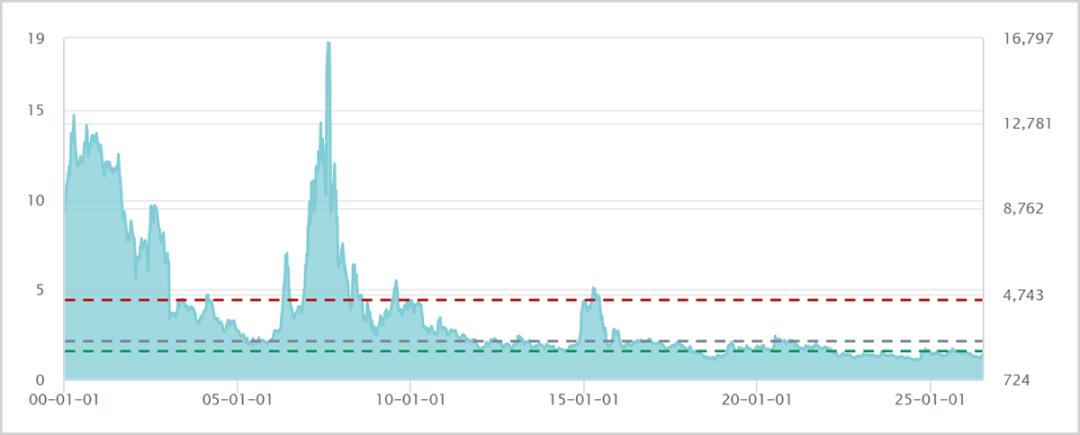
▲ Brokerage Index Historical PB Trend, Source: Wind
The combined direction of the four major asset sectors — technology, cyclical, consumer, and finance — will determine the trend of the capital market. If the market evolves in a positive direction, brokerage performance will maintain high prosperity. Coupled with low valuations and capital reflux, the pessimistic expectations for the brokerage sector will disappear.
However, the industry's overall beta should not be overestimated. The focus should be more on top-tier brokerages with alpha characteristics, which may bring some extra returns.
This article is from the WeChat public account "Market Value Observer," authored by Market Value Observer, and published with authorization from 36Kr.