Another mobile phone brand exits the Chinese market, and this move is the right call
After Meizu stopped updating its devices due to rising memory costs, another mobile brand is saying goodbye to the domestic market.
On July 16, Xu Qi, Vice President of realme, released an open letter announcing that realme is withdrawing from the Chinese market, and all resources will be fully invested in overseas markets going forward.
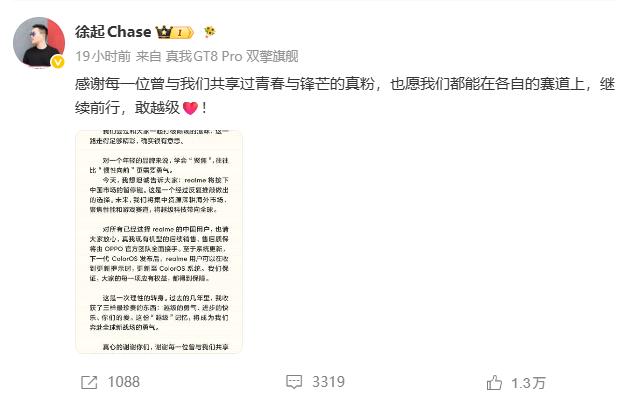
For the models still on sale domestically, after-sales service will be handled by the OPPO team, and realme users can upgrade their devices once the next generation of ColorOS is released.
From now on, the main OPPO brand will focus on the domestic mid-to-high-end market, OnePlus will occupy the domestic performance-focused segment, and realme will fully expand overseas.
Each brand will return to its most competitive market, and there will no longer be internal competition among the group's own brands.
realme once had its glorious days, but internal friction between the three sibling brands was too severe
The realme brand was originally designed for overseas markets. After achieving impressive results in markets like India and Southeast Asia, it did not enter the Chinese mainland market until 2019.
At that time, the mobile phone industry landscape was already very stable, with the top five brands occupying 91.3% of the market share. However, the realme X managed to gain a firm foothold with its pop-up full-screen design, the fastest charging speed in its price range, and extremely competitive cost-performance ratio.
2021 was the peak of realme's success: in the second quarter, it sold 15 million units globally, representing a 135% year-on-year growth, and as a sub-brand, it ranked among the top six mobile brands in global sales volume.
The Master Series designed by Naoto Fukasawa, and the 240W fast charging technology first launched on the GT Neo5, were indeed very powerful in the 2000-3000 RMB price range. Together with the competing brand iQOO, they put considerable competitive pressure on Redmi.

realme Neo 8
However, behind this glory, problems were gradually brewing.
realme's product line was overly fragmented: at its peak, more than 20 different realme phone models were sold simultaneously in the domestic market, with five separate product lines including the GT series, digital series, Q series, V series, and Neo series, launching over a dozen new models every year. The configurations were largely similar, and there was no clear pricing hierarchy between them.
Ordinary consumers could barely tell the difference between the GT Neo5 and the Q5 Pro.
Worse still, the chaos was not limited to realme alone, but spread across all sibling brands under the group.
There are three brands under the OPPO ecosystem: the main OPPO brand, OnePlus, and realme.
After OnePlus returned to the OPPO group, it launched the Ace series positioned for mid-range performance, which directly competed with realme's GT and Neo lines in the 2000-4000 RMB price segment.
Coupled with the OPPO Reno series also targeting this price range, the three sibling brands started competing against each other first.
The three brands operated independently with separate R&D teams, marketing departments, distribution channels, and after-sales systems. This meant the group was supporting three completely separate operational structures to compete for the exact same customer base.
The problems in distribution channels were even more prominent. OPPO adopted a provincial-level distribution system, where distributors held shares in local branch companies and earned profits and dividends by selling mid-to-high-end OPPO models.
realme followed an extreme cost-performance strategy, leaving very little profit margin for distribution channels. If realme products were placed in OPPO retail stores, they would divert customers from OPPO's mid-to-high-end models, directly reducing distributors' income.
As a result, realme struggled for a long time to integrate into OPPO's offline retail system. It did not announce full integration until April this year, but it was already too late: there were fewer than 1,000 offline stores, and most counties did not even have an official service point, forcing users to send their damaged devices away for repair.
In comparison, Redmi benefits from Xiaomi's nationwide network of 20,000 Xiaomi Home stores, making the gap clearly visible.
Ultimately, the entire mobile phone industry has undergone fundamental changes
If the only problem was a slightly messy product line, realme could have still survived, given its solid product competitiveness. The real issue is that the mobile phone industry has changed dramatically in recent years, becoming extremely challenging.
When realme first entered the domestic market, the mobile phone industry was still a growing market, where brands could always find new users.
Now it has long become a stock market with fierce competition. According to IDC data, China's 2025 smartphone shipments reached approximately 284 million units, a 0.6% year-on-year decline.
The average user device replacement cycle has extended to more than three years, and users will not replace their phones unless it is absolutely necessary, forcing all brands to compete for each other's existing customer bases.
The 100W+ fast charging, large memory, and high refresh rate displays that were once unique selling points for realme are now standard features across the entire product lines of Redmi, iQOO, and OnePlus.
Entry-level smartphones now have nearly identical hardware specifications, so users only compare prices instead of focusing on brand loyalty. Brands that grew up relying on cost-performance advantages naturally lack strong user loyalty: customers will buy your products today if they are cheap, but switch to another brand tomorrow if it offers a better deal.
In 2025, realme's domestic market share dropped to 1.26%, and its global market share fell to 3.6%.
By 2026, the sharp surge in memory prices became the final straw that broke many camels' backs.
DRAM contract prices rose by more than 90% quarter-on-quarter, while NAND prices also increased by over 55%.
Low and mid-tier smartphones already had very thin profit margins, and this round of price hikes directly increased their costs by nearly 10%, hitting cost-performance brands like realme the hardest.
Currently, the entire market is accelerating its concentration toward leading players.
According to newly released IDC data, China's smartphone shipments in the second quarter of 2026 reached approximately 66 million units, a 4.3% year-on-year decline, marking five consecutive quarters of negative growth.
Huawei ranked first with a 22.6% market share, shipping about 14.92 million units, representing a 19.4% year-on-year growth; Apple came in second with 18.1% market share, growing 24.4% year-on-year.
Among the top five brands, only Huawei and Apple recorded positive growth, while OPPO, vivo, and Xiaomi all saw declining sales.
The overall market size is shrinking, profits are getting harder to earn, and leading brands are growing increasingly dominant. realme's tiny market share was simply not enough to withstand this pressure.
For OPPO, this adjustment brings more benefits than drawbacks
After this restructuring, OPPO will gain more advantages than disadvantages, as the positioning of its three brands has become much clearer:
Main OPPO brand: Focus on the Find series, Reno series, and foldable smartphones, targeting the offline mid-to-high-end imaging segment;
OnePlus: Fully take over the domestic online performance-focused and cost-performance market;
realme: Discontinue domestic operations, and pour all resources into markets including India, Southeast Asia, and Latin America.
OnePlus recorded a 44% year-on-year sales growth in China last year, and its sales increased by another 27.4% in the first half of this year, making it the fastest-growing brand in the industry. It is a logical move to concentrate all resources for the domestic performance segment on OnePlus.
Meanwhile, realme originally started its business overseas, and has established a solid foundation in India and Southeast Asia. Data from Counterpoint shows that these markets still have room for growth. Instead of fighting a losing battle in the saturated domestic market, it makes more sense to focus on markets where it can win.
A month ago, OnePlus announced that it would scale back its operations in Europe and the United States, essentially transferring its overseas R&D and distribution resources to realme. This clear division of labor between domestic and overseas markets will no longer disperse the group's resources.
In the past, the three brands operated independently, developing their own imaging systems, heat dissipation technologies, and operating systems separately, leading to fragmented R&D resources.
By eliminating overlapping operations and internal friction, OPPO can now concentrate its capital and talent resources on developing high-end core technologies.
Conclusion
realme's 7-year journey in the Chinese mainland market has come to an end.
At its core, this is not a failure of the brand itself, but a proof that the growth-era business model is completely ineffective in a stock market environment.
The mobile phone industry can no longer achieve breakthrough growth simply by selling low-priced devices in large volumes. In the future, competition will focus on how precisely brands can position themselves, and how effectively they can invest their limited resources to build the strongest competitive moat.
This article originates from the WeChat Official Account "Tech Daily Update" (ID: apptoday), authored by Tech Daily Update, and published by 36Kr with authorization.