The three major courier companies have all reported positive news at the same time. Have they really turned the corner?
With 2026 already halfway through, the first-half competition across all industries has drawn to a close, and market attention is fully focused on the much-anticipated "mid-term report card" that measures success or failure.
The true operational strengths and hidden vulnerabilities of enterprises behind the fluctuations in their numerical indicators are all condensed within every single financial report they release.
The express delivery industry has never lacked dramatic developments, and now the sector is undergoing even more turbulent shifts. Right as the entire market waits in eager anticipation, STO, YTO, and Yunda have collectively "taken a head start" by being the first to publish their "2026 Semi-Annual Performance Preannouncements".
Following the release of these forecasted financial figures, the three express delivery companies are finally able to stand tall with renewed confidence.
Explosive Growth in Net Profit
Judging from the preliminary forecasted financial data, STO, YTO, and Yunda are advancing in lockstep, all delivering outstanding positive performance, with STO's growth standing out as particularly remarkable among the three.
As early as June 30, YTO took the lead in disclosing its performance preannouncement: it expects to achieve a net profit attributable to owners of the parent company of 3.10 billion to 3.40 billion RMB for the 2026 semi-annual period, representing a year-on-year increase of 69.34% to 85.73%; its projected non-recurring-gains-excluded net profit attributable to owners of the parent company will reach 3.04 billion to 3.34 billion RMB, marking a year-on-year growth of 72.19% to 89.18%.
Shortly after YTO's announcement, Yunda and STO also released their respective performance preannouncements in recent succession.
Yunda's net profit attributable to shareholders of the listed company for the first half of 2026 ranges from 905 million to 1.05 billion RMB, growing by 71.15% to 98.57% year-on-year; its non-recurring-gains-excluded net profit stands at 835 million to 980 million RMB, representing a year-on-year increase of 84.47% to 116.51%.
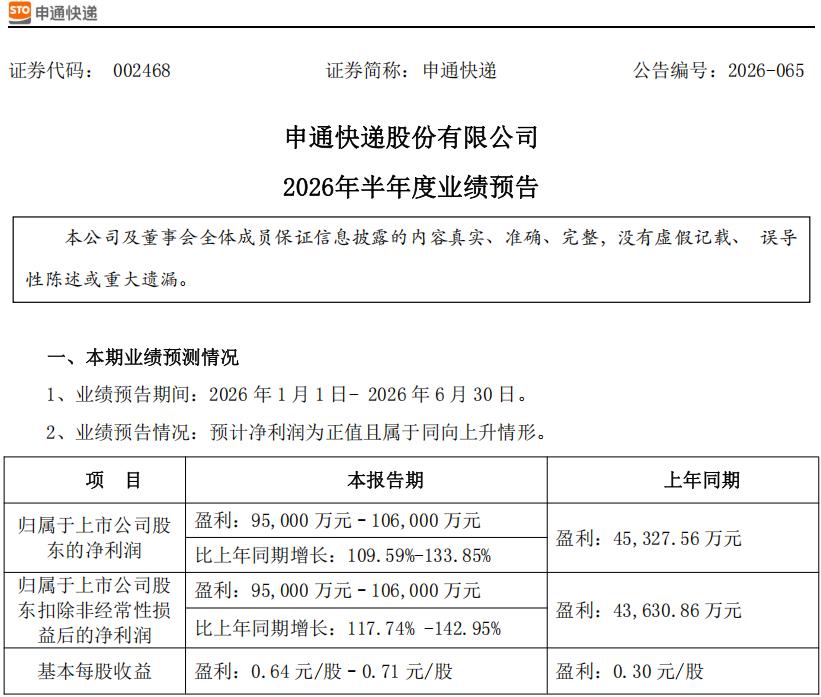
STO reports a net profit attributable to shareholders of the listed company of approximately 950 million to 1.06 billion RMB, up 109.56% to 133.85% year-on-year; its non-recurring-gains-excluded net profit attributable to shareholders of the listed company also falls between 950 million and 1.06 billion RMB, marking a year-on-year growth of 117.74% to 142.95%.
A horizontal comparison reveals that each of the three express delivery companies has posted a higher performance growth rate than the last.
Notably, the fact that all three companies' non-recurring-gains-excluded net profit exceeds their net profit attributable to the parent company is the most valuable highlight of this round of preannouncements. It clearly sends a clear signal to the market: In the first half of this year, these three express delivery firms have shaken off their reliance on non-core "windfall gains", and are generating genuine profits entirely from their core express delivery operations, with extremely low "impurity content" and fully solid high-quality earnings.
For this round of growth, the three companies have unanimously attributed their strong performance to two core driving forces: price recovery driven by the anti-involution policy, as well as efficiency improvements and cost reductions brought by intelligent technology applications. The combined effect of rising revenue and falling costs has continuously widened the profit gap, jointly supporting this impressive mid-term report card.
There is no doubt that since the implementation of the anti-involution policy in 2025, express delivery companies have gradually bid farewell to the years-long vicious cycle of sacrificing prices for higher order volumes. After a prolonged period of decline, industry unit prices have begun to rebound from their trough.

Entering 2026, the price recovery trend has further solidified, and a clear industry-wide minimum price threshold is gradually taking shape, giving express delivery companies a much-needed breathing room.
This temporary relief has directly translated to improvements in their income statements: YTO, STO, and Yunda have all delivered robust year-on-year net profit growth.
The Flip Side of Growth: The Question of Sustainability
It is crucial to remain vigilant: profit improvements do not equal a fully stable operational foundation, and this temporary cyclical recovery does not guarantee permanent success. The express delivery industry is far from being out of the woods, and the real challenges have only just begun.
The current price recovery is still largely driven by policy guidance, and has not yet formed a solid value support built on differentiated service offerings.
The root cause lies in the fact that the express delivery industry is still burdened with heavy cost pressures.
Even after the end of the price war, the industry has not entered a smooth, trouble-free era. Instead, it has shifted to a new competitive arena, moving from competing on low prices to competing on service value, where service experience, intelligent technology, and global expansion have become the new core competitive dimensions, each of which requires enormous capital investment.
In terms of services, consumer expectations have long moved far beyond the basic requirement of "deliver the parcel", now focusing on "when it arrives, how returns are processed, and how compensation works for damaged items". Truly improving service quality requires continuous investment in capital and operational management. Meanwhile, frontline delivery personnel who underpin the entire service network also need comprehensive guarantees for fair compensation and occupational safety.
To this day, the majority of frontline couriers are still trapped in difficult circumstances marked by falling delivery fees, excessive punitive fines, and insufficient social security coverage.
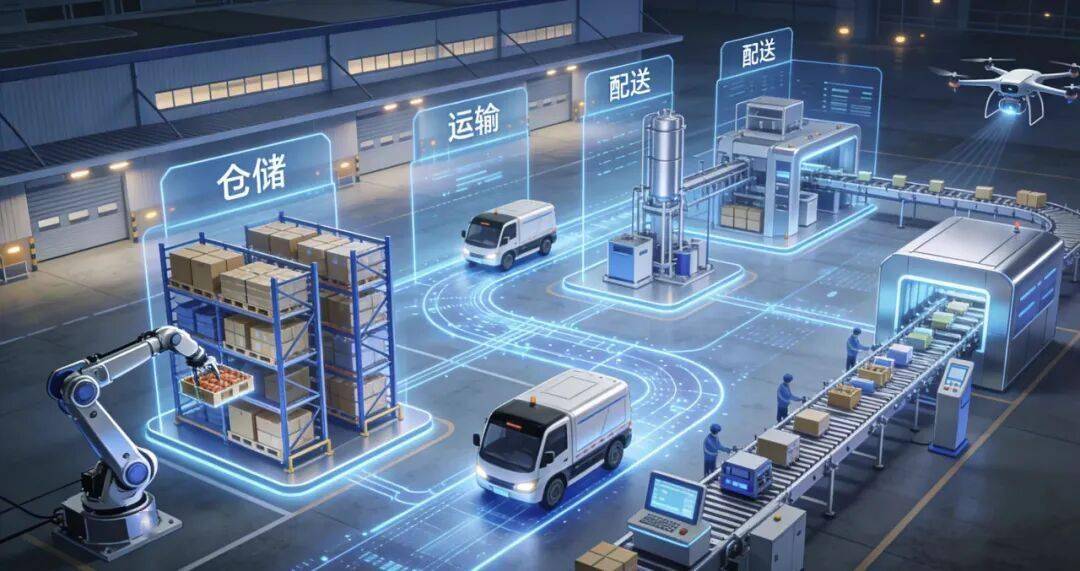
In the field of intelligent technology, from large language model-powered smart customer service, to AI dispatching systems that dynamically optimize delivery routes, and the large-scale deployment of autonomous delivery vehicles, the speed of technological iteration determines the upper limit of operational efficiency, and every round of technological upgrade requires massive investment.
On the global expansion front, there are no shortcuts to success. Building overseas operational networks from scratch, establishing local teams, and launching intercontinental trunk line services — every single link in this process is a years-long long-term battle that requires substantial real capital input.
In the era of price wars, competition was about endurance, where companies that could withstand the pressure survived; now, competing on service value demands a combination of financial strength and long-term strategic resolve, requiring companies to not only sustain continuous capital expenditure during the investment phase, but also stay patient as they wait for long-term returns to materialize.
Furthermore, the express delivery industry has bid farewell to the past era of double-digit high-speed growth driven by "market expansion". According to data from the State Post Bureau, in the first six months of 2026, the monthly year-on-year growth rate of express delivery business volume has remained in single digits.
With the era of incremental growth dividends fading away, the industry has entered a stock market competition phase. Against this backdrop, the value of price recovery and intelligent cost reduction has been amplified to an unprecedented level.

At the same time, a more practical issue has emerged: when incremental business volume is no longer sufficient to resolve the conflict between cost pressures and profit targets, can express delivery companies and their local service outlets hold onto this hard-won minimum price threshold?
The answer still remains uncertain.
While a basic industry-wide minimum price has been initially established, this policy has not been smoothly transmitted down to the grassroots level. Unregulated practices such as cutting delivery fees and imposing arbitrary fines still persist across the industry, and the benefit distribution mechanism has not been properly restructured. Under this distorted benefit chain, hidden under-the-table discounts are the only way many local outlets can barely stay operational. This means that as long as survival pressures remain high, there is a real risk of a return to destructive price competition, making this battle far more difficult than many anticipated.
Against this backdrop, Yunda explicitly stated in 2026 that it will continue to implement its development philosophy of "one unified network, shared growth for all". The core of this strategy is to break down barriers between individual outlets, as well as between regional branches and the headquarters, guiding all stakeholders to shift from conflicting interest games to collaborative win-win cooperation, and ultimately building a highly coordinated, shared-benefit community of shared future.
This strategy has become a powerful pillar for Yunda to escape the trap of involution-style competition. Since 2026, during multiple peak agricultural product delivery seasons, many Yunda outlets have established a standardized workflow of "instant response, scheduled parcel collection, same-day dispatch, and end-to-end priority processing", ensuring high delivery efficiency and service quality, earning praise from both merchants and consumers, and setting a replicable benchmark for the entire express delivery industry.
In conclusion, these three performance preannouncements have painted a long-awaited optimistic picture for the express delivery industry. However, impressive short-term results do not define long-term success. The true measure of the quality of these express delivery companies and the entire industry lies in their ability to sustain this growth over the long term, while navigating the dual pressures of operational transformation and slowing incremental growth.
This article originates from the WeChat Official Account "Express Delivery Guide", authored by Express Delivery Guide, and is published with authorization from 36Kr.