Property prices have truly stabilized!
Recently, top-level authorities have continuously released clear signals to stabilize the property market and underpin housing prices, bringing a steady stream of favorable policies to the market.
The latest positive signal comes from the housing price data of 70 major cities. For the first time in 13 months, new home prices in second-tier cities have finally stopped their month-on-month decline.
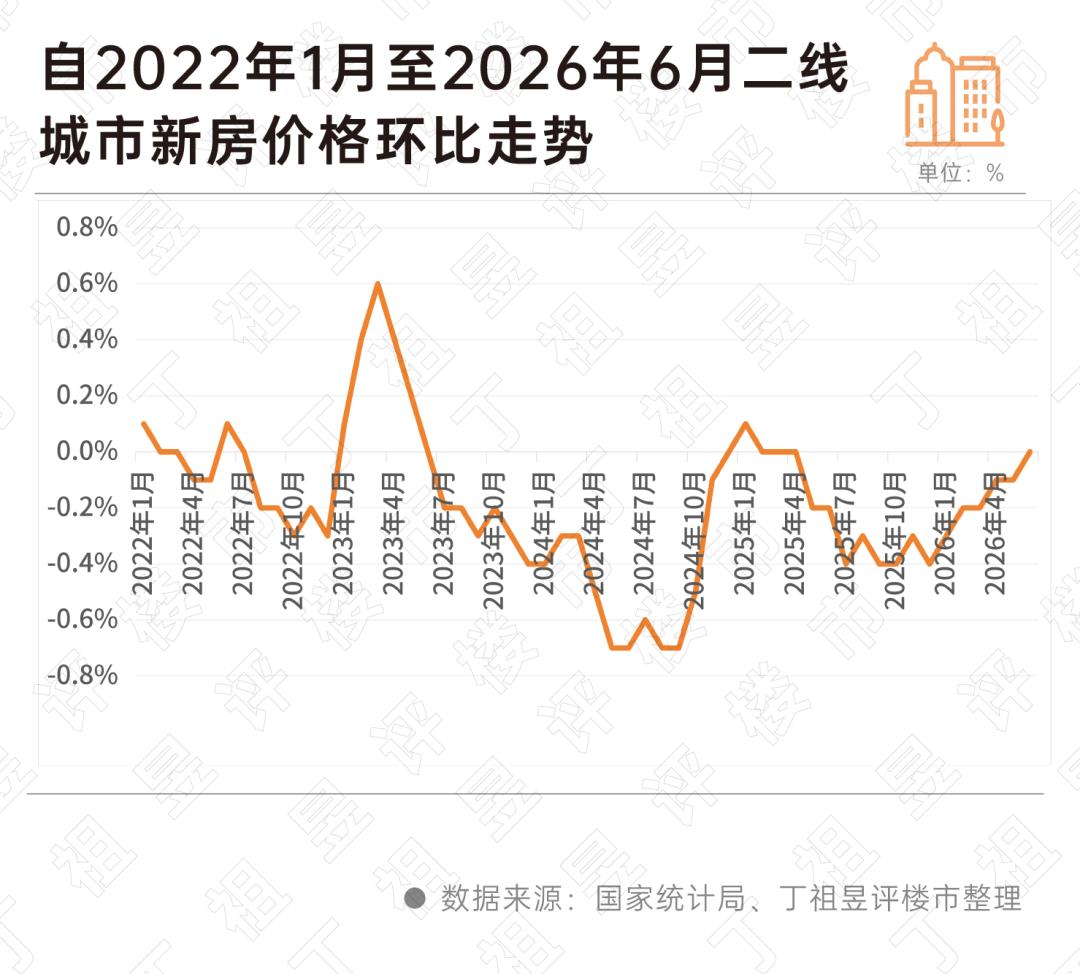
This data sends out an extremely strong market signal. Looking back at the cycle, since housing prices in second-tier cities began to decline month-on-month in May 2025 and officially entered a new downward channel, this is the first halt to the downward trend in the current round of decline cycle.
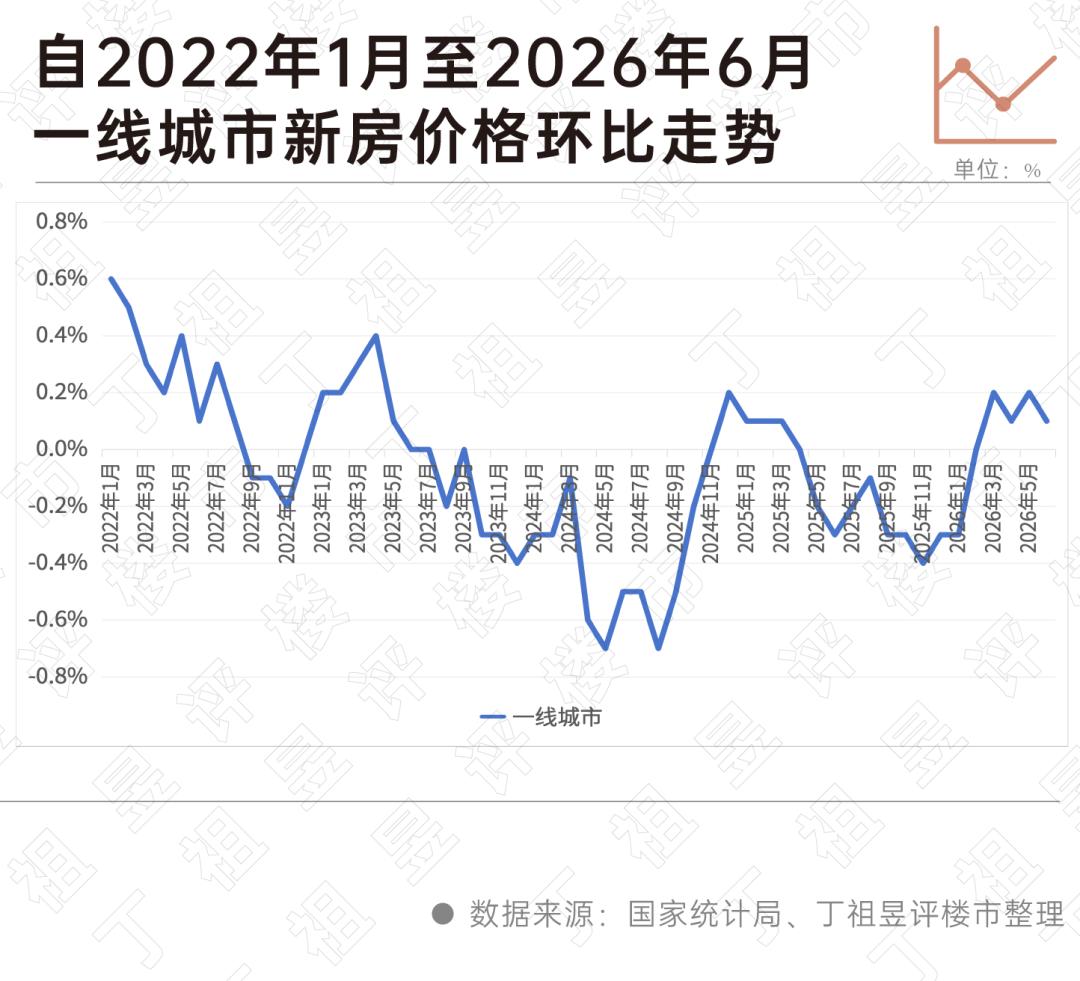
The housing price recovery in first-tier cities preceded that of second-tier cities, with prices bottoming out in February this year, followed by four consecutive months of month-on-month growth from March to June. Moreover, the number of cities across the country where housing prices have stopped falling continues to expand.
01
The certainty of housing prices bottoming out is one of the key signals confirming the 2026 market trough.
After nine months of decline starting from May 2025, housing prices in first-tier cities stopped falling in February. They then recorded four consecutive months of month-on-month growth from March to June, showing sustained upward momentum. The month-on-month increases in new home prices in first-tier cities from March to June were 0.2%, 0.1%, 0.2%, and 0.1% respectively, with overall low volatility.
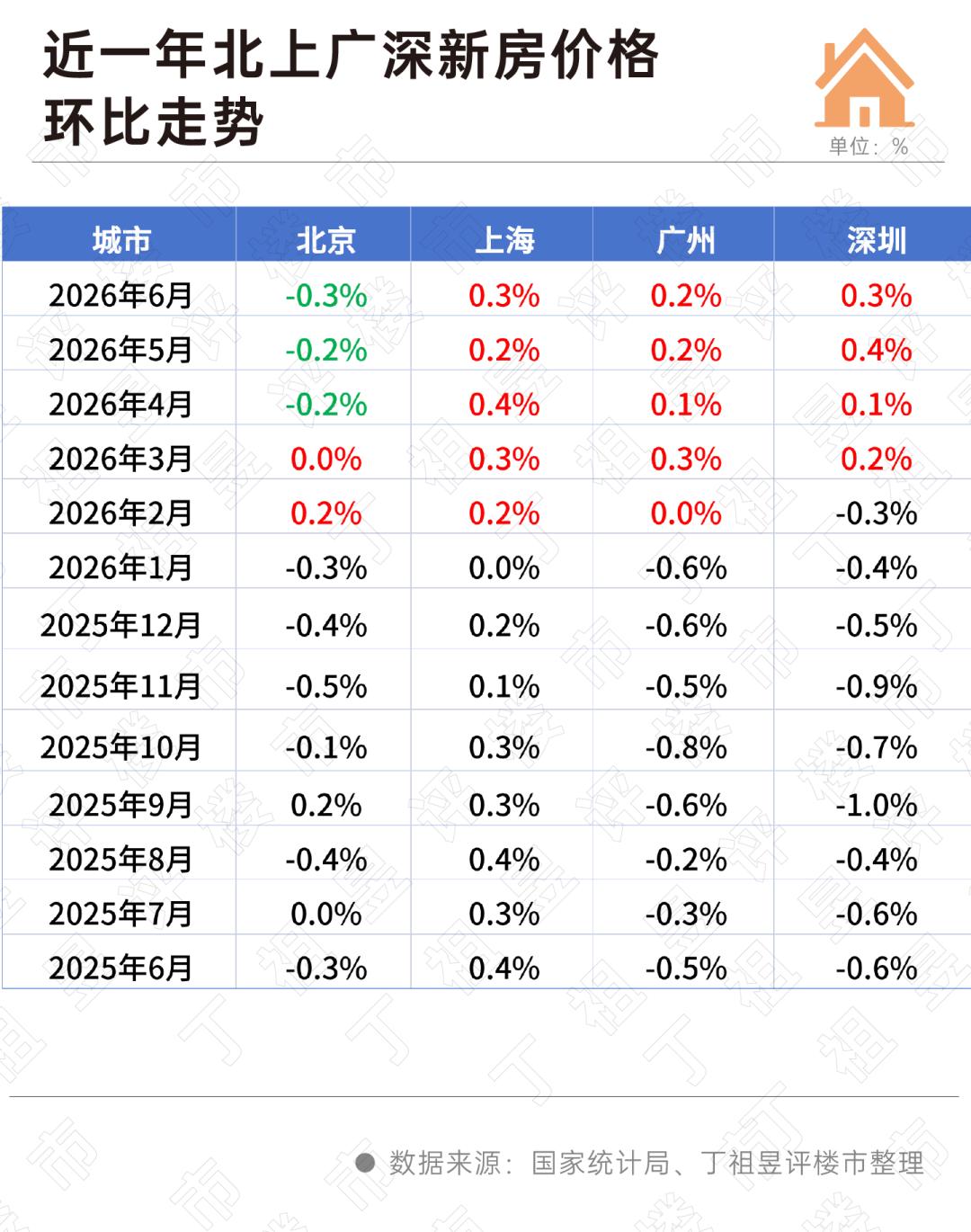
In terms of city-specific performance, among first-tier cities, only Beijing is still in a negative growth trend, while Shanghai, Guangzhou, and Shenzhen have all seen continuous month-on-month growth for several months.
Shanghai has maintained positive growth as always, recording 83 consecutive months of month-on-month positive growth as of June 2026, with no price drops during this period — only a few months of flat month-on-month performance. Its housing price resilience ranks among the top nationwide. Since 2026, new home prices in Shanghai have only posted a flat month-on-month reading in January, before returning to an upward trend from February to June.
Shenzhen has seen its new home prices in a recovery trend since December 2025, with the decline narrowing month by month, turning positive for the first time in March 2026 and maintaining month-on-month growth for four consecutive months thereafter.
Guangzhou's new home price trend is broadly consistent with the overall performance of first-tier cities, recording four consecutive months of growth after bottoming out in February.
The pressure now falls on Beijing, which entered a downward channel after a month-on-month increase in February this year, showing insufficient upward momentum.
A more critical inflection point signal has emerged: housing prices in second-tier cities have stopped falling month-on-month.
It took 13 months for second-tier cities to reverse their downward trend that started in March 2025, 4 months shorter than the previous housing price stabilization cycle.
Which cities are supporting the halt in second-tier city housing price declines?
Twelve second-tier cities have recorded month-on-month new home price growth: Taiyuan, Shenyang, Changchun, Nanjing, Hangzhou, Ningbo, Xiamen, Qingdao, Wuhan, Nanning, Yinchuan, and Urumqi.
In addition, Dalian saw flat month-on-month new home prices.
In other words, cities with stabilized housing prices account for nearly 42% of all second-tier cities.
Looking at the 70 major cities, the number of cities where new home prices have stopped falling also speaks volumes.
21 cities recorded a halt in month-on-month price declines in June, the highest figure in nearly a year. Among them, 20 cities saw price increases, 4 more than the previous month, with second-tier cities accounting for 60% of the total number of rising cities.
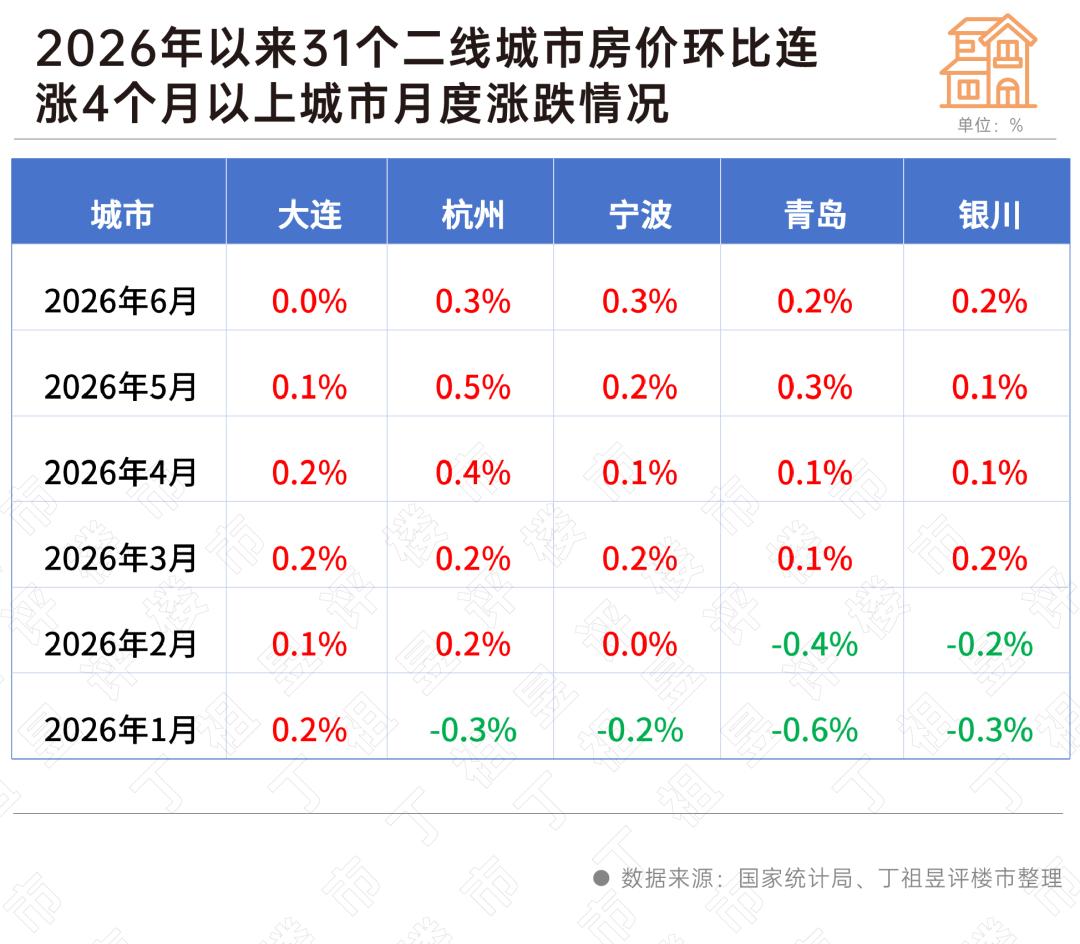
Five cities — Dalian, Hangzhou, Ningbo, Qingdao, and Yinchuan — have posted more than four consecutive months of month-on-month housing price growth.
This set of data sends two key signals: the current halt in second-tier city housing price declines is not an accidental rebound in a few isolated cities, but a joint upward force driven by a group of key cities supported by solid population and industrial fundamentals.
The sustained upward trend in housing prices across multiple cities further confirms that market confidence and home purchase demand are undergoing substantial recovery.
02
Entering 2026, second-hand home prices are also recovering in tandem.
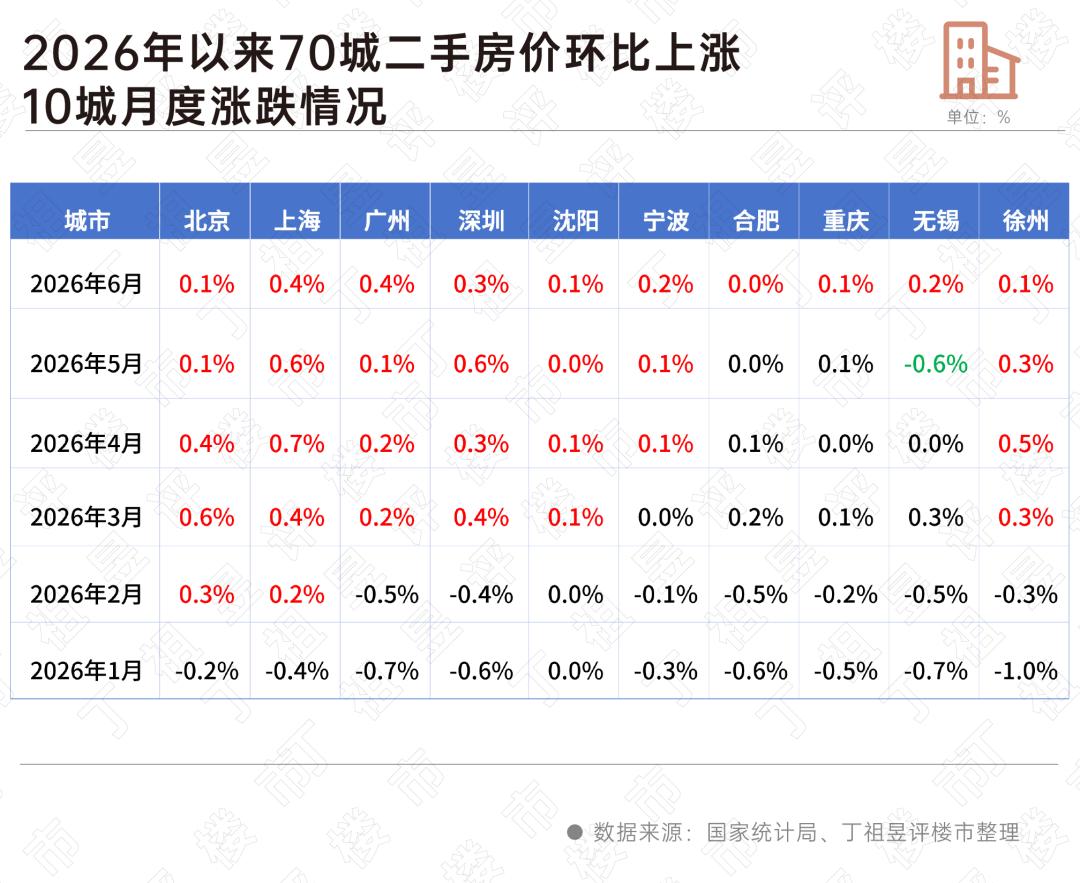
However, this recovery is currently concentrated in first-tier cities, where second-hand home prices rose 0.3% month-on-month in June, marking three consecutive months of growth. Second-hand home prices in all four first-tier cities — Beijing, Shanghai, Guangzhou, and Shenzhen — have posted four consecutive months of month-on-month increases.
At present, the number of cities with stabilized second-hand home prices has remained at no less than 10 for four consecutive months.
The 10 cities in June are: Beijing, Shanghai, Guangzhou, Shenzhen, Shenyang, Ningbo, Hefei, Chongqing, Wuxi, Xuzhou
This group includes not only first- and second-tier cities, but also third-tier cities such as Wuxi and Xuzhou that have stabilized simultaneously. The warming trend in second-hand home prices is spreading from core cities to second- and third-tier cities.
Further breaking down the monthly data, among these 10 cities, except for Wuxi, 9 cities have recorded more than four consecutive months of stabilized second-hand home prices. This means that the previously overcorrected second-hand home prices are truly bottoming out.
Looking at past international housing market adjustments, the average adjustment cycle is 4.5 years, with a price correction of around 22%. China's real estate sector has undergone 4 years of adjustment since 2022, with overall housing price corrections exceeding the international average — especially second-hand home prices have been overcorrected. Current price bubbles have been largely cleared, further reinforcing the signals confirming the sector's trough.
The market rule of "transaction volume leads price" in the second-hand housing market is taking effect, with transaction activity picking up ahead of price recovery.
Data from the Pury Research Center shows that the cumulative second-hand home transaction area in 20 key cities in the first half of the year saw a 12% year-on-year positive growth. Among them, 18 cities including Beijing, Shanghai, Shenzhen, Qingdao, Hefei, Ningbo, Dalian, and Xiamen recorded year-on-year growth in cumulative second-hand home transaction volume.
In addition, the active second-hand housing transaction trend is also reflected in data from the housing and urban-rural development authorities: the cumulative second-hand home online signing area in the first half of the year increased by 10.2% year-on-year, with the growth rate 2.5 percentage points faster than the first five months.
The second-hand housing market has moved from the "bottom-hunting and price-cutting" phase to a "structural recovery" stage.
The "15th Five-Year Plan for Expanding Consumption" classifies housing as a major durable consumer good, and explicitly promotes the sustained and healthy development of the real estate market, so as to expand the property income sources of urban and rural residents through multiple channels.
Combined with the related statement in the Qiushi Journal article "Boosting Consumption with Greater Efforts" that "we will focus on stabilizing the real estate market and prevent falling asset prices from forming a negative spiral that erodes consumer confidence".
The top-level policy guidance clearly conveys that maintaining the stability of the real estate market and stabilizing housing price expectations are key measures to coordinate steady growth and consumption promotion at present.
The current bottleneck in the real estate market recovery does not lie in policy tools, but in the restoration of market confidence. We judge that as top-level policy arrangements take effect, more cities are expected to see their housing prices stop falling in the second half of the year.
Once housing prices are stabilized, confidence will follow.
This article is from the WeChat public account "Ding Zuyu's Real Estate Commentary", authored by the editorial team, and published by 36Kr with authorization.