Netflix: Has the once-darling of the internet completely fallen from grace?
Netflix's Q2 results fell short of already muted expectations. While the underperformance was primarily driven by the tail end of its content cycle and the negative impact of recent price hikes in core regions, it also kept lingering concerns among some investors over the company's mid-to-long-term uncertainties alive.
Breakdown of Key Observations:
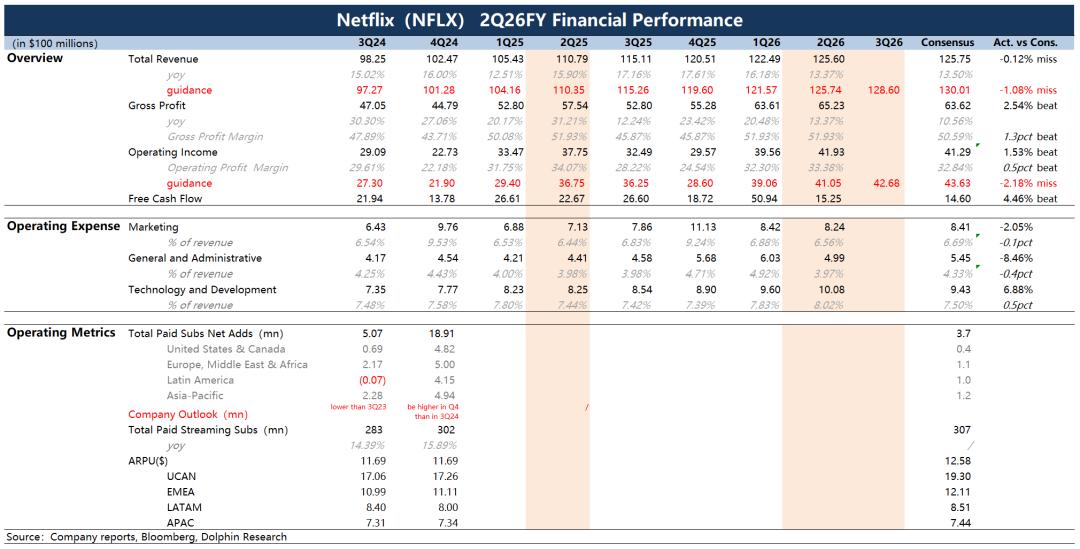
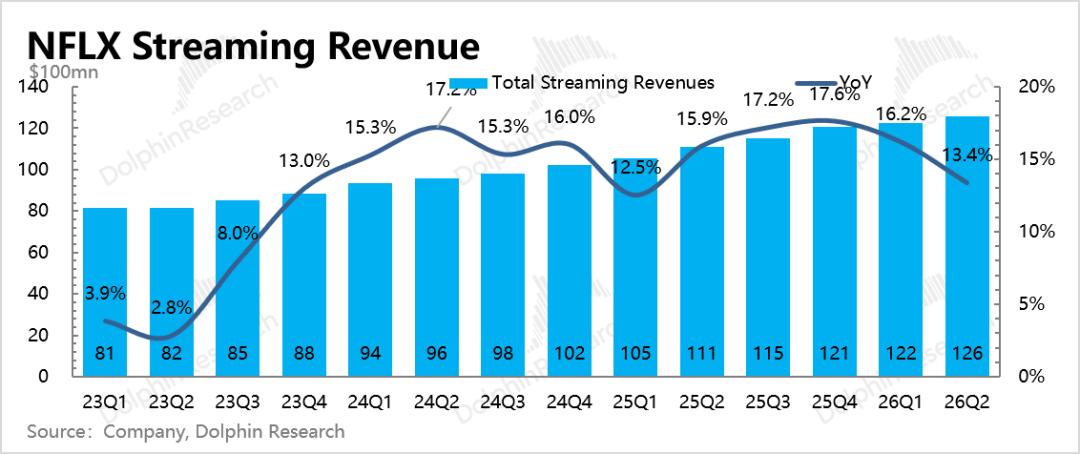
1. Sustained Slowdown in Revenue Growth: Q2 revenue hit $12.6 billion, marking a 13% year-over-year increase (12% growth at constant exchange rates). Though this figure largely aligned with guidance, the decelerating growth trend has further eroded market confidence in its future development trajectory.
While no additional price adjustments were implemented in Q2, the quarter was largely spent digesting the impact of late-2023 price increases in key markets including the U.S. This negative impact tends to be more pronounced and prolonged when occurring at the tail end of a content cycle.
Management's Q3 revenue guidance of $12.86 billion also came in below market expectations, with implied growth slowing from 13.4% to 11.8% — a figure that already includes a 1 percentage-point tailwind from favorable foreign exchange movements.
Meanwhile, although management did not lower its full-year revenue guidance, narrowing the range from $50.7-51.7 billion to $51.0-51.4 billion (with ad revenue still projected at $3 billion), implying 13-14% growth (12% at neutral exchange rates). However, market participants, accustomed to the company's historically conservative guidance style, had priced in revenue above $51.4 billion. As such, the full-year guidance failed to deliver any above-consensus growth that could restore market confidence.
2. Stable Profitability: Despite underwhelming revenue performance, Q2 operating profits modestly beat expectations, driven primarily by slight efficiency gains in sales and administrative expenses. R&D spending continued to rise in absolute terms due to investments in new product features including children's game apps and short-form "Clips" content.
After underperforming on profits last quarter, the market adjusted its profitability expectations downward following management's explanation of upcoming R&D investment plans, which created a positive earnings surprise this quarter.
We believe this resilience fundamentally stems from the inherent flexibility of Netflix's business model, compounded by the fact that price hikes naturally boost marginal profit margins. The company has maintained its full-year profitability target at 31.5% (up 2 percentage points year-over-year).
3. Accelerated Share Repurchases as Expected: Another notable development this quarter is the scaled-up buyback program, which had previously been paused for potential acquisitions. This move was widely anticipated by the market, after the company announced an additional $25 billion repurchase authorization in April. Q2 repurchases reached $4.7 billion, a significant increase from $1.3 billion in Q1 and well above typical quarterly levels in recent years.
Since launching its repurchase program in 2023, Netflix has deployed nearly 90% of its free cash flow toward buybacks in periods without major acquisition plans. Maintaining this ratio, with full-year FCF projected at $12.5 billion (per unchanged company guidance), annual repurchases could reach $11.2 billion or higher — particularly at current relatively undervalued levels.
Based on Netflix's $285 billion market capitalization following an 8% post-earnings drop, this would translate to a 4% shareholder return yield for the year, far exceeding levels seen in the past three years and providing meaningful support during the current valuation pressure phase.
4. Overview of Key Performance Metrics
Dolphin Research Insights
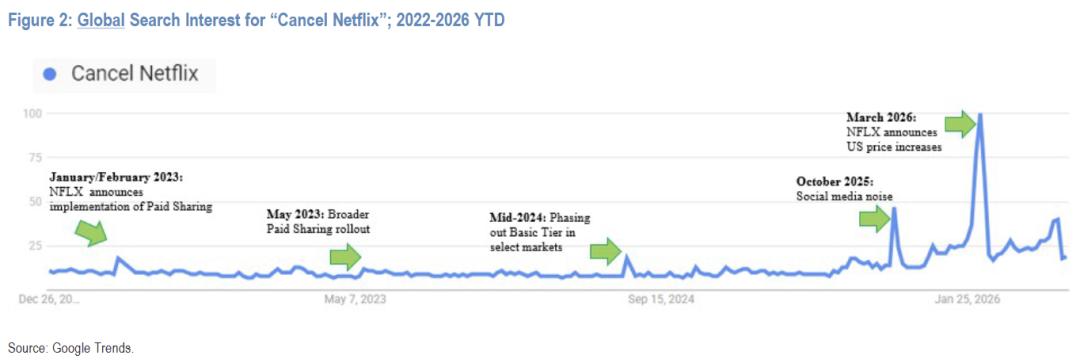
Last quarter, we noted that Netflix's valuation had largely recovered, and further upside would require the company to withstand price hike headwinds amid reduced content supply. In reality, Q2 played out our most pessimistic scenario — at the tail end of a content cycle, the backlash from price increases in core markets proved stronger and longer-lasting than in previous cycles.
Throughout Q2, the market had already anticipated this issue through user data from third-party platforms, with most of these concerns already priced into the downward-adjusted share price.
As the leading streaming platform, Netflix's business model and competitive advantages provide it with significant operational flexibility, meaning weak user metrics do not always translate directly to underperformance. During valuation corrections, the market typically maintains a baseline level of confidence in the company, creating rebound opportunities when sentiment becomes excessively bearish.
However, confirming a mid-to-long-term reversal will require improving forward-looking user data to restore investor confidence, which ultimately depends on the delivery of high-quality content.
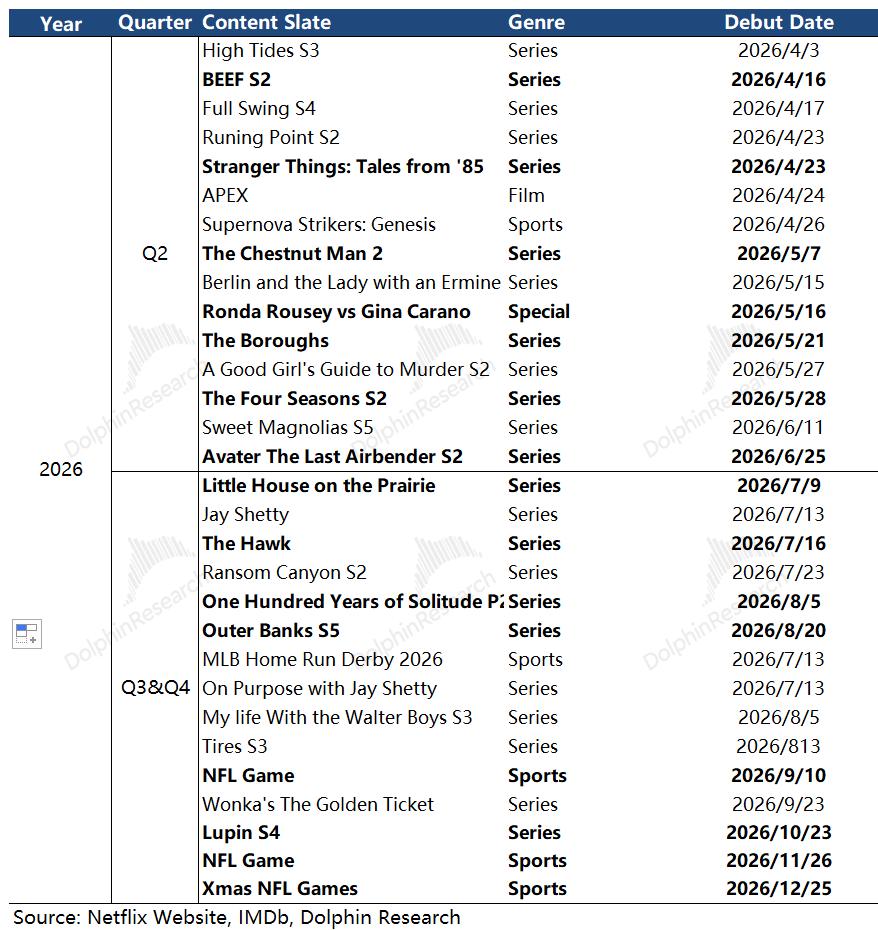
In terms of content volume, the second half of the year will see more releases than the first half (especially Q2), with a focus on live sports broadcasting and sequels to popular classic IPs, which should help mitigate the impact of price hikes over time.
Scripted content output will still lag behind peak levels seen two years ago. The growth in live sports streaming reflects the ongoing substitution of traditional cable TV by streaming services, and Netflix has secured broadcasting rights for NFL games in coming years. Sports events boast a broad audience base, long broadcast windows, and incremental ad revenue opportunities, making them a viable stopgap during periods of limited hit scripted content availability.
Overall, Q2's muted results and underwhelming guidance are primarily attributable to short-term content supply constraints, but negative market sentiment is amplifying long-term industry concerns (including short-form video competition and AI-generated animated content), creating valuation headwinds. Sentiment will quickly recover once user engagement rebounds with expanded content supply in the second half, driving marginal performance improvements.
Given Netflix's established market leadership and investor preference for the streaming business model, meaningful valuation compression typically only occurs at cyclical content bottoms when sentiment is at its weakest.
While revenue growth may continue to face pressure in the second half, the current valuation pullback represents an attractive accumulation opportunity for long-term investors, given management's proven track record and the market's underappreciation of AI-driven cost optimization potential.
Detailed Analysis
I. Revenue Growth Deceleration
Q2 total revenue reached $12.6 billion, up 13% year-over-year, with 2% organic growth at constant exchange rates, in line with expectations. Combined with Q3 guidance, the slowdown in growth is continuing, representing a weak overall trend. No multi-region price hikes were implemented in the quarter, as the company continued to absorb the impact of price increases in the U.S. from late last year and early this year.
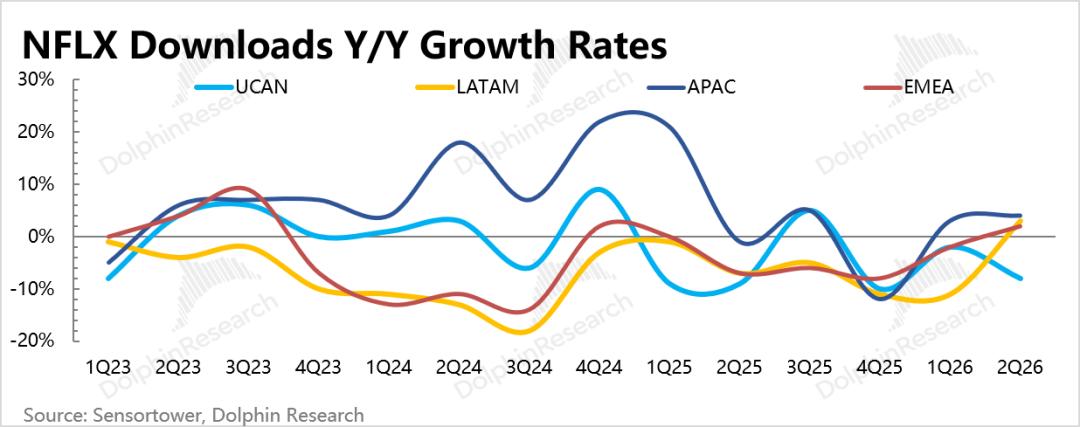
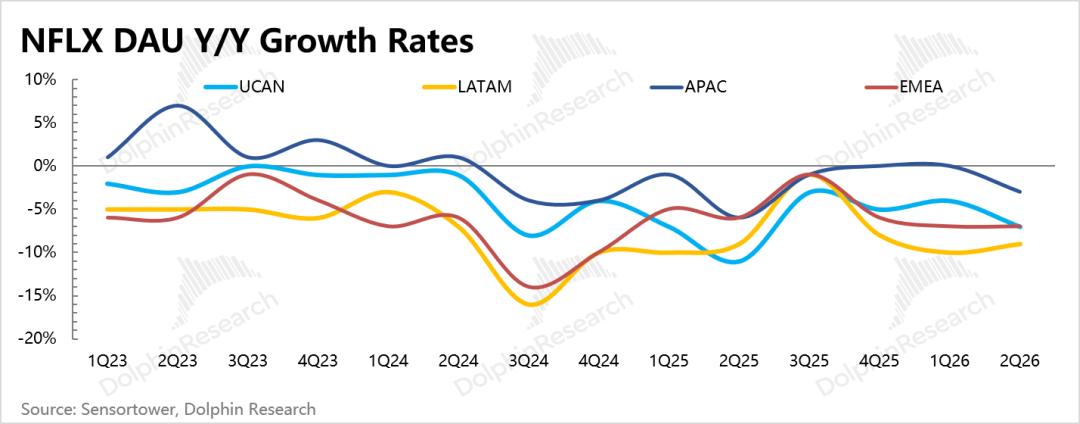
Data from Sensor Tower shows daily active users across regions continued to decline, with forward-looking indicators pointing to falling download volumes in the core U.S. market.
Second-Half Content Pipeline: Live Sports to Fill the Gap
The second-half scripted lineup remains relatively modest (highlights include Season 4 of *Lupin*, *Little House on the Prairie*, and Season 5 of *Outer Banks*), but the content slate will feature far more live sports events, particularly under Netflix's newly renewed NFL broadcast rights deal.
II. Increased Content Investments as Planned
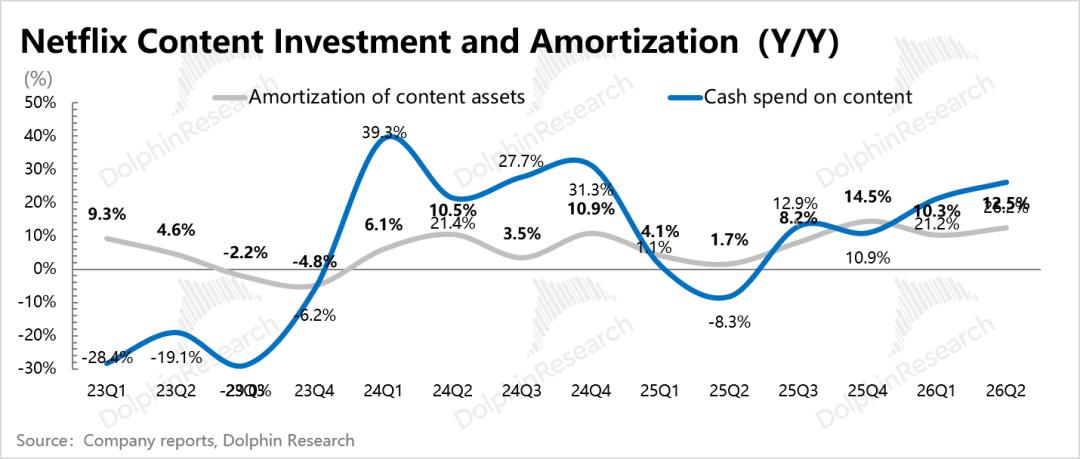
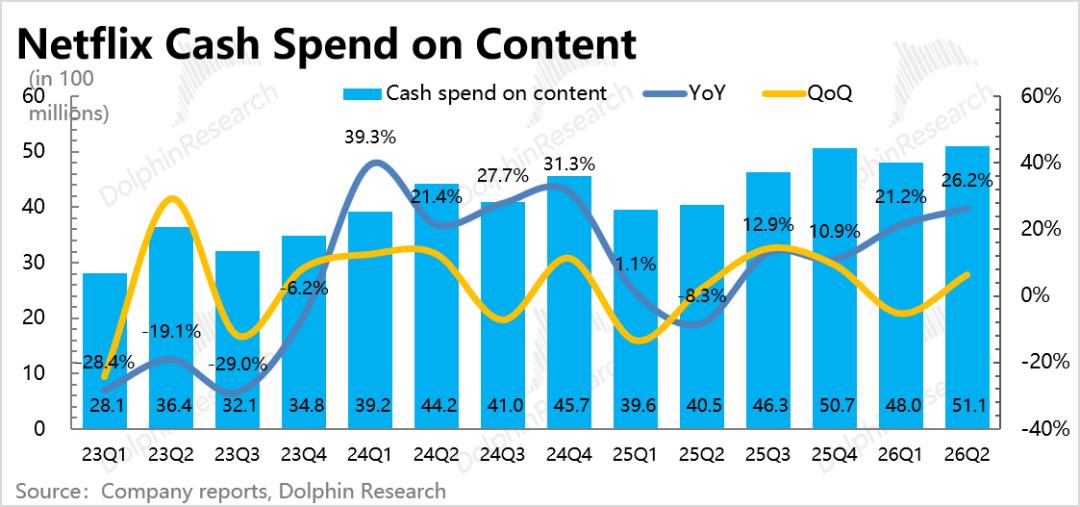
The pace of content spending among industry leaders typically reflects the intensity of sector competition, which is why we closely track content investment trends at Netflix and Disney. Netflix's Q2 content spending reached $5.1 billion, rising sequentially from Q1 and marking a 26% year-over-year increase, continuing its accelerating investment trajectory.
With nearly $10 billion spent in the first half alone, the company is on track to hit its full-year content spending target of $20 billion — representing a 10% increase in content amortization costs as outlined at the start of the year. After abandoning its planned acquisition of WBD, management has strong incentives to fully deploy its content budget to maintain competitive advantages.
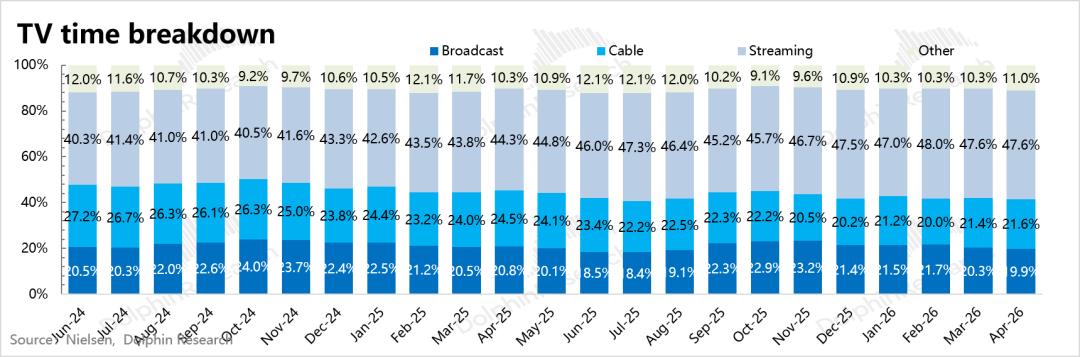
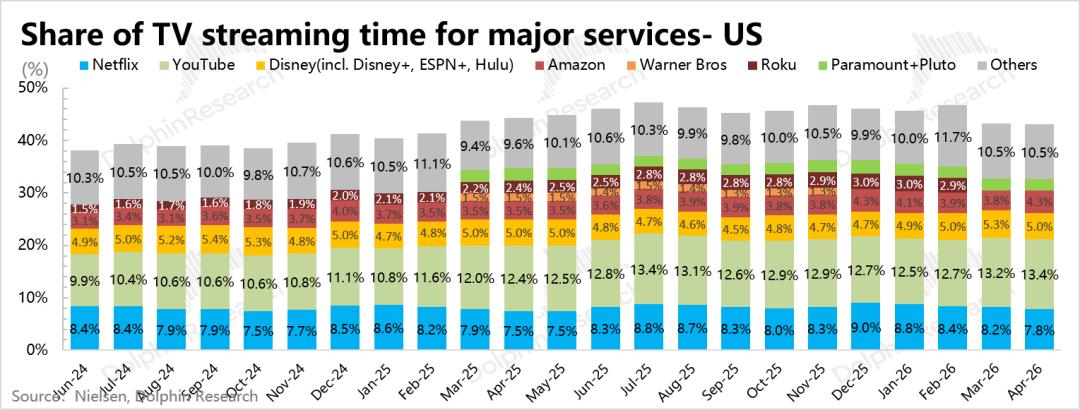
According to Nielsen viewership share data for North America, cord-cutting trends have stabilized temporarily, but competition in the streaming space remains fierce. YouTube continues to perform strongly, Amazon has taken the lead in the short term, while Netflix lags its peers.
III. Business Model Strength: Stable Profitability Amid Revenue Headwinds
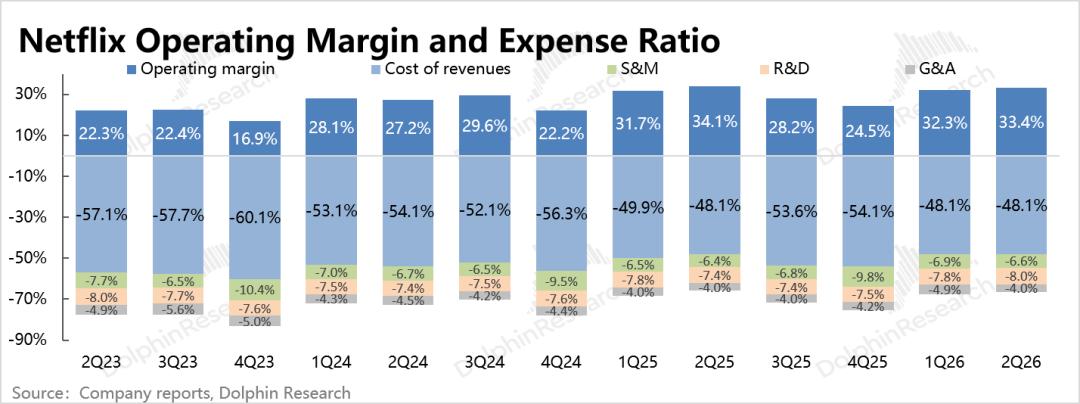
Netflix generated nearly $4.2 billion in Q2 operating profits, representing a 33% margin that modestly beat expectations, driven by operational cost efficiencies. Management has reaffirmed its full-year profitability target of 31.5% (up 2.5 percentage points year-over-year).
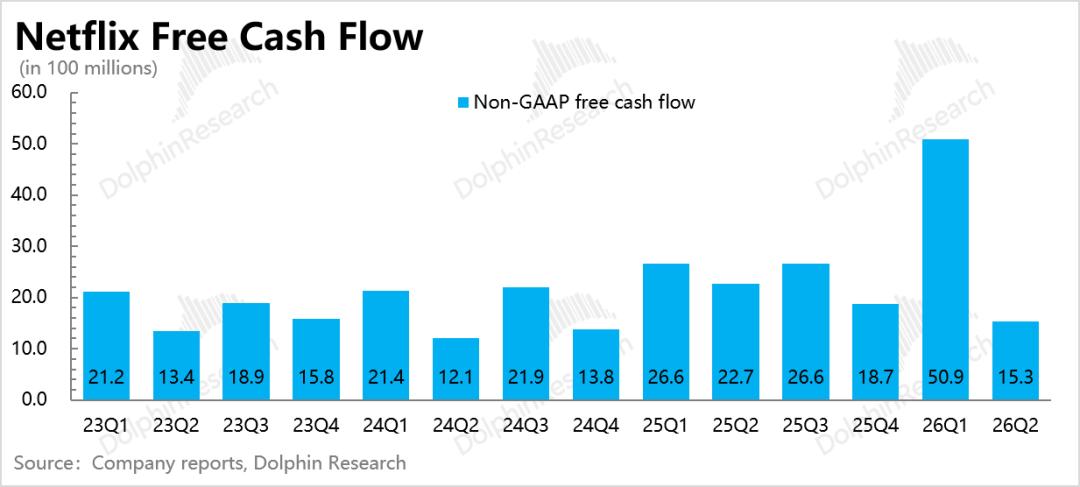
Netflix's Q2 free cash flow reached $1.5 billion, with full-year FCF still projected at $12.5 billion. The company held $6.5 billion in net cash on its balance sheet at quarter-end (with $2.5 billion in short-term debt, one tranche of which matures this year).
Following the announcement of the additional $25 billion repurchase program, buybacks in the quarter surged to nearly $5 billion, up from less than $2 billion in the prior quarter. Based on the historical 90% FCF allocation rate for repurchases, projected buybacks of $11.2 billion would deliver a 4% shareholder return at current valuations.
This article originates from the WeChat Official Account "Dolphin Research" (ID: haituntouyan), authored by the Dolphin Research team, and published with authorization from 36Kr.