Tragic: The stock price of a major memory chip maker has halved in less than a month
This morning, the Tokyo stock market staged another thrilling scene:
Leading Japanese memory chip giant Kioxia Holdings saw its stock price plummet 14% in early trading, marking a cumulative decline of over 51% from its all-time peak in mid-June. Its total market capitalization has evaporated by more than 29.5 trillion yen (approximately 181.7 billion US dollars), causing its ranking by market value to drop sharply from the top spot in Japan to fourth place.
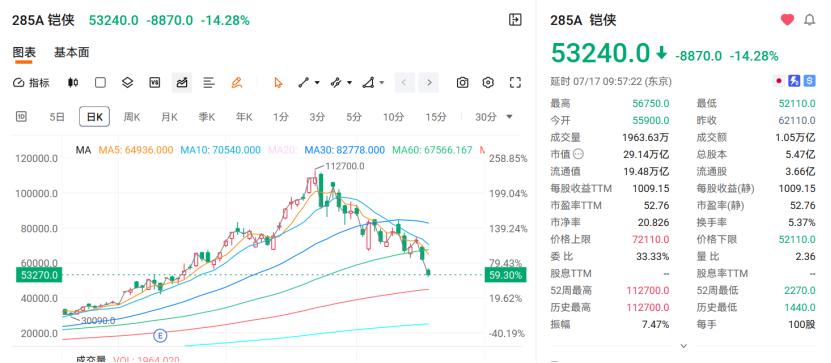
On June 22, Kioxia's share price surged to a high of 112,700 yen, surpassing Toyota Motor to claim the title of Japan's most valuable listed company.
Driven by the AI boom, Kioxia's maximum gain this year exceeded 600%, making it a member of the "memory miracle" club alongside SK Hynix, Samsung Electronics, Micron, and Western Digital.
However, after peaking at the end of June, it followed the same path as other memory chip companies, undergoing a dramatic shift from extreme optimism to panic selling.
The core driving force behind this sell-off is market concerns over the excessive run-up in valuations across the AI-related memory chip sector.
In hindsight, the market's pricing of Kioxia had already factored in an extremely optimistic scenario — that AI computing power investment would continue to grow exponentially, and Kioxia would capture a significant share of the high-end memory dividend.
Nevertheless, once the stock price has priced in years of future growth expectations in a short period, any marginal negative factor is enough to trigger a stampede for the exit.
The consecutive declines since July represent the market's brutal process of correcting these excessive premiums.
At a deeper level, these market concerns are not unfounded.
The memory chip industry has long been characterized by strong cyclicality, and the current AI-driven demand growth is facing two major practical challenges:
First, the pressure of capacity release on the supply side.
As major global memory manufacturers (including Samsung, SK Hynix, and Kioxia itself) increase capital expenditures during 2025-2026, high-end NAND capacity will gradually ramp up. The market is inevitably worried that capacity expansion could emerge from late 2026 through 2027, putting downward pressure on product prices.
This ultimately depends on the independent judgment of market capital. If the market believes the timeline is still distant and there's no need to worry, the situation remains manageable. But if investors suddenly decide this is no longer a distant concern but an imminent issue requiring attention, their behavior could shift 180 degrees in a very short timeframe.
Generally speaking, whether the situation calls for concern or can be treated as a long-term issue depends on valuation levels. When valuations have been pushed to elevated levels and trading becomes extremely crowded, the pendulum is likely to swing toward the side of anxiety.
Second, structural differentiation on the demand side.
While demand for enterprise-grade SSDs from AI servers remains robust, recovery in traditional consumer electronics segments such as PCs and smartphones has been sluggish — and these sectors still account for a substantial share of total memory chip shipments.
If consumer demand continues to weaken, it will be difficult to sustain the high prosperity across the entire industry.
The final question to consider is: even after the stock price has halved, does that mean the valuation bubble has been fully deflated?
From a valuation perspective, despite the 50% decline, Kioxia's current P/E ratio remains significantly above its historical average and the long-term semiconductor industry benchmark. The earlier 600% rally had already priced in years of future free cash flow and profitability expectations.
Entering the second half of the year, the memory chip market is likely to shift toward performance-based investment logic.
Meaning investors will no longer be satisfied with conceptual narratives and order expectations, but will demand tangible earnings per share (EPS) delivery and sustained gross margin improvement.
Once quarterly financial reports reveal slowing revenue growth or rising inventory days, the fortunes of high-valuation stocks could shift dramatically.
In addition, the Bank of Japan's potential monetary policy normalization expectations are putting pressure on highly leveraged tech companies, prompting capital to flow out of high-beta sectors and into defensive assets.
In the short term, panic sentiment may persist, with no clear timeline for when it will subside;
The medium-term trend will depend on two critical variables: first, whether leading AI customers (such as major cloud service providers) will make substantial cuts to their capital expenditure plans before year-end; and second, whether Kioxia itself can maintain pricing power through product structure upgrades (such as higher-layer 3D NAND and QLC enterprise-grade solutions) to withstand the industry downturn.
Kioxia, now with its market capitalization halved, is not necessarily a value trap — but it is also not a cheap bargain-buy opportunity.
There may be opportunities for sharp rebound rallies amid overshooting, and the trading range could be extremely wide. However, this requires the ability to seize gains amid high risks, and investors must carefully assess their own capabilities before acting.
This article originates from the WeChat Official Account "Gelonghui APP" (ID: hkguruclub), authored by the Gelonghui editorial team, and published by 36Kr with authorized permission.