The Hong Kong Stock Exchange is overwhelmed with listings, and IPOs have returned to their peak, behind which lies a profound transformation of the era.
On June 26, the Hong Kong Stock Exchange (HKEX) rang the listing bell six times in a single day. Inside the listing hall, HKEX Chairman Timothy Freshwater remarked with emotion:
"I have never seen so many people in this hall before."
In just three short weeks, a total of 35 enterprises made their debut on the Hong Kong stock market. Even more notably, an even longer queue of candidates remained waiting outside the venue.
By the end of June, HKEX still had 534 listing applications in active processing. The fundraising figures were staggering:
In the first half of the year, Hong Kong welcomed 87 new listed companies, marking a 98% year-on-year increase; total IPO fundraising reached HK$210.2 billion, up 92% from the same period last year.
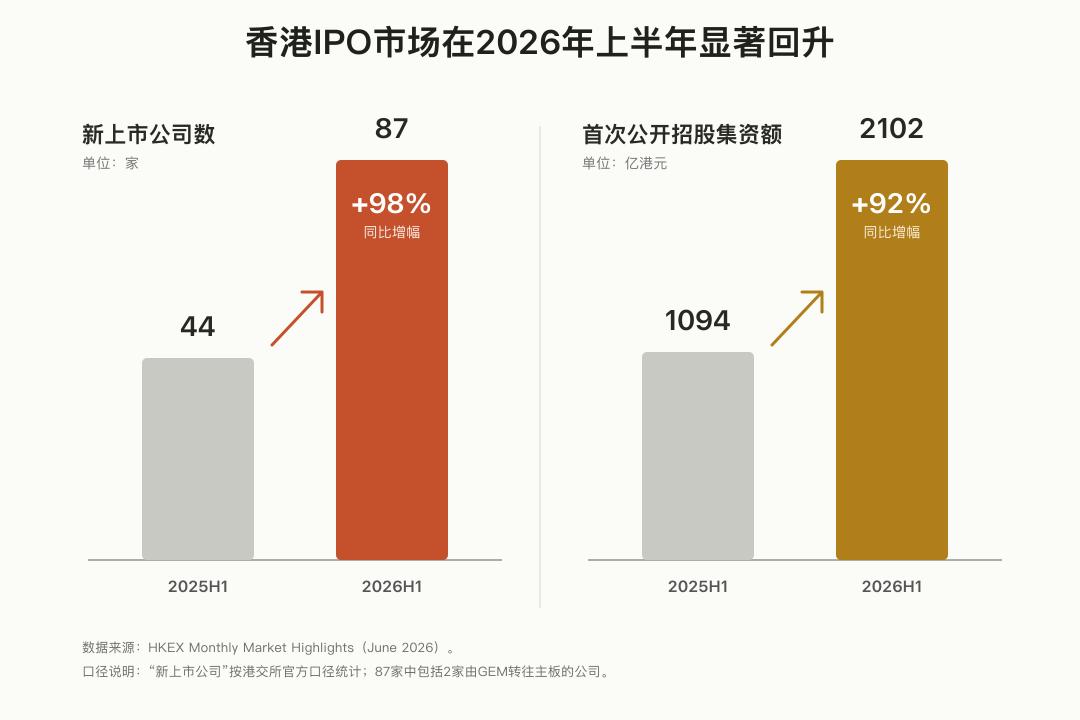
Both the number of new listings and total fundraising nearly doubled, with the HK$210.2 billion fundraising scale for the period almost matching the historical record.
It is worth noting that back in 2023, HKEX's total fundraising had plummeted to roughly HK$46 billion, a level that most enterprises actively avoided. In just three years, HKEX's IPO market has returned to its peak with remarkable momentum.
What exactly happened behind this dramatic turnaround?
The surge in listing applications at HKEX is underpinned by a sweeping, transformative era shift. Hong Kong is now fully dedicated to boosting its economy and seizing this historic opportunity.
01
Before returning to its peak, HKEX experienced a shocking cliff-like decline that left a lasting impression.
In 2020, Hong Kong's IPO fundraising volume neared HK$400 billion, making it the world's second-largest IPO market after Nasdaq. But soon after, a severe market downturn struck:
The number of new share issuances shrank year by year, the Hang Seng Index nearly halved in value, and trading activity in the secondary market dried up. Enterprises were reluctant to list, and investors were even more unwilling to buy in, pushing Hong Kong almost from its position as a global financing center to the fringes of the market.
In 2023, HKEX's total fundraising plummeted to around HK$46 billion, nearly 90% lower than its 2020 peak.
During those years, ongoing discussions circulated widely: Would Asia's financial center shift from Hong Kong to Singapore?
Today, Hong Kong has dispelled these doubts with a nearly symmetrical U-shaped recovery curve, reclaiming its position at the top of global IPO fundraising rankings.
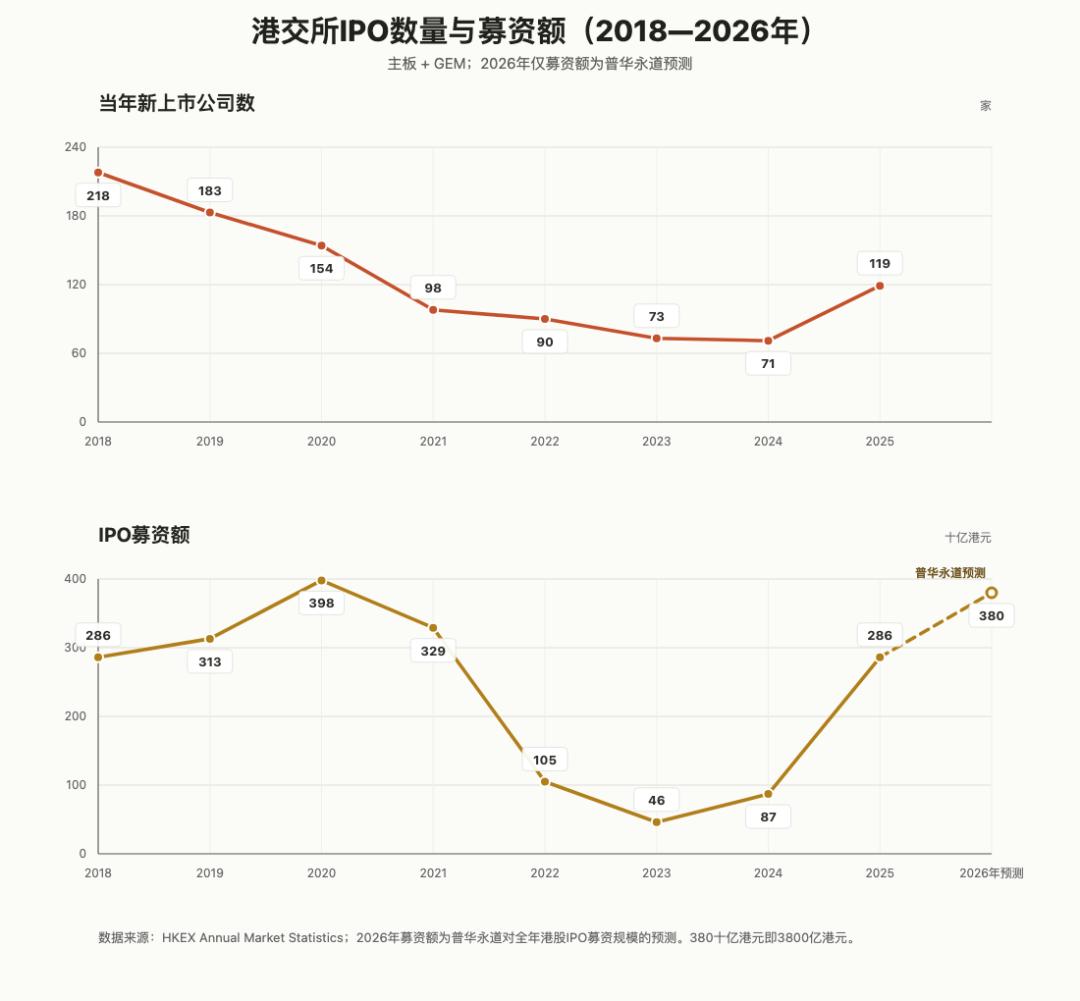
In 2025, Hong Kong recorded its first annual growth in new listed companies in seven years, with total IPO fundraising hitting HK$285.8 billion — exceeding the combined total of 2022, 2023 and 2024.
In 2026, the recovery has further accelerated. PwC projects that Hong Kong's full-year IPO fundraising could reach HK$380 billion.
If this forecast is realized, Hong Kong's IPO market size will once again approach its 2020 historical high, and is on track to rank among the top three annual fundraising totals in Hong Kong's history.
After hitting rock bottom in three years, it climbed back to peak levels over another three years, resembling the dramatic ups and downs of a roller coaster ride.
This is far more than a simple cyclical rebound. Behind it lies a massive reshaping of the era: Hong Kong's role has evolved, and the historic mission of HKEX has long since transformed.
Consider this: a mere market rally could never prompt 500 to 600 companies to queue up simultaneously for listing applications.
The core question is not why Hong Kong has recovered, but why enterprises are suddenly flocking to list there.
02
The answer lies in the shifting global landscape of listing destinations.
Chinese enterprises have historically had three primary options for public fundraising: the A-share market, Hong Kong stocks, and the U.S. stock market. For a long period, these three markets operated with distinct divisions of labor.
The A-share market has deeper familiarity with domestic enterprises and easier recognition from local investors; the U.S. market boasts a larger scale and a more mature valuation system for tech firms; Hong Kong occupied an intermediate position between the two, though it was not always the most attractive option.
Today, however, massive changes are underway, the old balance is breaking down, and the entire landscape is being reconstructed.
The A-share market has undergone tremendous adjustments in its positioning and core mission.
Since 2024, A-share listing regulations have placed greater emphasis on enterprise quality and board-specific positioning, raising certain financial thresholds for the Main Board and ChiNext, while the STAR Market has further highlighted its "hard technology" focus.
This means the A-share market now requires enterprises to demonstrate stronger profitability, better alignment with board positioning, and greater resilience to regulatory scrutiny.
The key challenge is that even as listing thresholds rise, enterprises' financing demands do not simply disappear.
Funding is needed to build factories, develop new technologies, and expand market reach. As a growing number of enterprises find it harder to meet A-share listing criteria, they naturally begin seeking alternative exit routes.
The transformations in the U.S. stock market have been even more drastic.
Historically, the U.S. market was the top choice for Chinese internet and tech enterprises seeking international financing, thanks to its massive scale, large pool of institutional investors, and established familiarity with high-growth, unprofitable tech companies.
However, after 2020, the certainty of this path began to erode.
The U.S. has continuously tightened regulatory requirements for Chinese concept stocks around audit inspections, VIE structures, data security, and information disclosure. The Holding Foreign Companies Accountable Act once exposed many Chinese enterprises to potential trading bans and delisting risks.
While progress in Sino-U.S. audit regulatory cooperation in 2022 temporarily alleviated the most pressing mass delisting risks, the underlying legislation remains in place, and uncertainties surrounding audits, data governance, and geopolitical tensions have not vanished.
For a Chinese tech enterprise preparing to list in the U.S., considerations now extend far beyond business models and financial statements.
They must now address a whole new set of questions:
Will ongoing audit requirements continue to be met? Will cross-border data flows face new restrictions? What level of disclosure and compliance costs will VIE structures incur? Could shifts in international relations suddenly disrupt financing and valuations?
These issues do not necessarily make listing impossible, but they make boardroom decisions far more difficult.
For these enterprises, the most unbearable burden is often not the high existing costs, but the inability to predict how much further costs could rise in the future.
Enterprise behavior speaks for itself.
In 2021 alone, eight U.S.-listed Chinese companies — including Baidu, Bilibili, Weibo, Ctrip, Autohome, XPeng, Li Auto, and Hutchmed — returned to Hong Kong to complete secondary listings or dual primary listings.
This was not because these companies could no longer operate successfully in the U.S. market.
Their core objective was to secure a second offshore financing channel, avoiding over-reliance on a single capital market for their growth.
As we can see, on one side the A-share market is implementing stricter enterprise screening, while on the other side the U.S. market faces rising uncertainties and compliance costs.
Chinese enterprises are now re-evaluating their options and lining up to enter the Hong Kong market.
03
Hong Kong has made full preparations to seize this historic wave of opportunities.
On the regulatory front, HKEX introduced the Chapter 18C listing regime for specialized technology companies, creating a new listing pathway for high-R&D, long-cycle, pre-profit tech enterprises in sectors like artificial intelligence, advanced software and hardware, new materials, and new energy.
In the past, many enterprises were not lacking in technology or growth prospects, but simply failed to meet the revenue and profitability requirements of traditional listing rules. Chapter 18C effectively fills this regulatory gap.
However, allowing enterprises to list only solves the "entry" problem. Ensuring sufficient capital support after listing is far more critical.
In the first half of 2026, Hong Kong stock market recorded an average daily turnover of HK$283 billion, up 18% year-on-year; in June alone, average daily turnover further rose to HK$319.1 billion, marking a 39% year-on-year increase.
The rebound in trading turnover demonstrates that Hong Kong's recovery extends beyond index performance to include real trading vitality and robust capital absorption capacity.
For example, industry giant CATL raised roughly HK$41 billion in Hong Kong in May 2025, making it the largest Hong Kong IPO since February 2021. The successful completion of such a massive financing deal carries far more weight than adding dozens of small listed companies:
Hong Kong is not just attracting new enterprises back — it has regained the full capacity to support large-scale listing projects.
04
A notable emerging trend is that A-share listed companies are also actively queuing to list in Hong Kong, building A+H dual-listing structures.
In the first half of 2026, A-share companies listing in Hong Kong raised a total of HK$121.7 billion, accounting for roughly 58% of Hong Kong's total IPO fundraising volume.
What explains this phenomenon?
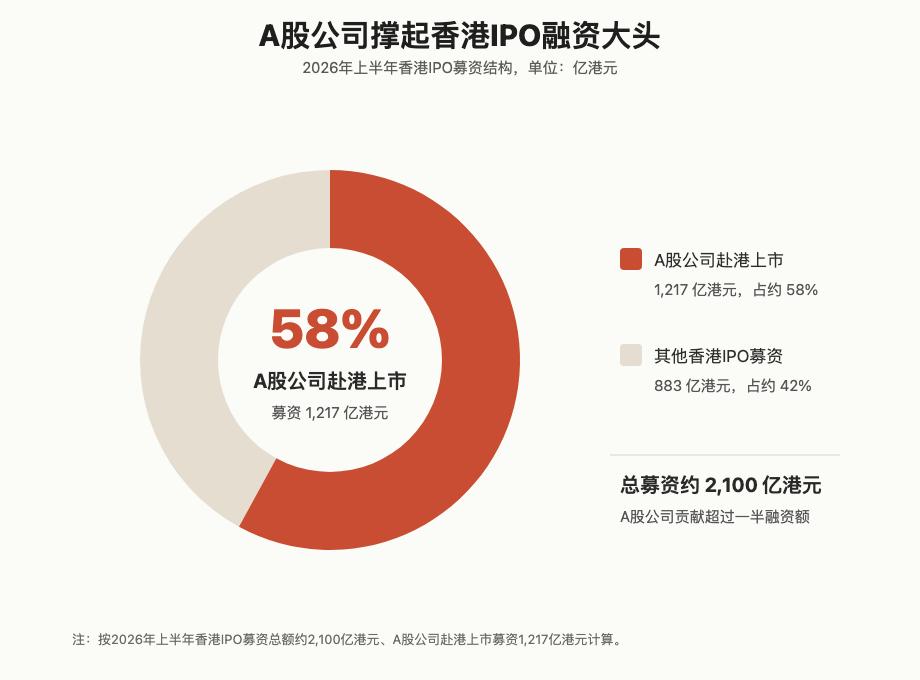
This precisely underscores Hong Kong's unique and critical role in the current era.
Leading mainland enterprises that already have established scale, industry influence, and financing capabilities are not listing in Hong Kong because they cannot secure funding domestically, but to build a second independent financing channel.
Through Hong Kong, they gain access to global institutional investors, raise international capital, and secure funding support for overseas factory construction, cross-border mergers and acquisitions, and global business expansion.
For Estun Robotics, roughly 60% of the funds raised in Hong Kong are directly allocated to its global expansion strategy; after listing, its share price once rose by about 25% from the offering price. Guanghe Technology has also directed its raised funds to overseas production bases and market development, with its share price nearly doubling from the listing price at one point.
For these enterprises, the Hong Kong stock market is not a fallback option — it is their strategic gateway to the global market.
This is not just a capital market story. Against the backdrop of the new era, Hong Kong's strategic positioning has undergone a massive transformation:
Hong Kong has become the world's only super-connector that simultaneously links China and international capital markets — hosting both Chinese assets and access to the U.S. dollar system, while operating the world's largest offshore RMB market.
As unilateralism and regional conflicts introduce uncertainties into the global economic outlook, capital is accelerating its flow toward stable, reliable "safe havens", and Hong Kong's "safe haven effect" has fully manifested.
In 2026, an unprecedented scenario unfolded: Hong Kong's GDP growth rate actually surpassed that of Shenzhen.
In the first quarter, Hong Kong recorded a GDP growth rate of 5.9%, which surprised many observers. This figure exceeded Shenzhen's 5.8% growth rate — a situation that has never occurred since China's reform and opening-up initiative.
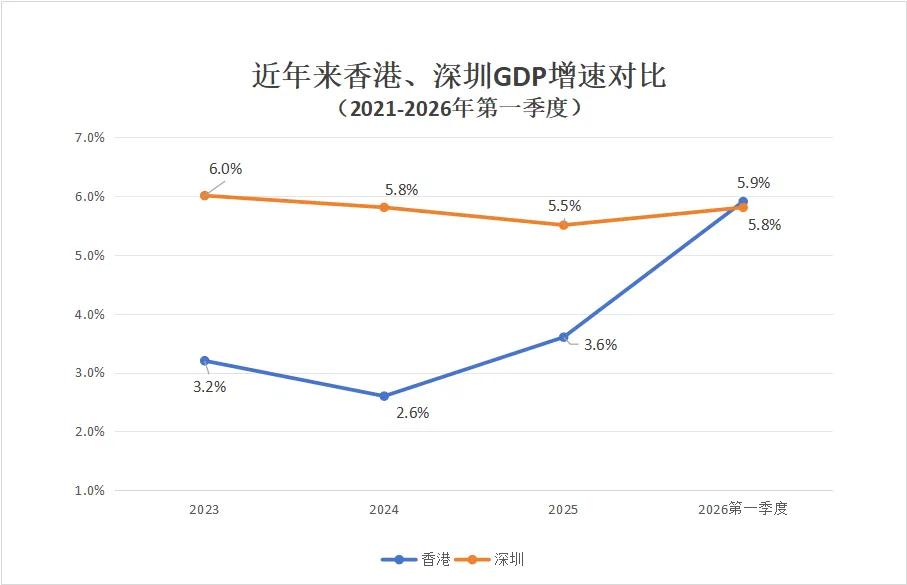
This does not mean Shenzhen's development has slowed down — it means Hong Kong has fundamentally transformed.
In the eyes of global capital, economies with stable growth momentum, consistent political resolve, and predictable regulatory frameworks are the destinations where they truly want to establish long-term presence.
Hong Kong's "certainty" stems directly from its unique status: under the "One Country, Two Systems" framework, it benefits from a common law system, free capital flow, a simple low-tax regime, robust banking regulation, and globally recognized financial services.
According to the "2026 Global Wealth Report" released by Boston Consulting Group (BCG), Hong Kong has officially overtaken Switzerland to become the world's largest cross-border wealth management center.
When viewed as a whole, the resurgence of Hong Kong's IPO market is not an isolated market trend — capital flows, enterprise activity, trade volumes, and cross-border services in Hong Kong are all on the rise.
The lengthening queue outside HKEX reveals an evolving roadmap linking Chinese enterprises and global capital, which is quietly reshaping the landscape. A new era belonging to the East is dawning, and Hong Kong stands right at the center of this stage.
This historic, epoch-making transformation has only just begun.
References:
1. Zhigu Trend: The century-old myth shattered, Hong Kong surpasses Switzerland to claim the global top spot
This article originates from the WeChat Official Account "Zhigu Trend", authored by Dong Yucheng, edited by Jian Shu, and published by 36Kr with authorized permission.