Do not deny the long-term value of high-quality companies just because the market sentiment of the US stock market has collapsed.
On Thursday in the U.S. Eastern time zone, AI tech stocks continued their steep decline.
Memory, optical communications, semiconductor equipment, and AI hardware sectors faced nearly broad pressure. From Samsung and SK Hynix in South Korea to the U.S. memory and AI industrial chains, capital sell-offs are no longer limited to one or two companies, but are occurring simultaneously across the world's most crowded tech trades.
Meanwhile, TSMC, despite delivering an almost impeccable earnings report, still failed to stabilize its share price. The market is sending a very harsh signal:
When capital begins a concentrated retreat, even strong fundamentals in the short term may not prevent position unwinding, valuation compression, and sentiment-driven stampedes.
I know many of you are going through extreme hardship right now.
The profits accumulated painstakingly over the past few months have been largely erased in just a few days; the faint hope of a rebound was quickly crushed by a new round of sell-offs. Especially for investors who have been trading around AI, chips, and memory all year, what they face is not just a regular pullback, but a sudden loss of market reward for the main investment theme they were most confident in.
You want to add positions, but fear there are even lower levels ahead; you want to reduce holdings, yet worry you might sell exactly at the emotional bottom. The company's performance hasn't suddenly deteriorated, but the stock price weakens day by day; the more the market falls, the more you want to cut losses, yet after clearing your positions, you fear a retaliatory rebound the next day.
Some friends are even in so much pain that they no longer want to open their accounts, just wanting to liquidate all stocks to free themselves from this repeated torment once and for all.
If you are caught in this tangle and anxiety right now, I fully understand. Like you, we are also experiencing the violent swings of tech stocks and facing the same position pressure and emotional test.
The more such moments arise, the less we should let pain make decisions for us. Before clicking "Sell All," we must first clarify:
Is this round of decline a fundamental reversal of the AI industry, or a concentrated deleveraging triggered jointly by high valuations, crowded positions, and leveraged capital?
This distinction will directly determine whether you should flee the market now, or weather through this most painful period.
Let's start with our judgment on Netflix's earnings today. Before the report release, we already alerted potential risks in our VIP group.
According to forward-looking data from U.S. stock big data platform StockWe, although growth in the Asia-Pacific region may provide partial offset, U.S. domestic user growth is facing severe weakness, with the core issue lying in a notable rise in churn rate — especially a sharper surge in churn during the first two weeks of July.
Furthermore, we identified a critical flaw in its content strategy in advance: while app opening frequency remained decent, the actual usage duration among young users did not see real growth due to insufficient content appeal. This targeted warning was fully validated the moment after-hours earnings were released.
After the market closed, Netflix reported Q2 revenue of $12.56 billion and EPS of $0.80. While the headline financial figures barely met Wall Street expectations, investor concerns over soft user engagement metrics were instantly ignited.
As the growth bottleneck revealed by our forward-looking data suggested, the market refused to buy into the "passable performance" narrative, and the stock price was ruthlessly sold off in after-hours trading, plummeting over 8% immediately.
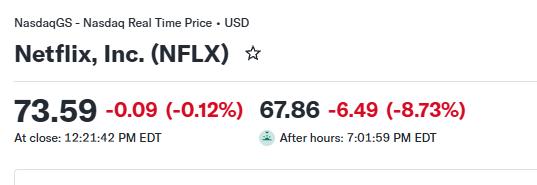
What further accelerated capital flight was Netflix management's announcement to reduce the release frequency of its core viewership report "What We Watched" to once a year, attempting to force the market's focus away from user duration metrics and onto pure financial results.
This move to conceal underlying weakness in core metrics precisely confirmed our big data's accurate prediction of its "user engagement erosion."
Two Earnings Reports, Two Fates
To answer whether AI fundamentals have reversed, the most worthy research today is not the indices, but two earnings reports with completely opposite trajectories.
AEHR Skyrockets: Orders Tell the Whole Story
The first comes from Aehr Test Systems, ticker AEHR.
Many investors are unfamiliar with this company. In short: it manufactures semiconductor testing and burn-in equipment.
Before mass production, AI processors, silicon photonic chips, and power semiconductors require wafer-level or package-level burn-in testing to pre-screen products prone to failure. The more expensive, higher-power-consuming, and costly to package a chip is, the more unacceptable it becomes to discover reliability issues only after completing advanced packaging or even installing the chip in a data center.
AEHR sells exactly this type of testing equipment, contactors, and consumables.
Thus, it is not the most glamorous AI chip design company, but the "quality insurance" hidden behind the chip mass production process. When customers prepare to ramp up production of AI chips, optical communication components, and data center processors, they often need to increase their testing and burn-in equipment purchases in advance.
AEHR rose nearly 46% on the trading day following its earnings release. What truly excited the market was not how much profit the company made this quarter, but the simultaneous inflection points in new orders, backlog, and next year's guidance.
The company's fiscal Q4 figures are as follows:
Revenue of $18.8 million, up from $14.1 million in the same period last year;
GAAP net income of $1.4 million, compared with a loss of $2.9 million a year earlier;
Non-GAAP EPS of $0.11, versus a loss of $0.01 in the prior year;
New orders in the single quarter reached a record $60.7 million;
Active backlog hit $100.6 million;
Fiscal 2027 revenue guidance is set between $130 million and $150 million.
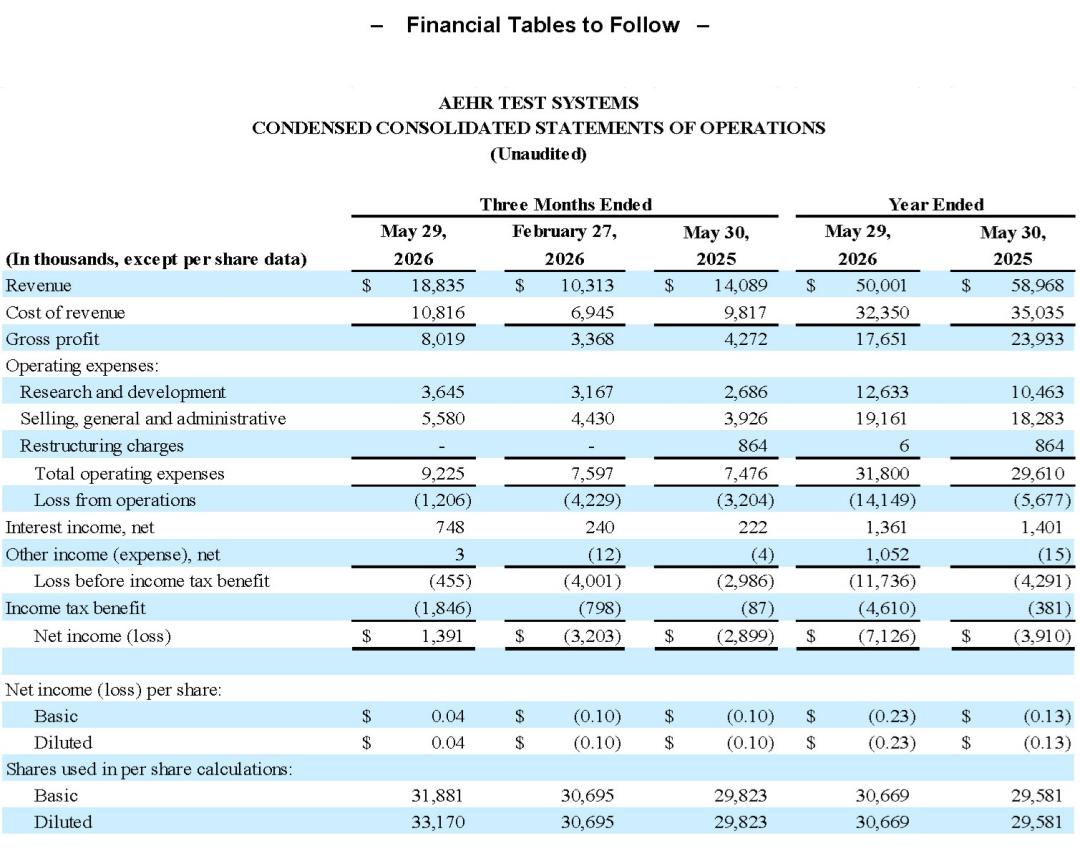
AEHR's total revenue in fiscal 2026 was only $50 million. This means the company's guidance for the next fiscal year represents a 160% to 200% year-over-year growth.
Why Was the Market Willing to Push the Stock Up Nearly 46% in a Single Day?
Because this is not a vague AI narrative, but tangible evidence that customer capacity expansion is translating into equipment orders and revenue guidance.
The company disclosed that leading AI customers are significantly ramping up production capacity, shifting burn-in testing for some AI accelerators from system-level to wafer-level; in package-level testing, a top hyperscale data center customer is also increasing equipment purchases for custom AI processors.
Silicon photonics business is also accelerating. The company stated that as AI data centers increasingly rely on optical I/O and high-speed interconnections, major silicon photonic customers are expanding production capacity, while another global network equipment customer has provided demand forecasts for additional testing systems.
This earnings report tells us: in the testing, silicon photonics, and data center infrastructure segments of the AI industrial chain, customers are not broadly canceling orders — they are preparing to expand production.
Of course, AEHR remains a relatively small company with high customer concentration and significant performance volatility. Its fiscal 2026 revenue still declined about 15% year-over-year, with a full-year GAAP loss of $7.1 million. Therefore, a one-day surge does not guarantee the stock will only rise from here, nor does it mean investors should blindly chase highs.
But it at least provides a critical industrial signal: part of the demand for AI infrastructure is still accelerating its realization.
The Stronger TSMC Gets, the More Demanding the Market Becomes
If you only look at operating metrics, TSMC's earnings report is nearly impeccable:
Q2 revenue reached $40.2 billion;
In New Taiwan Dollar terms, revenue grew approximately 36% year-over-year;
Net profit hit NT$706.6 billion, a 77% year-over-year increase;
Gross margin reached 67.7%, exceeding the upper end of the previous 65.5%-67.5% guidance range;
Operating margin hit 60.3%;
Q3 revenue guidance is set between $44.6 billion and $45.8 billion;
The full-year 2026 revenue growth outlook was raised from "over 30%" to "slightly above 40%."
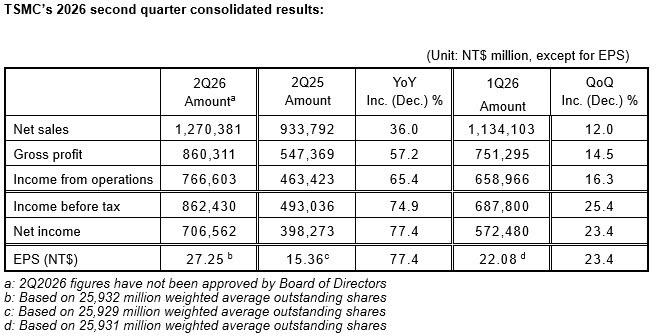
This is a report featuring robust revenue, profits, gross margins, and full-year guidance across the board. But why did the stock price still fall?
Because the market's focus has shifted from "Is AI demand strong enough?" to "How much more capital does the company need to invest to meet this demand, and how long will it take for these investments to generate returns?"
TSMC's actual Q2 gross margin was 67.7%, with Q3 guidance set at 65%-67%; actual Q2 operating margin was 60.3%, with Q3 guidance at 56%-58%.
It's important to emphasize that while Q3 margin guidance is lower than Q2's actual figures, it still remains at a very high level. This is more of a pullback from exceptionally strong profitability, rather than a sudden deterioration in operating conditions.
What truly made the market hesitant was the continued rise in capital expenditures.
TSMC raised its 2026 capex plan from the earlier $52-$56 billion range to $60-$64 billion, while announcing an additional $100 billion investment in the U.S., bringing its total U.S. investment commitment to approximately $265 billion.
Capacity expansion certainly signals strong demand, but it also means higher depreciation, larger cash outlays, and potential cost pressures from overseas fabs.
This is the contradiction presented by TSMC's earnings today:
On one hand, AI demand remains robust, with the company even anticipating strong demand could persist through 2029-2030; on the other hand, to accommodate this demand, TSMC must deploy more capital, prompting the market to question whether future return on investment and margin levels can be sustained long-term.
Thus, TSMC's decline does not directly prove that AI demand has collapsed. More accurately, the market is no longer simply rewarding "growth" — it has begun scrutinizing how much that growth costs.
What Is the Market Actually Trading in These Two Earnings Reports?
AEHR and TSMC, despite their seemingly opposing trajectories (one skyrocketing, one falling), actually point to the same industrial direction.
AEHR's record orders and 160%-200% revenue growth guidance for the next fiscal year demonstrate that AI processor, silicon photonics, and data center customers are ramping up production preparations.
TSMC's upward revision to full-year revenue growth and increased capex also indicates that advanced process capacity remains tight, with customer demand not vanishing suddenly.
Together, these two earnings reports confirm: AI infrastructure investment is still ongoing.
The real difference lies in the market's differing expectations for the two companies.
AEHR had a relatively low performance base beforehand, with the market anticipating a business inflection point. Now that orders and guidance have suddenly accelerated, expectations have been revised upward, and the stock price naturally received its reward.
TSMC, however, had already accumulated massive gains, with the market long expecting it to deliver a strong earnings report. Therefore, even with excellent performance, capital continues to press further questions: Is capex too high? Have margins already peaked? Will overseas capacity expansion dilute returns?
In short: AEHR is trading on a transition from low expectations to high growth, while TSMC is trading on a transition from high expectations to return scrutiny.
This explains why two companies that both benefit from AI can see one surge nearly 46% while the other falls after a strong earnings report.
The AI Crowded Trade Continues to Unwind
Let's return to Thursday's market action. Nearly three-quarters of S&P 500 constituents posted gains, with the healthcare sector rising 2.2%.
This indicates that the U.S. economy as a whole did not suddenly break down — instead, a handful of extremely high-weight, massive-gain, position-crowded tech stocks are undergoing concentrated position unwinding.
Memory stocks are particularly representative. Even after recent pullbacks, SanDisk is still up nearly 500% year-to-date, Western Digital has risen over 170%, and Micron's YTD gain is close to 200%.
When a trade has accumulated such enormous profits, any concerns over valuation, capex, and long-term demand can trigger institutional profit-taking, leveraged capital retreats, and quantitative position adjustments.
Compounding this, the U.S. 10-year Treasury yield rose to 4.56%, with elevated interest rates continuing to pressure high-valuation assets, naturally amplifying volatility in tech stocks.
Therefore, what was primarily de-risked today were valuations and crowded positions, not the overnight disappearance of demand across the entire AI industry.
A Falling Stock Price Does Not Equal Disappearing Value
When the market panics, people are most prone to reinterpreting all fundamentals through the lens of that day's stock prices.
During rallies, we believe in AI demand, technological moats, and long-term growth; during declines, we suddenly conclude that all demand is a bubble, all capex is wasteful, and the original investment thesis was flawed from the start.
But a company's competitiveness does not vanish simply because its stock price falls 10% in a single day.
The technological moat of advanced processes does not disappear overnight; cloud providers will not halt all data center construction just because of a few days of pullbacks; the demand for AI processors, memory, and high-speed interconnections will not suddenly drop to zero due to diminished risk appetite.
However, this does not mean every decline is an unjustified mispricing, nor does it mean any company with "AI" in its name should be held forever.
To judge a company's long-term value, you need to examine at least four things:
First, whether customer demand and orders have experienced a substantive reversal.
Second, whether revenue, margin, and cash flow expectations have been continuously revised downward.
Third, whether the company's technological moat and industry position have been eroded by competitors.
Fourth, whether the current valuation has already fully priced in the next several years of growth.
If orders are still increasing, profits are still being realized, and competitive moats remain intact, yet the stock price falls purely due to market sentiment and position unwinding, then the company's intrinsic value and short-term market price have become misaligned.
But if fundamentals have already deteriorated, you cannot hide poor judgment behind the excuse of "long-term investing."
Don't Make a One-Size-Fits-All Bet Amid Panic
Facing this kind of market, the greatest danger is often not the decline itself, but making a one-off decision at the peak of emotional extremity.
Liquidating everything is betting that the market will continue plummeting from today's level;
Fully adding to positions in one go is betting that today marks the absolute bottom.
We cannot make these two decisions for you right now. A more sensible approach is to re-examine your holdings:
Core companies with strengthening fundamentals and continuously realized orders and profits deserve focused monitoring of their valuations and position levels;
High-valuation companies with strong long-term narratives