Shanghai's property market mid-year review: new home prices rise 3.7% to lead the country, with second-hand home transactions exceeding 20,000 units for four consecutive months
On July 15, the National Bureau of Statistics released the changes in sales prices of commercial residential properties in 70 large and medium-sized cities across China for June 2026.
The data shows that in June, the sales prices of commercial residential properties in first-tier cities rose month-on-month, while those in second- and third-tier cities decreased or remained flat, and the year-on-year decline in first-, second-, and third-tier cities continued to narrow in general. The number of cities where the sales prices of new commercial residential properties rose month-on-month continued to increase compared with the previous month.
In addition, according to Mao Shengyong, Deputy Director of the National Bureau of Statistics, who revealed at a press conference held by the State Council Information Office on July 15, a housing price questionnaire survey conducted by the National Bureau of Statistics in 70 large and medium-sized cities shows that after the Spring Festival, real estate market practitioners' expectations for the price trends of new and second-hand homes have improved. In June, 63.1% of real estate market practitioners expected the sales prices of new commercial residential properties to remain stable or rise in the coming six months, maintaining above 60% for four consecutive months, up 20 percentage points from the low point last year.
Zhang Bo, Dean of the 58 Anjuke Research Institute, said in an interview with a reporter from *Times Weekly* that the housing price data of 70 cities in June clearly shows signs of the market bottoming out and recovering, with improving demand continuing to be released.
"Combined with the orientation of the 15th Five-Year Plan to increase the supply of improved housing, the potential for reasonable residential consumption will continue to be released, and the pace of market recovery in the second half of the year will remain unchanged for high-quality core improved housing resources in cities with concentrated populations," Zhang Bo stated.
Among the 70 cities, in June, Shanghai's new home prices rose 0.3% month-on-month, an increase of 0.1 percentage points larger than the previous month; in terms of second-hand homes, Shanghai's housing prices led the country with a 0.4% month-on-month increase, a 0.2 percentage point narrower increase than the previous month. Both the month-on-month growth rates of new and second-hand home prices in Shanghai ranked first among first-tier cities.
In the first half of this year, Shanghai's new home prices rose 3.7% year-on-year, significantly leading the country; second-hand home prices fell 5.4% year-on-year.
For the future market, Lu Wenxi, a senior analyst at Centaline Property Shanghai, told a reporter from *Times Weekly* that July is a traditional off-season for the real estate market, and there will be periodic seasonal fluctuations in the market. It is expected that the transaction volume of Shanghai's real estate market may shrink slightly, but housing prices will continue to rebound slightly with inertia, and the warming trend will continue.
01
Shanghai's new home prices rose 3.7% year-on-year in the first half of the year, with transaction enthusiasm for rigid-demand and first-improvement projects increasing
Data from the National Bureau of Statistics shows that in June, the sales prices of new commercial residential properties in first-tier cities rose 0.1% month-on-month, a 0.1 percentage point decrease from the previous month's growth rate; second-tier cities' prices changed from a 0.1% month-on-month decline in the previous month to remaining flat; third-tier cities' prices fell 0.3% month-on-month, with the decline narrowing by 0.1 percentage points compared with the previous month.
In addition, the sales prices of new commercial residential properties in first-tier cities fell 1.3% year-on-year, with the decline narrowing by 0.4 percentage points compared with the previous month; second-tier cities' prices fell 3.1% year-on-year, with the decline narrowing by 0.1 percentage points; third-tier cities' prices fell 4.2% year-on-year, with the decline remaining the same as the previous month.
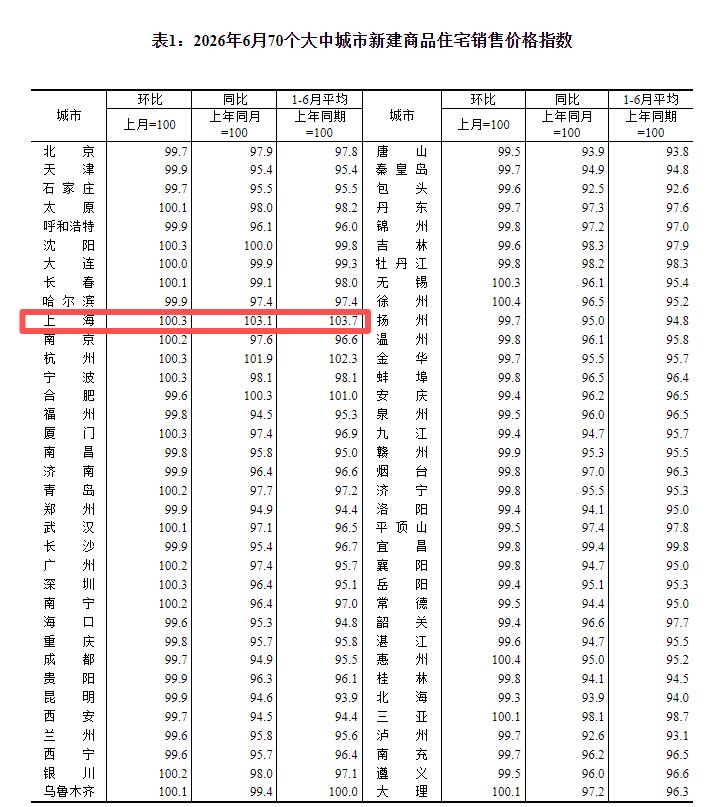
Image source: National Bureau of Statistics
In Zhang Bo's view, the full recovery of first-tier cities has been basically confirmed. He said that the continuous month-on-month rise in second-hand home prices in first-tier cities is mainly supported by the continuous release of improved replacement demand, which also resonates with the recent policy orientation of "increasing the supply of improved housing based on city-specific conditions" proposed in the 15th Five-Year Plan for Expanding Consumption.
However, Zhang Bo also pointed out that it is necessary to objectively recognize that homebuying confidence in first-tier cities is still in a stage of continuous recovery, and the upward momentum of the market is not balanced.
At the city level, in June, among the 70 large and medium-sized cities, 20 cities saw new home prices rise month-on-month, an increase of 4 from the previous month, the highest number since May 2025. Among them, Shanghai's new home prices rose 0.3% month-on-month, with the growth rate expanding by 0.1 percentage points compared with the previous month.
In terms of year-on-year growth, Shanghai's new home price increase reached 3.1%, ranking first in the country. Looking at the data for the first half of this year, Shanghai's new home price performance is even more prominent. From January to June, Shanghai's new home prices rose 3.7% year-on-year, significantly leading other cities across the country.
In Lu Wenxi's view, from the fundamental perspective of housing prices, Shanghai has scarce high-quality land and persistently high land prices. Coupled with the concentrated launch of multiple "land king" projects in various regions this year, there is no basis for new home prices to fall, and they will continue to show a trend of high-level fluctuations and steady growth in the future.
As for the rising housing prices, the transaction structure of new homes in Shanghai has changed significantly in the first half of the year. Lu Wenxi pointed out that the implementation of multiple policy dividends such as the "Seven Shanghai Housing Policies", new home purchase reserve, and expanded housing ticket scope has fully activated rigid demand and first-improvement homebuying demand.
Data from Centaline Property Shanghai shows that from January to June this year, the total transaction volume of new homes in Shanghai reached 2.5604 million square meters. In the top 10 list of new commercial residential property transaction areas in Shanghai, 4 projects have an average transaction price below 50,000 yuan per square meter, while this number was 0 in the same period of 2025.
At the same time, Lu Wenxi also pointed out that the high-end luxury home market has cooled down significantly, with insufficient growth momentum, and a divergent pattern has become prominent. Currently, only top-tier luxury projects in the core downtown areas and with scarce riverfront resources can maintain a high deconstruction rate of over 90%, while many other projects have a deconstruction rate of less than 60%.
Lu Wenxi believes that the downturn in the high-end market is due to two reasons: on the one hand, the homebuying threshold has risen sharply, with the average entry price in the inner and middle ring areas exceeding 14 million yuan per unit, and the average price in the middle and outer ring areas also reaching the 10 million yuan level, which has greatly overdrawn the purchasing power of ordinary improvement groups; on the other hand, the replacement chain has not been fully connected, with second-hand home transactions concentrated in the rigid demand segment below 3 million yuan per unit, and the proportion of improvement transactions above 5 million yuan per unit is relatively low. The average price of new homes per unit is nearly 9 million yuan, which requires multiple rounds of replacement iterations to meet the standard, and the replacement gap directly restricts the deconstruction of high-quality housing resources.
02
Shanghai's second-hand home prices fell 5.4% year-on-year in the first half of the year, with transaction volume exceeding 20,000 units for 4 consecutive months
The data shows that in June, the sales prices of second-hand residential properties in first-tier cities rose 0.3% month-on-month, a 0.1 percentage point decrease from the previous month's growth rate; second-tier cities' prices fell 0.3% month-on-month, with the decline expanding by 0.1 percentage points compared with the previous month; third-tier cities' prices fell 0.4% month-on-month, with the decline remaining the same as the previous month.
In terms of year-on-year changes, the sales prices of second-hand residential properties in first-tier cities fell 4.9% year-on-year, with the decline narrowing by 0.9 percentage points compared with the previous month; second- and third-tier cities' prices fell 5.4% and 6.0% year-on-year respectively, with the declines narrowing by 0.3 and 0.2 percentage points respectively.
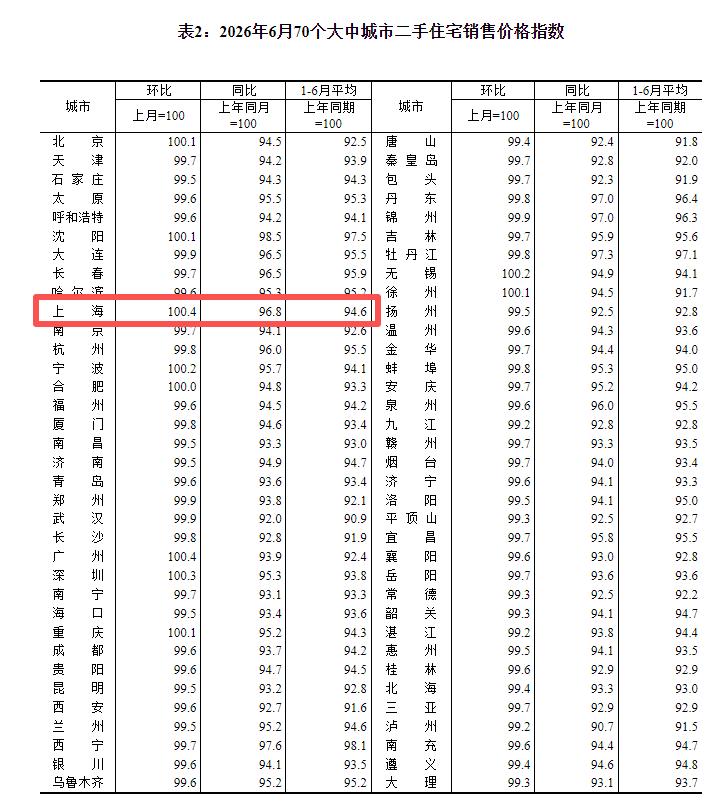
Image source: National Bureau of Statistics
At the city level, in June, among the 70 large and medium-sized cities, 9 cities saw second-hand residential property prices rise month-on-month, a decrease of 1 from the previous month. In this regard, Yan Yuejin, Vice President of the Shanghai E-House Real Estate Research Institute, pointed out that from the perspective of recovery momentum, the second-hand home market is relatively weaker than the new home market. This round of second-hand home warming is mainly concentrated in core cities and relatively economically developed second- and third-tier cities.
Among them, Shanghai's second-hand residential property prices rose 0.4% month-on-month, tying with Guangzhou for the first place in the country in terms of growth rate; in terms of year-on-year changes, Shanghai's second-hand residential property prices fell 3.2%, with the decline narrowing by 1.1 percentage points compared with the previous month. From January to June this year, Shanghai's second-hand home prices fell 5.4% year-on-year.
From the perspective of market activity, in June, the transaction volume of Shanghai's second-hand home market remained at a high level. According to data from the online real estate platform, in June, the transaction volume of second-hand homes (including commercial properties) in Shanghai reached 25,100 units, a year-on-year surge of 21%, maintaining above 20,000 units for 4 consecutive months. In the first half of 2026, the total transaction volume of second-hand homes (including commercial properties) in Shanghai reached 147,300 units, hitting a new high in the same period in the past 5 years, with a year-on-year increase of about 13%.
It is worth noting that even after entering the traditional off-season of July, this market activity is still continuing. Data from the online real estate platform shows that as of July 14, the transaction volume of second-hand homes (including commercial properties) in Shanghai in July reached 10,300 units, up 21% compared with the same period in 2025.
Lu Wenxi believes that the second-hand home market in the second half of the year is generally expected to focus on fluctuating recovery, with possible slight seasonal fluctuations in prices, but the overall upward trend of recovery will not change, and the full-year transaction volume this year will most likely exceed that of last year.
However, Lu Wenxi also pointed out that the current recovery of the second-hand home market still has limitations: homebuyers generally prefer to buy homes with full payment or pure provident fund loans with low leverage, which greatly restricts the improvement and replacement capacity. If more improvement-friendly policies are implemented in the future, it will effectively connect the replacement chain, activate improvement demand, and further consolidate the continuous rebound trend of the second-hand home market.
This article is from the WeChat official account "Times Weekly" (ID: timeweekly), written by Zhang Yijing, and published by 36Kr with authorization.