Second-hand luxury fuel cars see prices plummet sharply
Luxury fuel-powered vehicles once renowned for their high residual value are experiencing an unprecedented sharp price plunge in the used car market.
"Used car prices started dropping in April and May, then plummeted off a cliff in June, leaving many dealers exclaiming they simply can't hold on." On July 15, Fan Shuai (pseudonym), a used car dealer with years of experience in Changzhou, told a reporter from Caixin, compared to the market conditions in March, local pre-owned luxury fuel cars have generally seen price cuts of around 20%. For example, the price of a Mercedes-Benz E-Class has fallen by 30,000 to 40,000 yuan in just two months. "Last month, I arranged a flatbed truck to bring a used car back from another province, and the vehicle's price dropped while it was still in transit."
Thousands of kilometers away in Beijing, used car dealers are going through the exact same experience.
As a barometer of the industry, the Beijing Huaxiang Used Car Market is filled with dense posters announcing "Direct Price Cut of X0,000 Yuan" and "Limited-Time Shock Low Price". During an on-site visit, the reporter noticed most staff members seemed unenthusiastic when approached by inquiring consumers, while many small-scale dealer owners chose to stay cool indoors or in shaded areas.
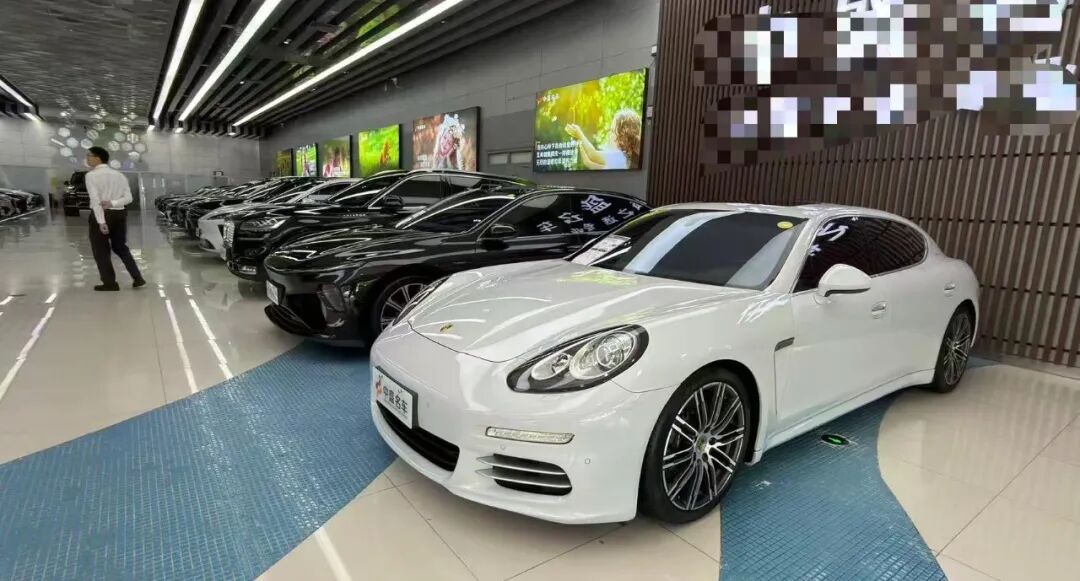
"Compared to a few years ago, every season feels like a slow period now. Take this blue 2019 Maserati Ghibli for example, it's priced at just over 200,000 yuan right now, and the price is negotiable—it's a really good deal," a sales staff at a luxury used car dealership in Beijing Huaxiang Market admitted, "There are no real peak or off-peak seasons in the auto market these days."
Inside the market, the listed price for a 2019 Maserati Ghibli 3.0T Standard is only 248,000 yuan; a 2015 Mercedes-Benz GL-Class GL450 4MATIC US-spec version is priced as low as 178,000 yuan; while a 2013 Bentley Mulsanne 6.8T Mulliner Special Edition that originally cost 6.28 million yuan new now has a used car quotation of roughly 1.088 million yuan. In addition, multiple mid-to-large luxury SUVs from Audi and Land Rover have also seen simultaneous substantial price reductions.
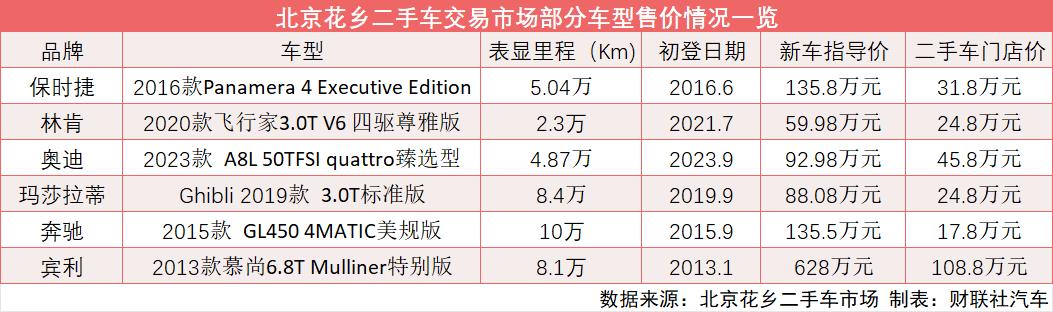
"All used car prices are falling right now, luxury vehicles just stand out more because their original price tags were so high," said the head of a relatively large used car dealership. Another dealer who specializes in pre-owned cars priced above one million yuan noted that the so-called "cheaper luxury used cars" mostly refers to models originally priced in the hundreds of thousands to around a million yuan range. For vehicles costing several million yuan like the Rolls-Royce Cullinan, the current market conditions are still fairly normal, and "these are the main profit drivers."
On July 8, the China Automobile Dealers Association released an in-depth analysis of the national used car market for May. In May, the national used car transaction volume reached 1.6016 million units, down 4.17% month-on-month and 0.15% year-on-year, with a total transaction value of 105.015 billion yuan. From January to May, the cumulative used car transaction volume hit 8.0948 million units, up 2.30% year-on-year, representing an increase of 182,300 units compared to the same period last year, with a total transaction value of 531.373 billion yuan. Among these transactions, vehicles priced above 300,000 yuan accounted for 2.8% of the market in May, a 0.2 percentage point decrease month-on-month.
"The continuous downward adjustment of new fuel car terminal prices has directly eroded the price support for used cars," Luo Lei, Vice President of the China Automobile Dealers Association, stated in an interview with Caixin. Since last year, steep price cuts on new luxury vehicles have dragged down used car prices and residual values. The narrowing price gap between new and used cars has forced dealers to lower their listing prices in tandem, trapping them in a loss-making cycle of "high acquisition costs and low selling prices". "The widespread price cuts for pre-owned luxury fuel cars aren't caused by poor dealer management, but are a ripple effect from excessively fierce competition upstream."
Data from the China Passenger Car Association shows that luxury car retail sales reached 170,000 units in June, down 30% year-on-year but up 3% month-on-month, accounting for 10.3% of the retail market, a 1.1 percentage point decline from the previous year. The data also indicates that promotional discounts for luxury cars gradually reached a moderately high level of 26.4% in June, up 1.2 percentage points from the previous month but down 0.5 percentage points year-on-year. Additionally, the average price of luxury cars in June was 329,000 yuan, a 5,000 yuan drop from the same period last year; since the start of 2026, the average luxury car price has been 330,000 yuan, down 3,000 yuan compared to 2025.
"Dealers restocked after the Spring Festival around March, only to face massive price drops between April and June. No one could have predicted such a widespread and intense price decline, leaving many operators completely caught off guard," Luo Lei analyzed. The ongoing push for higher-end products from domestic independent brands is one of the factors driving traditional luxury fuel cars to adjust their pricing. "Domestic new energy vehicles deliver exceptional performance in comfort, handling, and safety features, with driving experiences that can match or even surpass traditional luxury cars. Consumers are realizing that domestic vehicles priced at 700,000 to 800,000 yuan can offer an experience comparable to luxury cars costing several million yuan, which has weakened demand for traditional luxury vehicles."
In the second quarter of this year, a wave of domestic new energy "9-series" models hit the market, including the NIO ES8 five-seater variant, Zeekr 9X five-seater, Leapmotor D99, Li Auto i9, and nearly 10 other "9-badged" vehicles. Most of these models are sized to compete with traditional luxury brand C-class and even D-class vehicles, yet their price range of 400,000 to 600,000 yuan is roughly one-third to one-half lower than their luxury counterparts. On July 9, Li Xiang, CEO of Li Auto, announced on social media that the Li Auto i9, a new flagship SUV in the brand's "9-series" line, will be officially launched in September.
The downward trend in the new luxury car market has spilled over to the used car sector, shaping Fan's short-term market outlook: "If you refuse to sell a car for 800,000 yuan today, it might only be worth 780,000 yuan tomorrow, and in another two weeks, no one will want it even at 750,000 yuan."
"Despite current challenges, the long-term positive fundamentals of the used car industry remain unchanged," Luo Lei believes. First, China's 360 million vehicle fleet forms a massive market reservoir, and the current 6% turnover rate of used cars points to huge growth potential. Second, policy incentives like trade-in subsidies are continuously unlocking new opportunities, paired with the two blue ocean markets of new energy vehicles and auto exports, which provide strong incremental support for the industry. Based on the evolving ratio of new car to used car transactions approaching 1:1, Luo Lei concludes that the 2026 used car market is currently in a phase of value reconstruction.
This article is sourced from the WeChat public account "Caixin", written by Liu Yang and Zhang Yipeng, and published with authorization from 36Kr.